
You've finally assembled that dream sales team - diverse talent spread across different time zones, ready to conquer markets. But then reality hits: how do you effectively train these remote reps when they can't shadow colleagues, participate in office role plays, or absorb company culture through osmosis?
Remote sales training brings unique challenges that traditional in-office methods simply weren't designed to address. As one sales leader noted on Reddit, new hires often face "email overload" with too much information at once, while teams struggle to escape those "power point lessons everyone hates." Without the right approach, your distributed team can quickly become disengaged, inconsistent, and ultimately, ineffective.
The good news? Modern sales training methods designed specifically for remote environments can actually create more consistent, engaged, and high-performing teams than traditional approaches. Let's explore the five most effective salesperson training methods that are transforming how remote sales teams learn, practice, and perform.
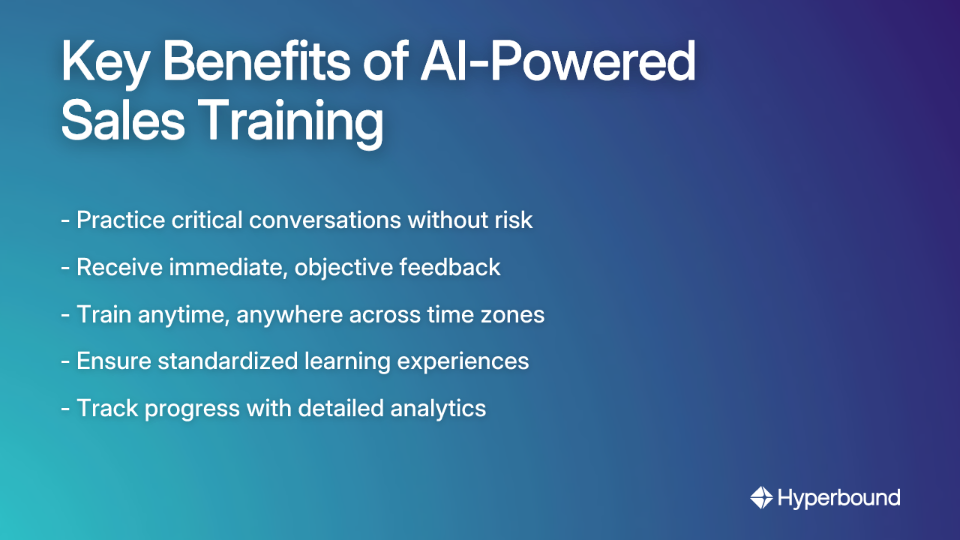
The most significant challenge in remote sales training is providing consistent, personalized coaching at scale. This is where AI-powered coaching platforms like Hyperbound are revolutionizing the landscape.
Think of these platforms as "flight simulators" for your sales team - they create safe spaces for reps to practice critical conversations without risking real deals or customer relationships.
Hyperbound's AI Sales Roleplays allow reps to practice every crucial conversation type from anywhere, anytime:
The system provides immediate, objective feedback on each practice session, analyzing talk ratios, key selling moments, and how effectively objections were handled. This creates a standardized learning experience regardless of a rep's location or time zone.
For sales leaders, AI Real Call Scoring takes this a step further by analyzing actual customer conversations. This ensures quality control and playbook adherence across distributed teams while identifying coaching opportunities without requiring managers to manually review every call.
Remote learning fatigue is real. Traditional training approaches that rely on lengthy webinars or massive information dumps simply don't work for distributed teams.
Instead, break complex sales techniques and product training into digestible, engaging modules that reps can consume when their energy and focus are at their peak.
Salespeople are naturally competitive - it's part of their DNA. As one sales leader perfectly put it, "Sales people are very competitive, and I play on that." By leaning into this competitive spirit through gamification, you can dramatically increase engagement and motivation in a remote environment where it's easy to feel disconnected.
One of the biggest losses in remote settings is the organic mentorship and collaborative learning that happens naturally in an office environment. Recreating these connections requires deliberate, structured programs.
In a remote environment, you can't manage by walking around or overhear conversations to gauge performance. It's critical to establish a culture of continuous improvement fueled by data and regular, structured feedback.
.png)
The most effective remote sales training programs don't rely on just one method - they integrate multiple approaches to create a comprehensive system. Here's how you might combine these methods throughout a remote rep's journey:
Week 1-2 (Onboarding):
Weeks 3-4 (Skill Building):
Weeks 5-8 (Real-World Application):
Ongoing Development:
Training a remote sales team doesn't have to be a disadvantage. With the right strategies and tools, you can build a high-performing, engaged, and consistent team regardless of geographic location.
Modern challenges require modern solutions. AI-powered platforms like Hyperbound are specifically designed to empower remote sales teams, providing the scalable practice, coaching, and data-driven insights needed to thrive in today's distributed work environment.
By implementing these five effective salesperson training methods, you'll not only overcome the challenges of remote training but potentially create a more skilled, consistent, and data-driven sales organization than was possible with traditional in-person methods alone.
Remember that the goal isn't just to train your remote sales team - it's to create a continuous learning culture where improvement becomes a daily habit rather than an occasional event. When you achieve this, geographic distance becomes irrelevant to sales excellence.
The most effective way to train a remote sales team is by implementing an integrated system that blends several modern training methods. This approach combines the scalability of AI-powered roleplays and digital microlearning with the human connection of virtual workshops, structured mentorship, and continuous, data-driven feedback to create a comprehensive and engaging learning environment.
You can provide consistent and scalable sales roleplay practice for remote reps by using AI-powered coaching platforms. These tools act as "flight simulators," allowing reps to practice critical conversations like cold calls, discovery, and objection handling anytime, anywhere, without needing a manager present. They receive immediate, objective feedback, ensuring a standardized and effective learning experience across all time zones.
Traditional sales training is often ineffective for remote teams because it wasn't designed for a distributed workforce. Methods like in-person shadowing, group roleplays, and lengthy seminars don't translate well to a remote setting, leading to issues like screen fatigue, information overload, and a lack of practical application. Remote teams require flexible, engaging, and asynchronous training solutions to thrive.
To keep remote salespeople engaged, you should incorporate gamification and interactive elements into your training. Using leaderboards for roleplay scores, running competitive quizzes, and setting up team-based challenges taps into the natural competitiveness of salespeople. Additionally, fostering connection through virtual workshops, peer learning groups, and mentorship programs helps combat the isolation of remote work.
The main benefits of using AI in remote sales training are scalability, consistency, and objective feedback. AI tools can provide unlimited, on-demand practice for every rep, ensuring a standardized learning experience regardless of location. They also analyze both practice and real calls to provide data-driven, unbiased feedback, helping managers identify skill gaps and coaching opportunities more efficiently.
You can measure the effectiveness of your training program by tracking both learning metrics and sales outcomes. Learning metrics include course completion rates, assessment scores, and skill progression on AI coaching platforms. These should be correlated with key performance indicators (KPIs) like conversion rates, deal size, and sales cycle length to demonstrate a clear return on investment (ROI).










Use Cases
Legal