
A discovery call has one primary function: to understand the prospect's problem before presenting anything. The call is not for lead qualification or demo preview; its purpose is problem diagnosis.
Most reps understand this distinction. Most scorecards do not reflect it. They grade for talk time, agenda adherence, and whether next steps were mentioned, while missing the behaviours that predict whether a deal closes. The result is a rubric that rewards process compliance and overlooks whether the rep learned anything useful.
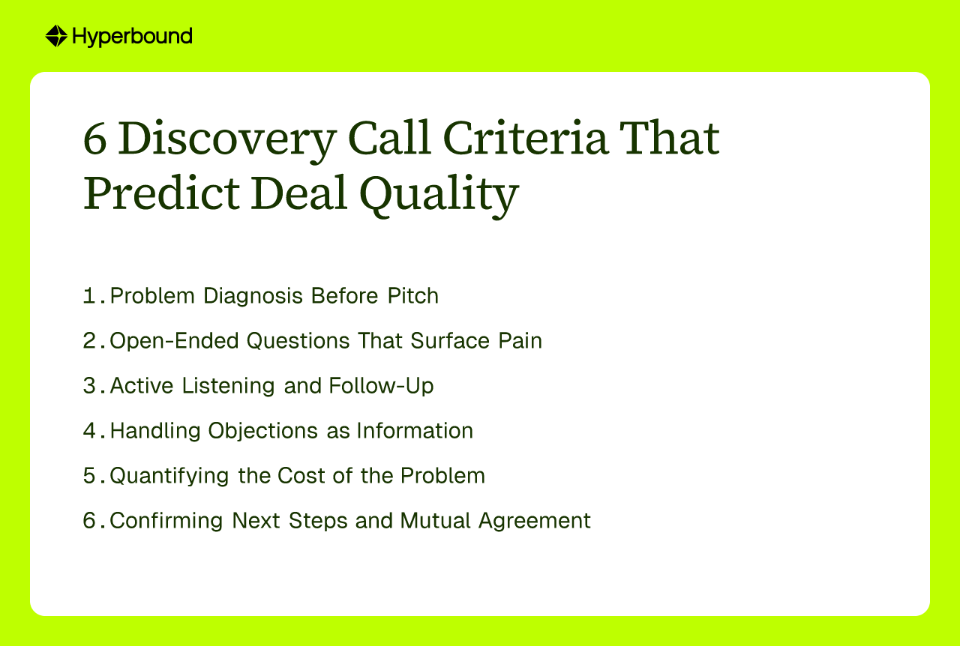
The six criteria below are the ones worth grading. For each, there is a short explanation of why it predicts deal quality, what a grader should look for, and how to write the criterion so it can be applied consistently, whether the grader is a manager, a peer, or a structured review process.
This is the criterion that catches feature dumping.
Feature dumping happens when a rep presents capabilities before confirming what problem the prospect has. The rep is not being lazy; they are often well-prepared. The problem is that preparation can create a bias toward the pitch. The rep knows what they want to say, and the call becomes a vehicle for saying it.
A Gong.io call scoring guide identifies this sequence as a core indicator of call quality: whether the rep accurately identified the issue before aligning solutions to it. That sequence matters. Presenting before confirming means the alignment is assumed, not earned.
What to look for: The rep asks clarifying questions that test their own assumptions, then summarises what they have heard before moving to the product. A phrase like "So if I am following you correctly, the core issue is X, which causes Y, and that is what is creating the pressure to look at this now. Is that right?" is a pass. Moving from "tell me about your business" directly into a feature overview is a fail.
Scorecard criterion: "Rep confirmed and summarised the prospect's primary business problem before introducing the product as a solution." (Yes / No)
Qualification frameworks like BANT and MEDDIC are useful for structuring what information a rep needs. They are not, on their own, discovery. A rep who wants a ready set of MEDDIC-style prompts can pair this with our list of MEDDPICC discovery questions. A rep who works through budget, authority, need and timeline via yes/no questions has qualified a lead. They have not necessarily understood the prospect's situation.
As Cognism notes, open-ended questions are what surface the detail that closed questions miss. The difference is consequential: "Do you have a problem with your current process?" confirms existence. "Can you walk me through your current process?" reveals what the problem looks like, how long it has existed, and what the prospect has already tried.
That last point matters. Understanding how a prospect has previously approached a problem is one of the clearest indicators of where the real pain sits and how realistic the prospect's expectations are about solving it.
What to look for: Questions that begin with "what," "how," or "why." Questions that invite narrative rather than confirmation. A grader should be able to count at least three questions in the call that required the prospect to explain or describe, not simply confirm.
Scorecard criterion: "Rep asked at least three open-ended questions that required the prospect to describe their challenges or current processes in detail." (Count-based, with a minimum threshold)
A rep can ask a good open-ended question and then not listen to the answer. This is more common than it sounds. If the next question in the call is unrelated to what the prospect just said, the rep is advancing a script, not a conversation.
This pattern frustrates prospects. It signals that the questions are procedural rather than genuine. (For a deeper read on what separates real listening from passive acknowledgment, see active listening vs. passive listening.) As observed across sales discussions, the call starts to feel like a one-way interrogation rather than a diagnostic conversation. Engagement drops.
Gong.io's scoring checklist flags this directly: whether the rep incorporates what the prospect has said into the conversation or moves on regardless. The most reliable indicator is whether follow-up questions are specific to what was just discussed. "You mentioned that your team switched tools last year. What drove that decision?" is a follow-up. "Okay, and what does your budget approval process look like?" is a pivot.
What to look for: At least one instance where the rep references something the prospect said earlier and builds on it. Paraphrasing ("So it sounds like...") followed by a deeper question is a strong positive signal.
Scorecard criterion: "Rep asked at least one follow-up question that directly referenced something the prospect said earlier in the call, rather than advancing to a pre-set question." (Yes / No)
An objection during a discovery call is not a threat to the sale. It is data. It tells the rep what the prospect is uncertain about, what they have already considered, and where their concerns are concentrated.
Reps who treat objections as barriers respond by defending the product, minimising the concern, or pivoting away from it. Reps who treat objections as information respond with curiosity. The Salesforce objection handling framework makes this explicit: the first move is to understand the root of the objection before responding to its surface form.
This matters for deal quality because unaddressed objections do not disappear. They resurface later in the cycle, often when a different decision-maker raises them and the rep is not in the room to respond.
What to look for: When an objection arises, the rep should ask a clarifying question before responding. "That is a fair concern. Can you tell me more about what is driving that?" is a pass. "I think you will find that our product handles that really well" is a fail, even if the statement is accurate.
Scorecard criterion: "When faced with an objection, the rep responded with a clarifying question to understand the root concern rather than immediately countering or deflecting." (Yes / No, or N/A if no objection arose)
Identifying a pain point is not the same as establishing its weight. A prospect can acknowledge a problem and still deprioritise fixing it. Urgency comes from understanding what the problem is costing, in time, revenue, headcount, or operational friction.
Sales discussions consistently identify this as the point where deals stall. If the prospect cannot articulate the cost of their current situation, the value of a solution remains abstract. The question "why now, and not in six months?" becomes unanswerable because there is no baseline cost to compare against.
HubSpot's discovery question frameworks and Gong.io's scoring guide both point to quantification as a prerequisite for building an effective ROI case. The rep does not need to arrive at a precise number. They need to probe for one.
What to look for: The rep asks questions such as "How much time does your team spend on this each week?", "What does it cost you when this goes wrong?", or "What is the business impact of not solving this by the end of the quarter?" The prospect does not have to provide a number for this to be a pass. The rep has to ask.
Scorecard criterion: "Rep attempted to quantify the business impact of the prospect's problem, whether in time, revenue, or another measurable unit." (Yes / No)

Vague closes are the most consistent cause of pipeline stalls. A call that ends with "I will send some information over" or "let us stay in touch" has produced no commitment from either party. The deal does not move because there is no agreed action to move it.
This pattern is well documented. Sales professionals consistently cite the absence of clearly defined, mutually agreed next steps as the primary reason discovery calls fail to generate pipeline momentum. The key word is mutual. A rep who books a follow-up without the prospect's explicit agreement has scheduled a meeting, not secured one.
What to look for: The rep names a specific next step, ties it to a date and time, confirms the prospect's agreement, and ends the call with both parties clear on what happens next. "Based on what we covered today, the logical next step is to bring in your operations lead and walk through how this applies to your workflow. Are you free Thursday at 10 AM?" is a pass. "I will follow up with some materials" is not.
Scorecard criterion: "Rep secured a specific, scheduled next step that the prospect verbally agreed to before the call ended." (Yes / No)
Writing a good discovery call scorecard criterion takes an afternoon. The six above can be adapted to most sales contexts in under an hour. Most experienced managers already know what good looks like on each one.
Definition is straightforward. Consistency is the operational challenge.
A scorecard that lives in a document shared with half the team, graded differently by different managers, and reviewed only when a deal is at risk is not a coaching system. It is a formality. Reps do not improve against criteria they encounter inconsistently, and graders cannot calibrate against a standard that is applied differently across the team.
The two problems that follow from this are practical. First, the same criterion must be applied to every scorecard the team uses, across every call type and every rep. Second, reps need a structured place to practice the specific behaviours being graded, rather than waiting for a live call to surface the gap.
That is the gap worth solving: defining what good looks like and building the system that makes it repeatable. This is also the exact problem the team built Kota Actions to solve: describe a scoring gap like feature dumping once, and Kota applies the new criterion across every scorecard in the instance, then generates the practice bots so reps can rehearse against it.
A discovery call scorecard is a structured evaluation form used by sales managers and enablement teams to grade reps on specific behaviors during sales discovery calls. It outlines criteria like problem diagnosis, open-ended questioning, active listening, objection handling, and next-step confirmation, ensuring consistent and objective call reviews. Unlike generic call scorecards that focus on talk time or agenda adherence, a discovery scorecard prioritizes the actions that predict deal quality and pipeline progression.
The six most important criteria for a discovery call are: (1) problem diagnosis before pitch, (2) open-ended questions that surface pain, (3) active listening and follow-up, (4) handling objections as information, (5) quantifying the cost of the problem, and (6) confirming next steps and mutual agreement. These criteria collectively ensure the rep understands the prospect's situation before presenting a solution and secures a tangible next step.
To evaluate a sales discovery call, use a scorecard with clear, observable criteria rather than subjective impressions. For each criterion, define what a "pass" looks like (e.g., the rep summarised the problem before showing the product) and grade consistently. Review call recordings or live calls, looking for specific behaviors: clarifying questions, open-ended questions, follow-up on the prospect's words, root-cause exploration of objections, quantification attempts, and a mutually agreed next step.
Problem diagnosis before pitching is critical because it ensures the rep's solution aligns with the prospect's actual needs. If a rep presents features before confirming the core issue, the pitch may address a problem the prospect does not have, leading to wasted time and lost credibility. Diagnosing the problem first also gives the rep a foundation for quantifying impact and tailoring the remainder of the conversation.
A practical threshold is at least three open-ended questions per discovery call, though the exact number can vary with call length and complexity. The key is to ask questions that begin with "what," "how," or "why," inviting the prospect to describe processes, challenges, and past attempts. Closed yes/no questions should be used sparingly, as they confirm rather than reveal.
A rep should treat objections as information, not confrontation. Instead of immediately countering or defending, the rep should ask a clarifying question to understand the root concern (e.g., "Can you tell me more about what is driving that?"). This approach uncovers underlying issues, builds trust, and prevents objections from resurfacing later in the sales cycle.
To quantify the cost of a prospect's problem, ask direct questions about time, revenue, or headcount impact. Examples include: "How much time does your team spend on this each week?" or "What does it cost you when this goes wrong?" The goal is to get a baseline metric, even a rough estimate, that creates urgency and supports an ROI case. If the prospect cannot provide a number, the rep should still probe for one.
At the end of a discovery call, a rep should secure a specific, scheduled next step that the prospect verbally agrees to. This means naming the action, tying it to a date and time, and confirming mutual commitment. Vague closes like "I will send some information" stall momentum. A clear next step with the prospect's buy-in turns the discovery conversation into pipeline movement.










Use Cases
Legal