
You've done the outbound work. You got the meeting. And then the discovery call wraps up, you feel like it went well — and the deal goes quiet.
According to experienced reps on Reddit, "the majority of potential deals get lost because reps don't spend enough time understanding the most critical challenges that the prospect is dealing with." The culprit isn't bad pitching — it's shallow discovery.
Most reps default to qualification frameworks like BANT or MEDDIC. These are useful for filtering, but they don't surface the emotional drivers and quantifiable business pain that create real urgency. Even worse, many reps pivot straight to a demo before truly understanding the problem — leading to generic, feature-dumping presentations that miss the mark entirely.
The fix isn't asking more questions. It's asking better ones.
A great discovery call operates more like a consultant's intake session than a qualification checklist. When done right, prospects don't feel interrogated — they feel heard. And as research shows, that consultant-like approach is precisely what builds the trust and urgency needed to move a deal forward.
Here are 20 discovery call questions, organized into four key categories, each designed to move you from surface-level qualification to genuine buyer pain.
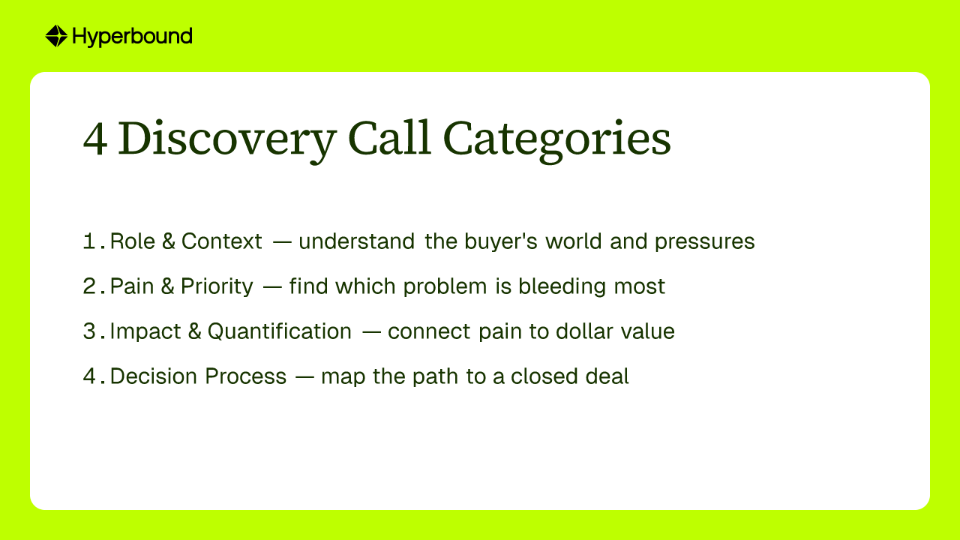
Before you can diagnose pain, you need to understand the buyer's world — their responsibilities, their definition of success, and the pressures they're operating under.
1. "What prompted you to meet with us today? What's the one thing you're hoping to get out of this call?"
Listen for: The top-of-mind problem that made them take the meeting — this is your starting thread.
Follow-up: "That's helpful. What's driving you to solve this now rather than later?"
2. "Walk me through your role. What are the top one or two goals your boss is holding you accountable for this quarter?"
Listen for: Personal motivations and pressures that go beyond the company's stated objectives.
Follow-up: "How does the challenge we're discussing today affect your ability to hit those specific goals?"
3. "When you look at your team's current process for [relevant area], what parts are working well — and what parts feel broken or inefficient?"
Listen for: Specific adjectives like "manual," "slow," "clunky," or "disconnected" — these signal friction points worth exploring.
Follow-up: "Can you give me a specific example of the last time that process caused a real problem?"
4. "What does your current tech stack look like for this process? What tools are you using today?"
Listen for: Gaps in their ecosystem, needed integrations, and signs of tool sprawl or workaround behavior.
Follow-up: "How well do those tools talk to each other? Where are the gaps?"
5. "If you had a magic wand and could change one thing about how you handle [xyz] today, what would it be?"
Listen for: Their ideal future state — this tells you what they value most in a solution.
Follow-up: "What's prevented you from making that change so far?"
Context sets the stage. Now you dig. Buyer pains typically fall into four categories: Financial, People, Productivity, or Process. These questions help you find which one is bleeding the most.
6. "You mentioned [challenge]. What's the biggest headache that's causing for you and your team on a daily or weekly basis?"
Listen for: Emotional language — "frustrating," "time-suck," "constant firefighting" — that signals personal pain, not just operational friction.
Follow-up: "Who on the team feels that pain the most?"
7. "How have you tried to solve this problem in the past? What were the results?"
Listen for: What they've already ruled out, lessons they've drawn, and any biases that may shape this evaluation.
Follow-up: "What did you learn from that experience that you'd apply now?"
8. "Of all the priorities on your plate right now, where does solving this issue rank? Top three, top five, or a 'nice-to-have'?"
Listen for: Where you fit in their hierarchy of needs — low-priority problems rarely convert to closed-won deals.
Follow-up: "What would need to happen for this to become a number one priority?"
9. "What are the top two or three pain points your department is running into right now that you're hoping a solution like ours can help with?"
Listen for: The problems they lead with — these are the ones they're most motivated to solve.
Follow-up: "Of those three, which one is causing the most significant negative impact on the business?"
10. "What happens if you do nothing and stick with the status quo for another 6–12 months?"
Listen for: Their perception of the cost of inaction. If they don't see a significant downside, there's no urgency — and urgency is what drives decisions.
Follow-up: "And what would your boss think about that outcome?"

Emotional pain gets attention. Numbers get budget. This category bridges the gap — connecting the operational problem to a dollar value that justifies a purchase decision.
11. "How is that challenge affecting you, your team, and the wider business? What metric is suffering most as a result?"
Listen for: Ripple effects beyond their immediate role — revenue impact, customer churn, employee attrition, or missed targets.
Follow-up: "If we could improve that metric by 10%, what would that be worth to the business?"
12. "Can you help me understand the scale of the problem? For example, how many hours per week is the team spending on [manual task], or how much revenue is at risk due to [inefficiency]?"
Listen for: Any hard number — even a rough estimate — that makes the pain tangible and quantifiable.
Follow-up: "What's the fully-loaded cost of those hours or that risk to the company?"
13. "What would be the impact on the business if you could eliminate this challenge entirely? What would you and your team be able to do with that reclaimed time or resource?"
Listen for: Positive business outcomes they're excited about — this is the vision you'll sell toward.
Follow-up: "Which of those new initiatives would be most exciting to your leadership team?"
14. "When we talk to other companies in your industry, they often struggle with [common problem]. To what extent is that also a challenge here?"
Listen for: Whether they recognize themselves in the pattern — and whether they've been underestimating a problem they thought was unique to them.
Follow-up: "How are your main competitors handling this, from what you can tell?"
15. "Ultimately, how does solving this problem help the company make more money, save money, or reduce risk?"
Listen for: Which of those three levers resonates most — that's the ROI angle that will matter most in the business case.
Follow-up: "Who at the executive level cares most about that outcome?"
You've uncovered the pain and started to quantify it. Now you need to map the path to a decision — because a deal without a clear process is just a conversation.
16. "Who, besides yourself, needs to be involved in evaluating and approving a solution like this?"
Listen for: The economic buyer, technical evaluators, and any champions or blockers you haven't met yet — this is where multithreading starts.
Follow-up: "What matters most to each of those individuals when evaluating a new technology partner?"
17. "What does your typical evaluation process for a new tool look like? What are the key milestones we should be aware of?"
Listen for: Procurement reviews, security assessments, legal sign-off, or board approvals that could extend the timeline without warning.
Follow-up: "What's the timeline you have in mind for making a decision?"
18. "As you evaluate potential vendors, what are the top three 'must-have' criteria versus the 'nice-to-haves'?"
Listen for: Deal-breakers you need to address head-on, and table stakes you can deprioritize in your pitch.
Follow-up: "Have you looked at any other solutions? What did you like or not like about them?"
19. "What does success look like a year from now if you move forward with the right partner? How will you measure the ROI?"
Listen for: How they define value — this becomes the foundation of your mutual success plan and positions you as a strategic partner, not a vendor.
Follow-up: "What data would you need to show leadership that this was a successful investment?"
20. "Is there a budget allocated for solving this problem? If so, what range are you working with?"
Listen for: Not just the number, but how confidently they answer. Hesitation often signals that budget hasn't been formally approved yet.
Follow-up: "If we can show a clear and compelling ROI, is there flexibility in that budget?"
Pro tip: Notice that the budget question comes last. Ask it after you've established real value and surfaced meaningful pain — and the conversation becomes dramatically easier.
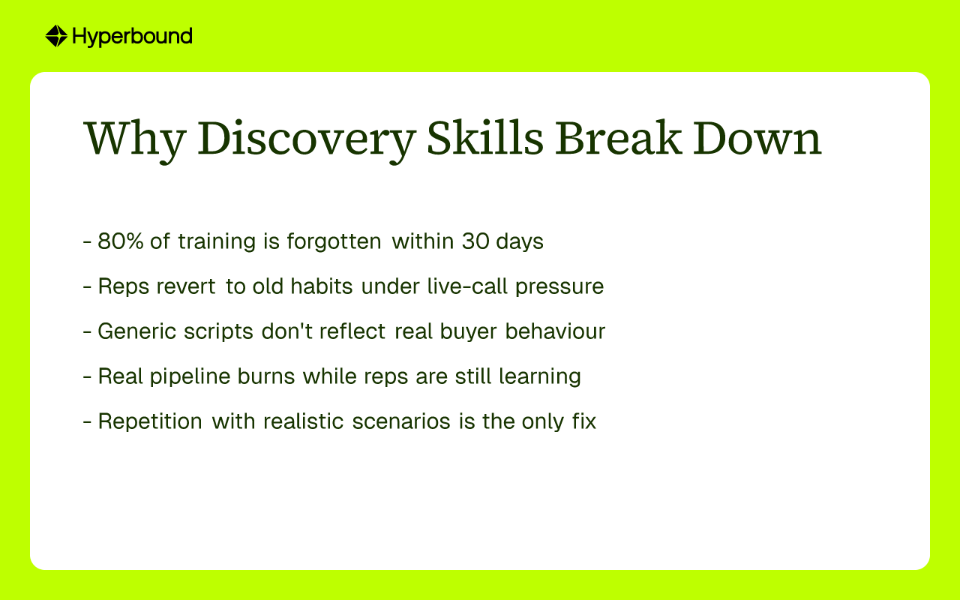
Knowing these questions is the easy part. Asking them naturally, following the thread of an unexpected answer, and pivoting when a prospect goes off-script — that's the skill that takes repetition to build.
Sales enablement leaders know the problem well: 80% of training is forgotten within 30 days. Reps leave workshops with good intentions, then revert to old habits the moment they're under pressure on a live call. The result? Real pipeline burned while reps are still learning on the job.
The solution is deliberate practice against realistic buyer scenarios — before the real call happens.
Hyperbound Practice is built exactly for this. It's an AI roleplay platform where reps can practice these 20 discovery call questions against AI buyer personas trained on over 2 million hours of real B2B sales conversations — not generic scripts. You can even build a digital twin of a specific buyer from their LinkedIn profile to prep for an upcoming meeting.
After every simulated discovery call, reps get an AI Scorecard tracking talk-to-listen ratio (top performers talk 46% of the time, according to industry research on sales conversations), methodology adherence, and how effectively they uncovered pain. Instant AI Coaching surfaces missed follow-up opportunities and suggests sharper phrasing — turning every practice session into a real learning moment.
For tenured reps who won't sit through a full-length generic certification, Bitesized Roleplays let them drill one specific scenario — like handling the "just send me the deck" objection — in under five minutes.
The results speak for themselves: teams using Hyperbound see 50% faster ramp times and a 150% increase in discovery-to-demo conversion rates.
Mastering the discovery call isn't about memorizing a list. It's about internalizing a framework deeply enough to stay curious, follow the thread, and go second and third layers deep — even when the conversation takes an unexpected turn. That kind of fluency only comes from practice.
Start with these 20 questions. Then put them to work in Hyperbound's discovery roleplay scenarios so your reps walk into every call ready to uncover the real pain that moves deals forward.
The main goal of a discovery call is to uncover a prospect's critical business challenges and the quantifiable impact of those challenges. It's not just about qualifying a lead; it's about building trust by making the prospect feel heard and understood. A great discovery call surfaces the emotional drivers and business pain that create genuine urgency, laying the foundation for a solution-focused sales process.
This discovery approach focuses on understanding the underlying "why" behind a prospect's needs, whereas frameworks like BANT or MEDDIC are primarily for qualification. While BANT and MEDDIC help you determine if a deal is worth pursuing, the consultative questions in this article help you build the business case by turning a simple qualification check into a deeper, problem-solving conversation.
The most critical questions are those that fall under "Impact and Quantification," as they connect a prospect's problem to a tangible business value. While understanding context and pain is essential, quantifying that pain in terms of dollars, hours, or risk is what gets executive attention and budget approval. This transforms your solution from a 'nice-to-have' into a 'must-have' investment.
You should ask about the budget near the end of the discovery process, only after you have successfully established significant value. Once you've uncovered a critical business pain and quantified its financial impact, the prospect is better positioned to see your solution as an investment rather than a cost. Asking too early can make the conversation feel transactional and premature.
If a prospect is hesitant to share information, it often signals a lack of trust or that they don't yet see the value in the conversation. Instead of pushing for answers, pivot to building more rapport. Frame your questions with context, like, "Other leaders in your role often mention X as a challenge. How is that showing up on your team?" This makes the question feel less like an interrogation and more like a collaborative discussion.
Focus on the quality of the conversation, not the quantity of questions you ask. A successful discovery call is a natural conversation, not a checklist. You might only use 5-7 core questions from this list, but the key is to ask thoughtful follow-up questions that go two or three layers deep on a single problem. The goal is to fully understand one or two critical pain points, not to superficially cover twenty topics.
Top-performing sales reps speak about 46% of the time, meaning the prospect should be talking more than half the time. Your role is to guide the conversation with insightful questions and then actively listen to the answers. A high talk ratio is a red flag that you're likely pitching features instead of diagnosing problems, which is the fastest way to lose a deal.










Use Cases
Legal