
You've scheduled a discovery call with a promising prospect. The meeting starts well, but quickly spirals as the potential client rambles about unrelated topics, asks if you provide therapy instead of coaching, and then ends with the dreaded "I'll think about it" before disappearing forever.
Sound familiar? You're not alone.
Discovery calls are the linchpin of the sales process for coaches and consultants, yet many struggle to convert these conversations into clients. The painful reality is that without a structured approach to these initial interactions, you're likely leaving significant revenue on the table.
"Your potential client can be very well into their own head if you don't know how to host this conversation," notes one coach in a Reddit discussion on discovery calls. Another laments meeting with unqualified leads who "tell me they're not ready to invest."
But there's good news: implementing systematic discovery call coaching can dramatically transform these outcomes. According to research from Forbes, companies that establish structured coaching programs see a remarkable 35% increase in close rates directly attributable to these initiatives.
Many coaches mistakenly view discovery calls as simple qualification tools—a quick chat to determine if someone is ready to buy. This limited perspective drastically undervalues what these conversations can accomplish.
The discovery call isn't just a gate; it's the foundation of your entire client relationship. It establishes rapport, creates a memorable first impression, and most critically, sets the trajectory of the entire deal, influencing everything from your presentation to objection handling and negotiation leverage.
A common challenge during discovery calls is the confusion between coaching and therapy. Many prospects come to calls uncertain about the distinction, potentially leading to misaligned expectations.
"Some people are trying to clarify what a coach does versus a therapist," notes one practitioner in the Reddit discussion. The discovery call presents a critical opportunity to address this confusion head-on.
Unlike therapy, which often analyzes past experiences, coaching focuses on the client's present situation and future aspirations. Mindvalley's guide on discovery calls emphasizes that making this distinction clear early in the conversation helps set appropriate expectations and qualifies prospects more effectively.
As one coach puts it: "Making sure you both are clear on goals and what you actually provide is super important before you move anywhere with a client."
Let's examine the headline statistic more closely. According to Forbes, "Companies that implemented coaching structures reported significant improvements in sales figures, attributing a 35% increase in close rates directly to coaching initiatives."
But this isn't just an isolated finding. The impact of discovery call coaching is supported by a wealth of additional data:
To put this in perspective, let's clarify what we mean by "close rate." The formula is straightforward: Close Rate = (Closed Deals / Total Sales-Qualified Leads) x 100%. Industry benchmarks vary widely—from 22% in software to 15% in biotech—making a 35% improvement transformative in any sector.
What exactly should you coach your team on? AI Sales Coaching platforms like Hyperbound analyze thousands of sales calls to identify what sets top performers apart. For example, a landmark analysis of over 500,000 recorded discovery calls revealed the specific behaviors that distinguish high-converting calls from mediocre ones. The findings provide clear, actionable coaching targets:
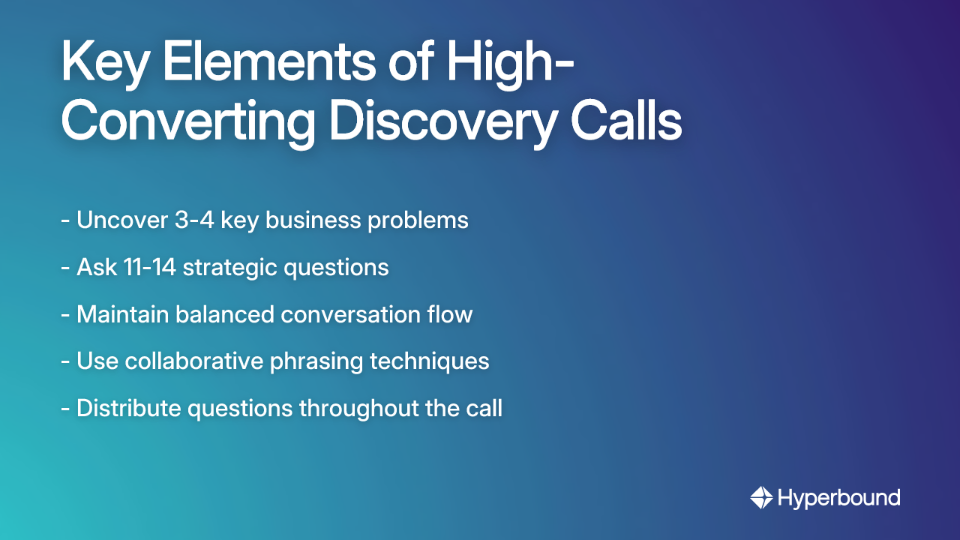
Successful discovery calls uncover 3-4 key business problems. This is the sweet spot—fewer than 3 problems may indicate insufficient pain to motivate action, while more than 4 can overwhelm prospects and diffuse focus.
When coaching your team, emphasize the importance of digging deeper rather than wider. The goal isn't to identify every possible challenge but to uncover the most significant ones that your solution can address.
High-converting discovery calls typically include 11-14 questions spread throughout the conversation. This balances thorough discovery with maintaining a natural, conversational flow.
The key isn't just asking questions, but asking the right ones. As one coach recommends, "Big open questions are the way to go," while another emphasizes the need to "ask deep questions and understand their needs."
Beyond the numbers, coach your team on conversational dynamics:
This approach creates psychological safety, encouraging prospects to open up about their challenges and aspirations.
Now that we understand what makes discovery calls successful, let's establish a framework for coaching these skills effectively:
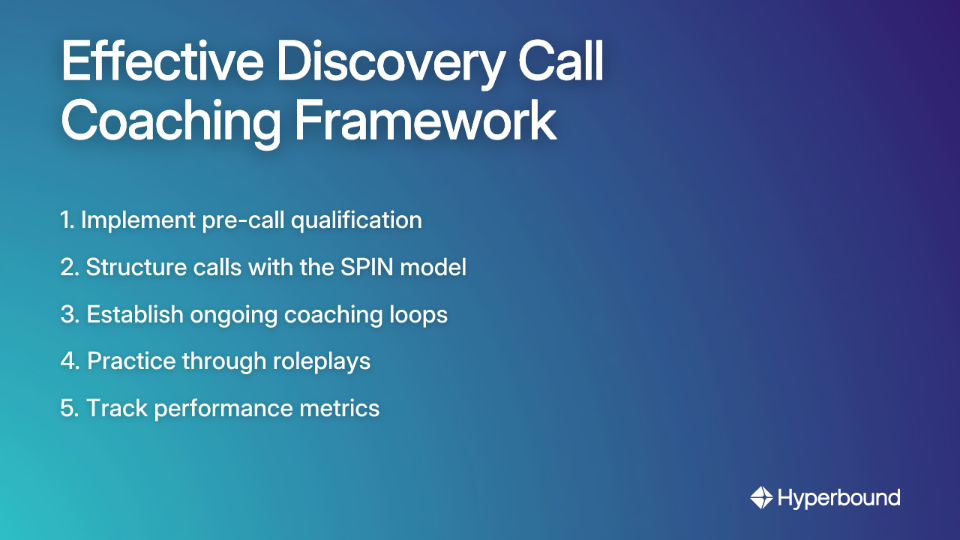
Begin by addressing one of the most common pain points—meeting with unqualified leads who aren't ready to invest. Reddit discussions highlight the value of pre-qualification: "Having a discovery or qualifying form allows for a really robust and productive conversation."
Coach your team to implement a brief pre-call questionnaire that gathers basic information about the prospect's situation and goals. This aligns with the first phase of the SPIN model (Situation) and ensures that discovery calls focus on qualified leads.
The SPIN framework provides an excellent structure for discovery calls. According to Mindvalley's coaching resources, this model includes:
This structured approach ensures comprehensive discovery while maintaining a natural conversational flow.
Remember that coaching is not a one-time event but an ongoing process. According to Forbes, the most effective coaching programs include regular one-on-one sessions, role-playing exercises, and tracking of clear performance metrics.
Yet only 19% of salespeople experience regular coaching sessions, representing a significant missed opportunity. To bridge this gap, modern sales teams are turning to AI Sales Coaching platforms like Hyperbound. These tools scale effective coaching by providing AI-powered roleplays for on-demand practice and automated call scoring for instant, objective feedback. This allows you to implement a consistent coaching cadence—weekly for new team members, bi-weekly for experienced ones—and drive continuous improvement without overburdening managers.

The final moments of a discovery call often determine whether a prospect becomes a client. Coach your team on this five-step closing process:
Additionally, coach your team to "ask for objections directly" rather than avoiding them. This creates an open dialogue and addresses concerns before they become reasons to walk away.
Discovery calls aren't just conversations—they're the foundation of your sales process and the beginning of lasting client relationships. By implementing systematic coaching focused on the key behaviors outlined in this article, you can drive significant improvements in close rates.
The data is clear: a 35% increase in close rates is achievable through structured discovery call coaching. This isn't just incremental growth; it's a transformation that can dramatically impact your bottom line.
Achieving this transformation requires the right tools to provide consistent, scalable practice and feedback. AI Sales Coaching platforms like Hyperbound are designed to do just that, using insights from your top performers to create realistic roleplays and providing objective scoring on every call.
For sales leaders and coaches, the message is simple: move beyond basic training and implement a consistent, data-driven coaching culture to unlock your team's full potential. Start by analyzing your current discovery call process against the frameworks provided, and begin the journey toward more effective, higher-converting client conversations.
The main purpose of a discovery call is to determine if a prospect is a good fit for your services by understanding their challenges and goals, while also establishing rapport and setting the foundation for a potential client relationship. It's more than just a qualification step. A successful discovery call creates a strong first impression, clarifies the value you provide, and sets the trajectory for the entire sales process.
You can significantly improve your discovery call conversion rate by implementing a structured coaching program that focuses on proven techniques. This includes uncovering 3-4 key problems, asking 11-14 strategic questions, and using a framework like the SPIN model. Research shows that structured coaching can increase close rates by up to 35% by ensuring you consistently apply best practices.
The key difference is that coaching is future-focused, helping clients move from their present situation toward their goals, while therapy often analyzes past experiences to resolve deeper issues. Clarifying this distinction during a discovery call is crucial for setting the right expectations and ensuring the prospect understands your role, which helps in qualifying them effectively.
The ideal number of questions for a high-converting discovery call is between 11 and 14. This range allows for a thorough understanding of the prospect's needs without turning the conversation into an interrogation. The key is to distribute these questions evenly throughout the call and use open-ended, collaborative phrasing to maintain a natural, two-way dialogue.
The SPIN model is a questioning framework that provides a logical flow for discovery calls, centered around four key areas: Situation, Problem, Implication, and Need-Payoff. You start by understanding the prospect's current Situation, identify their specific Problems, explore the Implications of those problems if left unsolved, and finally, guide them to see the value (the Need-Payoff) of your solution.
When a prospect says they "need to think about it," you should directly and respectfully explore the underlying reasons for their hesitation. This phrase often hides a specific objection related to price, timing, or value. You can respond by asking, "I understand. To make sure I've provided all the information you need, what specific part of the proposal would be most helpful to review?" This opens the door to address their actual concerns before the call ends.











Use Cases
Legal