
You've been on the call for 20 minutes, things are going well — and then it happens. "Actually, we need to talk about this price increase." Your stomach drops. You stumble through an apology, throw out a discount you weren't authorized to give, and hang up feeling like you just lost the deal and your margin in one swing.
Every sales rep knows the feeling. Certain conversations carry so much weight that the instinct is to avoid them, rush through them, or wing it and hope for the best. The problem isn't that reps don't know these moments exist — it's that most sales training never systematically maps specific conversation types to specific practice approaches. You get generic advice like "be empathetic" or "listen actively," but no playbook for the exact scenario you're about to walk into.
This article closes that gap. Below are five of the most difficult sales conversation types, a breakdown of what separates a strong response from a poor one, and the exact drill — including an AI roleplay prompt — to help you practice difficult sales conversations until they feel like second nature.
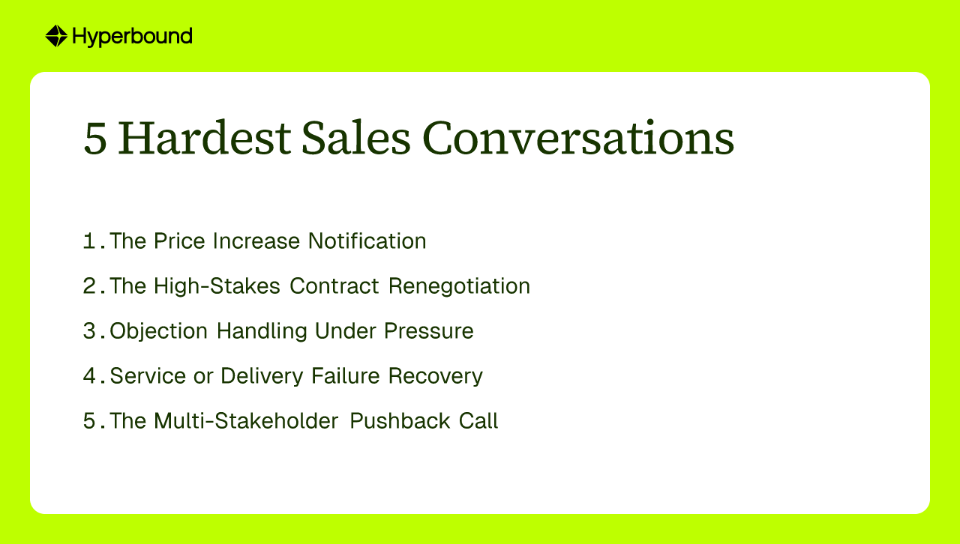
Why reps avoid it: Telling a loyal customer their price is going up is one of the most pressure-filled moments in sales. Reps fear damaging the relationship, triggering a competitive review, or watching a long-term account churn. That fear is so potent that many reps panic and either delay the conversation or immediately offer concessions before the customer has even reacted.
Poor response: Apologetic tone, vague justifications ("our costs just went up"), and a discount offered before the customer even pushes back. The rep focuses on their own discomfort instead of the customer's continuity.
Strong response: A confident rep anchors the conversation in value, not price. They leverage loss aversion psychology — reminding the customer what they'd be giving up by switching — and use market context to normalize the change. They frame the increase as evidence of continued investment in the customer's success, not a penalty.
The Practice Drill: The Value Reinforcement Roleplay
With Hyperbound Practice, use the LinkedIn Chrome Extension to build a digital twin of your actual customer — say, the VP of Operations at a key account — and run this prompt:
"You are 'Sarah,' a VP of Operations at a long-time customer. You're generally satisfied but very budget-conscious. I need to inform you of a 15% price increase effective next quarter. Push back hard — question the value, threaten to evaluate competitors, demand I justify the increase. Only concede if I successfully re-anchor the conversation on long-term ROI and make you feel like a valued partner."
Feedback focus: Track tone (confident vs. apologetic), the ability to pivot from price to value, and whether the rep can articulate business impact without getting flustered.
Why reps avoid it: This isn't just a price conversation — it's a negotiation over terms, scope, and service levels with someone whose job is to extract concessions. It requires empathy, business acumen, and strategic thinking simultaneously. Reps who aren't prepared tend to cave on key terms just to keep the peace.
Poor response: Walking in with a single take-it-or-leave-it offer, caving on pricing without getting anything in return, or failing to involve the customer's champion in the conversation.
Strong response: A prepared rep arrives with multiple options — balancing value and price — and uses a trading strategy: concessions are exchanged for something, never given away freely. They know their walk-away terms and use the champion in the room to help navigate procurement pushback.
The Practice Drill: The Multi-Option Scenario
Contract renegotiations often involve multiple parties with opposing goals. Use Hyperbound's Multiparty Roleplay feature to simulate this dynamic:
"Set up a two-person roleplay. Bot 1 is 'David,' the Director of IT — your champion who loves the product. Bot 2 is 'Maria,' from Procurement, tasked with cutting contract costs by 10%. David will advocate for technical value. Maria will push on price, liability, and payment terms. My goal is to use David's support to navigate Maria's objections and land a renewed contract that protects our key terms while making both parties feel they've won."

Why reps avoid it: Objections feel personal. When a prospect says "your price is too high" or "we're already talking to your competitor," the natural instinct is to get defensive or rush to a rebuttal — which only makes things worse. Research shows that reps often prioritize their response over actively listening, which alienates the prospect before the conversation has a chance to recover.
Poor response: Arguing, over-explaining features, or immediately offering a discount out of nervousness rather than addressing the root of the objection.
Strong response: A skilled rep stays composed, asks a clarifying question to understand the real concern, validates it ("that's a fair point given where you are"), and then pivots to a specific value story or proof point. Getting this right matters — mastering objection handling is one of the highest-leverage skills for improving deal outcomes.
The Practice Drill: The Rapid-Fire Gauntlet
This drill builds resilience and quick thinking. It's ideal as a Bitesized Roleplay — short, focused sessions that tenured reps will actually complete:
"I am a skeptical prospect late in the sales cycle. Throw a series of objections at me in rapid succession. Start with 'Your price is too high.' If I handle it, move to 'We don't have budget right now.' Then 'Your competitor offers something similar for less.' Then 'I need to loop in my boss.' Don't let me off the hook easily. Score my ability to stay calm, clarify each objection before responding, and avoid getting flustered."
Why reps avoid it: This call is the one where a customer might actually leave. They're already angry. The rep is on their heels. Everything that was built over months of relationship-building feels like it's on the line, and there's no easy way to open the conversation.
Poor response: Blaming another team, making excuses, over-promising on a resolution timeline, or failing to acknowledge the real-world impact of the failure on the customer's business.
Strong response: The rep leads with empathy and ownership — not explanation. They actively listen, take visible notes, and repeat the customer's concerns back to show they've truly heard what happened. Then they present a clear, credible action plan with defined next steps, not vague reassurances.
The Practice Drill: The De-escalation & Rebuilding Trust Scenario
This is a core competency for both AEs and CSMs. Hyperbound's AI Post-Sales Roleplays are purpose-built for exactly this scenario:
"You are 'Mark,' a customer whose critical go-live was delayed by a week due to a bug on our end. You're extremely frustrated and have mentioned activating the exit clause in your contract. Start the call angry and interrupt me early. I need to de-escalate your frustration, take full ownership without making excuses, and present a credible action plan. Success means you agree to the plan before the call ends."
Why reps avoid it: When a CFO, a technical lead, and an end-user champion are all in the same call, every sentence is a tightrope walk. Reps describe these deals as having "long timelines, multiple stakeholder groups, and moments where it feels like nothing is moving." The risk of losing the room — or worse, creating conflict between the stakeholders — is real.
Poor response: A one-size-fits-all pitch that speaks to nobody specifically. Getting pulled into a technical debate while the economic buyer disengages, or losing control of the agenda entirely.
Strong response: A skilled rep maps each stakeholder's priority before the call and switches registers fluidly: business value and ROI for the economic buyer, implementation clarity for the technical buyer, and momentum for the champion. They use the champion to help build internal consensus in real time.
The Practice Drill: The Aligned Front Simulation
This is another prime use case for Hyperbound's Multiparty Roleplay. Build each persona using the LinkedIn profile bot to mirror real buyer archetypes:
"Set up a three-person multiparty roleplay. Bot 1 is 'Susan,' the CFO — she cares only about ROI, budget risk, and implementation cost. Bot 2 is 'Tom,' the Head of Engineering — skeptical about integration with the existing tech stack. Bot 3 is 'Emily,' my champion — wants the solution but has low authority in the room. My goal is to navigate their conflicting questions, address each stakeholder's priorities, and secure a commitment for a paid pilot by the end of the call."
Running these drills is powerful — but only if reps are practicing the right scenarios. The missing piece is knowing, from real call data, which of these five conversation types is costing your team deals right now.
Most managers review less than 1% of recorded calls. That means the rep who panics on every price increase conversation, or loses the room on every multi-stakeholder call, can go weeks without anyone catching the pattern — let alone addressing it.
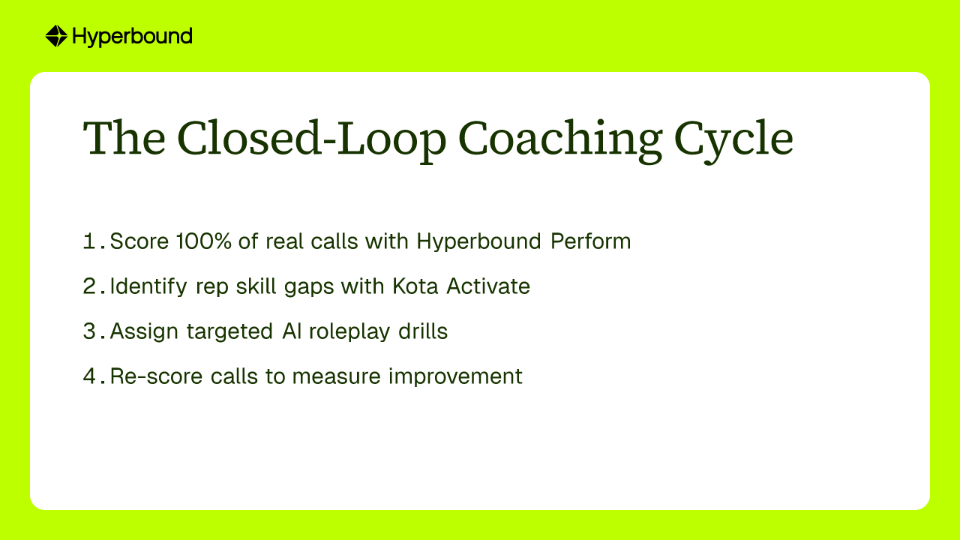
This is precisely the problem that Kota Activate solves. As Hyperbound's AI Revenue Analyst, Kota sits above both Practice and Perform to create a closed-loop coaching cycle:
The result is a continuous improvement cycle: score real calls → identify the specific conversation type where the rep is breaking down → assign a targeted practice scenario → score real calls again. No guessing. No generic training programs. Just precision coaching tied directly to the deals your team is working right now.
The five conversations above are the ones that separate good reps from great ones. They're uncomfortable precisely because the stakes are high — and that discomfort is exactly why most reps show up to them underprepared. With a systematic approach to practice and a closed-loop system connecting real-world performance to targeted drills, these conversations stop being the ones your team dreads and start becoming the ones they're known for winning.
The most common difficult sales conversations involve high stakes and emotional pressure. Key examples include notifying a customer of a price increase, handling high-stakes contract renegotiations, managing objections under pressure, recovering from a service or delivery failure, and navigating pushback from multiple stakeholders in a single call.
Practicing for difficult sales calls is crucial because it builds the confidence and muscle memory needed to handle high-pressure situations effectively. Most sales training is generic, but targeted practice on specific scenarios like objection handling or price increases allows reps to move past the instinct to panic, listen actively, and guide the conversation to a positive outcome, directly impacting win rates.
AI roleplay offers a scalable and psychologically safe way for reps to practice difficult conversations until they become second nature. Unlike traditional roleplay, AI tools like Hyperbound allow for instant, on-demand practice with realistic buyer personas. Reps can run drills for specific scenarios, like a budget-conscious VP or a skeptical CFO, receiving immediate feedback on their tone, word choice, and strategy without risking a real deal.
The best way to handle a price increase is to confidently anchor the conversation in value, not price. Instead of apologizing, a strong response reminds the customer of the value they receive and frames the increase as a necessary investment in their continued success. This approach leverages loss aversion and market context to normalize the change, preserving the customer relationship and margins.
A sales rep should handle objections by first staying calm, asking clarifying questions to understand the root cause, and validating the prospect's concern. Instead of getting defensive or immediately offering a discount, this process shows the rep is listening. Once the real issue is understood, the rep can pivot to a relevant value story or proof point that directly addresses the concern.
A closed-loop coaching system is a process that connects real-world performance data with targeted training to drive continuous improvement. For sales, this involves using AI to analyze 100% of a team's calls (score), identify specific skill gaps like struggling with price objections (identify), automatically assign relevant AI roleplay drills (practice), and then re-score future calls to measure improvement.










Use Cases
Legal