You've practiced "Peter Piper picked a peck of pickled peppers" countless times. You've mastered "She sells seashells by the seashore." Yet when you stand to speak, those filler words still creep in, your articulation falters on certain sounds, and that eloquence you're striving for remains frustratingly out of reach.
Sound familiar?
The truth is, basic tongue twisters alone won't transform your diction. As many in online forums lament: "I tried to do it for a while but it didn't work for me unfortunately." Or as another speaker confessed: "I am confident when it comes to speaking, it's just the fluency I'm lacking in."
If you're tired of generic advice that doesn't address your specific articulation challenges, this guide moves beyond the basics to provide advanced, targeted diction exercises that actually build real muscle memory, control, and clarity—techniques used by professional speakers, classical orators, and Speech-Language Pathologists alike.
Before diving into advanced techniques, it's essential to understand that the muscles used for speech—your jaw, tongue, lips, and facial muscles—need proper conditioning just like any other muscle group. Skipping your vocal warm-up is like trying to sprint without stretching.
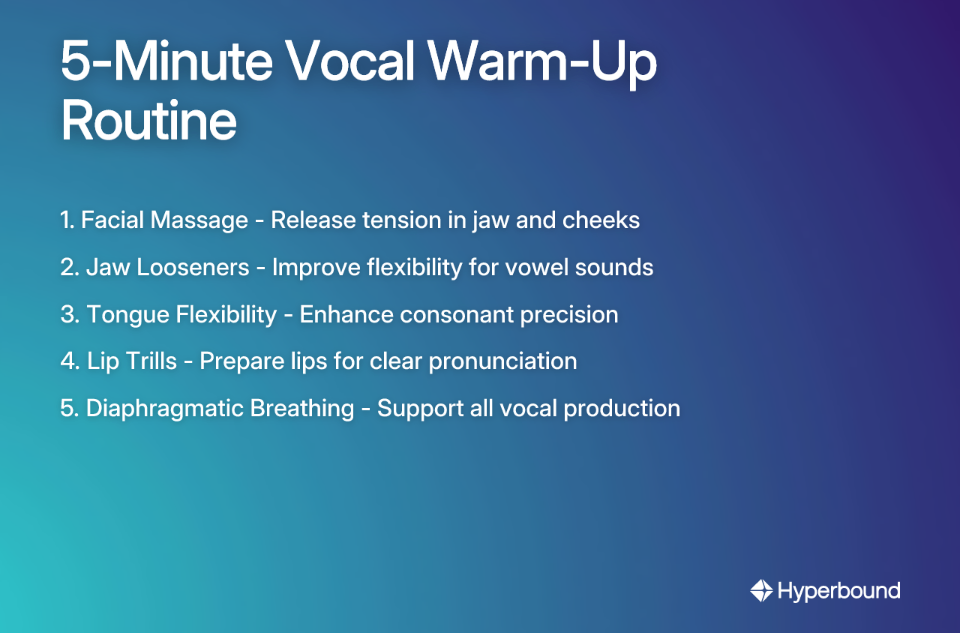
As noted by vocal experts at Voiceplace, "Proper breathing technique is the foundation of good diction. Without it, even the most well-practiced articulation exercises will fall short."
Now let's explore techniques that create resistance and build the muscle memory needed for clearer speech—methods that have worked for centuries.

Demosthenes, ancient Greece's greatest orator, wasn't born with perfect speech. In fact, he had a speech impediment. His innovative training methods transformed him into history's most renowned speaker.
Exercise 1: The "Pebbles in Mouth" Technique (Modern Version)
Demosthenes famously practiced speaking with pebbles in his mouth to force greater articulation effort. While we don't recommend actual pebbles (choking hazard!), here's a safer modern alternative:
The immediate difference you'll feel is remarkable. Your articulation muscles have been working overtime, and when the resistance is removed, your speech becomes noticeably clearer. With regular practice, this clarity becomes your new normal.
Exercise 2: The Pencil Exercise
Similar to the cork technique but with different benefits:
This exercise trains your tongue to be more active and precise—essential for clearer consonants—while preventing over-reliance on jaw movement, a common cause of mumbling.
Generic exercises often fail because they don't address your specific difficulties. Here's how to customize your practice:
Step 1: Identify Your Problem Sounds Record yourself reading a varied passage. Play it back, noting which sounds cause you trouble. Common culprits include:
Step 2: Three-Stage Sound Mastery
For each problem sound, follow this progression:
Toastmasters champion speakers often use this targeted approach rather than generic tongue twisters, focusing on their specific articulation challenges.
Exercise 3: Over-Exaggeration Drill
This technique, recommended by Speech-Language Pathologists, involves:
This exercise increases your awareness of mouth positions and builds muscle memory for clearer everyday speech.
Consistency trumps intensity when improving diction. A structured daily routine of 10-20 minutes will yield better results than occasional marathon sessions.
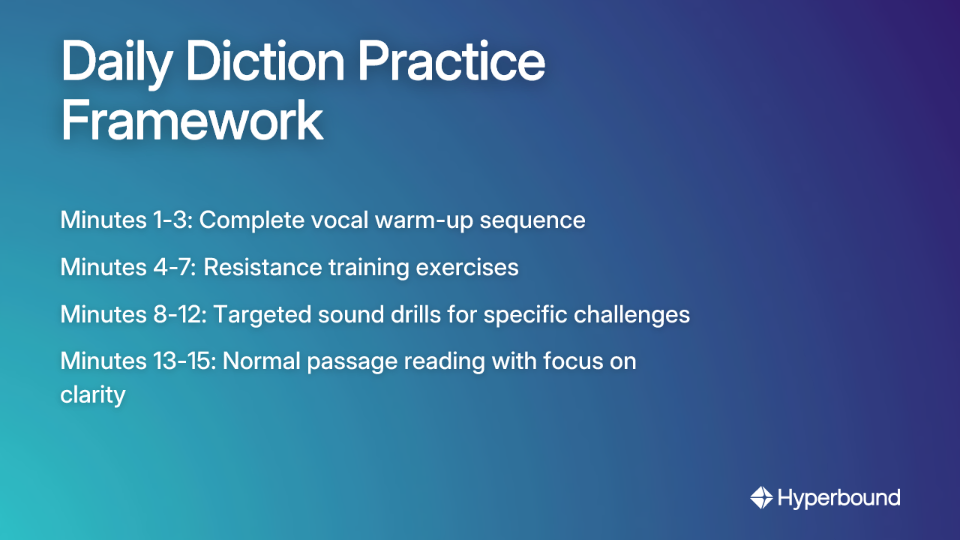
Without a coach or teacher, how do you know if you're improving? These self-assessment methods provide the objective feedback you need:
The Mirror Recitation Tool: Practice in front of a mirror to observe your mouth movements, facial expressions, and body language. Are you opening your mouth enough for vowels? Are your lips forming proper shapes for consonants?
Record and Analyze: Using your smartphone, record your practice sessions. Listen critically for:
Many speakers are surprised at the discrepancy between how they think they sound and their actual speech patterns. For deeper, automated insights, AI coaching platforms can analyze your recordings and provide objective data on clarity, filler words, and talk speed, accelerating your improvement.
Clear articulation is only part of effective speech. You also need appropriate vocal power—what speakers call "volume and fullness of voice." But true projection doesn't mean shouting.
Demosthenes famously practiced speeches against the roar of ocean waves to develop projection. Here's the modern equivalent:
This exercise builds projection power without vocal damage. As one Reddit user suggested: "By the highway, try to recite a speech and be louder than it without breaking your voice in any way, focusing on volume and fullness of voice."
This advanced technique combines physical exertion with speech:
This exercise strengthens the connection between your breathing and speech, improving stamina for longer talks and presentations.
Develop vocal control by practicing a single paragraph at different volume levels:
The key is maintaining the same clarity and articulation at each level. This builds the dynamic range essential for engaging public speaking.
To truly master diction, you must practice in varied environments that simulate real speaking conditions:
Organizations like Toastmasters offer opportunities to practice in supportive environments with immediate feedback. The advantage is real-time coaching on both your articulation and your overall Vocal Image—how others perceive you through your speech.
For targeted, scalable practice, AI-powered platforms offer a modern solution. Tools like Hyperbound allow you to practice crucial conversations with AI personas that respond realistically. These platforms provide instant, objective feedback on your pace, articulation, and use of filler words, helping you quickly identify areas for improvement in a private, low-stakes setting.
Improving diction isn't just about sounding "proper"—it's about removing barriers between your thoughts and your audience. When your articulation is clear, your breathing controlled, and your projection appropriate, your message can shine through without distraction.
The ancient art of elocution reminds us that effective speech is both a science and an art. The science lies in these structured exercises that build your vocal apparatus. The art emerges when that technical foundation allows you to focus entirely on your message and connection with your audience.
By consistently applying these advanced diction exercises—moving far beyond basic tongue twisters—you'll develop the clear, confident voice that makes people want to listen. As Demosthenes proved centuries ago, great speakers aren't born—they're built, one focused practice session at a time.
Start your 15-minute routine today, and within weeks, you'll notice not just clearer speech, but greater confidence in every word you share.

The most important first step is consistently performing a vocal warm-up. Just like an athlete stretching before a race, a 3-5 minute routine of facial massage, jaw looseners, and tongue flexibility exercises prepares your vocal instrument for effective practice. This foundational step releases tension and ensures your muscles are ready to build new habits for clearer speech.
You can often feel an immediate improvement in clarity right after performing resistance exercises like the cork or pencil method. However, for lasting, subconscious improvement, consistency is key. With a daily practice of 10-20 minutes, most people notice significant, consistent improvement in their everyday speech within a few weeks to a couple of months.
Advanced exercises are more effective because they build muscle memory through resistance, while basic tongue twisters primarily focus on repetition. Placing an object like a cork in your mouth forces your tongue, lips, and jaw to work harder to articulate sounds. When the object is removed, your speech feels significantly clearer because your muscles are conditioned for more precise movements.
The best way to identify your problem sounds is to record yourself speaking and listen back critically. Use your smartphone to record yourself reading a passage with a variety of sounds. As you listen, note which consonants or vowels sound mumbled, unclear, or are consistently dropped, particularly at the end of words. Common culprits include "th," "r," and "s/z" sounds.
Articulation is the clarity and precision of your individual sounds, created by your lips, tongue, and jaw. Projection is the power and fullness of your voice, supported by proper diaphragmatic breathing, which allows you to be heard clearly from a distance without shouting. Effective speakers must master both; clear articulation is lost without adequate projection, and loud projection is useless if the words are mumbled.
Practicing in realistic settings is crucial for making your new skills permanent. You can join organizations like Toastmasters to get feedback in a supportive group environment. Alternatively, AI-powered coaching platforms provide a modern solution, allowing you to have practice conversations with AI personas and receive instant, objective data on your articulation, pace, and filler words in a private setting.
Looking for more resources? Consider consulting with a Speech-Language Pathologist for personalized guidance on your specific articulation challenges.










Use Cases
Legal