
Between 40% and 60% of B2B deals are lost to customer indecision, not to a competitor. The prospect runs the process, attends the demos, and receives the proposal; the deal then stalls. By the time the close date slips in the CRM, the deal has been dead for weeks.
The most dangerous stalls are the deals reps still believe are progressing, which reps have not flagged. The CRM shows activity. The pipeline report looks healthy. CRM data is a lagging indicator because reps update it on a reporting schedule rather than at the moment momentum first breaks.
The early-warning signals for a stalling deal do not live in a data field. They live in the structure of the deal itself.
A pushed close date is the CRM's way of recording a stall that already happened. By the time a rep downgrades a stage or logs a missed follow-up, the real inflection point is weeks in the past.
This delay has a direct cost. Forecasts built on lagging CRM data reflect rep optimism rather than buyer intent. Sales teams then spend significant time reconstructing deal history to understand what went wrong, rather than intervening while there is still time to act.
Activity volume makes this worse. A deal that ends in no-decision often runs a full process, including extended pilots and proof-of-concept trials, before going silent. High activity is not a reliable indicator of deal health. It is a false signal that misleads pipeline reviews.
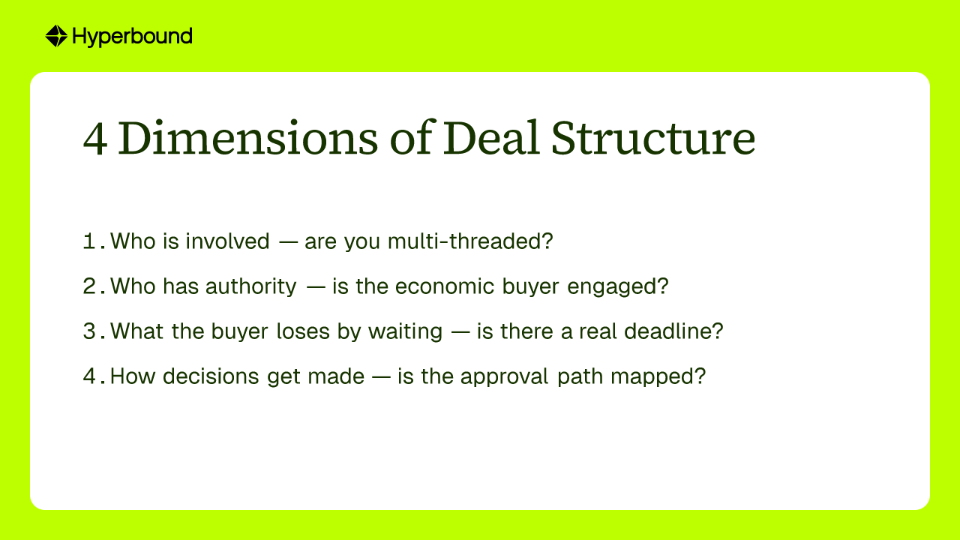
To catch the signs a deal is stalling before they surface in the forecast, sales teams need to examine four structural dimensions rather than activity counts.
These questions are answerable in discovery. When they go unanswered, each one becomes a structural defect that predicts friction ahead.
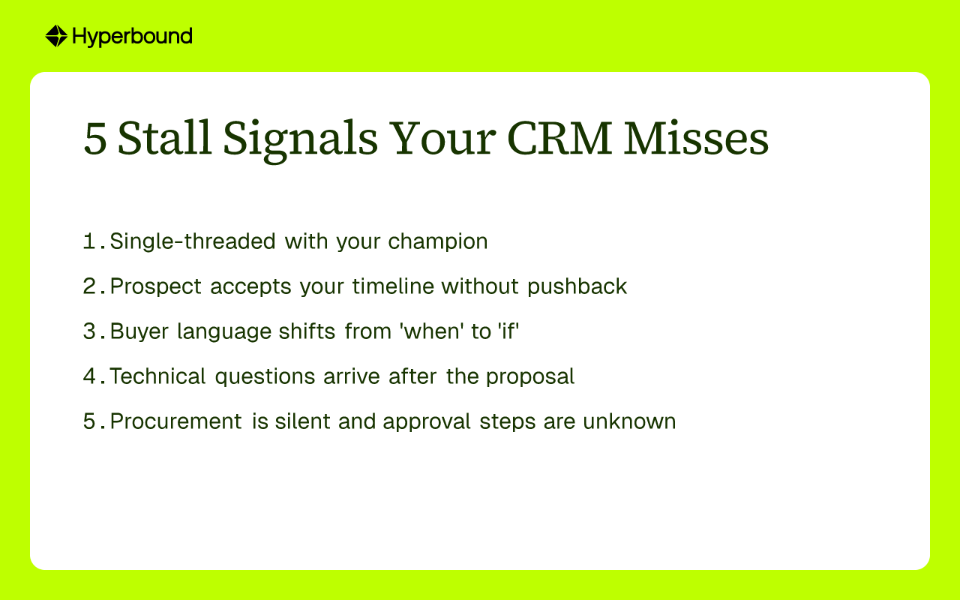
The following signals are structural and behavioral. None of them trigger an alert in a CRM. Each one is discoverable before a deal goes quiet.
1. The deal is single-threaded with the champion.
The champion has not introduced the sales team to any other member of the buying center. There is no direct line to IT, finance, or the executive who holds budget authority.
This signal is often rationalized as the champion managing the process internally. In practice, a champion who keeps all contact single-threaded often lacks the internal credibility or political capital to move the deal forward. If that champion leaves the organization, the deal typically collapses because the relationship was never anchored elsewhere.
A go-live date or decision deadline is proposed, and the prospect agrees immediately, with no questions and no negotiation.
The absence of friction at this stage is a warning sign. It indicates the prospect has not done the internal work to build a business case or align stakeholders to a real date. There is no compelling event forcing movement. The proposed timeline is a placeholder.
3. The buyer's language shifts from "when" to "if".
Early in the process, conversations are forward-looking: "When we implement this..." or "When we roll this out to the team..." A shift to "If we decide to move forward..." or "If this is something we pursue..." signals lost internal confidence.
This language change appears in emails and calls long before a rep would adjust a deal stage. It is an early indicator of hedging, often prompted by an internal objection the champion has not surfaced to the sales team.
After the demo and commercial proposal, the prospect asks about security assessments, data residency requirements, or integration architecture.
These questions are not routine. They signal that the approval process was never properly scoped and that the buying team did not map the internal steps before engaging commercially. Each unmapped approval step, including legal review, security assessment, IT sign-off, and executive authorization, can add four to eight weeks to the sales cycle. Discovering this at proposal stage means the timeline the CRM shows is structurally impossible.
5. Procurement is silent and approval steps are unknown.
The sales team has no visibility into who needs to sign off, in what order, or what thresholds trigger additional review. It knows the champion's name and possibly the champion's manager. It does not know the formal path from verbal agreement to executed contract.
This is not a gap that resolves itself. Every unidentified stakeholder in legal, security, IT, or finance is a potential hold point. Silence from procurement at mid-funnel is a primary driver of late-stage stalls, and it is addressable with a single discovery question asked early.
No single signal is conclusive on its own. Two or three signals present simultaneously in the same deal indicate a stall is coming. At that point, intervention is required immediately rather than after the next missed follow-up.
Waiting for the CRM to reflect the problem means waiting until the deal is already in decline. The intervention threshold is structural rather than chronological.

Generic re-engagement tactics produce near-zero response rates. The revival action must match the specific structural defect.
If the deal is single-threaded:
Gate the next scheduled step on an introduction to the economic buyer or an executive sponsor. The framing is straightforward: "To make sure the technical deep dive is useful for everyone involved, we need input from the VP of Finance before we book that session. Can you arrange an introduction this week?"
This makes the introduction a precondition rather than a request. If the champion cannot deliver it, that itself is diagnostic information.
If there is no compelling event:
Re-anchor on the cost of inaction. The goal is to make the prospect articulate, in their own words, what they lose by delaying. Ask: "Walk me through what happens if you do not make a decision on this by the end of the quarter. What are the tangible impacts on your team's goals?"
Urgency constructed by the prospect is durable. Urgency constructed by the sales team is not.
If the approval process is unmapped:
Pause before sending the final proposal. Do not proceed commercially until the full decision path is documented. Ask: "To make this as smooth as possible on your end, can you help me understand every step and stakeholder involved after we agree on terms? Who from legal, security, and finance will need to review this, and what does their timeline look like?"
This question surfaces hidden obstacles before they become timeline surprises. It also signals to the champion that the internal process is being treated as seriously as the commercial one.
Most forecasting conversations focus on the wrong question. Teams ask whether the deal is active when they should ask whether the deal is structurally capable of closing.
The signs a deal is stalling are present well before any CRM field changes. Single-threaded access, an absent economic buyer, no compelling event, and an unmapped approval process are all visible at mid-funnel if teams are examining deal structure rather than activity. Each structural defect is the condition under which indecision becomes a stall and a stall becomes a no-decision.
In the next pipeline review, sales teams should apply the four-dimension framework to every deal in the commit and best-case categories and identify the deals carrying two or more of these signals. Those are the deals that will consume the most rep time and deliver the least return unless the structural issues are addressed now.
The forecast will not show it yet. Hyperbound Perform reviews all calls in a deal and surfaces risk signals plus coaching actions for teams that want to spot structural signals before the CRM catches up. Once a stall is confirmed, the next step is to act, and our guide to what to do when a deal stalls in pipeline covers the specific fix for each root cause.
Early warning signs include a deal that is single-threaded with the champion, a prospect accepting the proposed timeline without any pushback, a shift in buyer language from "when" to "if", technical or security questions arriving after the proposal, and silence from procurement with an unmapped approval process. These signals are structural and behavioral rather than activity-based, so they rarely appear in CRM reports. Sales teams should review the four dimensions of deal structure, including who is involved, who has authority, the cost of inaction, and the decision process, to catch these risks before the deal goes quiet.
CRM signals arrive too late because they are lagging indicators. A pushed close date or downgraded stage records a stall that has already happened, often weeks after the real inflection point. By the time reps update the CRM, the deal has already lost momentum. This delay inflates forecasts with rep optimism and forces teams to reconstruct deal history instead of intervening while there is still time to act. The early-warning signals of a stalling deal live in the deal's structure and buyer behavior, not in the CRM's activity fields.
A deal is single-threaded when all communication runs through one contact, typically a champion, and there is no direct line to other members of the buying center such as IT, finance, legal, or an executive sponsor. To identify this, sales teams ask whether the champion has introduced them to anyone else or whether they can name the economic buyer and other stakeholders. If the answer is no, the deal is structurally fragile. A champion who keeps the relationship single-threaded often lacks internal credibility or political capital to move the deal forward, making it likely to collapse if that person changes roles.
A shift from "when" language, such as "When we implement this...", to "if" language, such as "If we decide to move forward...", is an early indicator of lost internal confidence. It signals that the prospect is hedging and likely facing an internal objection the champion has not surfaced. This shift appears in emails and calls long before a rep would adjust a deal stage, making it a valuable leading signal. Sales teams should treat this change as a prompt to re-examine the deal's structure and address the underlying concern directly.
To create urgency without a natural compelling event, re-anchor the conversation on the cost of inaction. Ask the prospect to articulate, in their own words, what they lose by delaying: "Walk me through what happens if you do not make a decision on this by the end of the quarter. What are the tangible impacts on your team's goals?" Urgency constructed by the prospect is durable, while urgency imposed by the sales team is not. This approach helps surface a real deadline or reveals that the timeline is arbitrary, allowing the rep to adjust the strategy accordingly.
To map a B2B approval process, ask: "Can you help me understand every step and stakeholder involved after we agree on terms? Who from legal, security, and finance will need to review this, and what does their timeline look like?" Also ask about the order of sign-offs, thresholds that trigger additional review, and any formal procurement steps. This question surfaces hidden obstacles before they become timeline surprises and signals to the champion that the internal process is being treated as seriously as the commercial one. It should be asked in discovery, not after the proposal is sent.
If procurement goes silent after a proposal, do not wait for the CRM to flag the deal. Instead, re-engage by asking for a documented approval path. Request a meeting with the champion specifically to map the remaining stakeholders and steps. If the champion cannot provide this visibility, treat that as a stall signal and pause further commercial activity until the path is clear. Silence from procurement is often a primary driver of late-stage stalls, and every unidentified stakeholder in legal, security, IT, or finance is a potential hold point that can add weeks to the cycle.
No single signal is conclusive on its own, but two or three stall signals present simultaneously in the same deal indicate a stall is coming. At that point, intervention is required immediately rather than after the next missed follow-up. The threshold is structural rather than chronological. Sales teams should apply the four-dimension framework to every deal in the commit and best-case categories and identify deals carrying two or more of these signals, as those are the deals most likely to consume rep time and deliver the least return unless the structural issues are addressed now.










Use Cases
Legal