Deal Stalled in Pipeline? Here Is What the Data Says to Do (and What to Stop Doing)
11
min read

11
min read
Your deal stalled in pipeline. You have sent three follow-ups. You offered a discount. You created urgency around end-of-quarter. Nothing moved.
Here is the uncomfortable truth: those tactics fail most of the time because they treat the symptom, not the cause. 55% of US sales leaders report lost revenue due to undefined sales processes, and the pattern is almost always the same. A rep has a deal going quiet, so they apply generic pressure. The deal dies anyway.
Sound familiar? One AE described their pipeline this way: "The vast majority of my pipeline is in Limbo waiting for the prospects to decide on a vendor or to spend money at all. Most of my pipeline used to die in that limbo, internal team convos I wasn't part of, and budget fights I couldn't see."
That is not a follow-up problem. That is a diagnosis problem.
Stalled deals almost always trace back to one of four root causes. Misdiagnosing which one is present means applying the wrong fix. This post gives you a framework to identify the actual cause and the specific action to take for each one.
Most reps default to a predictable rescue kit when a deal goes quiet:
None of these address why the deal stalled. Worse, aggressive follow-up after a clear signal burns the bridge entirely. As one sales leader put it: "Once they said no, that's your answer. One polite follow-up asking for feedback is fine, but calling multiple times the same day after a clear loss is just burning the bridge for next time."
The deal did not stall because you were not persistent enough. It stalled because something specific broke down somewhere in the deal arc. Your job is to find out what.
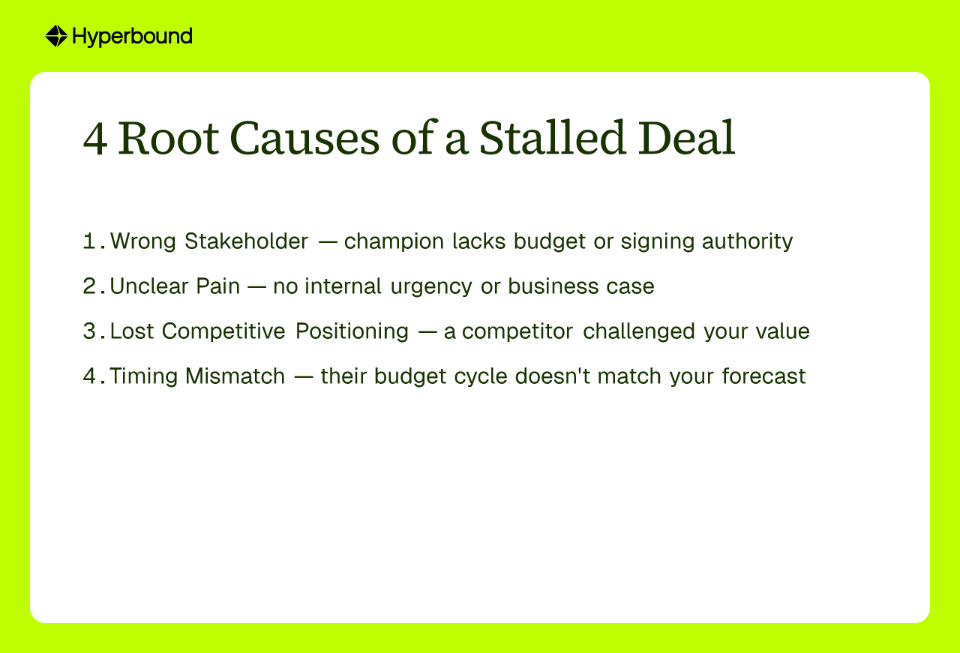
Research on stalled deals shows that pipeline stagnation is rarely random. It clusters around four core issues.
You have a champion who likes you. But your champion does not control the budget, cannot sign the contract, and struggles to get time with the people who can. The deal sits because the economic buyer is not engaged.
The telltale signs: your main contact goes quiet after internal meetings, unexpected objections come in from legal, finance, or IT, and you are told to wait while they "discuss internally." You are on the outside of a conversation you were never invited into.
The prospect agrees your solution is interesting. But "interesting" does not create urgency. The deal has no momentum because your champion cannot build a business case that competes with the fifteen other priorities on the CFO's desk.
The conversation stays at the feature level. Timelines slip. Meetings get pushed. The prospect is not saying no. They are just not saying yes, because no one inside their company is fighting for this.
A competitor entered the conversation and you did not handle it. The prospect is now doing an "internal evaluation" that is really a side-by-side comparison, and your value proposition has not been defended.
Late-stage feature requests, new questions about integrations, and sudden radio silence after a previously warm conversation are all signals that your positioning has been challenged and you did not win that round.
You need this deal this quarter. Their budget does not open until Q2. That gap will not close no matter how many follow-ups you send.
The prospect is not disengaged. They are just not on your timeline. When reps skip the timeline conversation in discovery, this root cause is almost guaranteed to surface late in the cycle.
Before you act, you need to know which cause you are facing. Here are three diagnostic questions for each.
If the answer to question three is "secondhand only," you have a stakeholder problem.
If the answer to question three is silence or a shrug, you have a pain articulation problem.
If you have been avoiding the competitive conversation, the competitor has not.
As one experienced AE shared: "You should find out their evaluation timeline early in discovery and remind them of it throughout the sales process." If you skipped this step, you are likely forecasting a deal that will not close when you think it will.
One metric to watch: Compare the deal's current age against your average time-in-stage for that pipeline phase. If it is sitting 2x the average, it is either time to apply a specific fix or to disqualify it. Deals that linger beyond stage averages rarely self-correct.
You have run the diagnostics. Now here is what to actually do. Not "re-engage your champion." Specific moves.
Your only goal is to get the economic buyer on a call. Work with your champion to orchestrate the introduction. When you get that meeting, do not pitch features. Lead with the business case your champion failed to make.
Frame it as: "I know [champion's name] has been working through this evaluation. I wanted to spend 20 minutes walking you through the ROI case so you have everything you need to make a decision." That is multi-threading with a purpose.
If your champion resists the introduction, that tells you something important about their actual influence level. Reassess whether you have a real champion or just an enthusiastic user.
Help your champion sell internally. They are fighting for budget against a dozen competing priorities and they are probably not great at building financial arguments. That is your job.
Co-create a one-pager or business case they can use in conversations you will never be in. One AE described the shift this way: "I started using AI deal coaching to get clear next steps right after calls. It helped me understand what was happening in those internal team convos I wasn't part of. Most of my pipeline used to die in that limbo."
When you re-engage, use The Challenge message: "When we first talked about [pain point], you seemed motivated to solve it before the end of the quarter. Then communication dropped off. What happened?" That directness breaks the polite avoidance loop and gets to a real answer fast.
Do not send a generic battle card. The prospect has already heard the comparison points that do not apply to their situation. Go back to the specific pain that originally drove this evaluation and reframe your differentiation around that exact outcome.
Acknowledge the competitor directly. Something like: "I know you are likely looking at [Competitor]. Most teams evaluating both of us care most about [X]. Here is where we consistently win on that." Facing it head-on is more credible than ignoring it.
Stop fighting the budget cycle. Acknowledge the gap and work with it. The best move here is often the Permission to Close Out message: "I haven't heard back from you on this. Usually, when this happens, it means this isn't a priority right now. If that's the case, let me know so I can close out your file. Is that correct?"
This breaks the passive avoidance pattern. Most prospects respect the directness and respond honestly. You either get a real timeline or you free up your pipeline for deals that can actually move.
The four root causes above do not appear suddenly when a deal goes dark. They are present in earlier calls. Managers who review call data across the full deal arc can spot the stall before it becomes a rescue situation.
Research points to a common misdiagnosis pattern: leaders assume reps have a closing problem when the actual breakdown happened in discovery, weeks or months earlier. The rep never confirmed who the economic buyer was. The pain conversation stayed at the feature level. The evaluation timeline was never pinned down. The competitive objection came up and was handled poorly and then never revisited.
By the time the deal goes quiet, the rep is trying to fix in the ninth inning what broke in the second.
Tools like Hyperbound Perform use AI-driven deal coaching to flag these signals automatically, looking across all calls in a deal to track engagement drops, analyze stakeholder sentiment, and surface risks before they stall a deal. Automated alerts for stagnant deals give managers a window to coach before the rep sends another pointless "just checking in" note.
The goal is to shift from deal rescue to deal health management. Identify the root cause early. Coach to it specifically. Do not wait for the deal to flatline.

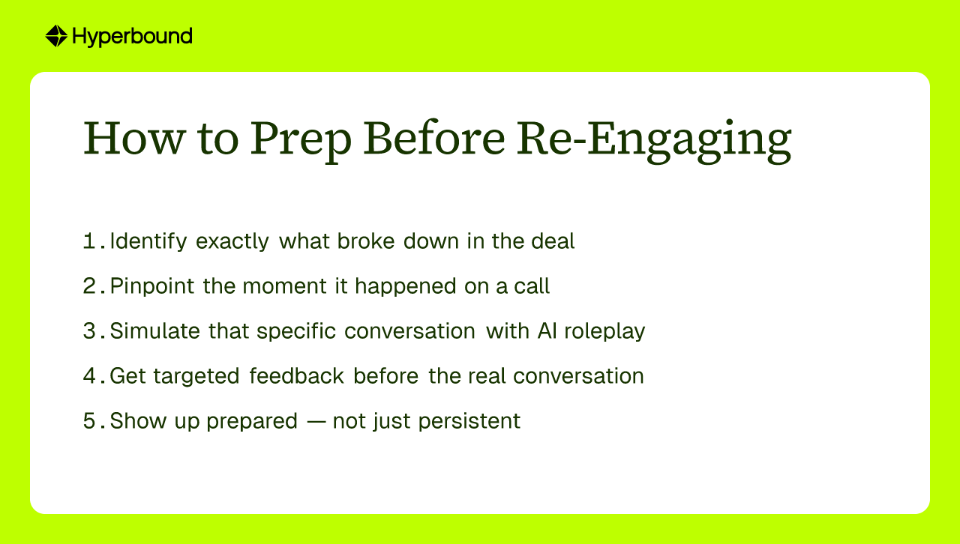
Here is the part most reps skip entirely.
If the deal stalled because you fumbled the competitive objection, re-engaging with the same pitch is not a fix. It is the same mistake repeated. If the deal stalled because you could not articulate the business case to the economic buyer, scheduling another call without preparing for that conversation will produce the same result.
Before you send the re-engagement email or get the economic buyer on the phone, practice the specific scenario you are walking back into. Not generic objection handling. Not role-play with abstract characters. Practice the exact conversation you are about to have, against the actual stakeholder profile and the actual objection that previously cost you momentum.
Deal-specific practice means knowing what broke down in this deal, identifying the moment it happened, and drilling that conversation until you can handle it cleanly. A 15-minute targeted practice session before a re-engagement call is worth more than 30 generic cold call reps. This is where AI roleplay platforms like Hyperbound Practice excel, allowing reps to simulate the exact deal scenario and get targeted feedback before the real conversation happens.
When a deal goes quiet, the answer is not more activity. It is better thinking.
Run the diagnostic. Identify which of the four root causes is present: no economic buyer engagement, a champion who cannot build the internal business case, a competitive objection that was fumbled, or a budget cycle that does not match your forecast date. Each one has a specific fix. None of them is "send another follow-up."
If you do not know which root cause is present, look at your call data. Go back through the deal arc. The signal is almost always there.
Then, before you re-engage, practice the conversation. Show up prepared for the moment that previously cost you. A stalled deal is recoverable. But only if you stop repeating the actions that stalled it in the first place.
Treat it like a diagnostic problem, and you will move from feeling helpless to being in control of your pipeline health.
A sales deal typically stalls due to one of four root causes: engaging the wrong stakeholder who lacks budget or authority, failing to establish a clear and urgent business pain, losing ground to a competitor, or a mismatch between your sales timeline and the prospect's budget cycle. Identifying the specific cause is crucial for taking the right action.
Generic follow-ups fail because they treat the symptom (silence) rather than the underlying cause of the stall. Without diagnosing why the deal has lost momentum—be it a stakeholder issue, lack of urgency, or a competitor's influence—these tactics come across as pressure without purpose and rarely move the deal forward.
You can identify the real reason by asking targeted diagnostic questions. For example, to check for stakeholder issues, ask if you've ever spoken directly with the economic buyer. To assess pain, ask if your champion can articulate the financial impact of not solving their problem. This diagnostic approach helps you pinpoint the exact breakdown in the sales process.
If your champion resists introducing you to the economic buyer, it's a strong signal that they may lack the internal influence you thought they had. The best action is to reassess if they are a true champion. You can also try to provide them with a compelling business case or one-pager that they can share, making the introduction feel less risky for them and more valuable for the decision-maker.
It's time to disqualify a stalled deal when it has been inactive for significantly longer than your average time-in-stage for that pipeline phase (e.g., 2x the average). Another key moment is after you've attempted a specific, diagnosis-based intervention and still see no movement or get no response. Using a "Permission to Close Out" message can often provoke a final, honest answer.
You can help your champion sell internally by co-creating the business case with them. This involves moving the conversation beyond product features to the financial impact and business outcomes. Provide them with a concise one-pager or ROI calculation they can use in internal meetings to clearly articulate the value and urgency of your solution to other stakeholders like the CFO.
The best way to handle a late-stage competitor is to address them directly instead of ignoring them. Acknowledge that the prospect is evaluating other options and re-center the conversation on the specific pain point that initiated the evaluation. Then, clearly articulate how your solution is uniquely positioned to solve that specific problem better than the competition.
Proactive sales coaching can prevent deals from stalling by identifying risks early in the sales cycle. By reviewing call data, managers can spot when a rep fails to engage the economic buyer, doesn't establish clear pain, or mishandles a competitive objection. Coaching on these specific moments allows reps to correct their course long before the deal loses momentum.











Use Cases
Legal