
The deal looked perfect. It was in late stage. The rep committed it to forecast. Then the prospect went dark. By the time anyone looked closely, it had been dead for weeks.
This pattern is not rare. Nearly 60% of deals stall due to unidentified risks, poor qualification, or weak stakeholder alignment. The signals were present throughout the deal cycle. Nobody was reading them.
That is the core problem with how most sales teams approach deal risk identification today. They rely on what reps report in the CRM and what they say in pipeline reviews. Both are lagging signals. Both reflect what the rep believes, not what the buyer is doing.
The most dangerous deals are not the ones your reps flag as at-risk. They are the ones your reps still believe are healthy.
One sales manager put it plainly in a public forum: a rep had been chasing a deal hard, following up repeatedly, but "it took time away from deals that could be worked." The real issue, as another commenter noted, was that "the real issue is you didn't have a strong enough champion from the start." The warning signs were there. They just weren't being surfaced systematically.
This article gives you a framework for catching those signals before your reps do.
Your CRM captures what has already happened. It is a record of conversations, not a window into deal momentum.
Reps update Salesforce when they have to. They do not update it when a deal first starts to slip. Sales reps often prioritize closing over data entry, which means that by the time a close date gets pushed or a stage gets walked back, the real inflection point happened weeks earlier.
The downstream cost is significant. Reps spend up to 30% of their time reconstructing deal history instead of selling. Managers make decisions based on incomplete, outdated, and subjective inputs. The forecast becomes a reflection of rep optimism, not buyer intent.
Research shows that managers routinely depend on "subjective assessments of deal health based on emotion rather than data-driven insights." This is not a rep failure. It is a process failure. When the only data you have is what a rep remembers to type, you will always be late.
The fix is not to nag reps for better CRM hygiene. The fix is to look at behavioral signals that exist independent of what reps report.
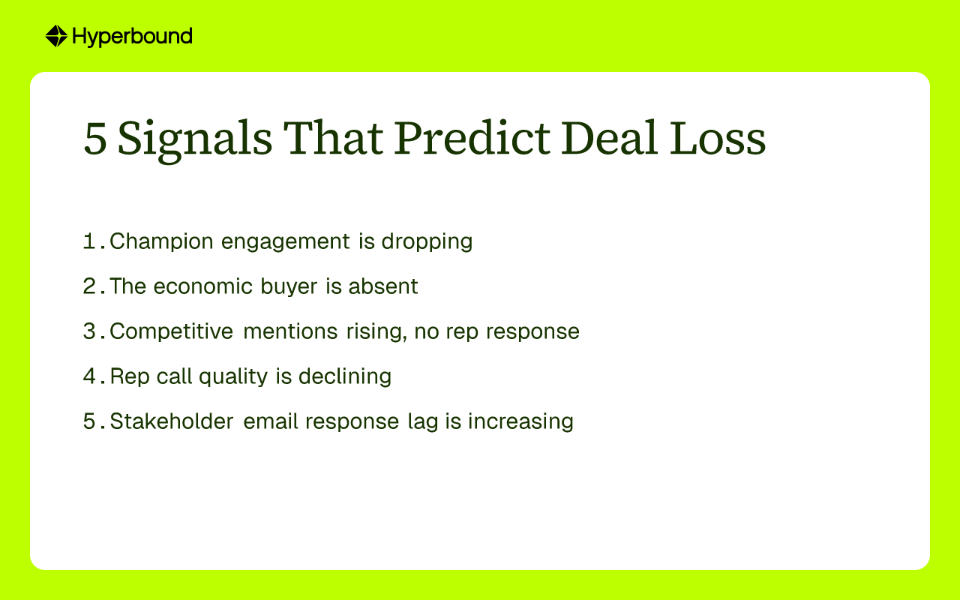
These signals live in the calls, emails, and engagement patterns across the deal arc. They are available before any rep updates a single field in Salesforce.
Your champion stops acting like one. Calls get shorter. They ask fewer questions. Email replies come later and say less. The person who was once pulling you into conversations is now hard to reach.
This is one of the clearest early-warning signals available. A disengaged champion is a primary driver of deal stall. A champion who went quiet likely lost internal momentum, got deprioritized by stakeholders above them, or stopped believing in the value of your solution. Any of those scenarios requires a coaching intervention, not another check-in email.
If the person who controls budget has not appeared on a call by mid-to-late stage, this deal has a serious structural problem.
Reps often "assume engagement with decision-makers" when their main contact is actually an influencer or user with no signing authority. That assumption is quiet and lethal. Lack of decision-maker engagement is a factor in up to 60% of stalled deals. If you cannot point to a specific call where the economic buyer was present and engaged, the deal is not as far along as the CRM stage suggests.
When a prospect starts asking about competitors, bringing up features your product doesn't have, or mentioning other vendors by name, it means two things. They are actively evaluating alternatives. And your rep may not have differentiated your solution clearly enough.
Reps often assume exclusivity when the buyer has been running a parallel evaluation the entire time. If competitive mentions are rising and the rep is not addressing them head-on, the deal is moving toward a comparison the rep is not prepared to win.
Pay attention to what is happening on the rep's side of the conversation, not just the prospect's.
When a deal starts to feel uncertain, reps shift from discovery to pitching. The talk-to-listen ratio climbs. They stop asking questions and start making statements. The call becomes a monologue. "Manager confusing activity with effectiveness" is how one sales professional described it. Reps who feel pressure to close stop doing the thing that actually moves deals forward: listening.
This pattern also tends to damage the buyer relationship. As one rep recalled, their prospect "was seeing that as aggression." Pushing harder when a deal is stalling does not revive it. It accelerates the collapse.

This one is quantifiable. Measure it.
Look at how long it takes key stakeholders to reply to emails across the deal arc. If response times that used to be same-day are now taking four or five days, or responses have stopped entirely, that is a behavioral change that means something. The deal is no longer a priority on their side. Ghosting is a signal that the upfront work on qualification and champion-building was insufficient, and it often shows up in email response patterns long before a rep notices or admits it.
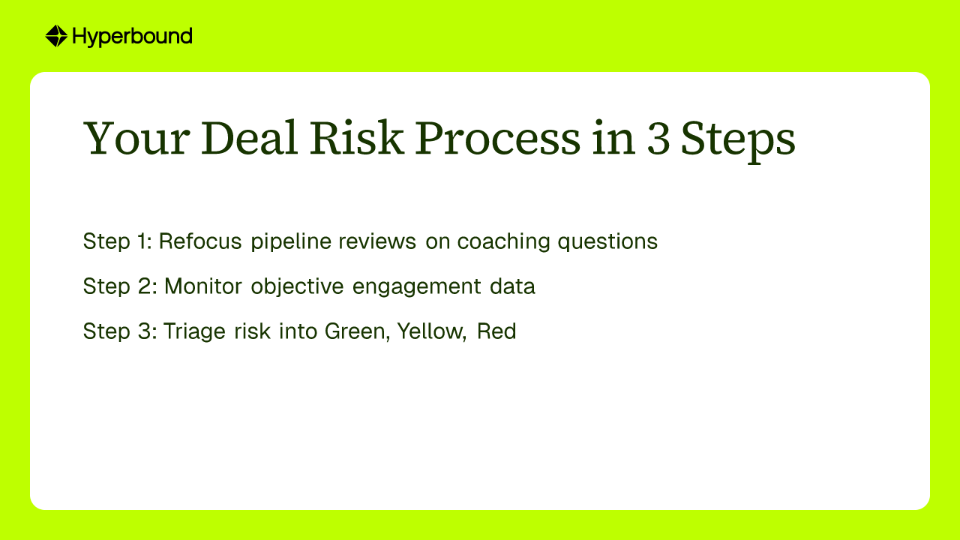
Identifying these signals does not require intuition. It requires a structured process.
Stop asking validation questions. Start asking coaching questions.
Instead of "What's the close date?" ask:
These questions are designed to audit the assumptions that are quietly killing deals. A rep who cannot answer them confidently has a risk problem, not a close date problem.
Beyond rep notes, track actual behavioral signals across every deal. Key metrics to monitor include:
These are the leading indicators of deal health that CRM stage alone cannot capture. A deal that has been sitting in the same stage for three weeks with no new stakeholder engagement is a different deal than one that advanced last week with two new contacts added.
This is where a Revenue Activation Platform provides real leverage. Tools like Hyperbound Perform surface cross-deal behavioral patterns automatically, giving managers visibility that would otherwise require manually reviewing every call and email thread.
Not every at-risk deal needs the same response. Use a simple three-tier classification to prioritize coaching time:
This classification is not for the forecast. It is for your coaching calendar. Industry best practices position systematic opportunity management and proactive risk identification as core skills for effective sales managers. Triage is how you apply those skills at scale.
The difference between a behavioral signal and a CRM signal is the intervention window.
Early detection scenario: You notice champion engagement has been declining for a week. You flag it in your next 1:1. You coach the rep on a value-driven follow-up that shares a relevant case study or offers to build a business case the champion can bring to their leadership. The champion re-engages. The deal moves forward.
Late detection scenario: The rep pushes the close date in Salesforce for the third time this quarter. You ask why. The rep says the prospect is "just busy." You press them to call. No answer. The deal was already lost. The rep just was not ready to admit it.
This is not a hypothetical. Every sales manager has lived the second scenario. Companies with structured deal inspection processes see win rate improvements of up to 20%. The causal mechanism is simple: early detection creates the time to act. Late detection only creates the opportunity to document what went wrong.
Reframe how you think about this.
Deal risk identification is not about building a more accurate forecast. A better forecast tells you what is going to happen. Early risk identification changes what happens. That is a different goal entirely.
Your reps are optimistic by nature. They believe in their deals longer than the data warrants. That is not a character flaw. It is how people are built. Your job as a manager is to look at the behavioral signals they are not reading and create the coaching conversation that turns at-risk deals into recoverable ones.
Stop managing your pipeline stages. Start coaching the behaviors that drive deal health. The calls and emails in your deals are already telling you where the risks are. You need a process to listen to them before your reps close the wrong column on the wrong deals.
The window exists. It is just shorter than you think.
Deal risk identification is the process of finding and assessing potential threats that could prevent a sales deal from closing. It involves moving beyond what reps report in the CRM to analyze objective, behavior-based signals from calls and emails that indicate a deal's true health and momentum.
Relying on CRM data for deal risk is not enough because the CRM only captures lagging indicators. Reps often update the CRM long after a deal has started to stall, meaning the information is outdated and subjective. By the time a risk is visible in the CRM (like a pushed close date), the critical window to save the deal has often already passed.
The key warning signs are behavioral signals that appear in live conversations and email exchanges. The five most critical signals are: 1) Your champion’s engagement is dropping, 2) The economic buyer is absent from conversations, 3) Competitor mentions are increasing without a response, 4) Your own rep's call quality is declining, and 5) Stakeholder email response times are getting longer.
Sales managers can proactively identify at-risk deals by implementing a structured process that focuses on coaching and objective data. This involves shifting pipeline reviews from validation questions ("What's the close date?") to coaching questions about buyer value and stakeholder alignment, monitoring engagement data like communication volume and multi-threading depth, and triaging deals into risk categories for targeted coaching.
The primary difference is their purpose: a forecast aims to predict an outcome, while deal risk identification aims to change it. A better forecast tells you what is likely to happen based on current data. Early risk identification, however, provides the opportunity to intervene and coach reps on specific actions that can recover a stalling deal and improve the outcome.
Early deal risk detection improves win rates by creating a window for effective intervention. When a manager spots a behavioral signal like a disengaged champion, they can coach the rep on a specific, value-driven strategy to re-engage them. This proactive coaching turns a potential loss into a recoverable opportunity, directly impacting win rates by saving deals that would otherwise silently stall and die.











Use Cases
Legal