
Pipeline reviews fail when they become status updates. A representative recites a close date, the manager acknowledges it, and the call ends without a clearer assessment of whether the deal will close. The underlying issue is the questions, not the meeting format.
Stage-specific deal review questions change this. Instead of asking how a deal is progressing, the review addresses what the economic buyer said about the price or what procurement step follows the signed quote. The answer either confirms the deal is sound or surfaces a risk that can be acted on immediately.
The 11 questions below are organized by deal stage: qualification, discovery, proposal, negotiation, and closing. Each one targets what matters at that point in the sales cycle.
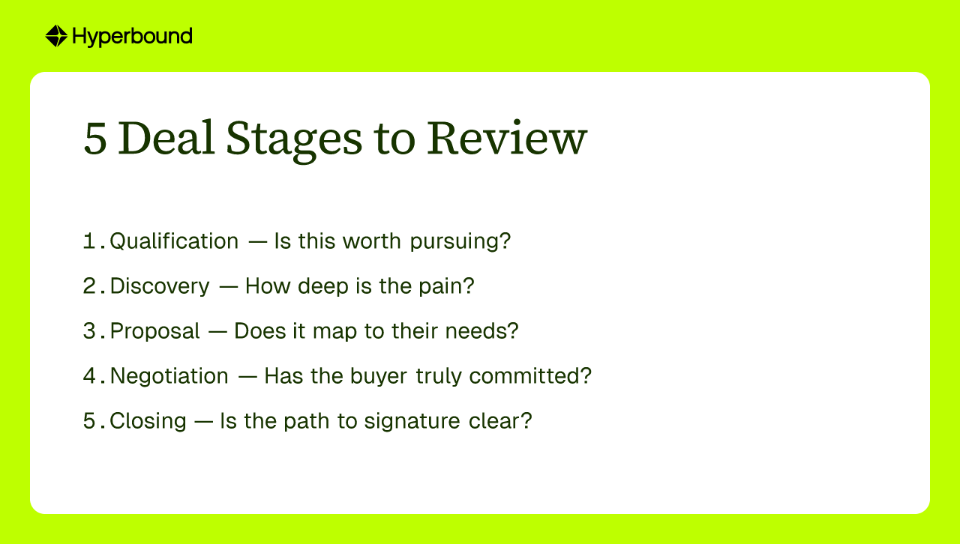
At this stage, the goal is to confirm that the opportunity is worth pursuing. Sales representatives can spend weeks on accounts that were never a fit. Two questions identify that risk early.
Question 1: Does this account match our Ideal Customer Profile, and what research supports that?
A representative who cannot answer this has not completed the baseline work. A strong answer maps the prospect against the organization's ICP on firmographics, technographics, or the criteria that define its best customers. ZoomInfo's qualification framework treats ICP alignment as the first filter, not an afterthought. If the match is weak, the deal should be deprioritized before it consumes more of the team's time.
Question 2: In the prospect's own words, what problem are they solving, and why now rather than in six months?
The "why now" is the part most managers skip. A prospect with a real, time-sensitive problem behaves differently from one who is exploring. Reevo.ai's pipeline review guide flags this explicitly: if a representative cannot articulate the cost of inaction for the prospect, the urgency is assumed rather than confirmed. Listen for whether the representative quotes the prospect or paraphrases the company's marketing language.
Discovery should produce a detailed picture of the buying committee and the daily operational impact of the problem. Generic answers at this stage indicate that the representative has not completed sufficient discovery.
Question 3: Walk me through how this problem affects their team's day-to-day workflow.
This question addresses operational friction rather than the problem at a high level. A representative who has completed thorough discovery will have specific operational details: which team spends how many hours on a workaround, which process breaks down and when. ZoomInfo's qualification questions include this framing for this reason. Specificity here makes a business case credible later.
Question 4: Who is involved in the decision, and who loses political capital if this project fails?
The first half of this question is standard; the second half is not. Identifying who has personal stakes in the outcome, not just who appears on the org chart, reveals who will advocate for the deal when the representative is not present. Reevo.ai surfaces this as one of the most revealing questions in a discovery review. The person whose reputation is tied to the project's success is often the deal's primary champion, and that person is not always the one who has been on the calls.
Once a proposal is issued, two risks appear: the proposal does not connect clearly to what the prospect described, and the representative has no clear picture of what happens on the prospect's side after receipt.
Question 5: Is our proposal directly tied to the specific problems they described in discovery, and what objections have come up?
A generic proposal is not effective in complex deals. This question requires the representative to demonstrate that the solution presented maps to the pain documented in Stage 2. If that connection cannot be made, the proposal requires revision before follow-up occurs. Salesforce's pipeline review guidance and SalesGrowth's deal review framework both treat proposal customization as a core quality check. Proactively surfacing objections at this stage prevents them from becoming late-stage blockers.
Question 6: Walk me through their legal and procurement process, step by step. Who signs off at each stage?
"It has to go through legal" is not an answer. This question requires the representative to be specific: which team reviews the contract, in what order, and who has final signature authority. This matters especially for accounts that have not bought software in this category before, where the prospect often does not know their own internal process. Reevo.ai identifies this directly, noting that first-time buyers are a distinct risk category because neither side fully understands the approval chain. Deals stall in procurement when this mapping has not been completed.
Negotiation is where optimism bias does the most damage. Representatives interpret ambiguous signals as positive, and the deal appears healthier than it is. These three questions address that distortion.
Question 7: Has the economic buyer explicitly said yes to the price?
This refers to the economic buyer, the person who controls the budget, rather than a champion or project lead. It is one of the most direct deal review questions a manager can ask, and Reevo.ai uses it as a filter for this reason. Approval from someone who does not control the budget is not a buying signal; it is a referral to a conversation that has not happened yet. If the representative cannot confirm this, the close date requires adjustment.
Question 8: What has changed since the last conversation with them?
Gong's research on closing questions recommends this framing because it is open-ended enough to surface both positive developments and new risks. A representative who answers "nothing" either has not spoken to the prospect recently or has not tracked shifts in the account. Changes in budget cycles, personnel, or competing priorities all alter deal health in ways that a static CRM record will not capture.
Question 9: What is the one objection they have not said out loud yet?
This question requires the representative to think analytically rather than optimistically. It asks them to read the subtext of their conversations and name what the prospect is signaling but not stating. Reevo.ai includes this as an advanced coaching question at the late stage. The answers reveal how well the representative understands the account and the level of strategic thinking applied beyond what is logged in the CRM.
The closing stage is about eliminating the final blockers and confirming a clear, shared path to signature. Vague answers here are costly.
Question 10: What is the next micro-commitment we are asking for today to move this forward?
A distant close date is not a plan. This question, drawn directly from Reevo.ai's pipeline review framework, shifts attention from a projected close date to what happens in the next 48 hours. A strong answer is specific: sending a redlined contract back by Thursday, scheduling a legal review call, or obtaining written confirmation of the agreed scope. A vague answer signals that the representative has not built a mutual action plan and is waiting for the prospect to drive momentum.
Question 11: If we sent a draft contract today, what would happen next on their side?
This question simulates the close without forcing it. Gong describes this kind of virtual close as one of the most reliable ways to surface remaining steps the representative has not mapped. A representative who can walk through the exact sequence, names, timelines, and approval steps is ready to close. A vague answer indicates that further discovery on the procurement process is required before the contract is sent.

The questions above only work inside a meeting structure designed to produce decisions, not recitations.
Focus time on the deals that need it. Do not spend equal time on every open opportunity. Reevo.ai recommends concentrating on at-risk deals and those approaching a critical stage transition. A deal in mid-pipeline with no imminent decision does not require the same scrutiny as one due to close in ten days with an unconfirmed economic buyer.
Define clear exit criteria for each stage. Without agreed criteria, deal stage movement is subjective. Salesforce's pipeline review guidance treats stage definition as foundational to consistent forecasting. When a representative says a deal is in negotiation, the exit criteria for proposal should already have been met and documented.
End every deal discussion with an owner and a date. A coaching conversation that ends without a named action item produces no accountability. Every deal reviewed should leave with at least one concrete next step assigned to a specific person, logged in the CRM before the call ends.
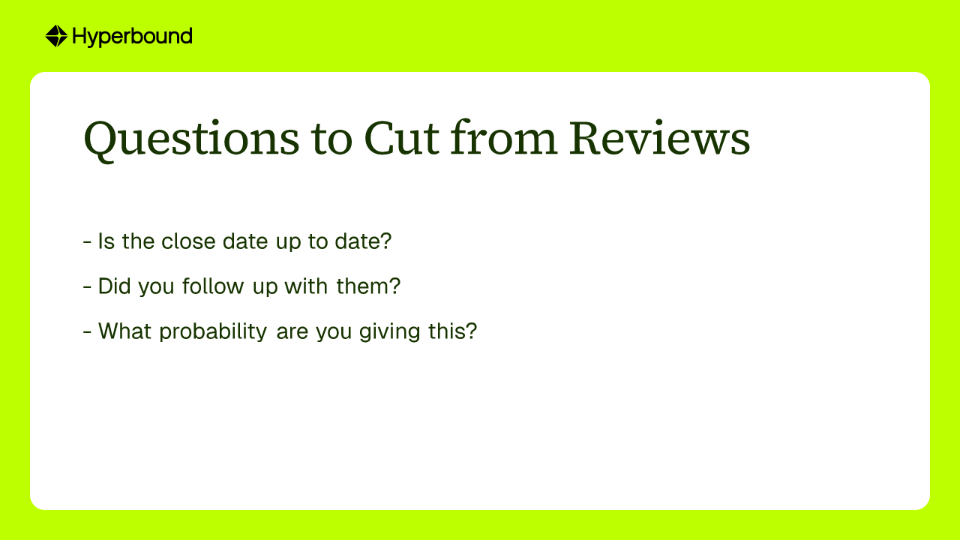
Some questions waste the meeting's time because the answer is already in the system or belongs to the representative's daily workflow, not a strategic review.
Reevo.ai makes this point directly: if a question can be answered by reading the CRM, it should not occupy review time.
The goal of a deal review is not spreadsheet maintenance; it is to identify what is blocking a deal and remove it before the close date becomes fictional. When a deal has already gone quiet, the review becomes a diagnosis, and our guide to what to do when a deal stalls covers the fix for each root cause.
These 11 deal review questions give managers a repeatable structure for that outcome. Each one targets a specific risk at a specific stage. Used consistently, they shift the conversation from reporting to coaching and the pipeline from a collection of guesses to a set of qualified, manageable opportunities.
Use these questions in the next pipeline review and track how many answers confirm the deal versus how many surface a gap. That ratio is a more reliable measure of forecast accuracy than any close date field.
The best questions are stage-specific and designed to surface risk, not status updates. Qualification questions confirm ICP fit and urgency; discovery questions reveal buying committee dynamics; proposal questions verify procurement steps; negotiation questions test economic buyer commitment; and closing questions identify the next micro-commitment. The 11 questions in this article follow that structure.
The 11 questions are grouped across five stages: qualification (ICP fit, why now), discovery (day-to-day impact, political stakes), proposal (problem-solution mapping, procurement process), negotiation (economic buyer price confirmation, changes since last conversation, unspoken objection), and closing (next micro-commitment, contract simulation). Each targets a specific risk at that stage.
Focus on the deals that need it most, define exit criteria for each stage, and end every deal discussion with a named owner and a date. Skip questions whose answers are already in the CRM or belong to daily rep activity. This turns the meeting from a status recitation into a coaching session.
An economic buyer is the person who controls the budget and has final authority to approve the purchase. The economic buyer is distinct from a champion or project lead. In deal reviews, confirm directly whether the economic buyer has explicitly said yes to the price, because approval from anyone else does not mean the deal will close.
A mutual action plan is a shared timeline of commitments between buyer and seller that leads to a signed contract. It replaces vague close dates with specific micro-commitments, such as returning a redlined contract by Thursday or scheduling a legal review call. Asking for the next micro-commitment reveals whether a rep has built one.
Happy ears syndrome is the tendency for sales reps to interpret ambiguous buyer signals as positive, which inflates forecast confidence. It is common when pipeline reviews rely on subjective probability estimates. Using objective stage exit criteria or tool-generated risk scores is more reliable than asking "what probability are you giving this?"
Qualify by confirming two things: the account matches the organization's Ideal Customer Profile and the prospect has a time-sensitive problem they can articulate in their own words. If the ICP fit is weak or the cost of inaction is unclear, deprioritize the deal before it consumes more resources.
Map the prospect's legal and procurement process step by step before sending a contract. Ask who reviews it, in what order, and who has final signature authority. Then simulate what happens if a draft contract is sent today. Deals stall when neither side understands the approval chain.










Use Cases
Legal