
Your weekly pipeline review is on the calendar. You brace yourself for an hour of what most sales teams silently call "CRM theater" — reps giving optimistic updates on close dates, you asking the same status questions, and everyone walking out with a slightly tidier CRM but zero clarity on how to actually win the deals sitting in the pipeline.
Sound familiar? You're not alone. And the worst part isn't the wasted hour. It's what happens on the next live call, when a rep freezes up because no one coached them on what to do differently. As one sales leader put it: "That 'wait what do I say' freeze up is soooo real and it absolutely tanks deals."
This is the gap that deal-level coaching is designed to close.
Deal-level coaching is tactical, forward-looking guidance on live, active opportunities — aimed at helping reps make the next right move, not just reviewing where a deal stands. It's not about auditing your reps' activity logs or updating forecast fields. It's about improving decisions while there's still time to change the outcome.
Think of it this way: deal inspection asks "What happened?" Deal coaching asks "What do we do next, and why?"
According to Federico Presicci, a respected voice in sales development, the distinction matters enormously. Deal inspection focuses on seller activity and CRM data. Deal coaching focuses on buyer evidence — what the buyer has actually said, done, or signaled — and uses that to stress-test assumptions and define the next move.
Most pipeline reviews never get there. And that gap is costing teams more than they realize.
Before fixing the problem, you need to diagnose it. Use this checklist to self-assess whether your deal reviews are actually coaching conversations — or just glorified status updates.
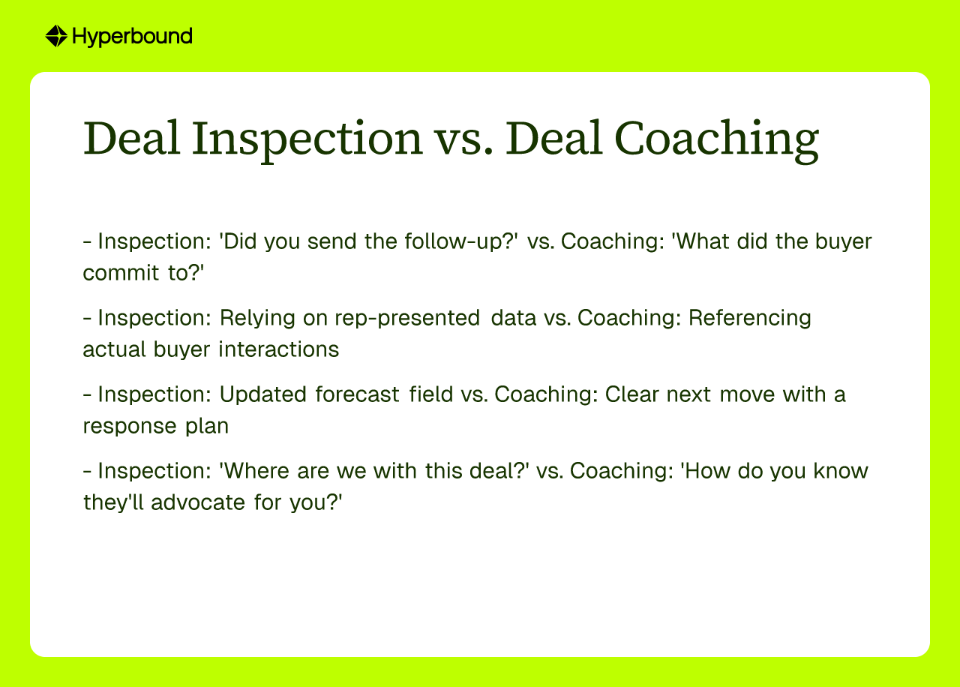
1. What's the focus of your conversation?
2. What's your basis for decisions?
3. What does the rep walk away with?
4. What kinds of questions are you asking?
If most of your answers landed on the left side, you're not alone — but you are leaving deals on the table. Industry research shows sales managers spend an average of 13 hours per week in pipeline reviews. That's nearly a third of the workweek. If those sessions are inspection-heavy, that time isn't moving deals forward — it's just managing the illusion of pipeline health.
The principles are clear in theory. But what does deal-level coaching actually look like when you're sitting across from a rep? Here's what changes depending on where a deal lives in the cycle.
Most managers ask: "Is this deal qualified?"
A deal coach asks: "Walk me through the MEDDPICC elements you've confirmed so far. Who is the champion, and what actions have they taken that prove they'll advocate for us internally?"
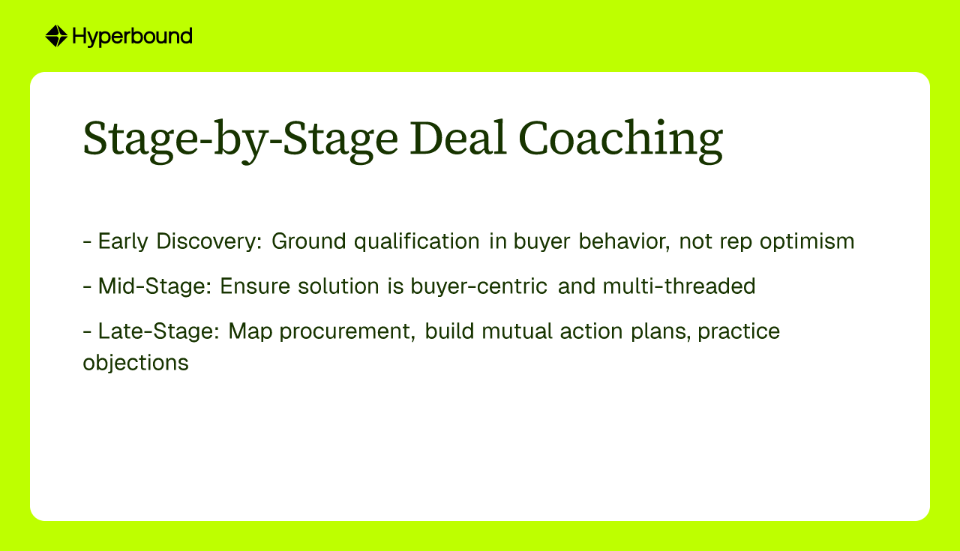
The difference is grounding the conversation in buyer behavior, not rep optimism. Effective early-stage coaching should focus on identifying the real buyer and uncovering actual urgency — not just checking whether a box is ticked in the CRM. If the champion hasn't done anything beyond receiving a demo, they're not a champion yet. That's a coaching moment.
Most managers ask: "How did the demo go?"
A deal coach asks: "How did you tie the demo back to the specific pain points from discovery? What questions did the other stakeholders ask, and what does that signal about where their priorities actually are?"
Mid-stage is where deals quietly stall. The rep feels like it's going well. The buyer goes quiet. Real deal coaching at this stage focuses on two things: whether the solution narrative is buyer-centric rather than feature-led, and whether the rep is multi-threading to ensure more than one person inside the account is bought in. If the deal lives and dies on one contact, it's at risk.
Most managers ask: "Are they going to sign this month?"
A deal coach asks: "What's actually preventing them from signing this week, and what's our response to their pricing objection? Have we mapped their procurement process? Do we have a mutual action plan with clear milestones endorsed by the buyer?"
Late-stage inspection is where the damage is most visible. Reps guess at close dates because no one coached them to establish clear mutual next steps. When the moment comes to handle a hard pricing objection or navigate a legal delay, the rep who hasn't practiced the response freezes. As one rep described it in our research: "Studying scripts all day doesn't actually matter until you have to respond to an objection live."
That freeze-up — in a late-stage negotiation — is often where deals are lost.
Here's the deeper problem: even managers who want to coach well are working with incomplete information.
Most deal coaching is based on the last call a manager happened to listen to, or whatever the rep chooses to share in the 1:1. That's single-threaded coaching — a snapshot, not a signal. But deals are won or lost across a series of interactions. The way a rep handled the first discovery call shapes what the champion is willing to advocate for three weeks later. A bad moment in an earlier demo creates the objection that surfaces at contract review.
Coaching on the last call alone misses all of that context. And research shows that automated deal analysis can identify at-risk deals weeks earlier than traditional methods — preventing a significant percentage of late-stage deal losses. The signal is there. But most managers aren't seeing it because they're only looking at one data point.
The real question isn't whether managers care about coaching. It's whether they have visibility into what's actually happening across the full lifecycle of a deal.
This is where the execution gap lives — and where most coaching frameworks break down at scale.
Managers are outnumbered. They're responsible for 8-10 reps and can't be in every call. The reality? Most managers are listening to less than 1% of recorded conversations. Coaching from that sample is coaching with blinders on. The reps who need the most guidance are often the ones flying under the radar because their calls never surface in a review.
Hyperbound Perform addresses exactly this gap. Rather than coaching on isolated snapshots, Perform analyzes behavior across all calls in a deal lifecycle — from the first cold call through to the final negotiation — and surfaces deal-level insights that tell managers what's helping or hurting each opportunity, and what specific actions can move it forward.
This isn't pipeline reporting dressed up as coaching. It's a layer that connects real buyer conversation behavior to deal outcomes, so managers can stop relying on rep narratives and start coaching on facts.
Where it gets particularly powerful is in closing the loop between inspection and execution. When Perform identifies a skill gap — say, a rep consistently losing control in late-stage pricing conversations — it can recommend targeted, deal-specific Bite-Sized Roleplays so the rep practices the exact scenario they're struggling with before the next call. Not a generic objection handling drill. A focused, 5-7 minute session built around the deal context, the specific objection, and the stage they're in. This maps directly to what practitioners recommend: "A framework that's worked for me is to practice in short reps — 5 to 7 minute roleplays focused on one skill, then review just 1 to 2 moments."
The result is a continuous loop: real call behavior surfaces coaching needs, targeted practice closes the skill gap, and the next conversation in that same deal reflects the improvement. That's what revenue activation looks like in practice.
The shift from deal inspector to deal coach isn't about working harder or adding more 1:1 time to your calendar. It's about asking different questions, grounding your conversations in buyer evidence rather than rep narratives, and — critically — having visibility into what's actually happening across the full arc of a deal.
Conversation intelligence made execution visible. But visibility was never the same as improvement. By the time a call summary lands in your inbox, the moment to change that conversation is already gone.
Real deal-level coaching intervenes during the deal, while outcomes are still yours to change.
If your pipeline reviews feel more like CRM audits than coaching sessions, that's the signal. It's worth asking: how many deals have stalled — or been lost — this quarter because the rep knew the product but hadn't built the muscle memory for the moment that mattered? And how many of those moments were visible to anyone before it was too late?
Effective deal coaching builds reps who can think critically in the middle of a live negotiation, navigate complex multi-stakeholder deals, and handle pushback without freezing. That capability doesn't come from a status update. It comes from a manager who coaches on behavior, not gut feel — and a system that makes that behavior visible across every deal, every call, every stage.
The main difference is that deal inspection looks backward at what happened, while deal coaching is forward-looking, focusing on what the sales rep should do next to win the deal. Deal inspection typically revolves around CRM data and seller activity, asking questions like "Did you send the follow-up?" In contrast, deal coaching focuses on buyer evidence—what the buyer has actually said or done—to strategize the next best move and improve decisions while there's still time to influence the outcome.
Traditional pipeline reviews are often ineffective because they devolve into "CRM theater"—glorified status updates that focus on inspection rather than providing actionable coaching to move deals forward. These meetings often involve reps giving optimistic updates and managers asking the same status questions. The result is a tidy CRM but no real clarity on how to win the deals, leaving reps unprepared for critical moments in live calls.
You can tell by the focus of your questions: if you're asking "Where are we with this deal?", it's inspection, but if you're asking "How do we know they'll advocate for us without you in the room?", it's coaching. Coaching conversations are grounded in actual buyer evidence from calls and emails, not just the rep's summary. The goal is for the rep to walk away with a clear next move and a plan for handling pushback, rather than just an updated forecast field.
Effective deal coaching adapts its focus based on the deal's stage: qualifying with buyer evidence in early stages, ensuring the solution is buyer-centric mid-stage, and preparing for negotiations in late stages. In early discovery, it's about grounding qualification in buyer behavior. Mid-stage, the focus is on framing the solution around the buyer's pain points and multi-threading. In the late stage, it shifts to mapping procurement, building mutual action plans, and role-playing objection handling.
Single-threaded coaching is a flawed approach where guidance is based on a single snapshot of a deal, such as one call or a rep's summary, rather than the complete series of interactions. This method is problematic because it misses crucial context. Deals are won or lost across multiple touchpoints, and challenges that arise late in the cycle often have roots in earlier conversations. By looking at only one data point, managers miss signals that could identify an at-risk deal much earlier.
Sales managers can coach more effectively by leveraging technology that analyzes behavior across all calls in a deal, surfacing critical insights and skill gaps without requiring them to listen to every recording. Since most managers have time to review less than 1% of conversations, tools can provide the necessary visibility at scale. This allows them to shift from gut-feel coaching to data-driven guidance and provide targeted, deal-specific practice to close skill gaps before the next crucial call.











Use Cases
Legal