
Your deal intelligence software just flagged a key opportunity as "at-risk." Engagement has dropped off, the close date has slipped twice, and the health score is blinking red on your dashboard. You open the alert, see a summary of the problem — and then what?
This is the moment where most deal intelligence software quietly fails you.
The tool diagnosed the problem. It cannot tell you what to do about it.
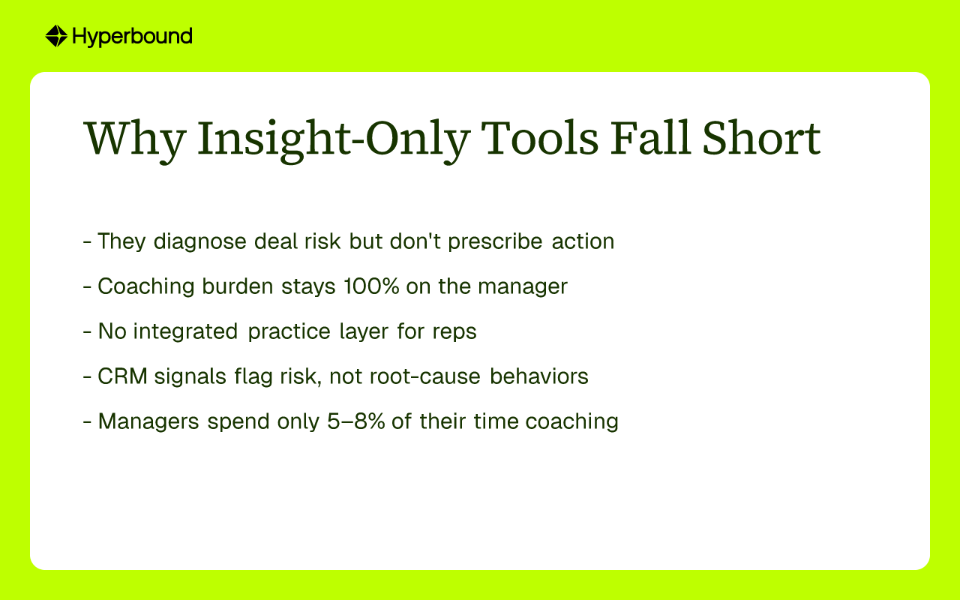
Managers are then left to manually scrub through call recordings, try to pinpoint the specific moment things went sideways, and somehow translate that retrospective analysis into a coaching conversation that changes the rep's behavior before the next call. Meanwhile, research consistently shows that sales managers spend only 5-8% of their time on coaching — and it's the first thing that gets cut when the calendar fills up.
This is the signal-to-action gap: the chasm between knowing a deal is in trouble and knowing exactly what to do to save it.
Most articles comparing deal intelligence software evaluate these tools on data quality, CRM integration depth, or forecast accuracy. Those things matter. But they miss the most important question a sales leader should be asking before they sign a contract:
Does this tool close the loop from insight to behavior change?
If the answer is no, you have a diagnostics tool — not a coaching system. And diagnostics alone don't move the needle on win rates.
The current landscape of deal intelligence software can be broadly split into two camps: tools that are great at telling you what is happening, and tools that help you change what happens next.
The "what" tools — think conversation intelligence platforms and revenue forecasting solutions — have built genuinely impressive capabilities. They capture every call, track every CRM signal, and surface patterns across your pipeline. For teams that previously had zero visibility into their sales conversations, these tools are transformative.
But as one rep put it bluntly in a community discussion: "Gong is way too complex" for what many teams actually need from a coaching workflow. The data is there; the path from data to rep improvement is not.
Users in the sales community have been vocal about this frustration. When a deal goes cold, they want tools that "understand normal patterns and flag anomalies" — but more importantly, they want to know what to do when those anomalies appear. Basic automation catches the obvious stuff. What scales organizations past the obvious is a system that connects the signal to the solution.
Here's a closer look at how the two most widely adopted platforms handle — and fall short of — closing that loop.
Gong remains the market leader in conversation intelligence, and for good reason. It records, transcribes, and analyzes 100% of customer conversations. It tracks talk-listen ratios, topic mentions, objection patterns, and deal engagement signals across your entire pipeline.
If you're flying blind on what's actually being said in sales calls, Gong gives you the rearview mirror you need.
The gap: Gong operates at the call level, not the deal level. It analyzes individual conversations in isolation and surfaces what happened, but it doesn't synthesize behavior patterns across the full arc of a deal — from first cold call to closing conversation. More critically, Gong has no integrated practice layer. When it identifies that a rep fumbled a pricing objection on Tuesday's call, there's no in-platform mechanism to get that rep practicing that exact scenario before Thursday's follow-up. The coaching burden remains 100% on the manager.
Clari excels at a different problem: forecast accuracy. It aggregates CRM activity data, email engagement, and AI-driven projections to give sales leadership a reliable view of what's in the pipeline and what's likely to close.
For VPs and CROs who need to call their number accurately, Clari is a powerful tool.
The gap: Clari's deal health signals are grounded in CRM data — close date slippage, activity cadence, engagement metrics. What it can't tell you is why the deal is stalling at a behavioral level. It knows the rep hasn't had a call with the economic buyer in three weeks. It doesn't know the rep lacks the skills to navigate a multi-threaded enterprise deal. As noted in comparisons of AI deal coaching tools, Clari flags risk without connecting it to the underlying rep behaviors that need to change. It's built for leadership to manage the business — not for reps to improve their craft.
Best for: Teams where rep skill development and deal momentum are the primary levers for revenue growth.
Hyperbound coined the term Revenue Activation to describe exactly what the deal intelligence market has been missing: a system that doesn't just analyze what happened on a call, but uses those insights to change what happens on the next one.
The platform operates through a three-product model — Practice, Perform, and Activate — that creates a continuous improvement cycle rather than a one-way data stream.
Hyperbound Perform is the deal intelligence engine. Unlike call-level tools that analyze conversations in isolation, Perform rolls up insights across every touchpoint in an opportunity's lifecycle — from the first cold outreach through the closing call. It surfaces early risk signals tied to specific rep behaviors: failure to identify the economic buyer, weak discovery on pain points, missing competitive differentiation. This is deal-level coaching, not just call-level commentary.
Hyperbound Practice is where the "action" happens. When Perform identifies a skill gap, reps can immediately jump into targeted AI roleplay sessions built around that exact scenario. Critically, Hyperbound's AI buyer personas are trained on 2M+ hours of real B2B sales conversations — not generic scripts. Reps aren't practicing against a predictable chatbot; they're navigating conversations that mirror the unpredictability of real deals. For tenured reps who find full-length roleplays tedious, Bitesized Roleplays let them sharpen specific skills in short, focused bursts. Every session is scored by AI Scorecards with instant, objective feedback — no waiting for a manager's calendar to open up.
Kota Activate sits above both products as the orchestration layer. Kota is an AI Revenue Analyst that synthesizes data across real call performance and practice sessions, then recommends personalized coaching interventions at the right moment. Managers stop guessing who needs coaching and what to focus on — Kota tells them.
The operational loop this creates: Score Real Calls → Identify Skill Gaps → Practice Targeted Roleplays → Apply on Next Live Call → Repeat.
The results speak to what this loop produces in practice. Vanta reduced rep ramp time by 60% — from 210 days down to 72. Nivoda saw a 150% increase in demo conversion rates and 2x revenue year-over-year. Across 45,000+ active users at companies including LinkedIn, Autodesk, and Monday.com, the pattern is consistent: connecting deal health signals to targeted practice drives measurable skill improvement, not just better dashboards.
Best for: Teams with no existing call recording infrastructure who need foundational visibility before building a coaching system.
Gong provides the raw material for coaching — comprehensive call libraries, transcript search, topic tracking, and deal engagement signals. For a manager who currently relies on ride-alongs and anecdote to understand rep performance, Gong is a meaningful step forward.
The limitation is that Gong surfaces the data, but the coaching workflow is entirely manual. Managers still need to find the coachable moment buried in a 45-minute recording, carve out calendar time with the rep, and deliver feedback they hope sticks. With managers spending less than 8% of their time on coaching to begin with, that workflow doesn't scale as the team grows.
Best for: Revenue operations and senior leadership teams who need reliable pipeline visibility and accurate forecasting above all else.
Clari is purpose-built for the "calling the number" problem. It gives RevOps and Sales leadership a macro view of pipeline health that's grounded in CRM data, activity signals, and AI-driven projections. For boards demanding forecast accuracy, it delivers.
What it doesn't deliver is a pathway to rep improvement. Clari tells leadership that 30% of Q3 pipeline is at risk. It doesn't equip the reps working those deals with the skills to de-risk them.
.png)
.png)
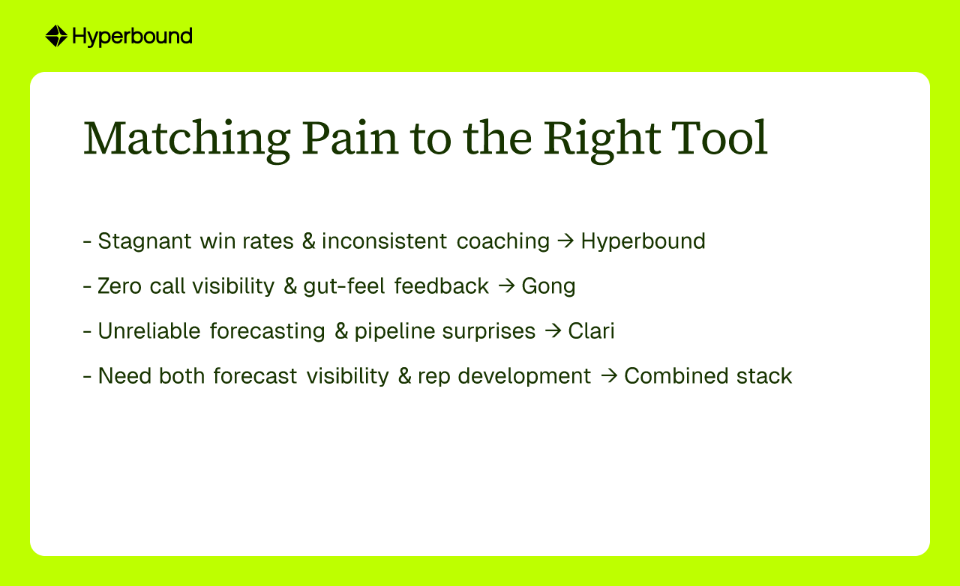
Not every sales team has the same problem. Use this framework to match your biggest pain point to the right category of deal intelligence software.
Choose Hyperbound if your primary pain is rep skill development and stagnant win rates.
Your reps are getting enough at-bats, but the conversion rates aren't moving. Coaching is inconsistent — each manager approaches it differently, and feedback doesn't stick between sessions. You've heard that 80% of training is forgotten within 30 days, and you're watching it play out in your pipeline.
Hyperbound is built for this problem. The Practice → Perform → Activate model creates a sustainable reinforcement cycle that turns deal-level insights into measurable skill improvements — without adding headcount to your enablement team. If you're scaling past 20 reps or dealing with long ramp times, this is where the ROI compounds quickly.
Choose Gong if your primary pain is a complete lack of call visibility.
You genuinely don't know what's being said in your sales calls. Coaching is gut-feel. You've never had a conversation intelligence layer of any kind. In this case, Gong is the right foundational investment — it gives you the data reality you need before you can build a more sophisticated coaching system on top of it.
Choose Clari if your primary pain is unreliable forecasting and pipeline surprises.
Your board is demanding forecast accuracy and you're consistently surprised by late-stage deal slippage. The primary need is a macro view of pipeline health that leadership and RevOps can act on. Clari is the market leader in this category for a reason — it gives your team the numbers to manage the business with confidence.
Consider a combined stack if you need both forecast visibility and rep skill development.
Many mature sales organizations run Gong or Clari alongside a dedicated coaching and practice platform. Hyperbound integrates natively with the tools your team already uses, including leading CRMs and conversation intelligence platforms, making it straightforward to layer behavioral coaching on top of the signals you're already collecting.
The deal intelligence market has done a remarkable job of making the problem visible. You can now see, with precision, which deals are stalling, which reps are struggling, and which conversations are going off-script.
What the market hasn't solved — until now — is what happens after the flag goes up.
The best deal intelligence software in 2025 doesn't just tell you a deal is at risk. It tells your rep exactly what to practice, gives them a realistic environment to practice it in, scores their improvement objectively, and tracks whether the behavior actually changes on their next live call. That closed loop between insight and behavior change is the new standard — and it's the question every sales leader should be asking before the next software renewal.
The difference between a stalled deal and a closed-won outcome often comes down to a single conversation. Equipping your reps to win that conversation — before it happens — is what Revenue Activation actually means.
The signal-to-action gap is the chasm between a deal intelligence tool identifying a problem (the signal) and a sales rep or manager knowing the specific steps to take to fix it (the action). Most tools are diagnostic, flagging at-risk deals without prescribing a clear path to get them back on track, leaving the coaching burden entirely on managers.
Conversation intelligence tools like Gong are excellent for visibility—they record and analyze what was said on calls. However, they are primarily diagnostic. They tell you what happened in past conversations but don't provide an integrated system for reps to practice and improve their skills before the next critical call, leaving an "open loop" that requires manual coaching intervention.
Revenue Activation is a system that closes the loop between sales insights and behavior change to drive revenue growth. Coined by Hyperbound, it moves beyond simple deal intelligence by not only identifying skill gaps from real-world performance but also automatically providing targeted AI-powered practice to fix them, ensuring insights lead directly to improved outcomes.
AI sales coaching improves performance by providing scalable, personalized, and immediate feedback. For example, Hyperbound uses AI to analyze real call data to identify specific skill gaps. It then allows reps to practice those exact scenarios in AI roleplays against realistic buyer personas. The AI provides instant, objective scores and feedback, allowing for continuous practice and reinforcement that doesn't depend on a manager's limited time.
The main difference lies in their primary focus. Gong focuses on conversation intelligence for call visibility. Clari focuses on revenue forecasting for pipeline predictability. Hyperbound focuses on Revenue Activation, creating a closed loop between identifying skill gaps in deals and providing AI-powered practice to improve rep behavior and drive deal momentum.
Yes, Hyperbound is designed to complement your existing tech stack. It integrates natively with leading CRMs and conversation intelligence platforms like Gong. This allows it to pull in data and signals from the tools you already use to inform its coaching and practice recommendations, layering behavioral coaching on top of your current intelligence systems.
Ready to see how deal intelligence can translate directly into rep improvement? See Hyperbound in action →







Use Cases
Legal