How Vanta and Nivoda Use Deal Intelligence Software to Change Deal Outcomes (Not Just Report Them)
8
min read

8
min read
Atul, CTO of Hyperbound, does not talk about deal intelligence software in theory. He runs it internally. His team used Hyperbound Perform on their own sales process and closed their strongest quarter ever. That is not a marketing claim. That is a practitioner telling you what happened when the tool met reality.
This matters because most sales leaders have heard the pitch before. You already have a conversation intelligence tool. You already have a CRM. You are already drowning in dashboards. The last thing you need is another tool that tells you a deal is at risk two weeks after you already knew it was at risk.
The real problem is not a lack of data. Sales ops professionals on forums describe it plainly: "useful information gets lost after meetings" and insights "get buried in call notes," hurting both coaching and forecasting. When insights stay in a rep's head, coaching suffers. When coaching suffers, pipeline suffers.
That is the gap this article is about. Not the gap between your forecast and your number. The gap between a signal and an action.
Two companies closed that gap with deal intelligence software. One is a high-growth SaaS company with a large SDR team and a 210-day ramp problem. The other is an outbound-heavy B2B marketplace with a demo conversion bottleneck. Their industries are different. Their motions are different. Their results are not.
Vanta is not a small experiment. Under CRO Stevie Case, the company scaled from a 200-person inbound-driven operation to a 1,000-person global leader in trust management. That growth came with hard lessons.
One of those lessons: headcount without measurement is just an expensive mistake. Stevie Case has said it directly: "Never scale headcount without measurement." Execution, she argues, is the fundamental differentiator between companies at the same growth stage.
Vanta had measurement. They had a leading conversation intelligence tool recording every call. They had CRM data on every deal. What they did not have was a way to turn that measurement into rep behavior change at scale.
Their SDR ramp time sat at 210 days. That is seven months before a new rep reaches full productivity. With a large and growing SDR team, that number compounded quickly into a pipeline problem. Meanwhile, the "coaching and analytics side" of their existing stack, a common complaint about call recording tools, was not translating recordings into specific manager actions.
Managers had recordings. They did not have answers.
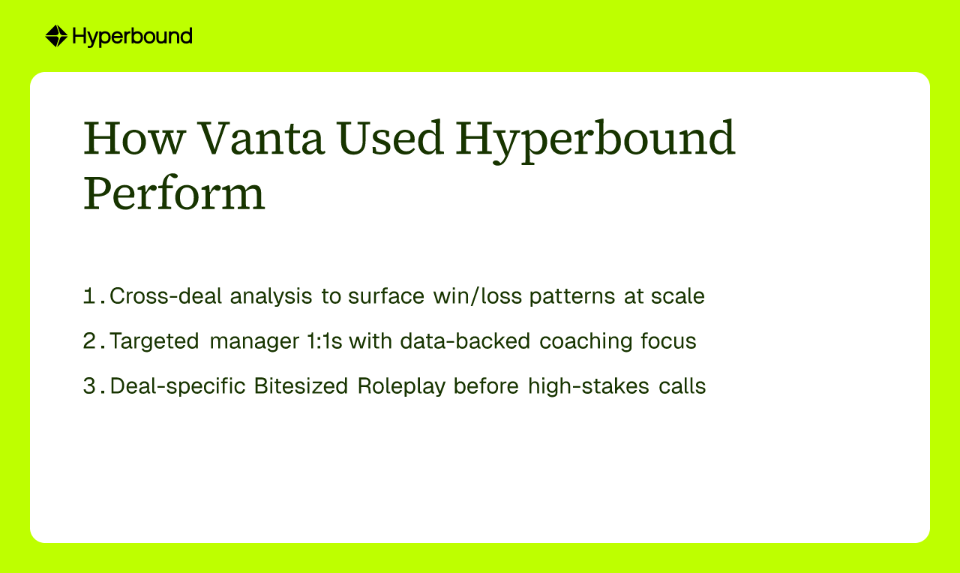
When Vanta implemented Hyperbound Perform, the workflow changed in three specific ways.
Cross-deal analysis replaced single-call review. Instead of a manager reviewing one call at a time and guessing whether it was representative, Perform analyzed patterns across hundreds of deals simultaneously. It surfaced which specific rep behaviors correlated with wins and which correlated with losses. The signal was not "this call went poorly." The signal was "reps who fail to anchor value in the first three minutes of outbound calls have a 40% lower conversion rate across your entire book."
Manager 1:1s became targeted. Before Perform, a 1:1 coaching session might cover three deals and two random call recordings. After, managers walked into each conversation with a specific, data-backed development focus for that rep. Coaching stopped being a guessing game and became a discipline.
Deal-specific Bitesized Roleplay replaced reactive post-call review. This is the piece that separates Perform from tools that only observe. Before a high-stakes call, reps used Perform's Bitesized Roleplay to practice the exact scenarios and objections identified by the platform for that deal. The prep was not generic. It was built around the live deal in the pipeline.
The outcomes were not incremental.
Vanta reduced SDR ramp time by 60%. The team delivered $125M+ in pipeline. Those numbers are connected directly to the workflow above. Ramp time shrank because new reps were coached on proven winning behaviors from week one, not month seven. Pipeline grew because the entire team executed more consistently on every call.
As one analysis puts it: "Intelligence without execution is just expensive research." Vanta closed the gap between the two.

Nivoda operates a B2B diamond and gemstone marketplace. Their business runs on outbound. The most critical metric in their funnel is demo conversion rate. You do not close a buyer on a marketplace like Nivoda without first getting them into a demo.
Their problem was not pipeline volume. Their problem was conversion. And the solution they kept reaching for, adding managers to coach more reps more often, was not scalable. You eventually run out of managers before you run out of reps who need coaching.
The challenge was specific: which conversations were causing low demo conversion, and what did reps need to do differently before the next outbound call?
Without deal intelligence, those questions had vague answers. With Perform, they had precise ones.
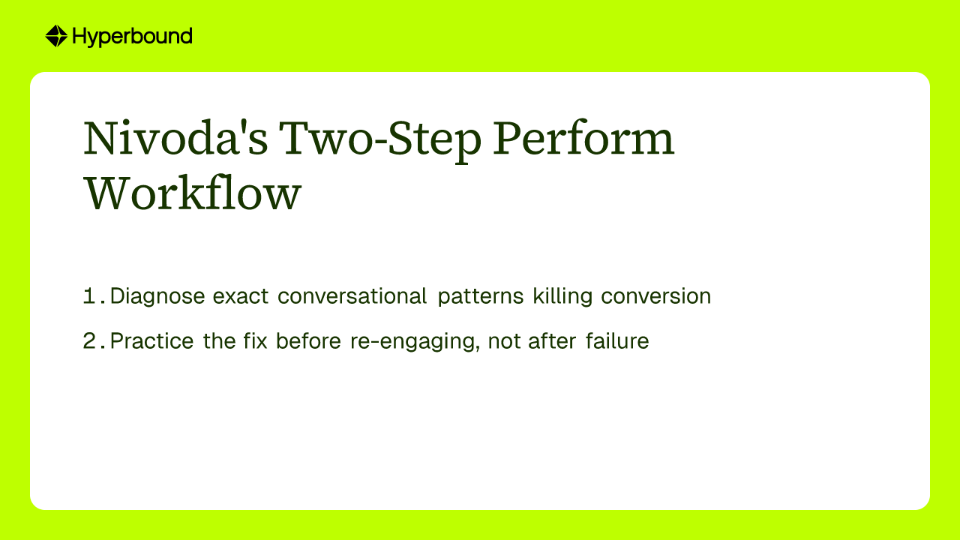
Nivoda's workflow with Perform focused on two steps that their previous stack could not deliver.
Step one: identify the exact conversational patterns causing low conversion. It was not enough to know that demo conversion was low. Perform analyzed Nivoda's outbound calls and pinpointed the specific moments where deals fell apart. Not "bad calls." Specific failure patterns. A weak opener on cold outreach. An objection that reps consistently mishandled. A value statement that did not land for a particular buyer profile. The diagnosis was surgical.
Step two: practice before re-engagement, not after failure. Once the conversion killers were identified, reps did not simply read a new talk track. They practiced it. Before re-engaging a prospect or running a new outbound sequence, reps used Perform to rehearse the specific responses and pivots designed to overcome the identified gaps. The practice loop ran before the conversation, not as a post-mortem afterward.
That sequence, identify the problem at the deal level, practice the fix before the next attempt, is what separated Perform from a reporting tool.
The results at Nivoda: a 150% increase in demo rates and 2x revenue growth.
The demo rate increase makes sense when you trace the mechanism. Reps stopped repeating the same objection-handling failures because they had practiced the correct response before it mattered. Doubling revenue followed from fixing the one metric that was the ceiling on their entire sales motion.

Vanta had a conversation intelligence platform. Nivoda had pipeline data. Neither had a system that connected what their deal data was telling them to a specific rep behavior change before the next call.
Perform closed that gap. Vanta cut ramp time by 60% and influenced $125M+ in pipeline. Nivoda grew demo rates by 150% and doubled revenue. Hyperbound ran Perform internally and closed their strongest quarter ever.
The pattern is not complicated. Deal intelligence that stops at the flag does not change outcomes. It provides a better record of why the deal was lost. The teams that win are the ones that connect intelligence to coaching to practice before the conversation happens, not after.
If your current stack shows you what is wrong but does not tell your reps what to do about it before their next call, you are not using deal intelligence. You are using an expensive mirror.
Deal intelligence software is a tool that analyzes sales data from calls, emails, and your CRM to identify what specific rep behaviors lead to winning or losing deals. It goes beyond simple call recording by providing actionable insights and coaching prompts to help reps improve their performance on future calls.
Conversation intelligence tools focus on recording and transcribing calls to tell you what happened in a single conversation. Deal intelligence connects those conversations to deal outcomes in your CRM, analyzing patterns across many deals to tell you why you are winning or losing and what reps should do differently to improve.
Hyperbound Perform is designed for the entire sales team, from reps and managers to sales leaders and RevOps. Reps use it for pre-call practice and self-coaching, managers use it to deliver targeted, data-backed 1:1s, and leaders use it to understand what winning behaviors to scale across the entire organization.
Hyperbound Perform reduces ramp time by identifying the proven winning behaviors of your top reps and turning them into a scalable coaching program. New reps can practice these specific behaviors from day one, allowing them to reach full productivity much faster, as seen with Vanta, who cut their SDR ramp time by 60%.
Deal intelligence can solve critical sales bottlenecks such as long rep ramp times, low demo conversion rates, inconsistent performance across the team, and deals getting stuck in the pipeline. By pinpointing the specific conversational gaps causing these issues, it allows for targeted coaching and practice to fix them.
Bitesized Roleplay is a feature in Hyperbound Perform that allows sales reps to practice specific scenarios and objections before a high-stakes call. The platform uses data from the actual deal to generate relevant practice simulations, ensuring reps are prepared for the exact challenges they are likely to face, turning pre-call prep into an active, effective exercise.
Yes, Hyperbound Perform is designed to integrate seamlessly with major CRMs and conversation intelligence tools. This ensures that all insights are based on your team's real-time deal data and that it fits into your existing RevOps workflow without creating data silos or requiring manual data entry.
Connecting intelligence to action is crucial because data without a clear next step does not change behavior or outcomes. Deal intelligence tools that only flag "at-risk" deals leave it up to managers to figure out the problem. By directly linking insights to specific coaching and practice actions, platforms like Hyperbound Perform close the gap between knowing there's a problem and actively fixing it before the next call.
See how Hyperbound Perform turns deal insights into rep action. Explore success stories here.










Use Cases
Legal