
I want to be upfront about something before we get into the comparison.
We built Hyperbound Perform to solve a problem we had on our own sales team. Before we released it to a single customer, we ran our entire team on it. The result was our strongest quarter in Hyperbound's history.
I'm Atul Raghunathan. I led that process. This article is written from that experience, not from a product marketing brief.
The deal intelligence platform market is loud right now. Every vendor promises pipeline clarity, revenue visibility, and forecast confidence. Most of them deliver a more expensive version of what your CRM already tells you. A few of them change how your reps show up on their next call. This article is about how to tell the difference.
Here is what the majority of deal intelligence tools actually surface.
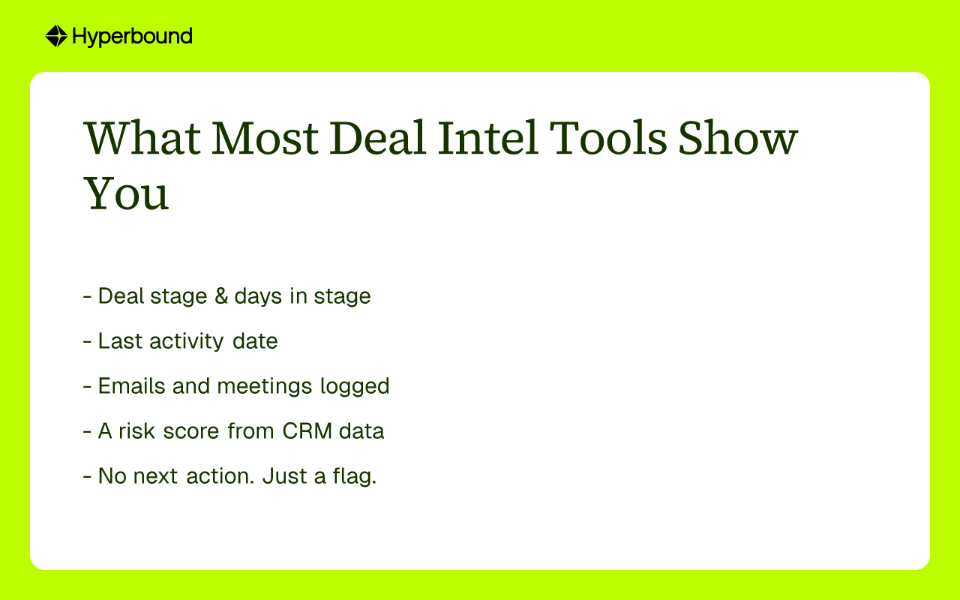
This is CRM-derived data. It is accurate. It is also shallow.
If you are a VP of Sales reviewing your pipeline on a Tuesday, you already know this information. You lived through it. You watched it happen. A platform that reflects it back to you in a nicer dashboard is not giving you intelligence. It is giving you a summary of what your reps already told you.
Many platforms operate at what some call the "Observational Layer." They surface signals. They do not act on them. The gap between observing a problem and fixing it is left entirely to the manager and the rep.
This is not a criticism of those platforms. Observation has value. But sales professionals are increasingly frustrated with tools that don't close the loop between insight and action. The common complaint on sales forums is this: the tool told me the deal was at risk. It did not tell me what to do about it.
That gap is the problem worth solving.
The question a VP of Sales is really asking in a deal review is not "what is happening?" It is "what should my rep do differently on the next call?"
That is a completely different question. It requires a completely different kind of intelligence.
True deal intelligence connects insights to next actions. It does not describe the deal's condition. It changes the deal's trajectory. That distinction is central to how Hyperbound defines revenue activation.
The difference between signal and noise comes down to one question: does the platform stop at the flag, or does it tell the rep what to do next?
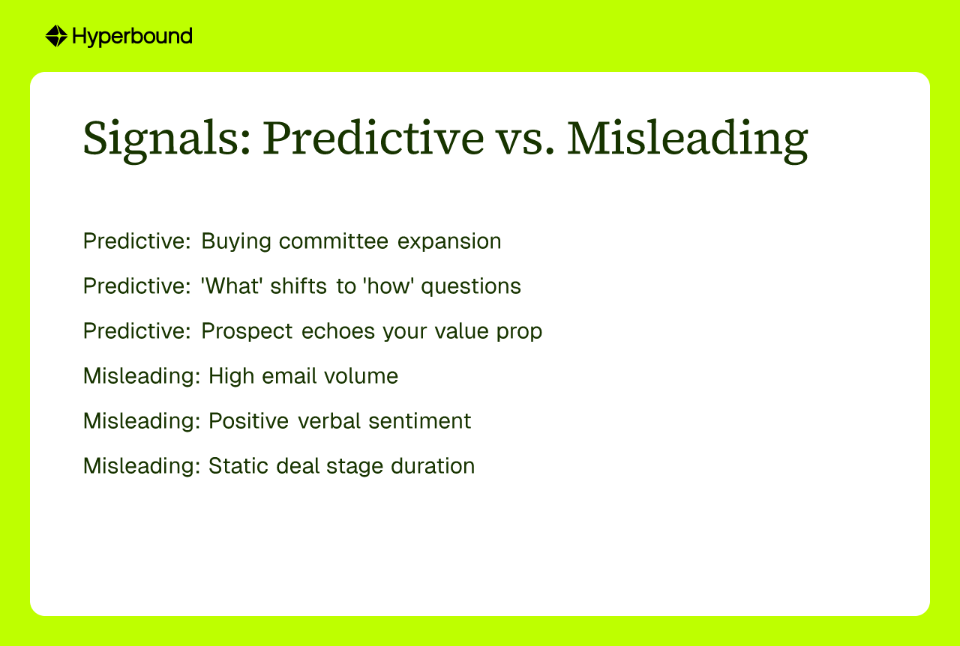
The most predictive signals are behavioral. They live in the substance of conversations. They are not found in CRM activity logs.
1. Buying committee expansion with new stakeholder questions
When a new senior stakeholder, a CFO, a CISO, a VP of Engineering, joins a call mid-deal, it is a strong indicator of internal momentum. The deal is being evaluated seriously. But the intelligence is not just that they showed up. What matters is what they asked and how the rep handled it. A rep who stumbled on a CFO's pricing question and never addressed it in the next call is the real signal. That is where coaching needs to happen.
2. Shift from "what" questions to "how" questions
When a prospect moves from asking what your product does to asking how it will work in their environment, pricing models, implementation timelines, integration with their existing stack, they have crossed into serious evaluation. These "how" questions are buying signals, not objections to be feared. The question is whether your rep is treating them that way.
3. Prospect repeating your value proposition back to you
When a prospect starts using your language unprompted, describing your solution to a new stakeholder on the same call, referencing a customer story you told two meetings ago, they have internalized it. They are starting to champion it internally. This is one of the clearest behavioral signals a deal is moving toward a close.
1. High email volume
A lot of email back-and-forth looks like engagement. It can also mean the prospect is confused, stalling, or stuck in an endless information-gathering loop. Activity is not progress. A rep sending 20 emails that avoid the hard question is not moving the deal forward.
2. Positive verbal sentiment
"This looks really interesting" and "we love what you've built" are weak signals. They indicate politeness, not commitment. Real buying intent is attached to next steps, to internal introductions, to specific questions about the purchase process. Happy ears have killed more deals than any competitor.
3. Static deal stage duration
Tracking how long a deal sits in a stage tells you it is stuck. It does not tell you why. It does not tell you what conversation skill is missing that is keeping it stuck. This is a lagging indicator that prompts a question without providing an answer.
This is the methodology we used on our own team. Here is how it works.
Perform does not look at individual calls in isolation. It analyzes all calls and touchpoints across the full deal lifecycle as a connected narrative. Each conversation is scored against your team's tailored scorecards using Real Call Scoring, identifying specific gaps in messaging, qualification, and objection handling.
The output is not a transcript. It is a deal arc. You can see how the conversation quality has evolved, where the rep gained ground, and where unresolved issues are compounding.
Perform's Deal Coaching layer identifies coaching opportunities within active deals based on real buyer behavior. It flags patterns across calls. If a rep is consistently failing to resolve pricing objections on deals that stall at the proposal stage, that pattern surfaces across the deal arc, not just in a single call review.
This gives managers specific, evidence-based coaching topics. Not "your numbers are down." But "on your last three deals that stalled, you didn't address the procurement timeline. Let's fix that."
This is the action layer. The part that separates a deal intelligence platform from a call recording tool.
Perform generates Bitesized Roleplays based on the actual signals from the deal. If a rep is heading into a call with a CFO who raised security concerns two meetings ago, Perform creates an AI-powered roleplay scenario so the rep can practice handling those exact objections before the live call. The practice is not generic. It is built from the deal's real context.
This is the loop that most deal intelligence platforms never close. They flag the risk. Perform gives the rep a way to resolve it before it costs them the deal.
Companies like Vanta used this methodology to reduce rep ramp time by 60% and influence $125M+ in pipeline. Nivoda cut ramp time by 50% and increased demo conversion rates by 150%.
The most immediate change when a team adopts Perform is in the 1:1.
The old version of a deal review sounds like this. Manager asks how the deal is going. Rep says the prospect is very interested and a decision is coming soon. Manager notes it in the CRM. The deal slips the following week.
The new version sounds like this. Manager pulls up the deal arc. The last two calls show the prospect asking about a competitor twice. The rep's response was weak both times. Perform has already flagged it and generated a competitive handling roleplay. The 1:1 starts with: "Let's run through this scenario before your call on Thursday."
That is the shift. Deal health analytics based on real buyer conversations, not rep summaries, change the nature of the coaching conversation entirely. Managers stop relying on gut feel. They start coaching from evidence.
This also changes how managers identify systemic problems. If five reps are all struggling at the same deal stage, that is not a pipeline problem. That is a skill gap. Perform makes that visible at the team level, not just in individual deal reviews.
A deal intelligence platform is a tool that analyzes sales conversations to identify risks and opportunities, then provides actionable steps for reps to improve their performance on the next call. Unlike tools that simply summarize CRM data (like deal stage or last activity date), true deal intelligence platforms dive into the substance of what was said in meetings. They connect insights from past calls to specific, evidence-based coaching and practice scenarios to change the trajectory of an active deal.
CRM data is not enough because it only tells you what happened in a deal (e.g., a meeting was logged), not why it's stalling or how to move it forward. CRM data provides lagging indicators like "days in stage" or "last activity date." This is observational data that confirms a deal is stuck but doesn't explain the root cause. Real deal intelligence comes from analyzing the conversations to uncover skill gaps, missed objections, or shifts in buyer sentiment that CRM data cannot capture.
The most predictive signals are behavioral and emerge from conversations, such as the expansion of the buying committee, a shift from "what" to "how" questions, and prospects repeating your value proposition. These signals indicate genuine engagement and internal momentum. Conversely, misleading signals like high email volume or positive but non-committal sentiment often create a false sense of security. Focusing on conversational behaviors provides a much more accurate picture of a deal's health.
No. Forecasting predicts whether a deal will close, based on historical patterns and pipeline data. Deal intelligence focuses on influencing how a deal closes by improving what happens in the next conversation. Perform is not a forecasting tool. It is a performance tool. Platforms like Clari are well-built for forecast accuracy. That is their primary function. Perform's function is to change the outcome of active deals by improving sales execution.
Clari is built for revenue operations and forecast accuracy. It gives leadership a picture of the pipeline and helps predict which deals will close. Its primary user is the revenue leader looking at the number. Perform's primary user is the frontline manager and the rep preparing for the next call. Clari tells you what the forecast looks like. Perform changes what happens inside the deals that make up that forecast.
No, and it is not designed to. Gong is a leading conversation intelligence tool for recording, transcribing, and analyzing past calls. It operates at the observational layer. Hyperbound Perform is a revenue activation platform that takes those insights and drives action. It turns call intelligence into coaching, and coaching into practice, before the next live call. The two tools serve different purposes. A fuller breakdown of the difference is here.
Hyperbound Perform helps reps improve by generating deal-specific practice scenarios based on actual coaching opportunities identified from their sales calls. The platform doesn't just flag a risk, like an unaddressed objection. It creates an AI-powered roleplay where the rep can practice handling that exact objection before their next live call. This closes the loop between identifying a weakness and actively strengthening that skill, ensuring reps are better prepared for critical conversations.
Perform integrates with Salesforce and HubSpot. It also reduces manual CRM maintenance through its Auto-CRM Fill feature, which automatically updates deal records with key information pulled from calls. Reps spend less time logging and more time preparing.
Most deal intelligence platforms are good at telling you something is wrong. Fewer are good at telling you what to do about it. Almost none make it easy for the rep to practice the fix before they walk into the next conversation.
A red flag on a dashboard is noise if it does not connect to a next action.
We built Perform because we needed to move our own team from insight to action. Before we gave it to any customer, we ran it on ourselves. The result was our strongest quarter. The mechanism was not magic. It was a tighter loop between what happened on the last call and what the rep did differently on the next one.
If you are tired of watching deals stall while your pipeline reviews produce more questions than answers, that is what real deal intelligence should solve.
Learn more about Hyperbound Perform.










Use Cases
Legal