Deal Intelligence in Slack: How CROs Are Getting Pipeline Answers Without Another Meeting
9
min read

9
min read
Your pipeline review is one of the most expensive meetings on your calendar. It runs 90 minutes. It pulls in your top revenue leaders. And it almost always runs on data that is already out of date by the time the call starts.
That is the problem Kota Activate solves. It delivers deal intelligence in Slack so CROs and RevOps leaders can get answers to their most pressing pipeline questions in seconds, not in a meeting scheduled for next Tuesday.
This post walks through exactly how it works: what you can ask, what data it pulls from, and what changes operationally when your pipeline review moves from a calendar block to a Slack thread.
Consider the last pipeline review you ran. You spent an hour listening to rep updates. You left with maybe one or two critical insights. One of those insights was buried in a verbal update and not visible in any dashboard.
That is not a hypothetical. It is a pattern. As RevOps practitioners describe it, "there's no shared, real-time view of what's actually happening, so revenue leaks quietly."
The issue is rarely a lack of data. The data exists. It lives in your CRM, your call recordings, your Slack channels, and your email threads. The problem is fragmentation. "Execution is spread across CRM, Slack, email, product, and CS" and no single system is stitching it together in real time.
So the weekly pipeline review becomes the stitching mechanism. A 90-minute meeting where senior leaders manually reconstruct the state of the pipeline from fragmented inputs. The result is a snapshot that is already stale. And "when no one is clearly accountable for moving a specific decision forward, deals stall quietly even though everything looks fine in dashboards."
Kota Activate is designed to fix this. Not by adding another dashboard. By bringing deal intelligence directly into Slack, where your team already works.
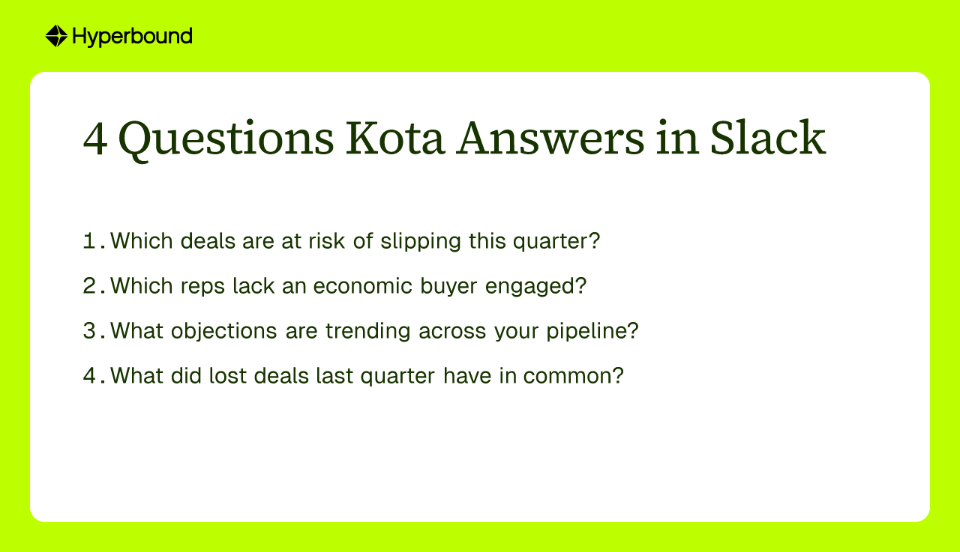
Instead of pulling up a report or scheduling a call, you ask Kota Activate a question in Slack. It pulls from real call recordings, deal activity, CRM data, and historical patterns. Then it gives you a direct answer.
Here are four queries CROs and RevOps leaders are using today.
This is the question every CRO asks in the first 10 minutes of a pipeline review. With Kota, you ask it in Slack and get an answer in seconds.
The difference is the data it pulls from. This is not based on a rep updating a close date in the CRM. Kota analyzes actual call recordings for signals of stalling. It looks for mentions of budget freezes, timeline pushback, or conversations that ended without a next meeting scheduled. Predictive insights like these allow proactive interventions before opportunities slip away.
You get a ranked list of at-risk deals with the specific signals driving the risk assessment. No guesswork. No waiting until the quarter is in trouble.
This query does something most CRM dashboards cannot do. It goes beyond checking whether a rep ticked the "Decision Maker Contacted" box.
Kota analyzes the actual conversation content and participant titles across calls. It identifies deals where conversations are happening, but not at the right level. If your rep has had six calls with a procurement coordinator and zero calls with a VP or CFO, Kota flags it.
This directly addresses a pattern that RevOps leaders identify as one of the most common deal killers: "ownership being assumed instead of explicitly named." When a rep assumes the champion will bring in the economic buyer, deals stall quietly. Kota surfaces this before it becomes a lost deal.
This is cross-deal pattern analysis. It is the kind of insight that normally requires a dedicated analyst and a week of work.
Kota automatically transcribes and categorizes objections across every active call in your pipeline. It surfaces trends in real time. If six reps are hearing the same pricing objection this week, you know immediately. If a specific competitor keeps coming up in discovery calls, you see it before it becomes a competitive threat to your quarter.
High-impact pipeline reviews surface these systemic patterns so leaders can respond at a strategic level, not just a deal-by-deal level.
This query uses historical pattern matching. It goes deeper than your CRM "Reason Lost" field, which typically reflects what the rep chose from a dropdown, not what actually happened.
Kota analyzes the full deal history: call recordings, activity timelines, and engagement patterns. It identifies common threads across losses. Deals lost after a specific competitor was mentioned. Deals lost when the economic buyer was not engaged within the first 30 days. Deals lost when there was no multi-threaded engagement beyond a single contact.
AI-driven forecasting uses historical patterns to improve accuracy and move away from unreliable, anecdote-based projections. This query turns last quarter's losses into a concrete playbook adjustment.
The reason Kota Activate can answer these questions is that it is not limited to what lives in your CRM. CRM data is only as good as what reps enter, and the inability to predict targets accurately is a direct consequence of manual reporting and incomplete data.
Kota pulls from three primary sources:
Real call recordings. This is the ground truth of what is happening in a deal. Kota uses conversation intelligence to understand context, sentiment, objections, and commitments made on calls. Not summaries. Not rep notes. The actual conversations. Hyperbound's approach to conversation intelligence helps surface real client interaction data that enhances deal management far beyond what CRM fields capture.
Deal activity. Kota tracks the frequency and nature of interactions across email and calendar to gauge deal momentum. A deal with no activity in two weeks shows up as a risk signal, regardless of what the CRM close date says.
Historical closed-won and closed-lost patterns. Kota builds a model of what a healthy deal looks like at each stage, based on your actual historical data. This makes its risk assessments specific to your business, not generic benchmarks.
The differentiator is synthesis. Each of these sources exists in some form already. What Kota does is pull them together and surface a single, actionable answer in Slack, where you and your team are already working.

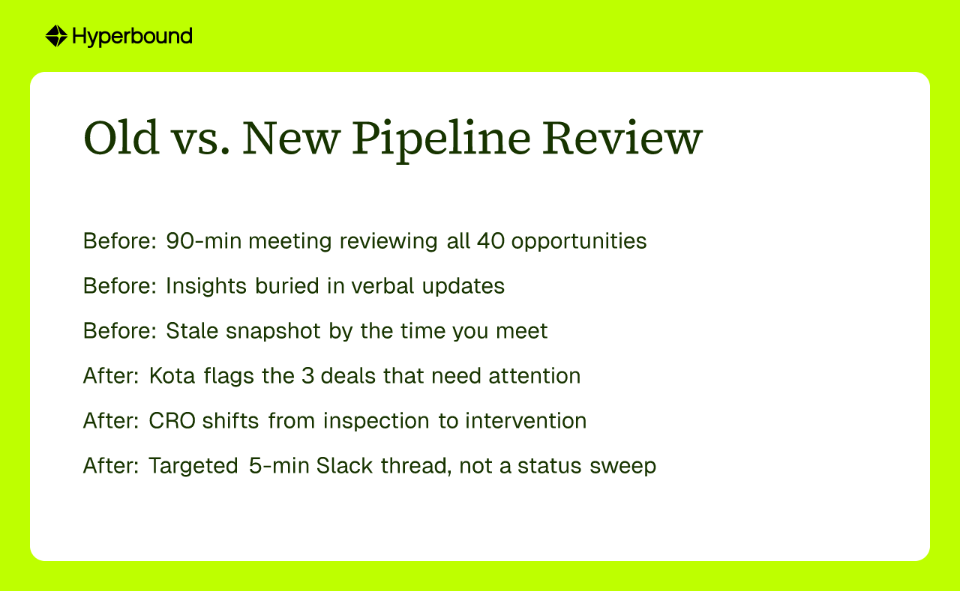
The operational shift here is significant. It is worth being specific about what changes.
The old way: A comprehensive review of all 40 opportunities in the pipeline. Much of that time confirms that healthy deals are still healthy. A small number of deals actually need attention, but they are buried in the format of a full pipeline sweep.
The new way: Kota proactively flags the three deals that need attention this week. The CRO's job shifts from inspection to intervention. Instead of asking "where are we on every deal," you are asking "what do we do about these three deals right now."
This is what RevOps practitioners mean when they say "the gap feels less about insight and more about translating context into action in the moment." The insight already exists. The problem is getting it to the right person fast enough to act on it.
With deal intelligence in Slack, the pipeline review becomes a targeted, five-minute Slack thread focused on a specific set of deals that need a decision. Not a 90-minute status update across the full pipeline.
For RevOps leaders, this also changes the conversation with the sales team. When commitments are visible and tracked automatically, "no system is watching, so commitments evaporate" stops being the default state. The system is watching. And it reports back in Slack.
One clarification that matters: Kota Activate is not an enablement tool. It is not a replacement for your coaching platform or your call library. It does not run rep training or manage skill development.
Kota is an orchestration layer.
It sits above your conversation intelligence tool (Practice) and your sales engagement platform (Perform). It consumes insights from those systems and from your CRM. Its purpose is to synthesize those inputs and route the right intelligence to the right person, in Slack, at the right moment.
Think of it this way. Practice helps your reps get better on calls. Perform helps them execute outreach. Kota watches what is happening across all of it and tells your CRO which deals need attention and why, without waiting for a weekly review to surface the signal.
This is what it means to build, as practitioners put it, systems that make "the next owner and the next action impossible to miss." Kota is that system, operating at the revenue leadership level.
Kota Activate is a deal intelligence platform that delivers real-time answers about your sales pipeline directly within Slack or Microsoft Teams. Instead of waiting for a weekly meeting, revenue leaders can ask questions and get immediate insights synthesized from CRM data, call recordings, and deal activity. It acts as an orchestration layer, pulling together fragmented data to provide a clear, real-time view of what's happening across your deals.
Kota Activate makes pipeline reviews more efficient by replacing long, comprehensive meetings with quick, targeted conversations in Slack about the specific deals that need attention. The platform proactively flags at-risk deals, multi-threading gaps, or trending objections. This shifts the focus from manual inspection of every deal to strategic intervention on the few that matter most, turning a 90-minute meeting into a 5-minute, data-driven discussion.
Kota Activate analyzes data from your CRM, real call recordings, deal activity from email and calendars, and historical closed-won/closed-lost deal patterns. By synthesizing these different sources, Kota moves beyond the limitations of manually entered CRM data. It uses conversation intelligence to understand what's actually being said on calls and activity tracking to gauge deal momentum, providing a more accurate and complete picture of pipeline health.
Getting deal intelligence in Slack is better because it brings actionable insights directly into the workflow where your team already collaborates, prompting immediate action rather than requiring someone to log into another system. Dashboards present data, but Kota delivers synthesized answers. It translates context into action by flagging a specific risk on a deal in a Slack thread where a CRO can immediately loop in the rep and manager to strategize. This closes the gap between insight and action.
Chief Revenue Officers (CROs), RevOps leaders, and front-line sales managers benefit most from using Kota Activate. CROs get a real-time, accurate view of the pipeline to improve forecasting and strategy. RevOps leaders can build a more efficient and data-driven revenue process without relying on stale reports. Sales managers can proactively coach their reps on the deals that are truly at risk.
Kota Activate identifies at-risk deals by analyzing conversation content for signals of stalling and comparing current deal activity against historical patterns of deals that have been lost. It goes beyond CRM close dates. The platform listens for mentions of budget freezes or timeline pushback on calls, flags deals that lack engagement with an economic buyer, and identifies when momentum has stalled (e.g., no activity in two weeks). This provides an early warning system based on real engagement data, not just rep sentiment.
Yes, Kota Activate is different because it acts as an orchestration layer on top of CI tools, focusing on cross-deal pattern analysis and pipeline-level insights rather than just analyzing individual calls. While a CI tool like Practice helps reps improve on calls, Kota synthesizes data from all calls, deals, and CRM records. You can ask it questions like "What objections are trending across the entire pipeline?" or "What did all our lost deals last quarter have in common?" It delivers strategic intelligence for leadership, not just tactical feedback for reps.
The 90-minute pipeline review is not the problem. It is a symptom. The real problem is that critical deal intelligence is scattered across call recordings, CRM fields, email threads, and Slack conversations, with no system pulling it together fast enough to act on.
Kota Activate does that. It brings real deal intelligence into Slack so CROs can ask the questions that matter and get answers grounded in real call data, deal activity, and historical patterns.
Stop spending 90 minutes reviewing all 40 opportunities. Spend 10 minutes on the three that actually need your attention this week.
That is what deal intelligence in Slack looks like in practice.
If you want to see how Kota Activate can change your pipeline review process, explore Kota Activate here.










Use Cases
Legal