
In most sales organizations, a lost deal is recorded as closed-lost and attributed to price without further review. That attribution closes the analysis instead of opening one.
A structured deal debrief converts a single outcome into usable information: where the process broke down, what the representative should do differently, and what patterns exist across the team. Managers who run these consistently build a feedback loop that compounds over time. Teams that skip them repeat the same losses.
The deeper problem is bandwidth. A manager with eight reps has time to work a handful of deals a week, so most deals never get reviewed at all. The ones that do get reviewed are the ones already flagged as important, which means the deal quietly going sideways is exactly the deal nobody talks through. A debrief discipline changes who gets coached.
This guide outlines a step-by-step process for running a deal debrief with sales representatives. It covers what to ask, in what order, and what a strong answer looks like versus a thin one.
A debrief focused on the result adds little to what is already recorded. A debrief focused on execution identifies what the representative did, what was missed, and where coaching should be applied.
Sales Gravy's coaching guide identifies recurring patterns called choke points: hesitation to ask for commitment, or consistent failure to surface a compelling reason for the prospect to act. These patterns are not visible in pipeline reports. They surface through structured debriefs.
Kurt Greening's analysis of the sales debrief states that the debrief is among the most important tools a manager has for recruiting, retaining, and developing top sales talent. The debrief should be approached with that level of importance.
Set a fixed cadence. Irregular debriefs produce inconsistent learning. Sales Gravy recommends scheduling dedicated debriefing slots on specific recurring days, for example Monday, Wednesday, and Friday at 2 PM, rather than fitting them in when a deal closes or falls. Consistency signals that the process matters.
Pull the pre-call plan before the meeting. The debrief is a comparison between what the representative expected and what actually occurred. If the representative submitted a pre-call plan, review it first. If not, that is the first coaching point.
Set the tone at the start. This is not an interrogation. Sales Gravy's framework is explicit on this: use a curious, coaching tone, not a judgmental one. Instead of "Why did you not ask about their budget?", use: "Help me understand what kept you from asking the prospect for that information." The distinction matters because representatives who feel assessed become defensive. Representatives who feel coached provide more complete information.
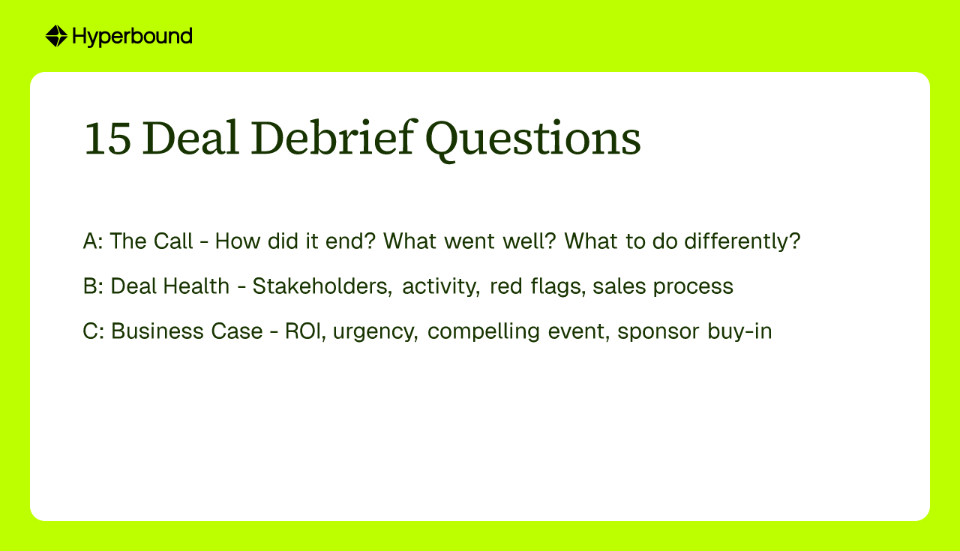
Structure the conversation in three categories. Move through them in sequence.
These questions review execution. Start here before moving into deal health or business case.
1. How did the meeting end?
This is the first question Kurt Greening recommends. It requires the representative to state the outcome and the next step immediately, rather than spending ten minutes on events before the decision point.
2. What went well?
Start with a positive observation. This is not flattery; it anchors the representative to what is repeatable.
3. What would you do differently?
This is the core coaching question. A representative who can accurately self-assess is coachable. A representative who says "nothing, really" requires more structure from the manager.
These questions inspect the state of the opportunity. They surface problems that are not visible in the CRM.
4. What has changed in this deal since our last conversation?
Clari's deal inspection guide flags stagnation as one of the clearest warning signs. A deal with no change in two weeks is not progressing; it is at risk of being lost.
5. What does the activity on this deal actually look like?
Volume matters less than type. The review should establish whether the right contacts are being engaged and whether meetings, rather than email activity alone, are occurring.
6. Who is involved on their side, and has the rep spoken to all of them?
Complex B2B deals involve multiple stakeholders. Clari identifies three roles that matter most: the economic buyer who controls budget, the end-user representative who will use the product, and any detractors who may oppose the deal internally. If the representative has only spoken to the champion, the deal is fragile.
7. Does this deal follow the sales process?
Managers should verify whether the representative has completed the required stages, whether the team's methodology such as MEDDIC or BANT is being used, and whether any steps have been skipped. Skipped steps compound into late-stage surprises.
8. What are the red flags?
Take the contrarian position. Databook's deal review framework recommends probing explicitly for risks: budget constraints, organizational changes on the customer's side, and internal champions losing influence. Ask the representative to name them first.
These questions validate the commercial viability of the deal.
9. How does this solution improve the customer's business?
Vague answers here predict lost deals. A representative who says "it saves them time" has not built a business case. A representative who says "it reduces their manual reconciliation work from three days to four hours per quarter, which frees up two FTEs they are currently paying overtime" has built a business case.
Databook's research shows that solutions mapped directly to measurable business outcomes are significantly more likely to reach approval.
10. Is this deal tied to an urgent initiative?
Clari's framework is direct: if the project is not a pressing priority for the prospect, the probability of it closing in the forecast period is low regardless of relationship strength.
11. What is the compelling event?
Identify the time-sensitive driver. A fiscal year-end, a product launch, a regulatory deadline. If no compelling event exists, the close date in the CRM is a guess.
12. Is the solution aligned with what the executive sponsor actually cares about?
Databook's analysis finds that solutions aligned with high-priority management initiatives are 1.9 times more likely to receive approval. If the representative cannot name the executive's top priority, that is a gap.
13. Has an executive sponsor signed off on a mutual action plan?
This confirms high-level buy-in. Without it, deals stall in procurement or legal with no internal advocate to push them through.
14. What is the real, committed revenue?
Distinguish between what the representative believes and what the customer has confirmed in writing. Forecast accuracy depends on this distinction being made explicitly.
15. If this is a loss, why could the competitor offer a significantly lower price?
This is the question most debriefs avoid. When a representative attributes a loss to price, this question opens the analysis. The explanations fall into three categories: a value gap, in which the representative failed to establish why the premium was justified; a product gap, in which the lower-priced option covered the customer's requirements; or a business model difference, in which the competitor operates at lower margins or absorbs the cost elsewhere.
Each answer points to a different response. A value gap is a coaching problem. A product gap is a product feedback item. A business model difference is a positioning and qualification problem.

A debrief without a defined next step is a conversation, not a coaching session.
Before ending, confirm three things:
The representative updates the CRM the same day. That record is what makes the next debrief more precise.
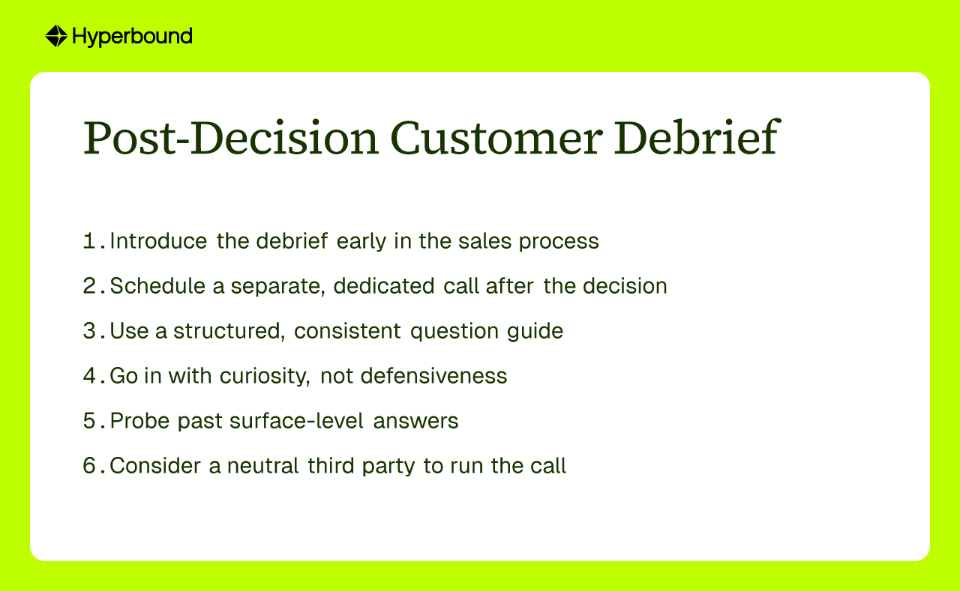
The most useful feedback often comes from the prospect directly, particularly after a loss. The Anova Group's research on post-decision debriefs finds that teams using a structured debrief guide with customers achieve a 15% higher close rate over time.
The key steps for running one effectively:
The After Action Review model used in military contexts applies the same logic: structured review by someone with standing, not by the individual whose performance is being examined, produces cleaner findings.
Individual debriefs surface coaching moments. A consistent cadence of deal debriefs across the team surfaces patterns.
When the same objection appears in three separate deals in a quarter, that is a product positioning problem, not a rep problem. When the same stage keeps stalling for multiple reps, that is a process problem worth fixing at the team level. Neither pattern is visible without the data that structured debriefs produce.

Teams that build in this review process systematically capture what works and correct what does not. Representatives who see their losses treated as learning inputs rather than failures stay longer and improve faster. Retention improves when the debrief becomes a standard part of team operations rather than an exception triggered by a painful loss.
The next debrief should be run before the details fade. The fifteen questions should be asked in order. Each debrief should end with a written next step. That is the entire process.
A deal debrief is a structured review of a specific sales opportunity, usually after it closes as won or lost, that examines the sales process, the representative's actions, and the lessons for future deals. It extends beyond a simple win/loss note by focusing on execution, decision points, and coaching opportunities rather than only the final result.
Deal debriefs turn individual outcomes into repeatable learning. They help managers spot recurring patterns, such as a representative consistently skipping discovery or failing to build a business case, that would otherwise remain hidden in CRM data. Over time, consistent debriefs improve representative performance, forecast accuracy, and team retention by creating a culture where losses are treated as learning inputs.
Sales managers should run deal debriefs on a fixed cadence, not just when a deal closes or falls. A recommended approach is to schedule dedicated debriefing slots on specific recurring days, for example, Monday, Wednesday, and Friday at 2 PM, so that the practice becomes a consistent part of the coaching rhythm rather than an ad-hoc reaction to losses.
The best questions are structured and sequenced. The sequence begins with call execution: "How did the meeting end?" "What went well?" "What would you do differently?" It then moves to deal health: "What has changed?" "Who is involved?" "What are the red flags?" Finally, the sequence examines the business case: "How does this improve the customer's business?" "What is the compelling event?" "Why could the competitor offer a lower price?" This order moves from representative actions to opportunity health to commercial viability.
A curious, coaching tone should be used instead of a judgmental one. Accusatory phrasing such as "Why did you not ask about budget?" should be replaced with "Help me understand what kept you from asking the prospect for that information." Beginning with questions about what went well also builds psychological safety. When representatives feel coached rather than assessed, they are more likely to share honest reflections and accept feedback.
A pipeline review focuses on current deal status, next steps, and forecast accuracy. A deal debrief looks backward at a specific opportunity to analyze execution, decision-making, and buyer behavior. The debrief is a coaching conversation about what the representative did and what could be done differently; the pipeline review is a forecasting and process check on active deals.
A customer debrief should be run after the decision is final, not in the same conversation where the decision is received. A separate, dedicated call should be scheduled, ideally within a few days, when emotions have settled. Prospects should be informed early in the sales process that the organization requests a short debrief after the decision, regardless of outcome. This normalizes the ask and increases acceptance rates.
Deal debriefs improve forecast accuracy by forcing explicit distinctions between what the representative believes and what the customer has confirmed. Questions about committed revenue, executive sponsor sign-off, and the presence of a compelling event reveal whether a deal is progressing or simply remaining in the pipeline. When debriefs consistently document these details, managers can build more reliable forecasts based on evidence, not optimism.
A representative should come to the debrief prepared to compare the pre-call plan against what occurred. Preparation includes reviewing the plan before the meeting, updating recent activity and stakeholder changes, and self-assessing what went well and what should be done differently. If the representative did not submit a pre-call plan, that omission becomes the first coaching point.
When a representative attributes a lost deal to price, the manager should ask: "Why could the competitor offer a significantly lower price?" This opens the analysis into three possible explanations: a value gap (the representative failed to justify the premium), a product gap (the cheaper option met the customer's needs), or a business model difference (the competitor operates at lower margins). Each answer points to a different solution: coaching, product feedback, or positioning and qualification adjustments.










Use Cases
Legal