
You have more call data, pipeline analytics, and deal inspection dashboards than ever before. And yet, win rates haven't moved. Sound familiar?
Here's the problem nobody in the deal coaching space wants to talk about: most platforms are built to analyze what went wrong after a deal is lost — not to change what happens before the next one is in play. They're retrospective by design. They flag the stalled deal, surface the missed signal, and generate a coaching note that a manager may or may not act on. And then the rep walks into their next discovery call with the exact same gaps they had before.
That's the practice-to-pipeline gap. And it's costing revenue teams more than they realize.
The real culprit is a market that evolved in silos. On one side, you have conversation intelligence (CI) tools — exceptional at recording, transcribing, and surfacing insights from calls, but fundamentally review tools. On the other side, you have AI sales simulators — useful for reps to practice in isolation, but disconnected from the live deals that actually need attention. Neither category alone closes the loop.
What the market needs — and what few platforms deliver — is a full activation model: a system that detects deal-level risk, traces that risk back to a specific rep behavior, and automatically prescribes a targeted practice intervention to fix it. Practice and performance not as separate tools, but as a single, continuous improvement engine.
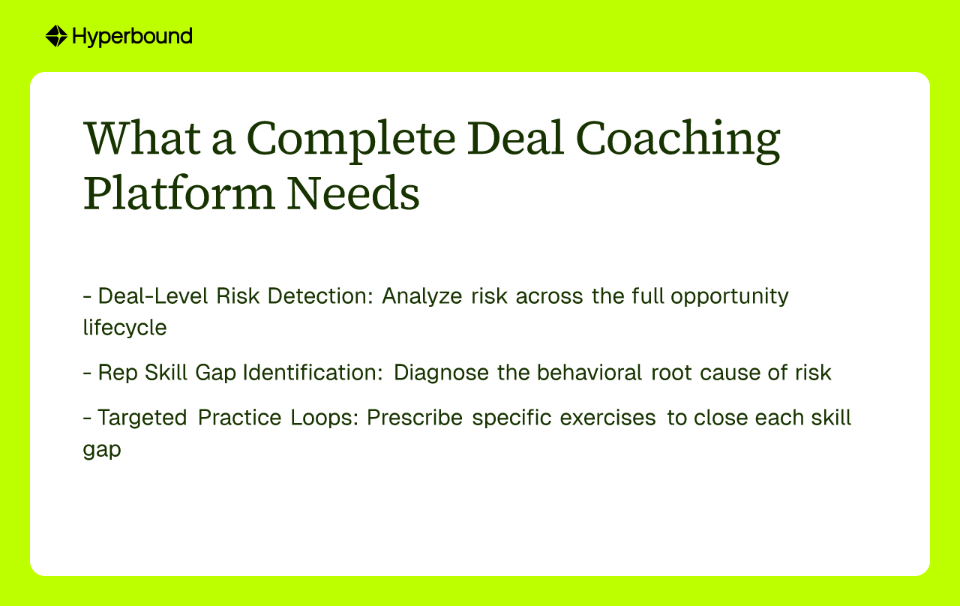
To cut through the noise, we'll evaluate the top deal coaching platforms across three dimensions that only a complete solution can satisfy:
Let's break down what each pillar actually requires — and then score the top contenders.
Analyzing a single call in isolation misses the forest for the trees. Winning or losing a deal happens across a series of interactions — first cold call, discovery, demo, pricing, legal, close. A true deal coaching platform must analyze signals across all touchpoints to catch risk early, while deals are still winnable.
As AI research from Logicon.tech highlights, the warning signs are often subtle: buyer engagement drops after pricing discussions, key stakeholders stop joining calls, or activity picks up with no meaningful progression. These patterns only become visible when you're looking at the deal holistically — not call by call.
Knowing a deal is at risk is the beginning of the conversation, not the end. The harder and more valuable question is: why? Is it because the rep failed to build urgency? Couldn't handle a competitor objection? Never multi-threaded to the economic buyer?
One sales leader on Reddit put it well: "I am looking for how to improve rep skill gaps not just on a deal or call. Then help me recommend what to change across all rep calls." That's the standard a platform should be held to. The system must connect deal health to specific rep behaviors — and do it consistently, not just when a manager happens to dig in.
This is what VPs and CROs actually need when they say they "can't pinpoint the root cause" of stagnant win rates.
This is the layer that almost no deal coaching platform has — and the one that makes everything else matter. Once a skill gap is identified in a live deal, the platform must close the loop: assign a specific practice exercise tied to that specific weakness, measure whether it improved, and feed that improvement back into deal performance.
Generic roleplay doesn't cut it here. A rep who just fumbled a pricing objection on a $200K deal doesn't need a 45-minute onboarding simulation. They need a 5-minute Bitesized Roleplay on that exact objection, grounded in the context of their current deal. That's the difference between practice as a training event and practice as a revenue intervention.
Deal-Level Risk Detection: ⭐⭐⭐⭐⭐ (5/5) Rep Skill Gap Identification: ⭐⭐⭐⭐⭐ (5/5) Targeted Practice Loops: ⭐⭐⭐⭐⭐ (5/5)
Hyperbound is the only deal coaching platform built from the ground up to close the practice-to-pipeline gap. What makes it fundamentally different from every other tool is the Practice → Perform → Activate model — three products that work as a unified system, not three separate tools bolted together.
Hyperbound Perform provides deal-level intelligence by analyzing 100% of real customer conversations across the entire opportunity lifecycle — not just one call. Its AI Deal Coaching surfaces what's helping or hurting each deal based on actual buyer behavior, giving managers early risk signals while there's still time to act. It integrates with Gong, Salesloft, Chorus, and other call recording systems, and automatically updates CRM fields from sales conversations with Auto-CRM Fill.
Kota Activate, Hyperbound's AI Revenue Analyst, sits above both products — orchestrating insights from real call analysis and roleplay performance to recommend the right coaching intervention at the right time. Ask Kota "which reps are consistently struggling with multi-threading?" and it answers with data, not guesswork.
And when a skill gap surfaces from a live deal, Hyperbound Practice closes the loop. AI buyer personas — trained on 2M+ hours of real B2B sales conversations — make the practice feel like the real thing. Bitesized Roleplays let tenured reps sharpen one specific skill in minutes, not hours. The gap identified in Perform becomes the drill assigned in Practice. That cycle repeats, continuously.
The proof is in the outcomes: Vanta cut ramp time from 210 to 72 days (a 60% reduction) while growing their BDR team 4x and hitting 5x pipeline. Nivoda saw a 50% ramp reduction and 150% increase in demo conversion rates. LinkedIn deployed Hyperbound across 3,000+ sellers in NAMER and EMEA.
When seniors are too busy to train newbies — and that's almost always — Hyperbound replaces the "lose to learn" cycle with a system that prepares reps before they burn real pipeline.
Deal-Level Risk Detection: ⭐⭐⭐ (3/5) Rep Skill Gap Identification: ⭐⭐⭐⭐ (4/5) Targeted Practice Loops: ⭐ (1/5)
Gong is the gold standard for call recording and conversation analytics. It's genuinely excellent at surfacing what happened on a call — talk ratios, competitor mentions, question frequency, and engagement signals. For managers who know how to use it, Gong sharpens deal reviews and gives context that CRM notes never capture.
But Gong is, at its core, a review tool. It analyzes calls in isolation rather than rolling up insights across the full deal lifecycle to surface deal momentum or behavioral risk patterns. And when it comes to closing the loop — when it comes to actually building the skill that was exposed on that call — Gong stops short. There's no native practice mechanism. A manager has to manually diagnose the gap, schedule a coaching session, find a way to create practice, and hope it sticks. That's a lot of manual work sitting between insight and behavior change.
As one sales professional put it: "Gong is good for recording and coaching real calls with prospects. I wouldn't waste too much time doing fake calls with AI." That instinct makes sense — but it also reveals the gap. What moves the needle isn't choosing between real calls and practice; it's connecting them.
Deal-Level Risk Detection: ⭐⭐⭐⭐ (4/5) Rep Skill Gap Identification: ⭐ (1/5) Targeted Practice Loops: ⭐ (1/5)
Clari excels at pipeline visibility and forecast accuracy. It aggregates signals from CRM activity, email, and calendars to flag deals that look risky — pushed close dates, no recent meetings, low email engagement. For revenue operations leaders managing large pipelines, this is genuinely useful.
The limitation is that Clari diagnoses the symptom, not the cause. It can tell you a deal is stalled; it cannot tell you why the rep keeps losing momentum after pricing conversations, or that they've been failing to build champion relationships across four consecutive opportunities. Because Clari doesn't analyze call recordings, it has no window into rep behavior. And without behavioral diagnosis, there can be no prescription. Clari is a data aggregation and forecasting platform — it's not a deal coaching platform, and it's not designed to be.
Deal-Level Risk Detection: ⭐ (1/5) Rep Skill Gap Identification: ⭐⭐⭐ (3/5) Targeted Practice Loops: ⭐⭐⭐⭐ (4/5)
Second Nature is built for practice, and it does it reasonably well. Reps can run through simulated conversations, receive scoring, and review their performance. For teams that need structured roleplay as part of onboarding or certification, it's a legitimate option.
The core limitation is that Second Nature operates in a vacuum. Its simulations aren't connected to your live CRM deals, your call recordings, or the specific objections your reps are facing this quarter. When the AI buyer persona doesn't reflect your actual buyers, or when the scenario doesn't map to the real friction in your current pipeline, the practice loses relevance fast. There's no signal flowing from performance into practice — the loop that makes deal coaching actually change outcomes doesn't close.
The community insight that "the tools that work best are ones where you can customize the AI prospect to match your actual buyer personas" points directly at this gap. Practice needs to be grounded in reality to matter.
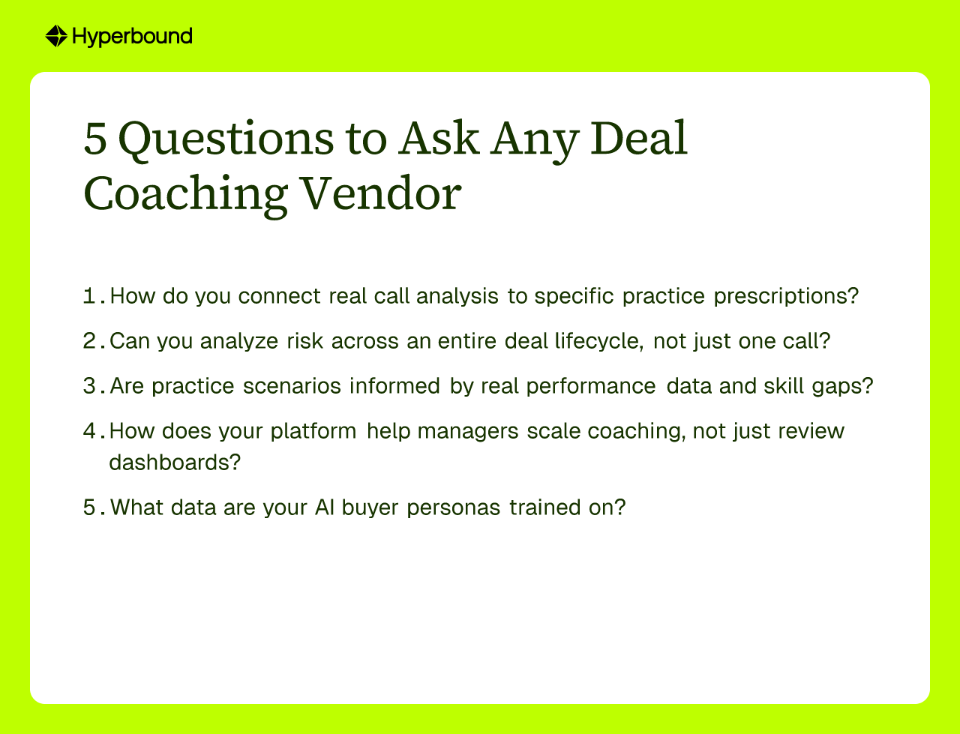
Use these questions in your next vendor demo. They're designed to cut through marketing claims and reveal whether a platform truly closes the practice-to-pipeline gap — or just claims to.
1. How do you close the loop between analyzing a real sales call and prescribing a specific practice exercise for the rep?
This is the fundamental question. If the answer is "managers review the call and assign training manually," you're looking at a tool, not a system. A true deal coaching platform should automate the connection between performance data and practice prescription.
2. How does your platform analyze risk across an entire deal lifecycle — not just on a call-by-call basis?
Single-call analysis is table stakes. Push for opportunity-level coaching: can the platform identify that a rep has been failing to multi-thread across three consecutive deals, not just that one call last Tuesday had a low talk ratio?
3. Are your practice scenarios based on generic templates, or are they dynamically informed by the actual performance data and skill gaps of my team?
Generic roleplay loses value fast. Ask vendors to show you how a rep's real-call behavior informs the scenarios they're assigned to practice. If there's no data connection, the practice isn't targeted — it's just content delivery.
4. Show me how your platform helps a manager scale coaching — not just gives them another dashboard to review.
Every platform has a dashboard. The differentiator is whether the platform recommends specific actions, or whether it hands managers a pile of data and expects them to draw conclusions on their own. With managers spending only 5-8% of their time on coaching, that gap matters enormously.
5. What data are your AI buyer personas trained on — and how do you ensure they reflect the actual conversations my reps are having?
This question separates platforms with genuine AI fidelity from those running on generic scripts. The answer should include specifics: volume of real call data, how personas are customized, and whether the scenarios evolve based on your team's real deal patterns. Hyperbound's AI personas are trained on 2M+ hours of real B2B sales conversations — not templated scripts.
The market for deal coaching platforms is crowded, but most tools are solving a 2018 problem: how do we capture and review call data? That problem is solved. The challenge in 2026 is different: how do we turn that data into rep behavior change, at scale, before the next deal is at risk?
That requires a complete activation model — not just conversation intelligence, not just simulation, but a unified system where real call performance feeds skill gap identification, skill gap identification drives targeted practice, and practice results feed back into the next real call. Analyze. Practice. Repeat.
Very few platforms are built to actually deliver that loop. Conversation intelligence tools give you data, AI simulators give you practice, and revenue forecasting hubs give you pipeline visibility. But none of them close the loop between all three.
Hyperbound's Revenue Activation Platform — connecting Perform, Practice, and Kota — is the only deal coaching platform that does.
If your reps are still "losing to learn" on live pipeline, that's a gap you can close. See how Hyperbound's Revenue Activation Platform works.
A deal coaching platform is a software solution designed to analyze sales conversations, identify risks in live deals, diagnose sales rep skill gaps, and prescribe targeted practice to improve performance and win rates. Unlike traditional tools that only review past calls, a complete deal coaching platform connects real-world performance to targeted training. It creates a continuous loop where insights from live deals are used to create specific practice exercises, helping reps improve the exact skills they need to close their current and future deals.
Conversation intelligence (CI) tools alone often fail to improve win rates because they are primarily retrospective review tools; they show what went wrong on a call but don't provide a direct, automated way to fix the underlying skill gap. CI platforms are excellent for recording and analyzing calls. However, they place the burden on managers to manually diagnose the root cause of a problem, create a coaching plan, and implement training. This creates the "practice-to-pipeline gap" where insights are not translated into behavior change.
The practice-to-pipeline gap is the disconnect between sales training or practice activities and their actual impact on live deals and revenue outcomes. It occurs when sales reps practice generic scenarios in isolation or when managers review past calls without a system to connect those activities. Closing this gap requires a platform that uses data from real deals to identify specific weaknesses and automatically assign targeted practice to fix them, ensuring that training directly impacts pipeline performance.
An AI-powered deal coaching platform works by integrating with your CRM and call recorders to analyze conversations across the entire deal lifecycle, using AI to detect risks, pinpoint rep skill gaps, and automatically prescribe personalized practice simulations. This creates a full activation model. The AI first analyzes deal health to flag risks, then identifies the specific rep behavior causing that risk, and finally assigns a targeted AI roleplay exercise to close that skill gap, allowing the rep to improve before their next critical call.
When choosing a deal coaching platform, you should look for three key capabilities: deal-level risk detection across the entire sales cycle, precise identification of rep skill gaps, and the ability to assign targeted, automated practice loops to correct those gaps. A platform must go beyond single-call analysis to see patterns across an entire opportunity. It must connect deal risk to a specific rep behavior. Most importantly, it must close the loop by automatically prescribing a practice intervention, turning data into action.
Sales teams can practice more effectively by moving away from generic roleplays and adopting targeted, data-driven practice that is directly linked to their performance in live deals. The most effective practice is specific and contextual. For example, if a rep is struggling with pricing objections in a live deal, they need a short, focused simulation on that exact objection. Platforms that use insights from real calls to create "Bitesized Roleplays" address immediate skill gaps relevant to a rep's active pipeline.








Use Cases
Legal