
In 2023, a frustrated sales leader posted on Reddit: "I am looking for how to improve rep skill gaps not just on a deal or call. Then help me recommend what to change across all rep calls." This sentiment echoes across sales organizations worldwide — traditional training methods are failing to deliver consistent results in our data-rich environment.
For decades, sales training has relied on sporadic workshops, theoretical roleplays with colleagues who act nothing like real customers, and manager ride-alongs based on gut feel rather than data. These approaches are fundamentally flawed: they're generic, inconsistent, and impossible to scale.
The new paradigm? Data-driven sales training that leverages AI and analytics to objectively identify what works, scale those winning behaviors, and continuously measure improvement. According to McKinsey research, companies using data-driven techniques experience 15-25% higher growth and profitability compared to their peers who rely on traditional methods.
As one sales leader put it: "The key is to find a solution that connects call analysis, performance metrics, and enablement into one seamless workflow." That's exactly what we'll explore in this article — five game-changing sales training opportunities that forward-thinking companies are already implementing to create unstoppable sales teams in 2026.
.png)
What It Is: This foundational shift moves from separate analysis and training activities to an integrated system. It involves using AI to automatically analyze 100% of your sales conversations to identify the winning behaviors of top performers, then immediately turning those insights into hyper-realistic practice scenarios where the rest of the team can master those same techniques.
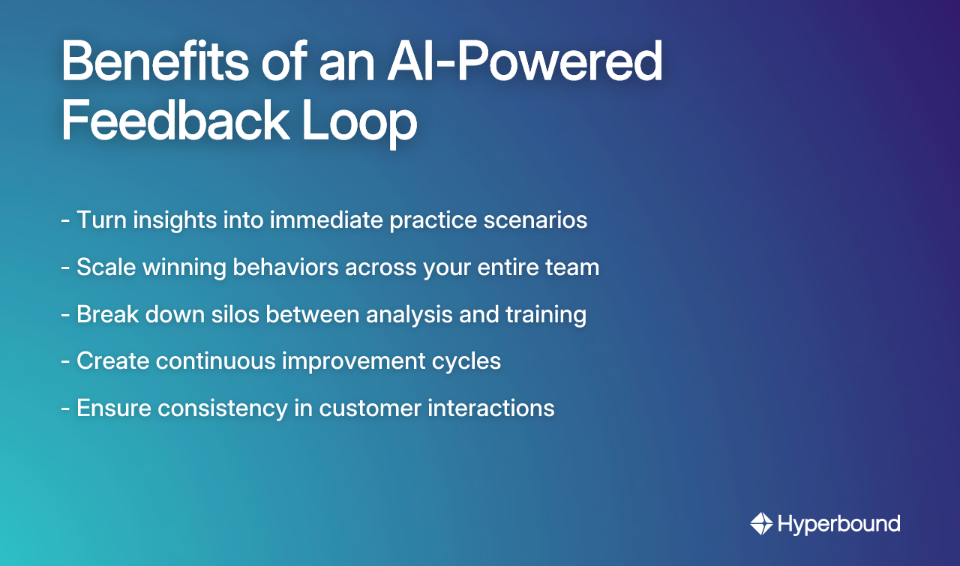
Why It Matters: This directly addresses what many sales leaders described as a "fragmented tech stack" where valuable insights are trapped in call recordings that most reps never hear. By creating a continuous loop between analysis and practice, you ensure that every winning talk track or objection handle becomes a scalable training asset for the entire team.
Implementation Guidance:
Expected Outcomes:
Measurement Framework: Monitor improvements in AI scorecard grades over time, track the adoption of winning talk tracks, and measure time-to-quota for new hires onboarded with this approach versus traditional methods.
What It Is: Using AI to deliver immediate, personalized, and actionable feedback on every single call. This isn't just a transcript or generic advice; it's targeted coaching that highlights missed buying signals, poorly handled objections, and deviations from your playbook — delivered moments after the conversation ends.
Why It Matters: Even the best sales managers can only review a tiny fraction of calls. As one sales leader lamented on Reddit: "From there, I would take that transcript and plug it into ChatGPT and ask it to give me feedback based on my criteria." This manual process isn't scalable. AI coaching democratizes access to quality feedback, empowering reps to self-correct and improve continuously without waiting for their weekly 1:1.
Implementation Guidance:
Expected Outcomes:
Measurement Framework: Track individual rep performance metrics over time (talk-to-listen ratio, objection success rate) and use sentiment surveys to measure gains in rep confidence and competence.
Hyperbound's AI Coaching delivers personalized feedback tailored to your playbook, identifying missed opportunities and off-track messaging after every conversation.
What It Is: Using conversation intelligence to pressure-test and dynamically update your sales playbook. Instead of being based on theory or the opinions of a few vocal leaders, your playbook becomes a data-validated guide built on what is proven to work in the field.
Why It Matters: Most sales playbooks are created with great fanfare and then forgotten. A data-driven approach ensures your messaging, competitive positioning, and objection handling guides are always optimized based on real-time market feedback and customer reactions.
Implementation Guidance:
Expected Outcomes:
Measurement Framework: Measure playbook adherence scores across the team using call scoring and track key sales metrics before and after significant playbook updates.
What It Is: Extending data-driven training beyond the initial sale to the entire customer lifecycle. This means analyzing and coaching on renewal conversations, upsell pitches, quarterly business reviews, and difficult customer service interactions.
Why It Matters: Customer retention and expansion are the lifeblood of modern SaaS businesses, yet post-sales teams often receive far less coaching and training than their new-business counterparts. Applying data analysis to customer success conversations represents a massive opportunity to reduce churn and increase Net Revenue Retention (NRR).
Implementation Guidance:
Expected Outcomes:
Measurement Framework: Track key post-sales metrics like churn rate, Net Revenue Retention, and expansion revenue. Monitor scorecard improvements for CSMs on skills like value positioning and objection handling.
Hyperbound's AI Post-Sales Roleplays provide a purpose-built solution for this often-overlooked area, enabling CSMs and Account Managers to master the critical conversations that drive retention and expansion.
What It Is: Integrating AI-driven roleplays directly into your sales hiring process. Instead of relying solely on interview answers and resumes, you can see how a candidate actually performs in a simulated, yet realistic, sales scenario.
Why It Matters: A bad sales hire is incredibly expensive—in lost salary, training costs, and missed quota. This data-driven approach removes subjectivity from the interview process, allowing you to objectively identify candidates with the core skills to succeed before you make an offer.
Implementation Guidance:
Expected Outcomes:
Measurement Framework:Compare the 90-day and 1-year quota attainment of reps hired using AI assessments versus those hired previously, and track first-year attrition rates for the sales team.
Hyperbound's AI Roleplay Hiring Assessments provide a scalable and objective way to evaluate sales talent, ensuring you hire top performers from the start.
The future of sales training isn't about more workshops or generic roleplays; it's about leveraging data to create a continuous cycle of analysis, practice, and performance improvement. By implementing these five data-driven sales training opportunities, you'll move from subjective coaching based on limited samples to objective, scalable excellence based on comprehensive data.
In 2026, the gap between top-performing sales organizations and everyone else will be defined by their ability to turn conversational data into a competitive advantage. The tools exist today to make this transformation—from Hyperbound's integrated AI coaching platform to custom scorecard systems that align with your specific methodology.
As one Reddit user put it when discussing the fragmented state of current sales tools: "I'm sure this could be improved upon as well, but this is a scrappy and cheap way of doing it." The good news is that you no longer need to cobble together a "scrappy" solution. Purpose-built, data-driven sales training platforms are ready to help you uncover winning behaviors, scale best practices, and build an unstoppable sales team.
Are you ready to transform your sales training from an art into a science? The competitive advantage awaits those who move first.
Data-driven sales training is a modern approach that uses AI and analytics to objectively identify winning sales behaviors from actual customer conversations and then scales those behaviors across the entire team through targeted practice. Unlike traditional methods that rely on generic workshops and subjective feedback, this approach analyzes 100% of sales calls to find out what truly works. These insights are then used to create realistic practice scenarios, ensuring that training is based on proven success rather than theory.
AI improves sales coaching by providing immediate, personalized, and scalable feedback to every sales representative on every call, something that is impossible for managers to do manually. AI acts as a personal coach for each rep, analyzing their conversations against a proven sales methodology. It highlights specific areas for improvement, such as missed buying signals or poorly handled objections, allowing reps to self-correct and continuously improve without waiting for a weekly 1:1 meeting. This frees up managers to focus on high-level strategy rather than routine call reviews.
The primary benefits of an AI-powered sales training program include faster new hire ramp times, higher meeting conversion rates, consistent messaging across the team, and a significant reduction in costly mis-hires. Companies using this approach typically see a 30-50% reduction in ramp time and a 15-25% increase in conversions. It also creates a culture of continuous improvement, ensures playbook adherence, and provides objective data for hiring decisions, leading to a more effective and efficient sales organization.
Data-driven training is highly effective for post-sales teams, such as customer success and account management, by analyzing and coaching on conversations critical to retention and expansion. By applying AI analysis to renewal calls, quarterly business reviews (QBRs), and upsell pitches, organizations can identify best practices for reducing churn and increasing Net Revenue Retention (NRR). AI can create targeted roleplay scenarios for CSMs to practice handling difficult renewal negotiations or positioning expansion opportunities, leading to improved customer loyalty and revenue growth.
You can measure the ROI of AI sales training by tracking improvements in key sales metrics, such as meeting conversion rates, new hire ramp time, quota attainment, and customer churn rates. A robust measurement framework involves comparing performance data before and after implementation. Key metrics to monitor include AI scorecard grades over time, adoption of winning talk tracks identified by the system, time-to-quota for new hires, and post-sales metrics like Net Revenue Retention. Comparing these data points provides a clear picture of the financial impact.
The first step is to integrate an AI platform with your existing CRM and call recording systems to begin analyzing your sales conversations. Start by connecting a platform like Hyperbound to your data sources. Then, define your sales methodology within the platform by building custom AI scorecards. This ensures the AI measures what matters most to your business. Once set up, the system can begin analyzing calls to uncover the winning behaviors of your top performers, which forms the foundation for all future coaching and practice.
Ready to see how data-driven sales training can transform your team's performance? Request a demo of Hyperbound to discover how our AI Sales Coaching platform can help you identify winning behaviors, scale best practices, and create an unstoppable sales team.










Use Cases
Legal