
You've just ended another sales call feeling like you failed a Fallout speech check. The prospect seemed frustrated, and you missed crucial moments to address their concerns. Despite attending countless training sessions, you're still struggling with those moment-specific responses that could turn skepticism into interest.
Sound familiar?
If you're nodding your head, you're not alone. Many sales reps feel stuck in a cycle where traditional training focuses on product pitches and scripted responses, but real growth happens elsewhere.
"The majority of my growth as a sales professional has happened after formal training," shares one experienced sales rep. Another admits, "I don't believe in that hype bullshit. I hate that shit."
The truth is, most sales training fails because it promises magic dust instead of teaching the fundamentals that actually work: quick follow-ups, targeted information, and consistent skill-building.
What if instead of searching for that elusive sales secret, you committed to improving "a small amount every day and after every sales call"?
This article provides a practical, repeatable framework for daily skill-building that actually moves the needle. We'll focus on a system of structured reflection, targeted practice, and accountability that transforms even the most challenging sales conversations into opportunities for growth.
The most powerful tool for daily improvement isn't a new script or closing technique—it's a structured process for reflecting on every significant sales interaction. This is where your real education begins.
Introducing the SAID Framework:
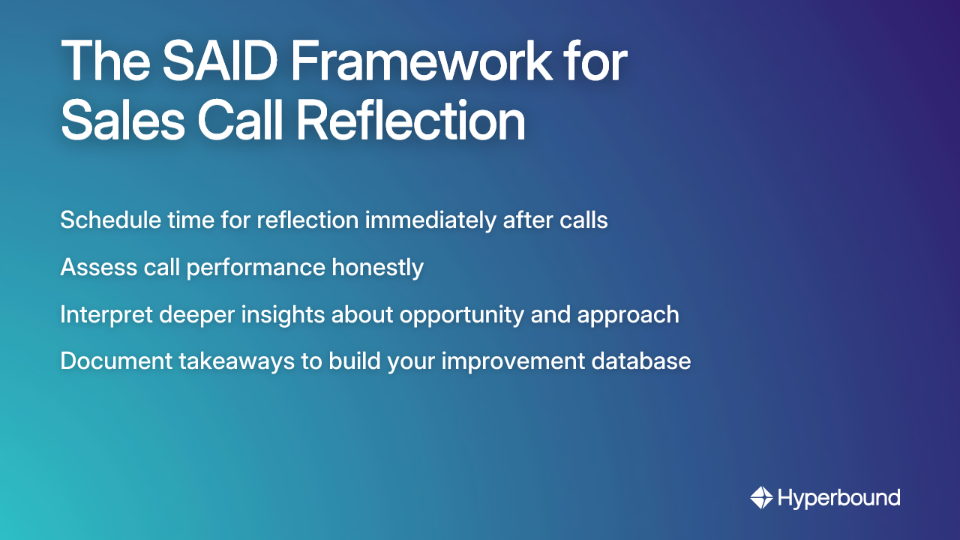
Immediately after your call (or within a few hours), block 15-30 minutes on your calendar for reflection. This isn't optional—it's the foundation of your improvement. The goal is to capture insights while they're fresh before details fade.
Conduct a candid evaluation of the call using these key questions:
Don't rush this step. Honesty here drives real improvement.
Now dig deeper to uncover strategic insights about both the opportunity and your approach:
Opportunity Questions:
Approach Questions:
Record your answers and key takeaways in a consistent format. This documentation builds a personal improvement database that prevents you from repeating mistakes and helps identify patterns over time.
.png)
To implement the SAID framework immediately, you need practical tools. Below is a call debriefing template combining insights from sales experts:
Sales Call Debrief Template
Date:
Client Name:
Call Objective (from pre-call plan):
Actual Outcome:

What Went Well:
1.
2.
3.

Areas for Improvement:
1.
2.
3.

Key Learnings about Prospect/Company:
1.
2.
3.

Next Steps & Ownership:
1.
2.
3.
Beyond the basic template, elevate your debriefs with these critical reflection questions:
Debriefing identifies improvement areas, but you need deliberate practice to develop those skills. Here's how to transform insights into action:

Manually reviewing calls is time-consuming and prone to bias. Instead, leverage AI to get objective, data-driven feedback. Platforms like Hyperbound's AI Real Call Scoring can automatically analyze your conversations against your sales methodology.
Exercise: Use an AI tool to review one of your recent calls. Focus on the automated analysis of:
Generic roleplays with colleagues often lack realism and are hard to scale. Instead, practice specific scenarios identified in your debriefs using AI-powered simulations.
Exercise: Use a platform like Hyperbound's AI Sales Roleplays to practice handling pricing objections. You can run the simulation multiple times with a hyper-realistic AI buyer, getting instant feedback and building muscle memory before your next high-stakes call.
A powerful strategy is addressing likely objections before the prospect raises them.
Exercise: After identifying patterns in your debriefs, create a "pre-emptive objection" script for your top three most common objections. For example:
"Before we go further, clients often ask about implementation time. While our full enterprise rollout takes 60 days, you'll see initial results within the first two weeks through our quick-start program."
Treat each call as a scientific experiment rather than a pass/fail test.
Exercise: Each week, select one specific technique to test (a new opening, discovery question, or value demonstration). Track results in your debrief documents to identify what works for your specific selling environment.
The hardest part of improvement isn't knowing what to do—it's doing it consistently. Building systems of accountability ensures your daily practice becomes habit.
The data is clear: 87% of mentors and mentees report increased confidence, and 94% of employees are more likely to stay at a company that invests in their learning. Here's how to find a mentor who can accelerate your growth:
To ensure consistent implementation of your improvement plan:
The system is a continuous loop:
This flywheel of improvement compounds over time. What starts as small daily gains transforms into significant competitive advantage as your skills-based training builds expertise that can't be replicated overnight.
Stop searching for magic dust or lamenting that you're selling a commoditized product. The best sales professionals aren't born with supernatural abilities—they're built through deliberate, consistent practice and reflection.
Your next sales call isn't just an opportunity to close a deal; it's an opportunity to get 1% better. Over time, those small improvements compound into mastery that will separate you from competitors who rely on outdated product pitches and generic scripts.
The question isn't whether you can become an elite sales professional—it's whether you'll commit to the daily practice that makes it inevitable.
Start with your very next call.
The SAID framework is a four-step process for structured reflection after a sales call: Schedule, Assess, Interpret, and Document. This method helps you systematically review your performance by scheduling time to reflect, honestly assessing what went well and what didn't, interpreting deeper insights about the opportunity, and documenting takeaways to track improvement over time.
You can improve your sales skills daily by adopting a system of consistent, deliberate practice rather than relying on occasional training. This involves using a framework like SAID to debrief every call, practicing specific skills with targeted exercises like AI role-playing, and creating accountability through mentorship and peer reviews.
Most sales training programs fail because they focus on generic scripts and one-time events instead of building fundamental, repeatable skills. Real improvement comes from continuous practice, personalized feedback, and structured reflection on actual sales calls, which traditional training often overlooks.
AI can significantly help a sales representative improve by providing objective, scalable, and instant feedback. AI tools can analyze call recordings to score performance against a playbook, identify filler words, and measure talk-to-listen ratios. Additionally, AI simulations offer a risk-free environment to practice handling specific scenarios like objection handling.
The most critical questions to ask after a sales call go beyond a simple win/loss assessment. Key reflection questions include: Did I accomplish my call objectives? What went well that I should repeat? Where did I struggle? How did I build trust and differentiate from competitors? And what is the clear next step for this opportunity?
It is recommended to block 15-30 minutes for reflection immediately after a significant sales call or within a few hours. The key is to make it a consistent habit, as capturing insights while the details are still fresh is crucial for effective learning and improvement.










Use Cases
Legal