
Every week a new sales rep spends without a closed deal isn't just a patience problem — it's dead Customer Acquisition Cost (CAC). You're paying salary, benefits, and onboarding overhead while your pipeline sits empty. According to research on B2B revenue cycles, unpredictable ramp times don't just delay revenue realization — they make financial planning nearly impossible and mask the true ROI of your hiring and marketing investments.
Before we talk about fixing the problem, let's make sure we're measuring the right thing.
Time to First Revenue (TTFR) is the duration from a rep's start date until they generate their first dollar of closed revenue. It's the ultimate measure of onboarding effectiveness — not how much they've read, but how much they've earned.
Time to First Sale is more specific: the clock from hire date to first closed-won deal. It's a useful leading indicator but doesn't account for deal size or revenue impact.
Time to Productivity is broader — it measures when a rep consistently hits a standard output threshold (meetings booked, pipeline generated). It's a leading indicator for TTFR, but it's not the finish line.
For this guide, we're focused on compressing time to first revenue. Because that's the number your CRO actually cares about.
Here's the math nobody wants to do: if a new AE's on-target earnings are $120K and it takes them 6 months to close their first deal, you've spent $60K before seeing a single dollar of return — and that's before factoring in recruiting, tools, and manager time.
Sales Enablement leaders are fighting this battle outnumbered. One enablement professional typically serves 50–100 reps, and research consistently shows that 80% of training content is forgotten within 30 days. Manual coaching doesn't scale. One-off ride-alongs don't stick.
And the traditional fix — hand new hires a 40-page onboarding doc and call it a day — actively backfires. As one sales manager put it on Reddit: "New hires usually show up pumped, full of energy… but when you hand them a 40-page onboarding doc or training videos, their enthusiasm is gone." The structure meant to prepare them ends up deflating them.
Meanwhile, managers are spending only 5–8% of their time on coaching, and listening to less than 1% of recorded calls. Even with conversation intelligence tools capturing every word, most of that data never translates into behavior change. Visibility without action isn't improvement — it's just an expensive archive.
The fix isn't more data. It's a structured sequence that moves reps from learning to performing to winning, as fast as possible.
This sequence is built on the Practice → Perform → Activate model — a continuous loop that connects skill-building to real deals and turns insights into targeted interventions. Here's how it runs week by week.
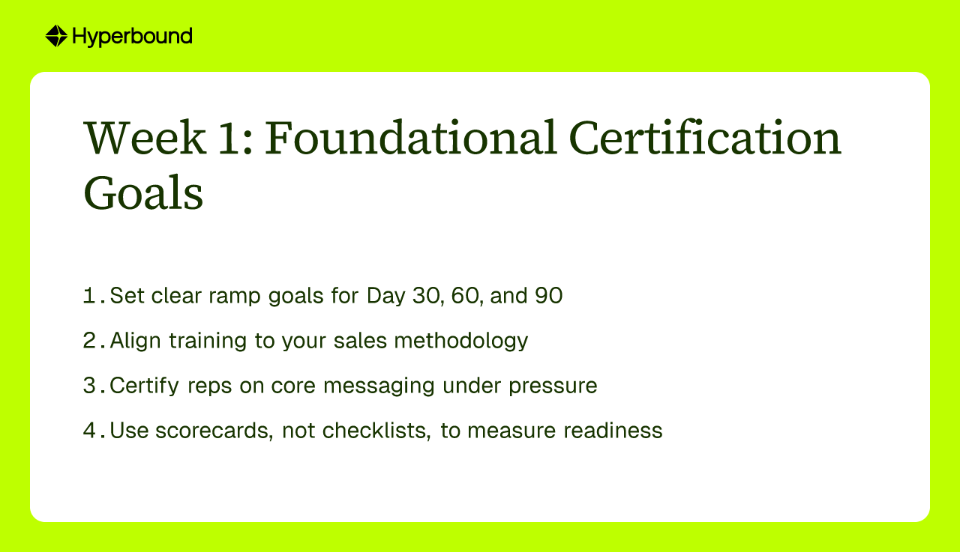
The goal of Week 1 isn't information transfer — it's verified readiness. There's a critical difference between a rep who has read your value proposition and a rep who can deliver it under pressure without flinching on an objection.
Your Week 1 priorities:
Hyperbound Practice makes this scalable. Its Certifications feature lets reps submit recorded roleplays demonstrating their grasp of core messaging and product knowledge — scored against a consistent rubric, not subject to manager availability or scheduling conflicts. No more "I think they're ready" guesswork.
Knowledge doesn't build muscle memory. Repetition does.
The biggest gap in most onboarding programs isn't content — it's "at-bats." Reps need to practice cold calls, run discovery conversations, handle pricing objections, and recover from curveballs dozens of times before they're ready for a real prospect. The problem is that every practice opportunity traditionally required a manager's time, a willing peer, or burning a live lead.
AI roleplay solves the volume problem — but only if the AI is realistic enough to matter. This is where most tools fall short. As one rep noted in a Reddit discussion on AI roleplay tools: "ChatGPT still couldn't replicate realistic responses to what we say as the objections." Users consistently flag that AI avatars can't replicate the complexity of real customers or adapt to unexpected conversational turns — making the practice feel hollow.
That's a training data problem. Generic scripts produce generic buyers.
Hyperbound Practice sidesteps this entirely. Its AI buyer personas are built from analysis of over 2 million hours of real B2B sales conversations — which means they push back the way real prospects push back, go off-script the way real buyers do, and surface the objections your reps will actually face in the field. You're not practicing against a script. You're practicing against a simulation of your actual ICP.
Key capabilities that matter in Weeks 2–4:
Industry research consistently points to fast feedback as the most critical variable. The faster the feedback loop, the faster skills develop. Waiting for a weekly 1:1 to review a call from three days ago is not a feedback loop — it's a postmortem.
By Week 5, reps are in real conversations. This is where the real work begins — and where most onboarding programs quietly give up.
The operational loop that actually compresses time to first revenue looks like this:
Score Real Calls → Identify Skill Gaps → Prescribe Targeted Practice → Score Real Calls Again
This isn't a one-time event. It's a continuous improvement cycle that runs throughout a rep's first months and beyond.
Hyperbound Perform is the engine for this stage. Unlike tools that analyze calls in isolation, Perform rolls up insights across all touchpoints in a deal — first cold call through closing conversation, including email interactions and stakeholder analysis. It surfaces early risk signals while deals are still winnable and recommends deal-winning actions before opportunities slip.
This directly addresses a frustration that comes up repeatedly among sales ops and managers: tools like Gong show you what happened, but by the time a call summary is generated and reviewed, the moment to act is already gone. Perform doesn't report on closed opportunities — it intervenes during active ones.
Then there's Kota Activate — the orchestration layer that sits above Practice and Perform. Kota analyzes data from both products simultaneously and recommends personalized coaching interventions at the right moment, delivered directly in Slack or Teams. If a rep is consistently struggling with pricing objections on live calls, Kota can automatically assign a targeted pricing objection roleplay in Hyperbound Practice — closing the loop between what's happening in the field and what reps are working on in training.
This is the intervention gap that traditional enablement has never been able to close.
This isn't a theoretical framework. It's the model Hyperbound runs internally and deploys with customers.
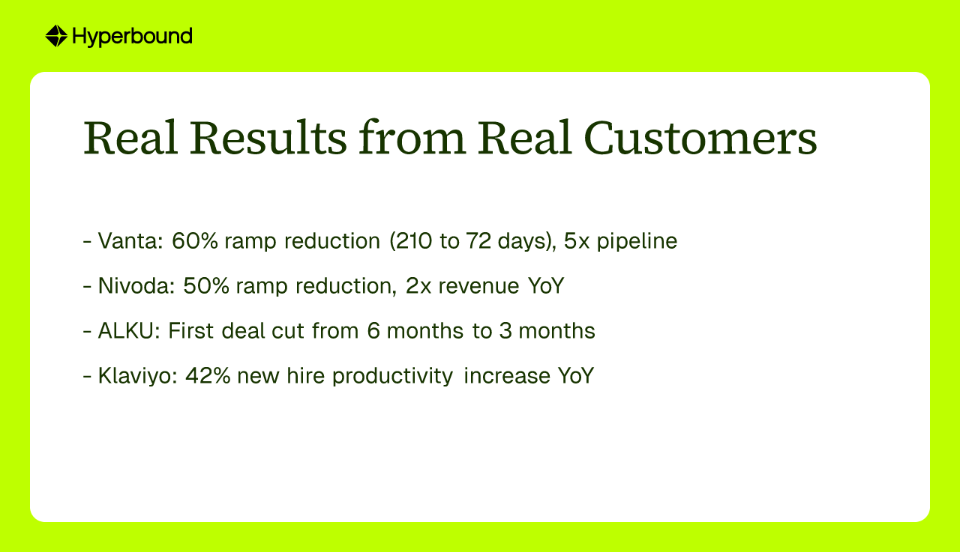
Vanta implemented the Practice → Perform → Activate model and reduced their sales ramp time from 210 days to 72 days — a 60% reduction. That compression didn't just feel good on a slide deck. It allowed them to scale their BDR team 4x, grow their pipeline 5x, and influence over $125M in pipeline. Stevie Case, Vanta's CRO, credited the structured AI-driven approach as the foundation for that growth.
The results aren't isolated:
These outcomes share a common thread: they replaced passive onboarding with a repeatable, measurable, AI-driven loop that connects practice to performance to pipeline. You can explore more at Hyperbound's success stories.
For years, revenue teams have been told that visibility is the answer. Record more calls. Build more dashboards. Review more data. And yet, win rates remain stagnant and ramp times stubbornly resist improvement.
Visibility was progress. But it was never the same as improvement.
The time to first revenue problem isn't a data problem — it's an execution problem. Reps don't lose deals because their managers didn't see it coming in Gong. They lose deals because they didn't know how to run better discovery, build a stronger champion, or handle the objection that killed the opportunity. By the time a call summary surfaces those insights, the moment to change the outcome has already passed.
The Practice → Perform → Activate model closes that gap. It's the foundation of Revenue Activation — a category built on the premise that data should change outcomes, not just describe them. Week 1 certifies that reps are ready to engage. Weeks 2–4 build the conversational muscle memory to execute. Week 5 and beyond connects real-world performance back to targeted practice, creating a compounding loop that accelerates with time.
This is how you compress time to first revenue. Not by adding more training content — but by building a system where every rep, every call, and every deal improves the one that follows.
Time to First Revenue (TTFR) is the duration from a new sales representative's start date until they close their first dollar of revenue. It is a critical metric because it directly measures the return on investment (ROI) of your hiring and onboarding process, providing a clear financial indicator of a new hire's effectiveness. Unlike other metrics that track activity (Time to Productivity) or ignore deal value (Time to First Sale), TTFR focuses on what matters most: revenue generation.
The "Practice → Perform → Activate" model shortens ramp time by creating a continuous development loop that connects training directly to real-world performance. Reps build foundational skills through structured roleplays (Practice), apply those skills in live customer calls (Perform), and then receive AI-driven coaching and targeted exercises based on their performance data (Activate). This cycle rapidly identifies and closes individual skill gaps, accelerating a rep's journey to becoming a revenue-generating team member.
AI-driven roleplay is more effective than traditional training because it offers scalable, consistent, and immediate practice opportunities. New reps can get hundreds of "at-bats" handling objections and running discovery calls without needing to schedule time with managers or peers. This high volume of practice, combined with instant, objective feedback after every session, builds deep conversational muscle memory far more quickly and efficiently than reading documents or occasional live coaching.
Hyperbound's AI is fundamentally different because it is a specialist trained on over 2 million hours of real-world B2B sales conversations, not generic internet data. This specialized training allows its AI buyer personas to replicate the specific challenges, objections, and nuanced behaviors of actual prospects in your industry. This ensures that the practice reps receive is a realistic simulation of their future calls, making them significantly better prepared for live deals.
After the initial onboarding, the system transitions into a continuous coaching and performance improvement engine for the entire team. By analyzing live calls and deal data with Hyperbound Perform, the platform identifies ongoing skill gaps or deal risks for any rep, new or tenured. The AI, Kota Activate, can then automatically assign personalized practice scenarios to address those specific weaknesses, ensuring continuous development and skill refinement throughout a rep's career.
Reducing ramp time has a direct and significant impact on revenue and team productivity. Companies implementing this AI-driven model have seen dramatic results, such as Vanta, which cut its ramp time by 60% (from 210 to 72 days) and grew its sales pipeline 5x. Others, like Nivoda, achieved a 50% ramp reduction and doubled their year-over-year revenue, proving that a faster ramp leads directly to accelerated business growth.

Ready to see it in action? Book a demo with Hyperbound and see how AI roleplays trained on 2M+ hours of real B2B call data can compress your ramp cycle — starting this quarter.










Use Cases
Legal