
Here's the tension every VP of Sales knows intimately: you need new reps producing revenue faster, but the only lever you've ever been handed is more manager coaching. So you ask managers to do more ride-alongs, more call reviews, more 1:1s — and three months later, you're still watching green reps burn through pipeline while they figure out the fundamentals.
The problem isn't your managers. It's that manual coaching doesn't scale.
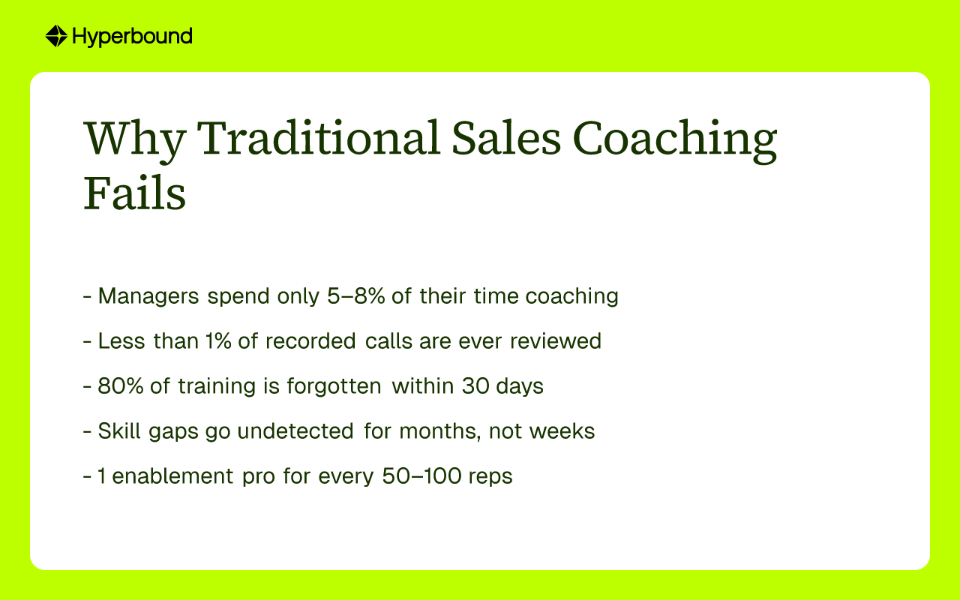
Managers already spend just 5–8% of their time on coaching, and it's the first thing that gets cut when the quarter heats up. They're listening to less than 1% of recorded conversations, which means skill gaps go undetected for months — not weeks. By the time you realize a rep is struggling with discovery, they've already cost you three or four deals.
The sales team ramp time benchmark most organizations quietly accept is somewhere between three and nine months depending on deal complexity. That's a long time to carry a rep who isn't yet contributing. But teams that rethink how reps develop skills — not just what content they're trained on — are seeing 50% faster ramp and 2x faster time to first won deal.
The shift isn't about working harder. It's about building a system that runs whether or not your manager has bandwidth that week.
Here's the three-phase operational framework that makes it possible.
Before getting into the framework, it's worth naming why the traditional model keeps failing.
Most onboarding is product-focused. Sales professionals consistently flag that ICP knowledge, buyer personas, and actual sales fundamentals are "left to the field" — meaning reps absorb them through trial and error on live prospects. That's expensive. Every cold call or discovery session with a real buyer is pipeline being spent on training.
Meanwhile, the Ebbinghaus Forgetting Curve tells us that 80% of training is forgotten within 30 days without active reinforcement. You can run the best onboarding week imaginable and still watch it evaporate before someone hits their first quota period.
Enablement leaders are outnumbered — typically one enablement professional to every 50–100 reps. They can build programs, but they can't personally ensure each rep retains and applies the right behaviors in the field.
The answer isn't hiring more coaches. It's building the infrastructure that replaces the bottleneck.
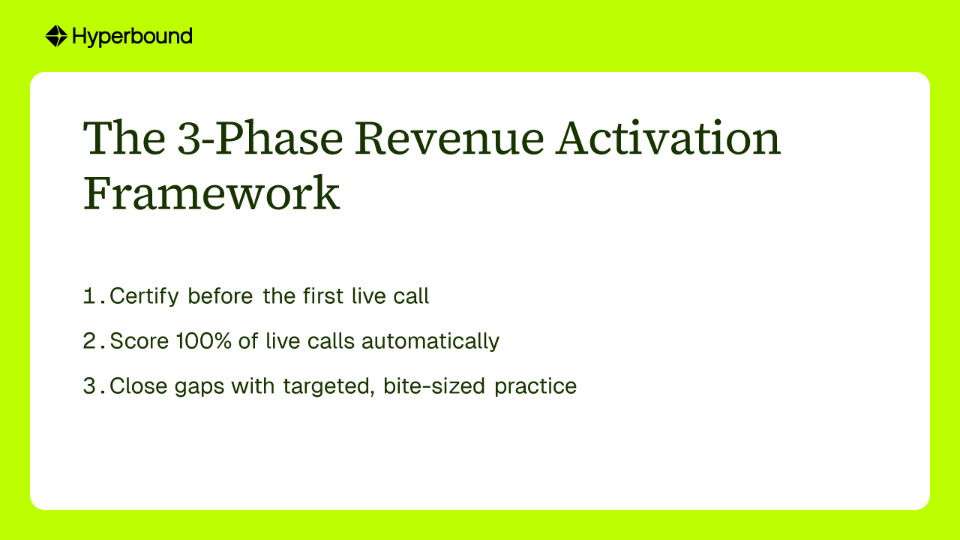
This framework mirrors a continuous loop: Certify → Score → Close Gaps → repeat. Each phase is designed to reduce the time between "new hire" and "quota-carrying contributor" — without adding management headcount.
The default assumption in most sales orgs is that reps learn by doing — throw them in, let them figure it out, and coach them when things go sideways. The problem is that "doing" means practicing on real prospects.
Reddit discussions among sales leaders are blunt about this: "Lack of onboarding and just throwing you in makes for an unprepared rep." When lead generation is already a challenge and account lists are finite, every wasted first call is a real cost.
The fix is a "practice, then perform" model: reps must demonstrate competency in a controlled environment before they touch live pipeline.
This means going beyond slide decks and product videos. Reps need to practice cold call openers, navigate discovery conversations, handle pricing objections, and run demos — all in a realistic, pressured environment that mirrors real buyer behavior.
Hyperbound Practice is built for exactly this phase. Reps can run AI roleplays across every core scenario — cold calls, discovery, demos, objection handling, renewals — with AI buyer personas that don't feel scripted. What separates Hyperbound's approach is that its AI buyer personas are built from an analysis of 2M+ hours of real B2B sales conversations, not generic templates. The AI pushes back the way real buyers push back.
After each session, reps receive instant feedback through AI Scorecards that track talk ratios, methodology adherence, key selling moments, and specific coaching areas. Managers can then use Certifications to formally verify that a rep has proven competency on a new playbook, product, or messaging change — at scale, without sitting in on every practice session.
The result: reps arrive at their first live call with reps already behind them, not ahead of them.
Even after a solid certification process, real conversations surface new gaps. The question is how fast you catch them.
In most organizations, managers catch problems in month three — when they show up as a missed number. They've reviewed maybe a handful of calls by then. The rep has been reinforcing the wrong habits for 90 days without knowing it.
The solution is automated, comprehensive call scoring that covers every call, not just the ones a manager has time to listen to.
Hyperbound Perform turns live deal activity into clear, actionable next steps. Unlike call-level coaching tools that analyze conversations in isolation, Perform connects insights across all calls in a deal — from the first cold call to the closing conversation. This is deal-level coaching: understanding not just what happened in a single call, but what pattern is emerging across an entire opportunity.
One of Perform's standout features is Auto-Scorecard Routing, which automatically assigns the right scorecard based on the type of meeting recorded. A discovery call gets scored against discovery criteria; a demo gets different benchmarks. This means feedback is always relevant — not generic.
Perform also integrates with the call intelligence tools teams are already using — like Gong, Salesloft, Chorus, and Aircall — so it adds a layer of deal-level insight and coaching on top of what's already in place.
The impact: skill gaps that would have taken three months to surface now appear in week one — while there's still time to correct them.

Identifying a skill gap is only useful if you do something about it before the next deal. This is where most enablement programs stall — they generate insights, but the pathway from "insight" to "improved behavior in the field" is slow, generic, and disconnected from what reps are actually working on.
A rep struggling to quantify pain in late-stage deals doesn't need to sit through a full discovery training module. They need a targeted, context-specific practice session they can complete in 10 minutes before their next call.
Kota Activate is the orchestration layer that closes this loop. Kota is Hyperbound's AI assistant that sits above both Practice and Perform, analyzing data from both products simultaneously. Where Perform identifies what's happening inside a single deal, Kota identifies what's happening across all deals — surfacing patterns like "this rep consistently fails to build a business case in mid-stage opportunities" or "this team is losing deals at pricing discussions across the board."
Kota doesn't just flag the gap. It recommends a specific coaching intervention and can create the practice session automatically.
Those sessions take the form of Bite-Sized Roleplays — short, focused practice runs that target a specific skill based on what live call analysis uncovered. This format solves a real adoption challenge: tenured AEs won't sit through a 45-minute generic certification. But they will complete a 10-minute roleplay that's directly relevant to a deal they're actively working. In-deal, contextual practice is something experienced reps find genuinely valuable — it's the generic stuff they tune out.
The loop then closes: the rep practices, gets back on calls, and Perform scores the next set of conversations to confirm whether the skill gap has actually improved.
This framework isn't theoretical. Teams that have implemented the Certify → Score → Close Gaps loop are seeing dramatic reductions in time-to-productivity.
Vanta cut ramp time by 60% — from 210 days down to 72 — while simultaneously growing their BDR team 4x. That's not a tradeoff between speed and scale. That's both, at the same time.
Nivoda saw a 50% ramp reduction alongside a 150% increase in demo conversion rates and doubled revenue year-over-year. Rob Rangel, Director of Sales Performance at Nivoda, credits the shift to a system that gave reps structured, scalable ways to develop skills continuously — not just at onboarding.
These results reflect what becomes possible when the sales team ramp time benchmark stops being an accepted constraint and starts being an engineering problem with a solvable system behind it.
Faster ramp doesn't come from adding more managers to the coaching equation. It comes from building infrastructure that works in parallel with — and independent of — manager bandwidth.
The three-phase framework is straightforward:
Each phase compounds. Reps ramp faster. Gaps close sooner. Managers spend their coaching time on judgment calls that actually require human input, not on reviewing routine calls that a system could flag automatically.
Winning By Design's research on ramp time is clear: effective ramping isn't a one-time event, it's an ongoing, iterative process. The teams winning on ramp time are the ones that have turned that iteration into a system.
The biggest challenge is that traditional sales coaching relies on manual efforts from managers who have very limited time. Sales managers typically spend only 5-8% of their time on coaching and review less than 1% of recorded calls. This creates a bottleneck where skill gaps go undetected for months and 80% of training is forgotten without reinforcement.
Sales teams can reduce ramp time by implementing a scalable, three-phase framework: Certify, Score, and Close Gaps. This system moves away from a "trial-by-fire" approach. First, reps are certified in a safe AI practice environment. Second, 100% of their live calls are automatically scored to identify skill gaps in near real-time. Third, those gaps are closed with targeted practice. This systematic approach has been shown to cut ramp time by up to 60%.
The 3-Phase Revenue Activation Framework is a continuous loop designed to accelerate sales rep productivity: Certify → Score → Close Gaps.
Practicing with AI allows reps to build confidence and prove competency in a controlled, risk-free environment before they use valuable pipeline for training. When reps learn "in the field," every mistake happens with a real prospect, potentially costing a deal. AI roleplays simulate realistic buyer conversations, letting reps master their talk tracks and get instant feedback so they are fully prepared from their very first live call.
While tools like Gong and Chorus are excellent for recording and analyzing individual calls, this framework connects those insights to a complete coaching and development loop. Hyperbound integrates with these tools to add a layer of deal-level intelligence, connecting patterns across an entire opportunity. It then automatically identifies skill gaps and assigns targeted AI practice, effectively closing the loop from insight to improved behavior.
No, this framework is valuable for reps at all experience levels. While it dramatically accelerates onboarding, the continuous loop of scoring live calls and closing gaps with targeted practice is highly effective for tenured reps as well. It helps them master new messaging, adapt to product changes, or refine skills. The bite-sized, contextual practice is particularly valued by experienced reps who want relevant coaching, not generic training modules.
Ready to cut your ramp time in half? See how Hyperbound powers this framework →










Use Cases
Legal