
You already know your CSMs need to practice. Renewals, escalations, QBRs, expansion plays — these are the conversations that directly move Net Revenue Retention (NRR), and getting them wrong is expensive. Yet if you're like most CS leaders or enablement managers, your current approach to customer success roleplay training looks something like this: a manager runs a session before a big product launch, everyone "plays along," nobody gets consistent feedback, and three weeks later it's like the session never happened.
Sound familiar? According to CS practitioners on Reddit, enablement feels like "yet another meeting" rather than operational support — disconnected from the actual challenges CSMs face daily. Many CSMs are running on fumes, buried under escalations and renewals, and when they do get training, it's often a one-way slide deck blitz or a release note dropped in Slack with a cheerful "Have fun!"
The result? CSMs who "wing it and hope for the best" — every single time.
The problem isn't that roleplay doesn't work. It's that most teams have no system. And without a system, human-led roleplay breaks down fast:
This guide is designed to fix that. Below is a four-phase framework for building a structured, measurable customer success roleplay training program from scratch — one that turns ad-hoc practice sessions into a scalable engine for CSM performance.
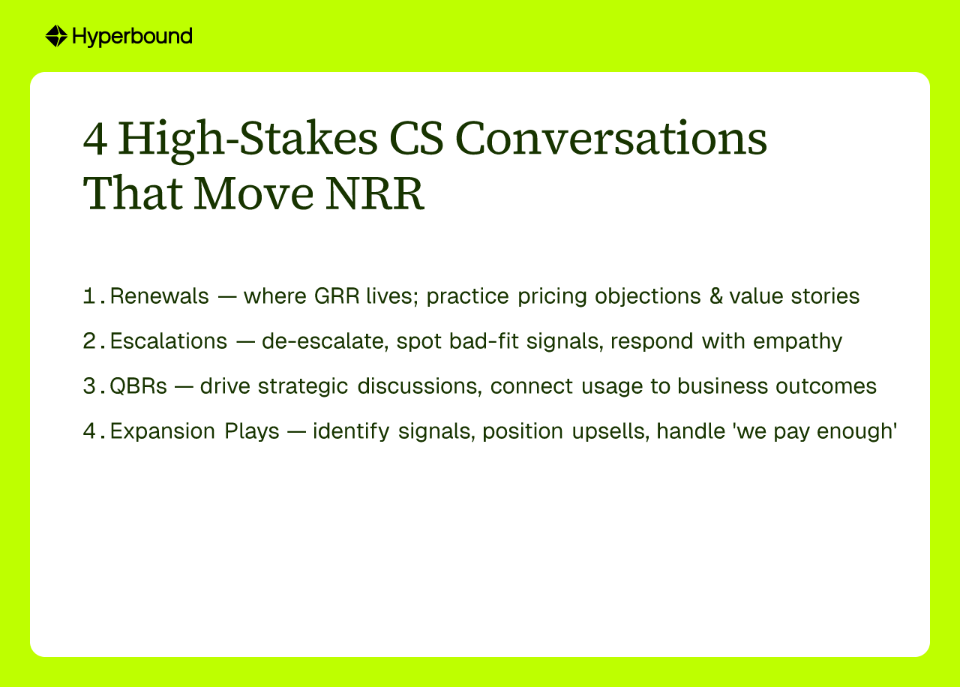
Not all customer conversations are created equal. Before you build a single scenario, start by identifying the moments that most directly influence retention and revenue. Spreading your training effort too thin across every possible touchpoint is a fast track to mediocrity. Instead, focus your customer success roleplay training on four high-leverage categories:
Renewals. The stakes are obvious — this is where GRR lives. CSMs need to practice navigating pricing objections, reinforcing the value story without leaning on buzzwords, and converting hesitant customers into committed long-term partners. A CSM who fumbles a renewal conversation doesn't get a second chance.
Escalations. According to CS community discussions, a lot of escalation cases are rooted in enablement problems. CSMs need de-escalation reps — practice identifying bad-fit signals early, applying escalation rules calmly, and addressing complaints with genuine empathy rather than reactive defensiveness.
Quarterly Business Reviews (QBRs). QBRs done poorly feel like a product update read off a slide. QBRs done well are strategic conversations that deepen executive relationships and open expansion doors. CSMs should practice delivering data-driven insights, connecting usage to business outcomes, and driving strategic planning discussions.
Expansion Plays. Upsell and cross-sell conversations are often the most undertrained. CSMs need to practice identifying expansion signals, positioning the value of additional investment, and handling the "we already pay enough" objection without killing the relationship.
Once you've mapped these four scenario categories, build out realistic practice situations for each. Pull from your call intelligence platform — like Hyperbound Perform, Gong, or Chorus — to source real objections and difficult moments your team has already encountered in the field. Develop detailed customer personas for each scenario: customer title, industry, tenure, primary pain point, and their most likely objections.
This is where Hyperbound's AI Post-Sales Roleplays can dramatically accelerate your setup. Instead of manually scripting static scenarios, the platform generates dynamic AI customer personas — a frustrated churning customer, a champion trying to build internal support for renewal, an executive stakeholder in a QBR — that respond and adapt in real time. CSMs practice against a realistic simulation, not a colleague going through the motions.
Once you know what to practice, you need to define what success looks like in each scenario. This is where most ad-hoc programs fall apart: without a standard rubric, feedback is purely subjective and impossible to scale.
Structured feedback forms are foundational to effective roleplay training — they give both the coach and the person being coached a shared language for what good looks like. Here's what a solid CS scorecard should include:
Measurable scenario objective. What's the primary goal of this specific conversation? For a renewal call: "Secure verbal commitment to renew and identify one expansion opportunity." For an escalation: "De-escalate the customer and confirm documented next steps within the call." Make it binary: did they achieve it or not?
Core competency assessment. Score foundational skills like active listening (did they paraphrase the customer's concern back to them?), empathy in delivery, clarity of communication, and ability to pivot when the conversation goes off-script.
Methodology adherence. Did the CSM follow your established playbook? Did they ask the required discovery questions before jumping to solutions? Did they use the approved talk tracks for pricing objections? Scoring methodology adherence ensures consistency across your entire team.
Binary "winning criteria" moments. For the two or three most critical moments in a scenario, use simple yes/no scoring. Did they correctly articulate the value story? Did they confirm next steps before ending the call? These binary checkpoints make aggregate scoring clean and comparable over time.
The hard truth about manual scorecards: even a well-designed rubric becomes a bottleneck when managers are responsible for filling one out for every rep after every session. You've traded inconsistent feedback for a different problem — no feedback at all, because nobody has time.
Hyperbound Practice solves this with AI Scorecards that automatically evaluate every roleplay the moment it ends. The platform tracks talk ratios, key selling moments, and adherence to specific methodologies — with instant, objective scores delivered to the rep without a manager lifting a finger. The AI Coaching layer goes further, identifying missed opportunities, weak objection responses, and off-track messaging with specific, actionable recommendations. What would have required 30 minutes of a manager's time now happens in seconds, for every rep, every session.
Here's the uncomfortable truth about one-time training events: 80% of training content is forgotten within 30 days without reinforcement. A great roleplay session in January doesn't translate into better renewal conversations in March. Practice has to be continuous — and it has to fit into how CSMs actually work.
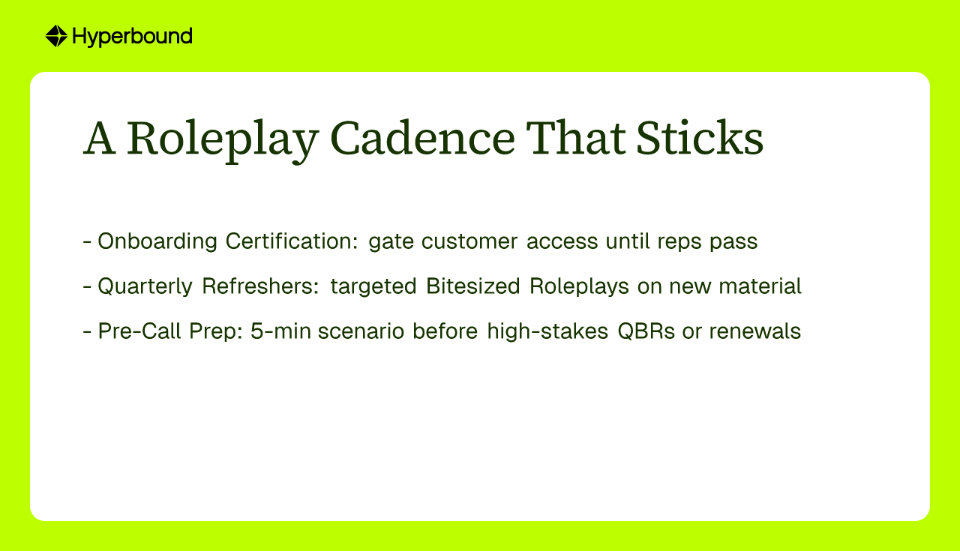
The most effective cadence maps roleplay to key lifecycle moments:
Onboarding certification. New CSMs should not get on a live customer call until they've completed and passed certification roleplays on your core scenarios. This isn't optional — it's a readiness gate. Teams using this approach with Hyperbound Practice have seen 50% faster ramp times, meaning new hires are delivering value in half the time. Define the minimum pass score for each scenario, and block customer-facing access until it's achieved.
Quarterly refreshers. Every time a new product feature ships, messaging changes, or a new competitive dynamic emerges, your team needs a practice rep. Instead of a slide deck drop and a "good luck," run a targeted Bitesized Roleplay that gets CSMs hands-on with the new material in under five minutes. This directly solves the Reddit-documented pain of receiving a release note with "Have fun" as the only preparation.
Pre-call preparation. Before a high-stakes QBR or a renewal call with a customer showing churn signals, CSMs should run one quick targeted scenario. Not a 30-minute training session — a focused, 5-minute simulation of the specific objection they're likely to face. This "call-ready" preparation model transforms practice from a training exercise into a performance tool.
The prerequisite for all of this is making practice asynchronous and accessible. If CSMs have to block time on a shared calendar to participate in a group roleplay session, you've already lost most of them. As CS enablement practitioners put it: enablement should cater to workflow, rather than the other way around.
Hyperbound Practice is built for exactly this model. Bitesized Roleplays integrate directly into Slack, your LMS (via SCORM with leading learning and enablement platforms), and CRM — meaning CSMs can complete a practice session, get scored, receive AI coaching, and move on, all without leaving the tools they're already in. This async approach saves managers an average of 3.5 workweeks of coaching time per year, while giving reps more practice reps than any live session schedule could ever provide.
If you can't connect your training program to business outcomes, it's vulnerable. Budget gets cut, participation slides, and leadership loses interest. Phase 4 is about building the measurement layer that transforms your customer success roleplay training program from a cost center into a proven revenue lever.
Step 1: Establish your baseline. Before launching your program, document your current metrics: NRR, GRR, CSAT, upsell conversion rates, average time to resolve escalations, and renewal call success rates. These are your before numbers.
Step 2: Track roleplay KPIs. Using a structured measurement framework, monitor: Roleplay Completion Rate, Average Score by Scenario, Score Improvement Over Time, and Time to Certification for new hires. For scenario-specific tracking, monitor success rates on renewal objection handling and the frequency with which CSMs identify expansion opportunities during QBR practice sessions.
Step 3: Correlate and act. Do CSMs who score higher on renewal roleplays have better GRR on their book of business? Do teams who actively practice escalation handling see fewer churn-risk flags in their accounts? Start running these correlations quarterly. Even directional data builds a compelling case for continued investment.
Manually correlating all of this is where most programs hit a wall. The data lives in too many places — roleplay scores here, call recordings there, CRM outcomes somewhere else — and nobody has time to stitch it together.
This is where Hyperbound's full platform creates a closed-loop improvement cycle. Hyperbound Perform analyzes real customer calls to surface skill gaps at the team level. Kota Activate, the AI assistant layer, sees those gaps and automatically assigns targeted practice scenarios to the right CSMs in Hyperbound Practice. The CSM completes the roleplay, improves their score, applies the skill on their next real call — which gets analyzed by Perform. The cycle repeats: Score Real Calls → Identify Skill Gaps → Practice Roleplays → Score Real Calls.
This operational loop is what turns a training program into a performance system. It's no longer about whether CSMs did the training. It's about whether the training is changing what happens on actual customer calls.
Here's the recap: building a customer success roleplay training program from scratch means doing four things well.
Done right, this framework turns CSMs from people who "wing it and hope for the best" into confident, prepared customer partners who know exactly what to say — and exactly why it works.
The infrastructure to run this at scale exists. If you're ready to stop building from scratch manually, explore how Hyperbound's AI Post-Sales Roleplays can automate scenario delivery, scoring, and coaching for your entire CS team — and finally give your program the data layer it needs to prove its impact.
Most customer success roleplay training fails because it lacks a system. Without a structured framework, sessions are often ad-hoc, leading to manager burnout from the heavy time commitment, inconsistent feedback due to varying coaching styles, and a complete lack of data to track improvement or tie practice to business outcomes like NRR.
CSMs should focus their practice on the highest-stakes conversations that directly impact Net Revenue Retention (NRR). The four most critical categories are: Renewals (to prevent churn), Escalations (to manage risk and customer satisfaction), Quarterly Business Reviews (QBRs) (to demonstrate value and build strategic relationships), and Expansion Plays (to identify and act on upsell/cross-sell opportunities).
The key to objective and consistent feedback is using a standardized scorecard for every roleplay session. A strong scorecard defines what "good" looks like by including a measurable scenario objective, an assessment of core competencies (like active listening and empathy), checks for adherence to your company's playbooks, and binary "yes/no" criteria for critical moments in the conversation.
Roleplay should be a continuous practice, not a one-off event, to ensure skills are retained and applied. The most effective cadence embeds practice into the CSM workflow at key moments: as a certification gate during onboarding, as quarterly refreshers for new products or messaging, and as quick, 5-minute pre-call preparation before high-stakes customer conversations like renewals or QBRs.
You can measure the ROI of a training program by directly correlating practice performance with business outcomes. First, establish baseline metrics like NRR, GRR, and CSAT. Next, track training KPIs such as roleplay completion rates and average scores. Finally, analyze whether CSMs who score higher in practice also achieve better results in their live customer interactions, proving the program's financial impact.
AI roleplay uses artificial intelligence to simulate realistic customer conversations, allowing CSMs to practice scenarios on-demand without needing a manager or peer. It solves the biggest challenges of manual roleplay by providing instant, objective scoring based on a predefined rubric, delivering personalized coaching, and making practice scalable and asynchronous so it can fit into any CSM's workflow.







Use Cases
Legal