
Sales leaders scrutinize pipeline reviews and find the same thing every quarter: a CRM that has become, as one recurring observation in ops forums puts it, "a polished but inaccurate representation of what is happening." The default response is to tighten compliance, add required fields, and remind reps to log their calls. The problem persists.
The diagnosis is wrong. CRM data quality degrades for two distinct reasons, and neither of them is a motivation problem. The first is mechanical: contact and company records decay on their own, regardless of rep behavior. The second is structural: the qualitative knowledge that actually drives deals forward, the buyer's real objection, the decision-maker's hesitation, the coalition forming against the purchase, lives only in the rep's head and in the conversations they have every day. The manual entry workflow cannot retrieve it.
A rep who resists filling out six required fields will talk through the same deal in two minutes. That conversation is where the data lives. The capture mechanism has to match the medium.
Understanding why CRM data is out of date starts with separating two problems that most teams treat as one.
Firmographic decay is the mechanical churn of contact records. A Dun & Bradstreet analysis cited by the NAW found that 91% of data in CRM systems is already incomplete due to duplication and outdated information. Landbase's decay rate research puts the annual decay rate for B2B contact data between 22.5% and 70.3%. Within any 12-month window, 65.8% of contacts change job title or function, 42.9% change phone number, and 37.3% change email address. This decay happens before a rep touches the keyboard. It is a data infrastructure problem, and it is addressable with enrichment tooling.
Deal-context decay is the harder problem, and it is the one that costs the most. This is the loss of qualitative knowledge: which stakeholder is blocking the deal, what the buyer said off the record about budget timing, which competitor came up on the last call. Because CRMs only capture what someone manually types, they default toward what one industry analysis describes as a "glorified Rolodex" of tasks and basic contact notes. The rich context that determines whether a deal closes is absent.
Enrichment APIs cannot supply deal-context data. It does not exist in any external database. It exists in conversations, and the only way to capture it is to make the conversation itself the capture mechanism.
The workflow is broken, not the rep. Three structural conditions explain why even disciplined teams produce incomplete records.
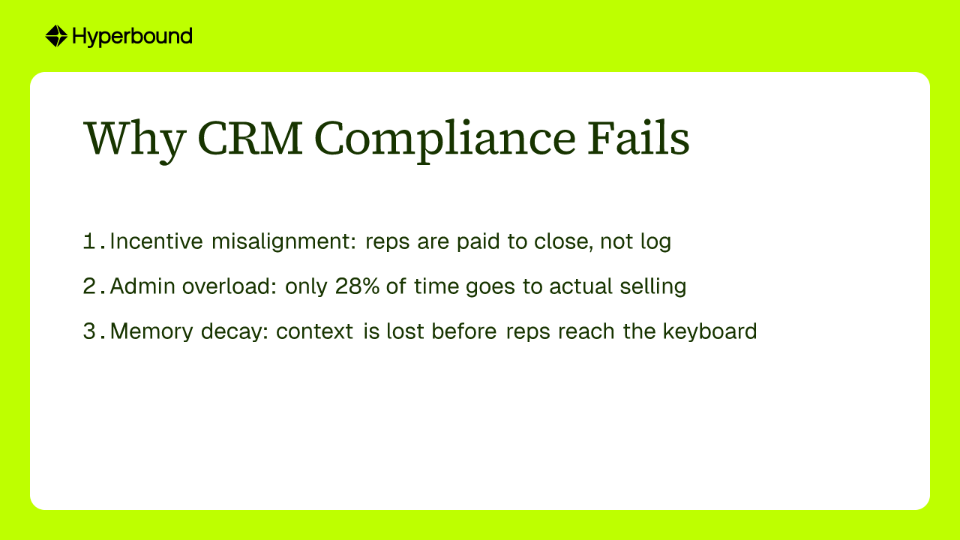
First, incentive misalignment. Reps are compensated for closing deals, not entering data. Asking them to prioritize CRM hygiene over the next call creates a friction that runs deeper than forgetfulness. It runs against the grain of every incentive the role carries.
Second, the data entry workload is a second job. According to Salesforce's State of Sales report, reps spend approximately 28% of their working week actually selling. The remainder goes to administrative tasks, internal meetings, and CRM updates. Switching from the high-context work of a sales conversation to the low-context work of structured data entry also carries a measurable cognitive cost: research from the American Psychological Association shows that task-switching reduces productivity by up to 40%.
Third, human memory degrades quickly after a call ends. A rep who intends to update the CRM after finishing their next call will write a less accurate record than one who updated it immediately. A common pattern in practitioner discussions captures this directly: by the time the rep is at a laptop, some of the information is already gone. Even the most conscientious rep produces degraded data when the logging window extends past the conversation itself.
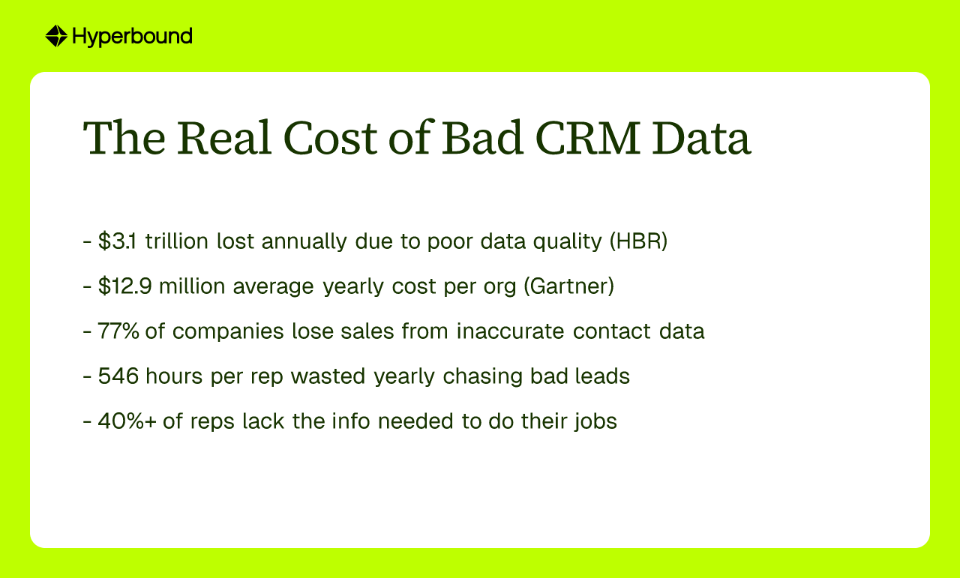
The downstream costs of why CRM data is out of date are measurable and substantial. According to Harvard Business Review data cited by Landbase, poor data quality costs U.S. businesses $3.1 trillion annually. At the organizational level, Gartner estimates the average cost of bad data at $12.9 million per year.
The sales-specific damage is equally concrete:
The last figure is the most telling. The reps who are blamed for incomplete records are themselves operating blind because of those same records. The dysfunction runs in both directions.
The correct model inverts the current workflow. Instead of asking reps to translate a conversation into structured fields after the fact, it captures the conversation directly and derives the structured data from it.
This is not a future capability. The infrastructure already exists and is already embedded in the sales tech stack. Conversation capture APIs, such as those provided by Recall.ai, integrate with Zoom, Google Meet, and Microsoft Teams to capture transcripts, recordings, and participant data from sales calls in real time. HubSpot, Apollo, Attio, Pipedrive, and ZoomInfo have all built on this infrastructure.
AI tools then act on that raw data to update the CRM automatically. The specific actions include:
Coffee.ai's 2026 analysis of conversation intelligence tools identifies automated data entry from calls as the most critical differentiator in the conversation intelligence category. That is a significant shift from the earlier framing of these tools as coaching and win-rate platforms. The primary value is now data capture.

Addressing CRM data quality requires separate strategies for firmographic and deal-context decay.
For firmographic decay, automated enrichment and cleansing tools handle the baseline. This is table stakes. The contact and company records that decay on their own schedule need a feed that refreshes them on a similar cadence, not a quarterly manual audit.
For deal-context decay, the fix is conversation capture. When evaluating tools, the relevant criteria differ by team size and complexity:
Once capture is working, the next step is turning that deal context into better execution. When the CRM is missing context, the forecast built on it is unreliable, which we cover separately in sales forecast accuracy without CRM data. Hyperbound's Revenue Activation Platform pairs live deal insights from Hyperbound Perform with AI buyer roleplays and deal-level coaching to close the loop between CRM data and rep behavior.
On the results side, the business case for clean data is supported by published figures. Organizations that address data quality report approximately 20% better campaign response rates, 15% higher close rates, and roughly 30% improvement in AI-assisted forecast accuracy within the first year (Landbase).
The pattern to watch for in any sales organization is the gap between what reps know and what the CRM contains. When those two diverge, the downstream effects show up in forecast accuracy, pipeline visibility, and the quality of coaching conversations. The instinct is to treat that gap as a compliance problem. It is not.
CRM data is incomplete because asking sellers to act as data entry clerks is structurally at odds with how they work, when they work, and what they are paid to do. The information exists. It surfaces in every call, every demo, every follow-up. The question is whether the organization has built the means to capture it at the source.
Stop measuring rep compliance with required fields. Start measuring how much of each deal's qualitative context is making it into the record automatically. That shift in measurement reflects the correct diagnosis and points directly to the workflow changes that will fix it.

CRM data falls out of date for two main reasons: firmographic decay and deal-context decay. Contact and company records deteriorate mechanically as people change jobs, titles, phone numbers, and email addresses, while the qualitative deal context that lives in sales conversations never gets captured because manual entry is slow, misaligned with rep incentives, and dependent on memory.
Bad CRM data quality is caused by a mix of automated data decay and structural workflow failures. Firmographic data decays at rates between 22.5% and 70.3% per year, and deal-context data is lost when reps cannot accurately translate conversations into structured fields after the fact. The result is incomplete, duplicated, or outdated records that undermine pipeline visibility.
B2B contact data decays continuously. Studies cited in the article show that within any 12-month window, 65.8% of contacts change job title or function, 42.9% change phone number, and 37.3% change email address. This makes automated enrichment and scheduled data refreshes essential rather than optional.
Firmographic decay refers to the mechanical churn of contact and company records, such as job changes, new phone numbers, or email updates. Deal-context decay refers to the loss of qualitative selling knowledge, such as objections, stakeholder concerns, budget timing, and competitive insights, that exists only in conversations and is not captured by traditional CRM data entry.
Sales teams can improve CRM data quality by using conversation capture tools that automatically transcribe calls and write structured summaries, contact records, and opportunity updates to the CRM. This removes the need for reps to manually log every detail after calls and aligns data capture with how selling actually happens.
Conversation capture in sales is the use of APIs and AI tools that integrate with Zoom, Google Meet, and Microsoft Teams to record, transcribe, and analyze sales calls in real time. The resulting data is then used to update CRM records automatically, capturing deal context that would otherwise be lost.
Poor data quality costs U.S. businesses an estimated $3.1 trillion annually, according to Harvard Business Review data cited in the article. At the organizational level, Gartner estimates the average cost of bad data at $12.9 million per year, with additional losses from missed sales and wasted rep time.
The best way to fix CRM data quality is to treat firmographic decay and deal-context decay separately. Use automated enrichment and data cleansing to keep contact and company records current, and use conversation capture technology to turn live sales conversations into structured CRM updates without relying on manual data entry.
Sales reps often resist updating the CRM because the workflow is misaligned with their incentives and cognitive load. They are paid to close deals, not enter data; they already spend only 28% of their time selling; and they lose context between the conversation and the moment they reach the keyboard. The problem is structural, not motivational.
AI helps with CRM data entry by automatically generating call summaries, creating contact and company records from call participants, logging activities in real time, and updating opportunity fields based on sales methodologies like BANT or MEDDIC. This reduces manual effort and captures more accurate deal context.










Use Cases
Legal