You've been working tirelessly on a promising enterprise deal for months. The prospect seems interested, your solution perfectly addresses their needs, and yet... nothing happens. The deal stalls in that dreaded "decision pending" limbo. Sound familiar?
If you're struggling to close big deals because you "cannot figure out how to create urgency," you're facing what might be the biggest challenge in modern sales. And it's not what you think.
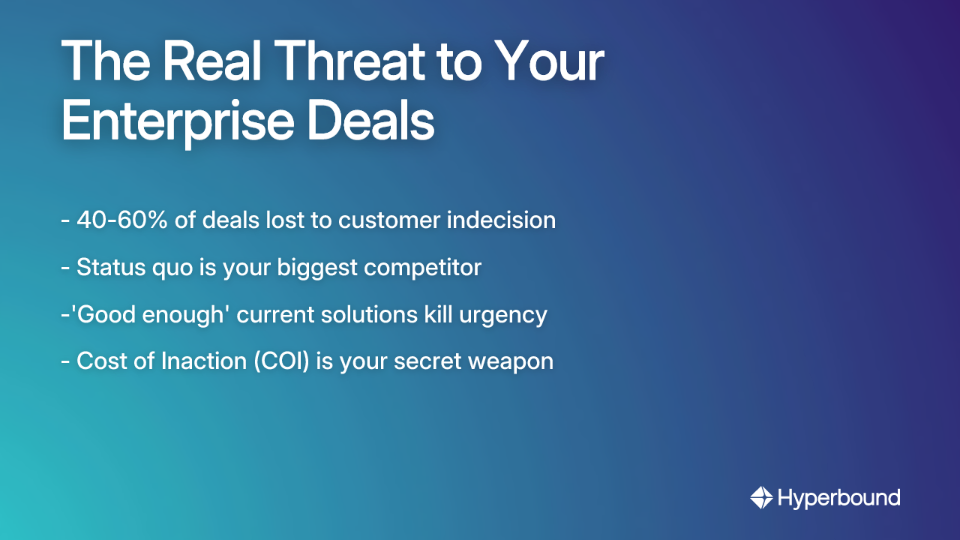
According to research by Matthew Dixon and Ted McKenna published in Harvard Business Review, over 40-60% of deals are lost to customer indecision, not to competitors. That's right - your biggest competitor isn't the other vendor; it's the status quo.
As one sales professional put it: "In most cases, the sense of urgency is not there because you are replacing a solution that, although not as good as yours, does work 'good enough' to keep things going."
This is where understanding and leveraging the "Cost of Inaction" (COI) becomes your secret weapon.
The Cost of Inaction is the tangible and intangible price a business pays by maintaining the status quo - by not making a change or decision. It encompasses:
While most salespeople focus on ROI (Return on Investment) to showcase what prospects gain by using their solution, the COI flips the script and reveals what prospects lose by doing nothing.
It answers critical questions that create natural urgency:
When you help prospects quantify their pain in concrete terms, several powerful things happen:
When a CFO understands they're losing $25,000 monthly due to inefficient processes, waiting suddenly seems expensive. When a CTO realizes security vulnerabilities expose them to $1.5M in potential breach costs, "someday" becomes "today."
By quantifying the cost of problems, you give decision makers the ammunition they need to justify the purchase internally. This is especially crucial when dealing with executive decision makers who must defend spending to their boards or leadership teams.
The SPIN model teaches us that when you help prospects discover and quantify their own pain points, you position yourself as a trusted advisor rather than a pushy salesperson. This dramatically shifts the power dynamic in your favor.
Let's break down how to effectively uncover, calculate, and communicate the Cost of Inaction to create genuine urgency.
.png)
Begin with targeted qualifying questions to uncover the full scope of your prospect's pain points. The best questions follow a progression:
Initial Discovery Questions:
Impact-Quantifying Questions:
Future-Pacing & Consequence Questions:
Using AI sales roleplay platforms like Hyperbound, reps can practice these questions in realistic scenarios until they become second nature. Remember, the goal is to guide prospects to articulate the pain in their own words, making it more real and urgent to them.
Don't present a pre-calculated cost analysis. Instead, collaborate with your prospect to build the calculation together:
[Hours wasted per week] × [Number of employees affected] × [Average hourly cost] × 52 weeks = Annual cost of inefficiency[Number of lost opportunities] × [Average deal size] = Revenue impact[Error frequency] × [Cost per error] × [Time period] = Total error costThis approach builds credibility and ownership because they're participating in the calculation.
Once you've established the cost, present two clear futures:
Scenario A (Inaction):"Based on our calculation, continuing with the current process means you'll lose approximately $300,000 over the next year, plus face increasing competitive pressure and employee frustration."
Scenario B (Action):"By implementing our solution, you could recapture a significant portion of that $300,000, while positioning your team to handle the upcoming market expansion more effectively."
Then ask the pivotal question: "If we could help you recover even 50% of that $300,000, would that justify moving forward with this project now rather than later?"
Let's look at how the Cost of Inaction manifests across different industries with concrete examples:
Simulated cold call scenario: A CRM implementation for a sales team currently using spreadsheets.
Cost of Inaction calculation:
Tailored scenario for the executive decision maker: "Your sales team is spending over 25% of their time on administrative tasks rather than selling, while competitors with automated systems are converting leads 40% faster."
Pain point: Inefficient patient data management leading to errors and readmissions.
Cost of Inaction calculation:
"Every month of delay costs your hospital nearly $500,000 in preventable expenses, not counting the patient experience impact and reputation damage."
Pain point: A sales team's deals are consistently stalling, with win rates suffering against the "do nothing" alternative.
Cost of Inaction analysis with AI:
"The data from our calls is clear: we are losing deals because we fail to make the cost of 'doing nothing' tangible for our prospects. This isn't a competitor issue; it's a sales skill gap that's costing us millions."
Remember that true urgency isn't created through artificial deadlines or pressure tactics. It emerges naturally when prospects fully understand the consequences of maintaining the status quo.
By helping prospects quantify their Cost of Inaction, you transform from a vendor pushing products into a trusted advisor helping them make informed business decisions. This approach not only shortens the sales cycle but builds stronger, more sustainable customer relationships.
The next time you face a stalled deal, don't immediately resort to discounts or artificial deadlines. Instead, revisit your discovery process and help the prospect answer the most critical question in sales: "What happens if you do nothing?"
Because in today's competitive business environment, doing nothing is rarely free—in fact, it's often the most expensive option of all.
The Cost of Inaction (COI) is the total price a business pays for maintaining its current situation and not making a decision. It goes beyond direct financial losses to include wasted time, missed opportunities, increased risks, and a decline in competitive advantage. By focusing on what a prospect loses by doing nothing, COI creates a natural sense of urgency that is more powerful than focusing solely on the Return on Investment (ROI) of a new solution.
Customer indecision is a bigger threat because a significant portion of deals, often between 40-60%, are lost not to a competing vendor but to the customer choosing to do nothing. This "no decision" outcome is often due to the perception that their current solution is "good enough." Your primary challenge is to overcome the inertia of the status quo by clearly demonstrating that inaction is more costly and riskier than making a change.
To calculate the Cost of Inaction, guide your prospect through a collaborative process of quantifying their pain points. Use simple formulas based on the information they provide, such as [Hours wasted per week] × [Number of employees] × [Average hourly cost] for inefficiency, or [Number of lost opportunities] × [Average deal size] for lost revenue. The key is to co-create the calculation, which builds credibility and helps the prospect internalize the true cost of their problem.
The key difference lies in their focus: Return on Investment (ROI) highlights the future gains from purchasing your solution, while the Cost of Inaction (COI) emphasizes the current and future losses from not purchasing it. While ROI is about a positive future, COI is about avoiding a negative one. Effective salespeople use both, first establishing the COI to create urgency and then using ROI to justify the investment.
Introduce the Cost of Inaction by positioning yourself as a strategic advisor, not a pushy salesperson. This is achieved through consultative questioning. Instead of telling them their costs, ask impact-quantifying questions like, "How many hours does your team spend on this weekly?" or "How does this issue affect your revenue goals?" When you guide them to discover and state the costs themselves, the urgency feels authentic and self-realized, not manufactured by you.
The best time to discuss the Cost of Inaction is during the discovery and qualification stages of the sales process, after you have established rapport and understood their initial problems. It's not a topic for the first few minutes of a cold call. Introduce it once you have a clear understanding of their business challenges, allowing you to ask targeted questions that help quantify the pain. This quantified pain then becomes the foundation for your business case throughout the rest of the sales cycle.











Use Cases
Legal