
How many critical insights are lost the moment a sales call ends? For many sales teams, the answer is: most of them. As one Sales Ops leader put it on Reddit, "useful information gets lost after meetings" — a classic headache where valuable context gets buried in call notes or, worse, lives exclusively in a rep's head.
The downstream consequences are real. When teams "rely mostly on notes and CRM updates, which isn't very efficient," coaching suffers, forecasting becomes guesswork, and the nuanced "why" behind a prospect's objection evaporates before anyone can act on it. And on the talent side? "Seniors have no time, the newbies just end up losing to learn."
This is exactly the problem that conversational intelligence tools were built to solve. By automatically capturing, transcribing, and analyzing every sales interaction, these platforms turn unstructured conversations into actionable data — automating CRM updates, surfacing deal risk, enforcing the sales playbook, and enabling smarter coaching at scale.
But here's the catch: not all conversational intelligence tools are built the same. In 2026, the market is led by three distinct platforms, each solving a different core challenge:
Let's break down exactly what each tool does, who it's for, and how to decide which one belongs in your tech stack.
Conversational intelligence software automatically captures, transcribes, and analyzes business conversations — calls, meetings, emails — using Natural Language Processing (NLP) to transform raw dialogue into strategic insights.
Think of it as the bridge between what happens on a sales call and what your team actually does with that information. The best platforms don't just store recordings — they surface closing signals, flag deal risk, detect tone shifts, and enable managers to coach on specific moments rather than re-listening to hours of calls.
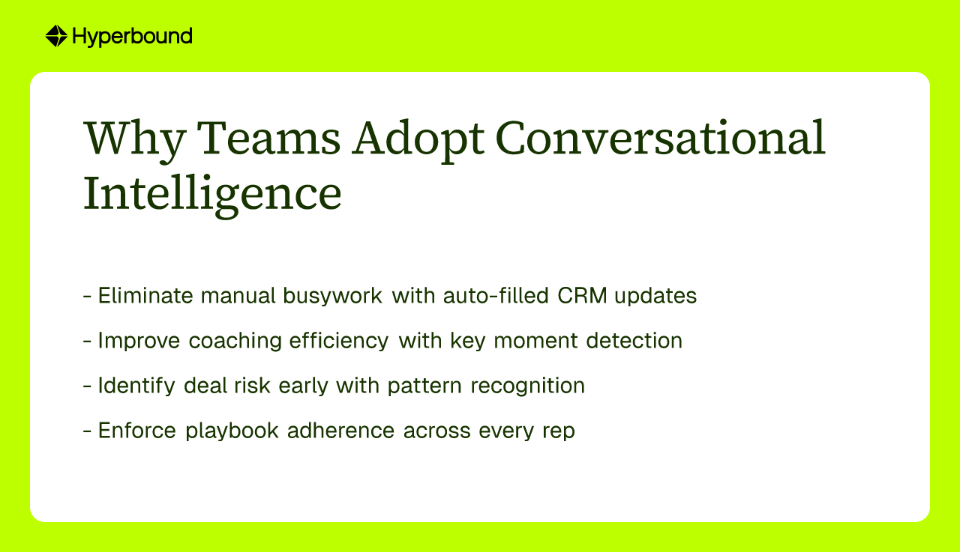
Here's why teams are rapidly adopting conversational intelligence tools in 2026:
The teams that truly win with conversational intelligence, as noted in sales ops communities, "have a structured review process where managers are listening to specific moments" — not just storing recordings to gather digital dust.
Best for: Sales enablement leaders, managers, and reps who need to reduce ramp time, drive playbook consistency, and scale coaching without burning out managers.
Hyperbound takes a fundamentally different approach to the conversational intelligence problem. While Gong and Clari answer the question "What happened on our calls?", Hyperbound answers: "How do we make sure our reps are ready before the call even starts?"
This shift from reactive analysis to proactive skill-building is what makes Hyperbound a distinct category within the broader CI landscape.
Key Features:
Where Hyperbound Shines:
Hyperbound directly addresses the hardest-to-solve pain in sales: the fact that "no tool will fix weak discovery or poor note-taking habits on its own." It doesn't just tell reps what went wrong — it gives them a safe, repeatable environment to actually fix it through practice.
It also scales beyond the core sales team. AI Post-Sales Roleplays prepare CSMs and AMs for renewal and upsell conversations, while AI Roleplay Hiring Assessments help organizations screen sales candidates on real-world selling ability — not just interview charisma.
Hyperbound supports 25+ languages, integrates with existing call recording systems (including Gong), and is SOC 2 Type II compliant for enterprise security requirements.
Best for: Enterprise sales leadership and RevOps teams that need deep deal intelligence at scale.
Gong is the category leader that most sales ops professionals think of first when someone says "conversational intelligence." Its Revenue AI platform is built around one core mission: analyze 100% of customer interactions to give revenue leaders unmatched visibility into what's actually happening across their pipeline.
The numbers back up its dominance. Gong has achieved 55%+ YoY growth with ARR exceeding $500 million — a signal that enterprise sales organizations are betting big on its approach.
Key Features:
Where Gong Shines:
As one Sales Ops leader noted, "Gong is strong for deal insights, call scoring, and pattern recognition across the team. Expensive but worth it at scale." If you need to understand what's happening across thousands of calls and dozens of reps simultaneously, there's no more powerful lens.
Where to Watch Out:
Gong is primarily a reactive tool — it excels at analyzing what has already happened. Some users note that "the coaching and analytics side is thinner" when it comes to proactive skill-building. And at its price point, smaller teams may struggle to justify the investment.
Best for: Sales Ops, forecasting teams, and VPs of Sales who need one platform to connect conversations, pipeline, and revenue.
Where Gong goes deep on conversation analysis, Clari goes wide — integrating conversational intelligence into a complete revenue operations suite that includes forecasting, pipeline management, and deal execution. Its CI product, Clari Copilot, feeds conversation data directly into the broader revenue intelligence engine.
Key Features:
Where Clari Shines:
Clari's superpower is breaking down data silos. Instead of conversation data living in one tool and your pipeline in another, Clari makes them part of the same picture. For Sales Ops leaders who are tired of toggling between platforms to get a read on what's real in the forecast, this single-source-of-truth approach is genuinely compelling.
Its sales enablement features also support reps in the moment — not just after the fact — with live guidance that makes it more than a passive recording tool.
Where to Watch Out:
The flip side of Clari's breadth is complexity. For teams solely focused on call coaching and rep skill development, the platform can feel "workflow heavy" — rich with features that go well beyond what an enablement team or frontline manager actually needs on a daily basis. Like Gong, its coaching capabilities center on analyzing past performance rather than preparing reps for future conversations.
.png)
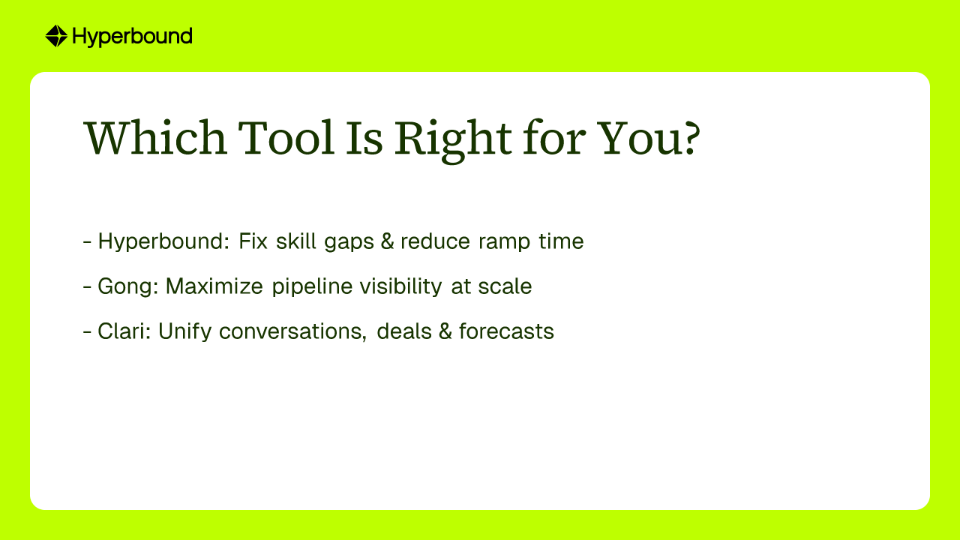
The right choice comes down to where your biggest pain lives. Here's a straightforward decision framework:
Choose Hyperbound if: Your biggest challenge is inconsistent rep performance, long ramp times, or managers who are too stretched to coach effectively. If you've ever looked at your team's call data and thought "we know the problem, but how do we actually fix it?" — Hyperbound is the answer. It's the only platform that gives reps unlimited, risk-free practice to build the skills that show up on calls.
Choose Gong if: Your primary goal is maximizing revenue from your current pipeline and understanding deal risk at scale. Its horizontal analysis and pattern recognition capabilities are unmatched for enterprise organizations that need to understand trends across thousands of calls at once.
Choose Clari if: You need to break down data silos and run your entire revenue process — from conversation to forecast — in a single platform. Clari is built for Sales Ops and leadership teams who are tired of triangulating insights from three separate tools to understand what's actually in the pipeline.
Not sure yet? Ask your team these questions:
Choosing a conversational intelligence platform in 2026 is about aligning your tech investment with your most urgent sales objective.
If your goal is building a team that consistently wins future conversations, Hyperbound is in a category of its own. For analyzing past revenue signals and understanding what's driving — or threatening — your pipeline, Gong remains the gold standard. For managing the present with an integrated view of conversations, deals, and forecasts, Clari is purpose-built for that challenge.
The smartest teams may ultimately leverage a combination: using Gong or Clari to identify a specific weakness — like poor objection handling surfacing across multiple reps — and then deploying Hyperbound's AI Sales Roleplays to create a targeted training workflow that actually fixes it at scale.
The primary difference lies in their core focus: Hyperbound is a proactive AI coaching platform for skill development, Gong is a reactive revenue intelligence tool for analyzing past deals, and Clari is a unified platform for connecting conversations to forecasting. Simply put, Hyperbound prepares reps before a call, Gong analyzes what happened after a call, and Clari manages the entire revenue process in real-time.
Conversational intelligence tools improve sales performance by automating manual tasks, providing data-driven coaching insights, identifying deal risks, and ensuring sales playbook adherence. They free up reps from note-taking to focus on selling, help managers coach more effectively on specific call moments, and use AI to spot winning behaviors that can be scaled across the team.
AI-powered sales coaching is superior because it is scalable, consistent, and immediately available, offering personalized feedback without manager burnout. Traditional coaching is often limited by a manager's time. AI platforms like Hyperbound score every call against a custom rubric, provide instant feedback, and use AI roleplays to give reps a safe space to practice and improve without risking live deals.
Yes, Hyperbound is designed to complement tools like Gong and Clari. Many teams use Gong or Clari to identify a team-wide skill gap (like poor objection handling) and then deploy Hyperbound’s AI roleplays to deliver targeted training that actively fixes the problem. This turns insights from your analytics tool into an actionable training program.
The main benefit of AI sales roleplays is providing reps with a safe, scalable, and realistic environment to practice any sales scenario on-demand and receive instant feedback. Unlike peer roleplays, which are time-consuming and hard to scale, AI roleplays are always available. This helps reps master talk tracks and build confidence before speaking to a real prospect, which significantly reduces ramp time.
Conversational intelligence tools are most beneficial for B2B sales organizations, specifically for sales enablement leaders, sales managers, RevOps teams, and individual reps. Enablement uses them to scale coaching, managers use them to improve team performance, RevOps uses them for accurate forecasting, and reps use them to automate tasks and get self-coaching insights.
If you've identified that building consistent, elite-level sales skills is the key to unlocking your revenue goals, see what that looks like in practice. Try Hyperbound's free interactive demo and let your reps practice any sales scenario — before it costs you a real deal.










Use Cases
Legal