
You get off a discovery call feeling great. The prospect shared their budget range, named two internal champions, and dropped a hint about a Q3 deadline. Then you close your laptop, fire off a follow-up email from memory, and log a two-line CRM note.
Two weeks later, that context is gone — and with it, the nuanced "why" behind every objection they raised.
This is the classic Sales Ops headache. As one sales leader put it in a recent community thread, teams "rely mostly on notes and CRM updates, which isn't very efficient." Useful information gets lost after meetings, coaching and forecasting both suffer, and reps keep making the same mistakes on the next call.
Conversational intelligence tools were built to solve this. They record, transcribe, and analyze sales conversations — surfacing keywords, talk ratios, deal risks, and coaching opportunities. And they work, to a point.
The problem? Most conversational intelligence tools stop at the insight. They tell you what happened. They don't change what happens next.
This creates a growing gap in the market. Managers review less than 5% of recorded calls weekly, meaning most coaching opportunities never materialize. Reps burn live pipeline while they're still learning. And the cycle repeats itself, quarter after quarter.
The next evolution of the category closes that loop. Rather than building a library of call data that sits largely unread, Revenue Activation platforms use conversation analysis to drive rep behavior change, targeted practice, and deal-level execution — turning insights into wins.
This article evaluates 9 of the best conversational intelligence tools for B2B sales teams across four consistent criteria:
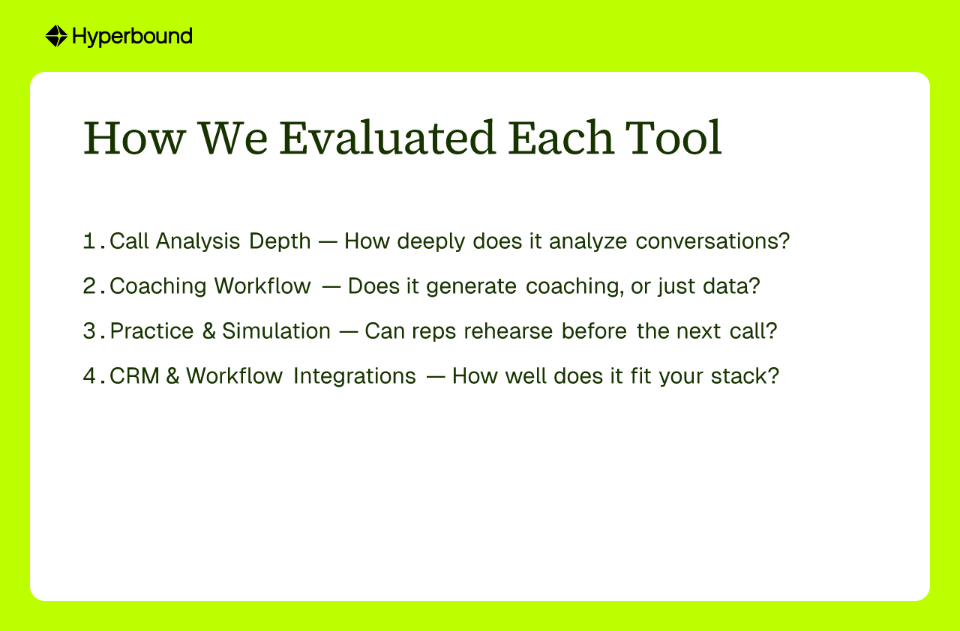
The tools are split into two tiers: one Revenue Activation platform that connects insights to outcomes, and eight traditional CI tools evaluated against the same framework.
Best for: B2B sales teams that want to turn call intelligence into measurable performance improvement
Hyperbound coined the term "Revenue Activation" to describe what happens when teams stop just analyzing call data and start using it to change outcomes. It's not a call recorder with a coaching tab bolted on — it's a purpose-built platform built around a continuous improvement loop: Practice → Perform → Activate.
Call Analysis Depth: Hyperbound Perform analyzes interactions across the entire deal lifecycle — not just individual calls in isolation. It surfaces deal-level insights, tracks stakeholders, grades email interactions, and matches patterns against historical closed-won and closed-lost deals to recommend deal-winning next steps. This gives sales leaders the "horizontal analysis of a client's journey" that standalone call recorders can't provide.
Coaching Workflow: This is where Hyperbound separates itself from every other tool on this list. Kota Activate, Hyperbound's AI Revenue Analyst, lives in Slack or Teams and orchestrates coaching interventions across your entire pipeline simultaneously. It doesn't just flag a bad call for a manager to review — it analyzes skill gaps, recommends specific coaching actions, and can automatically assign targeted AI roleplays to the rep so they practice before the next conversation. The result: 3.5 workweeks of coaching saved without reducing coaching quality.
Practice/Simulation Capability: Hyperbound Practice is the flagship product and the strongest practice layer in this entire list. AI buyer personas are trained on 2M+ hours of real B2B sales conversations — not generic scripts. Reps can build digital twins from LinkedIn profiles, practice demos with screen comprehension, and simulate multiparty calls with multiple AI stakeholders. 250,000+ simulations have been delivered across 7,000+ companies, with results including 50% faster ramp and, for Vanta, a 60% ramp reduction (210 days down to 72).
CRM/Workflow Integrations: Deep integrations with Salesforce, HubSpot, Gong, Chorus, Salesloft, Slack, Teams, Zoom, and LMS platforms like Seismic and Highspot (via SCORM). Auto-CRM Fill automatically captures and pushes conversation data into HubSpot, eliminating manual data entry. Salesforce AutoFill is coming soon.
Bottom line: If you already have Gong or Chorus and feel like you're drowning in data but not moving the needle on win rates or ramp time, Hyperbound is the activation layer your stack is missing. It integrates with the tools you have and closes the loop between insight and execution.
Best for: Enterprise teams that need deep call analytics and deal visibility
Gong is the market leader in Revenue Intelligence and the benchmark every other CI tool gets measured against. Its strength is scale — building a searchable, analyzable library of every customer conversation, with AI-powered pattern recognition that surfaces deal risks, competitor mentions, and coaching moments.
Call Analysis Depth: Excellent. Gong tracks keywords, talk ratios, topic trends, and deal momentum signals across thousands of calls. Its deal boards give revenue leaders clear visibility into pipeline health at a glance.
Coaching Workflow: Gong provides rich data for coaching but relies entirely on managers to act on it. With managers spending only 5–8% of their time coaching and reviewing fewer than 5% of calls weekly, the bottleneck isn't insight — it's activation. As the Hyperbound vs. Gong breakdown notes, Gong is "a giant library of data." Finding and acting on coachable moments remains a manual, manager-dependent process.
Practice/Simulation Capability: None. Gong tells you what went wrong; it doesn't give reps a place to rehearse doing it differently.
CRM/Workflow Integrations: Excellent — deep Salesforce integration and broad support across the major CRM and engagement platforms.
Bottom line: The gold standard for call analytics and pipeline visibility. Pair it with a practice layer like Hyperbound to activate the insights it generates.
Best for: Teams already embedded in the ZoomInfo ecosystem
Chorus is a strong Gong alternative with robust conversation analytics and a tight integration with ZoomInfo's contact and company data — useful for enriching call insights with buyer context.
Call Analysis Depth: Comparable to Gong, with solid transcription, keyword tracking, and deal-level analytics. The ZoomInfo enrichment adds a layer of buyer intelligence that standalone recorders lack.
Coaching Workflow: Provides scorecards and coaching opportunities, but like Gong, the process is largely post-mortem and manager-driven. There's no automated pathway from insight to intervention.
Practice/Simulation Capability: Limited to none natively.
CRM/Workflow Integrations: Strong, particularly for organizations already using ZoomInfo's broader data platform.
Bottom line: A capable CI platform — especially valuable if ZoomInfo is already part of your stack. The same activation gap as Gong applies here.
Best for: Teams that want sales engagement and basic CI in a single platform
Salesloft is primarily a sales engagement platform — cadence management, dialer, email sequencing — with conversation intelligence built in as a feature. It's a reasonable choice if you want to consolidate your engagement and recording tools, but it's not a dedicated CI platform.
Call Analysis Depth: Functional but narrower than Gong or Chorus. Analysis is typically limited to calls made through the Salesloft dialer, which creates gaps if your team uses multiple channels. The depth of analysis is generally considered lighter than dedicated tools.
Coaching Workflow: Salesloft includes some coaching features, but they're not the platform's primary strength. Teams serious about coaching typically pair it with a dedicated tool.
Practice/Simulation Capability: None.
CRM/Workflow Integrations: Strong — CRM sync is a core part of its engagement platform DNA, with deep HubSpot and Salesforce integrations.
Bottom line: A solid all-in-one engagement platform. If CI is your primary need rather than a nice-to-have, a dedicated tool will serve you better.
Best for: Contact centers prioritizing compliance and quality assurance
Observe.AI is built for contact center environments where compliance, QA scoring, and agent performance are the primary concerns. It's a powerful tool in its lane — but that lane is customer support and inbound contact centers, not complex B2B sales cycles.
Call Analysis Depth: Strong across its target use cases — real-time transcription, sentiment analysis, and auto-QA scoring across 100% of conversations. Compliance tracking is a standout feature.
Coaching Workflow: Structured coaching workflows exist, but they're optimized for support agents and compliance scenarios rather than the nuanced multi-stakeholder dynamics of B2B sales.
Practice/Simulation Capability: No interactive sales simulation capabilities.
CRM/Workflow Integrations: Integrates with contact center platforms and common CRMs, though with less depth for sales-specific workflows.
Bottom line: A category leader in contact center intelligence. For B2B sales teams, the fit is limited unless your primary need is compliance and QA.
Best for: Budget-conscious teams that need reliable transcription and summaries
Fireflies.ai is a cost-effective AI meeting notetaker that attends your calls, transcribes them, and surfaces action items. Among the budget-friendly options recommended by the sales ops community, it's consistently praised for getting the basics right.
Call Analysis Depth: Good at keyword tracking, topic filtering, and sentiment tagging. Summaries are reliable and easy to share. Sales-specific analytics — like deal health or methodology adherence — are limited.
Coaching Workflow: Minimal. Fireflies is a meeting documentation tool more than a coaching platform. As community feedback puts it, tools like this are "lighter on the coaching analytics side."
Practice/Simulation Capability: None.
CRM/Workflow Integrations: Broad integration coverage, including most major CRMs. Notes and summaries push automatically, which helps reduce the "post-demo data leak" teams experience with manual logging.
Bottom line: A practical, affordable starting point. If your primary pain is losing information after calls, Fireflies solves that. If your primary pain is rep performance, you'll need more.
Best for: Individual contributors and small teams on Zoom who want a free notetaker
Fathom is a popular, often free meeting assistant that records and summarizes Zoom calls. It's widely adopted by individual reps and small teams who want to stop taking notes without investing in an enterprise platform.
Call Analysis Depth: Automated highlights and summaries are solid. A keyword search and basic call library are available. AI scoring is gated behind paid plans, and it's notably thinner than dedicated platforms — consistent with community feedback that "the coaching and analytics side is thinner" with tools like Fathom.
Coaching Workflow: Essentially none at the team level. Fathom is designed for the individual user experience, not structured manager-rep coaching workflows.
Practice/Simulation Capability: None.
CRM/Workflow Integrations: CRM sync exists but is less robust than enterprise platforms. As one sales ops user noted, "Fathom covers the basics well for solo reps, but the CRM sync is pretty thin."
Bottom line: Excellent free option for individual reps. Not a fit for teams running structured coaching or pipeline review processes.
Best for: Teams that need accurate transcription across meeting types
Otter.ai is best known for its transcription accuracy — it handles sales calls, internal meetings, and interviews equally well. The recent addition of "Otter AI Chat" lets users ask questions about meeting content after the fact.
Call Analysis Depth: Exceptional transcription and speaker diarization. Sales-specific analytics like competitor tracking, talk ratio analysis, or methodology scoring are absent. It's a transcription product, not a revenue intelligence platform.
Coaching Workflow: Not a coaching tool. It replaces manual note-taking effectively but doesn't generate structured coaching opportunities or workflows.
Practice/Simulation Capability: None.
CRM/Workflow Integrations: Basic — transcript syncing is available, but deep CRM or sales workflow integrations are limited.
Bottom line: Best-in-class transcription for teams that just need accurate records. Not a substitute for a CI platform when coaching and deal intelligence are the goal.
Best for: Enterprise teams that want a unified sales readiness and enablement platform
Mindtickle is a comprehensive Sales Readiness platform that wraps conversation intelligence inside a broader enablement suite — onboarding, training modules, certifications, and content. It's a natural fit for enterprise teams that want a single vendor for readiness.
Call Analysis Depth: Mindtickle's "Call AI" feature provides solid CI functionality, but it's positioned as an input to the readiness platform rather than a standalone analytics layer.
Coaching Workflow: Coaching is a core feature, woven into the broader training and certification workflows. It's well-suited for structured enablement programs, though it can feel heavyweight for teams that just need fast, targeted coaching.
Practice/Simulation Capability: Mindtickle offers practice scenarios, but Hyperbound is purpose-built for AI roleplay at a deeper simulation fidelity — trained on real B2B call data rather than generic scenarios. For teams where simulation quality directly impacts deal outcomes, that distinction matters.
CRM/Workflow Integrations: Broad integrations with CRMs and sales tools as part of the platform suite approach.
Bottom line: A strong choice for enterprise enablement teams running formal readiness programs. If your primary need is AI roleplay depth and deal-level coaching, a more specialized platform will outperform it.
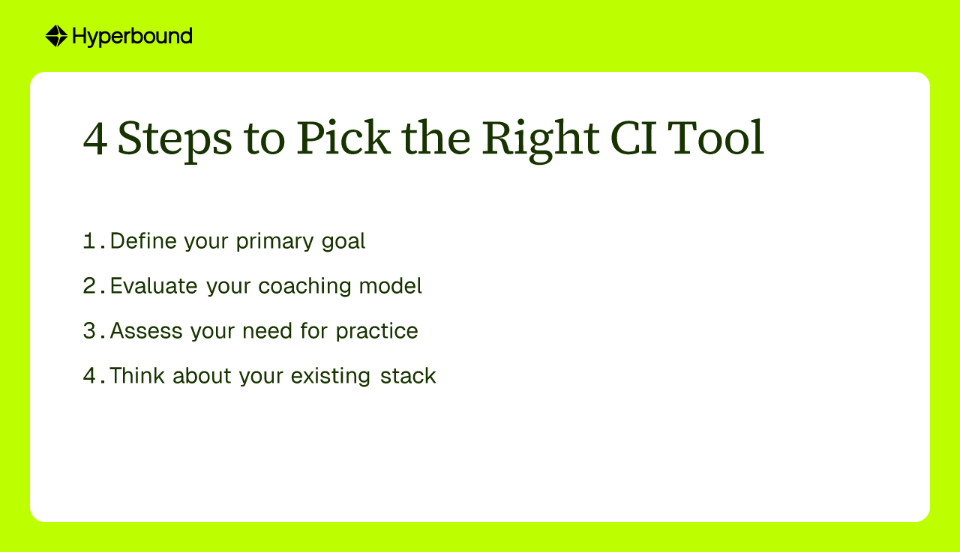
The sales ops community has clear advice here: "Don't just look at features — figure out what features you really need." The tools on this list serve genuinely different needs. Here's how to match your situation to the right choice.
Step 1: Define your primary goal.
.png)
Step 2: Evaluate your coaching model.
If your coaching is reactive — managers review flagged calls when they find time — Gong and Chorus give them better material to work with. But the bottleneck isn't data; it's activation. If managers are only coaching 5–8% of the time and reviewing fewer than 5% of calls, more data won't move the needle.
If you want a proactive, scalable coaching engine — one that identifies gaps automatically and delivers practice to reps before they burn live pipeline — you need a platform built around that loop. Hyperbound's continuous cycle (Score Real Calls → Identify Skill Gaps → Practice Roleplays → Score Real Calls) is designed specifically for this.
Step 3: Assess your need for practice.
Traditional conversational intelligence tools show you the problem after the fact. The rep mishandled the pricing objection. The discovery call went shallow. The economic buyer was never mapped. Now what?
Platforms with a robust practice layer let you fix those problems in a safe environment — before the next call. If your reps don't get enough at-bats, or if you're rolling out new messaging and need to certify the whole team fast, practice infrastructure isn't a luxury. It's the mechanism that makes your CI investment pay off.
Step 4: Think about your existing stack.
If you already have Gong or Chorus, you don't necessarily need to replace them. Hyperbound integrates natively with both, activating the call data you're already collecting. Auto-CRM Fill addresses the manual data entry burden. SCORM compatibility with Seismic, Highspot, and Showpad means practice content embeds directly into your existing LMS.
The question isn't always "which tool do I choose?" — sometimes it's "what layer is missing from what I already have?"
The conversation intelligence tools on this list represent a spectrum. At one end, you have transcription tools that help your team stop losing context after meetings. At the other, you have a Revenue Activation platform that connects every call, every coaching intervention, and every rep practice session into a closed loop that drives win rates.
There's an analogy that captures the difference well: a library versus a gym. Traditional CI tools are libraries — massive, well-organized, searchable. A gym is where you actually get stronger. Both have value. But if your problem is performance, you need the gym.
For B2B sales teams dealing with long ramp times, inconsistent deal execution, and win rates that won't budge despite mountains of call data, the answer isn't more insight. It's activation.
The tools exist. The question is whether you're using them to build a dashboard or to drive outcomes.
A conversational intelligence (CI) tool is a software platform that records, transcribes, and analyzes sales conversations from calls and video meetings. These tools use AI to surface key insights like keywords mentioned, talk-to-listen ratios, and potential deal risks, helping sales teams understand what happens in their customer interactions.
Conversational intelligence is important because it solves the problem of lost information and context after sales calls. Without it, valuable details from prospect conversations are forgotten, coaching becomes inefficient, and forecasting is less accurate. CI tools create a searchable library of every interaction, ensuring that insights are captured and can be used to improve coaching, strategy, and overall sales performance.
The main difference is that Conversational Intelligence (CI) tells you what happened on a call, while Revenue Activation uses those insights to change what happens next. Traditional CI tools provide analytics and data, but Revenue Activation platforms like Hyperbound close the loop by connecting insights to action through automated coaching, targeted practice simulations, and AI-driven recommendations to improve rep behavior and execution.
To choose the right tool, you should first define your primary goal (e.g., note-taking, deal visibility, or performance improvement). Then, evaluate your current coaching model, assess your need for a practice or simulation environment, and consider how the tool will integrate with your existing tech stack, such as your CRM. This article's decision framework can guide you through matching your specific needs to the right platform.
The primary limitation of traditional CI tools like Gong and Chorus is that they stop at the insight. While they are excellent at creating a library of call data and surfacing analytics, they rely entirely on managers to manually review calls and initiate coaching. With managers reviewing less than 5% of calls, most coaching opportunities are missed, creating a gap between data and actual performance improvement.
AI-powered sales practice allows reps to rehearse critical conversations in a safe, simulated environment before engaging with live prospects. Platforms like Hyperbound use AI buyer personas trained on real sales data to create realistic roleplays for objection handling, new messaging, or complex deal scenarios. This allows reps to get more "at-bats," build muscle memory, and refine their skills, leading to faster ramp times and higher win rates.
Yes, you can. Revenue Activation platforms like Hyperbound are designed to act as an "activation layer" on top of your existing tools. They integrate directly with Gong and Chorus to pull in the call data you're already collecting and use it to drive automated coaching workflows and practice simulations, closing the gap between insight and execution without requiring you to replace your current system.









Use Cases
Legal