
You're talking to someone who's excitedly sharing their new passion project. They finish their story, looking at you expectantly. Your mind goes blank. "That's cool!" you reply, and then... silence. The conversation deflates like a punctured balloon, and you've inadvertently killed another potentially meaningful exchange.
Sound familiar? You're not alone. For many people, especially those with anxiety, it can be incredibly difficult to come up with questions in the moment. As one person shared on Reddit, "and I've effectively killed the conversation by accident." This isn't just about talking; it's about a deeper, often unmet "need for connection."
The good news? Transforming conversational dead-ends into doorways for genuine connection is a learnable skill. This guide will show you how to move beyond passive reactions to create meaningful dialogue—even if you struggle with anxiety or feel intense pressure to perform socially.
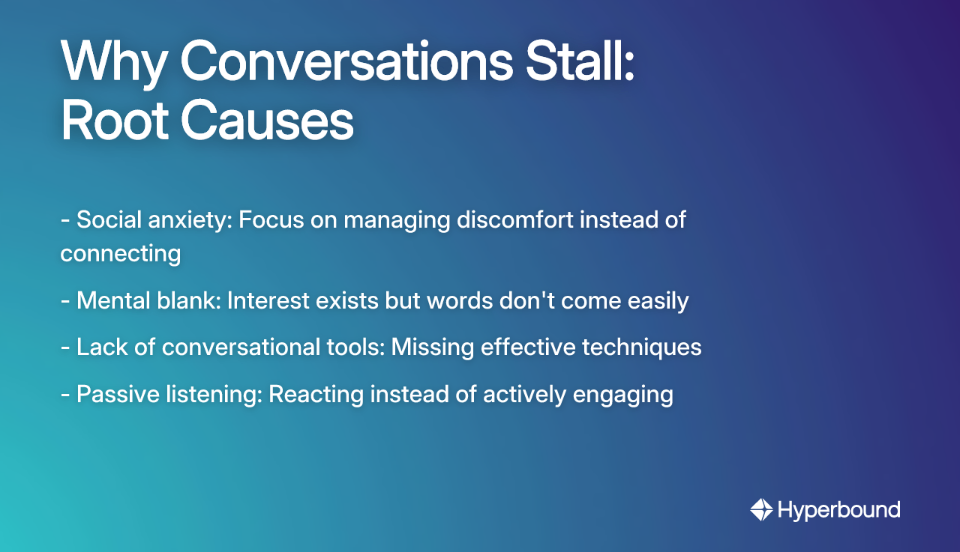
When we respond with phrases like "That's cool" or "Interesting," we're often engaging in passive listening rather than active engagement. These responses can stem from:
Remember that this struggle isn't a personal failing—it's a common challenge that many people face due to anxiety disorders or simple lack of practice. The difference between those who connect easily and those who struggle often comes down to having the right mindset and techniques.
The core mindset shift is moving from reacting to engaging with genuine curiosity. As technology PR professional Andy Lowe suggests, the goal is to be genuinely interested in what drives your conversation partner. View every conversation not as a test of your social skills, but as an opportunity to learn something fascinating about another person.
Open-ended questions are conversation gold because they cannot be answered with a simple "yes" or "no." They invite stories, opinions, and feelings—the building blocks of meaningful connection.
Before: "That's cool!"
After: "That's cool! What inspired you to start that project?"
Before: "Did you have a good day?"
After: "What was the most interesting part of your day today?"
Before: "I like that movie too."
After: "I like that movie too! Which character did you relate to most and why?"
Before: "Nice hobby."
After: "What do you love most about that hobby? How did you first discover it?"
The key is to move from closed statements that end exchanges to open invitations that extend them.
Reflective listening is a powerful communication technique rooted in psychological principles where you demonstrate understanding by paraphrasing what the speaker has said, asking clarifying questions, and summarizing their points. Its goal is to validate the other person's feelings and build trust.
.png)
Before: "That's cool!"
After: "It sounds like you're really excited about that! What aspect of the project excites you the most?"
The goal isn't to pepper someone with questions until they feel like they're being interviewed by a journalist—or worse, interrogated. Balance is key to natural conversation flow.
Instead of another direct question, use gentle prompts that invite elaboration:
These phrases create space for the other person to expand on their thoughts without feeling pressured to answer a specific question.
When conversations need direction, these topic areas can help you dig deeper with natural follow-up questions:

For those who think, "I think about all the things I wanted to say/ask earlier," practice is essential. These exercises help build the muscle for spontaneity in conversation:
After your next conversation, take two minutes to reflect:
This builds a mental library of better responses you can draw from in future conversations.
Find a friend who also wants to improve their conversation skills:
This helps you practice staying with a topic rather than jumping to new ones when you feel uncomfortable.
For those who want to practice solo, technology offers powerful new tools. AI platforms can simulate conversations and provide feedback, helping you build confidence at your own pace. For professionals in fields like sales, platforms like Hyperbound offer AI-powered role-plays to master specific business conversations. Other tools like Yoodli and Second Nature focus on general public speaking and communication skills.
Transforming "That's cool" into meaningful dialogue isn't about becoming someone you're not. It's about developing tools that help you express the interest you already feel and manage the pressure to perform that often comes with social interaction.
This isn't a performance; it's a practice. Be patient with yourself. Every conversation is a chance to learn and grow. The goal isn't to be a perfect conversationalist—it's to build more authentic, rewarding connections, one follow-up question at a time.
Remember that meaningful connections aren't built on clever techniques alone, but on genuine empathy and investment in others. When you approach conversations with sincere curiosity about the person in front of you, the right questions and responses will flow more naturally over time.
Start small. Practice one technique at a time. Celebrate your progress. And most importantly, give yourself permission to be a work in progress. Even the most engaging conversationalists had to start somewhere.
The next time you hear yourself say "That's cool," pause. Take a breath. And then, ask the question that might just open the door to a deeper connection.
Saying "That's cool" is often bad for conversations because it is a passive response that signals the end of an exchange rather than inviting further discussion. It closes the door on the topic, whereas the goal of a meaningful conversation is to open doors by showing active engagement and genuine curiosity.
The easiest way to ask better follow-up questions is to use open-ended questions that cannot be answered with a simple "yes" or "no." Instead of asking a closed question like, "Did you have a good day?" try an open-ended one like, "What was the most interesting part of your day?" This invites the other person to share a story, feeling, or opinion, which deepens the conversation.
You can prevent your mind from going blank by shifting your focus from performing to being curious. Instead of worrying about saying the perfect thing, concentrate on genuinely learning about the other person. Use simple prompts like "Tell me more about..." or practice "Conversation Rewind" exercises after an interaction to build a mental library of go-to responses for the future.
To avoid making a conversation feel like an interrogation, balance your questions with your own contributions. Use the "1-for-1" rule: after they answer your question, briefly share a related anecdote or thought of your own before asking another question. This creates a natural give-and-take rhythm and shows you're an engaged participant, not just an interviewer.
Reflective listening is a powerful technique where you show you understand someone by summarizing or paraphrasing what they've said and acknowledging the emotions behind their words. Using phrases like, "So, it sounds like you felt..." confirms you're actively listening and validates their experience, which builds trust and fosters a stronger connection.
Yes, these techniques can be incredibly helpful for social anxiety because they provide a clear structure to follow when you feel overwhelmed. The key to sounding authentic is to focus on genuine curiosity rather than on perfect execution. Start with small phrases that feel natural to you, and remember that the goal is connection, not performance. Your curiosity will make the interaction feel genuine, even if you're nervous.











Use Cases
Legal