
Conversation intelligence tools answer one question: what happened on the call. They record, transcribe, and analyze the conversation, then surface a flag for the rep or manager: a missed objection, weak discovery, or unconfirmed next step. That is a legitimate capability, and most revenue organizations already pay for it. The harder question is what happens after the flag, and almost nothing in the category is built to answer it. Revenue Activation takes the flag conversation intelligence produces and converts it into practice built from that exact call, then verifies whether the same miss occurs on the next call. It does not replace the conversation intelligence tool underneath it. It runs on top of the data that tool already captures.
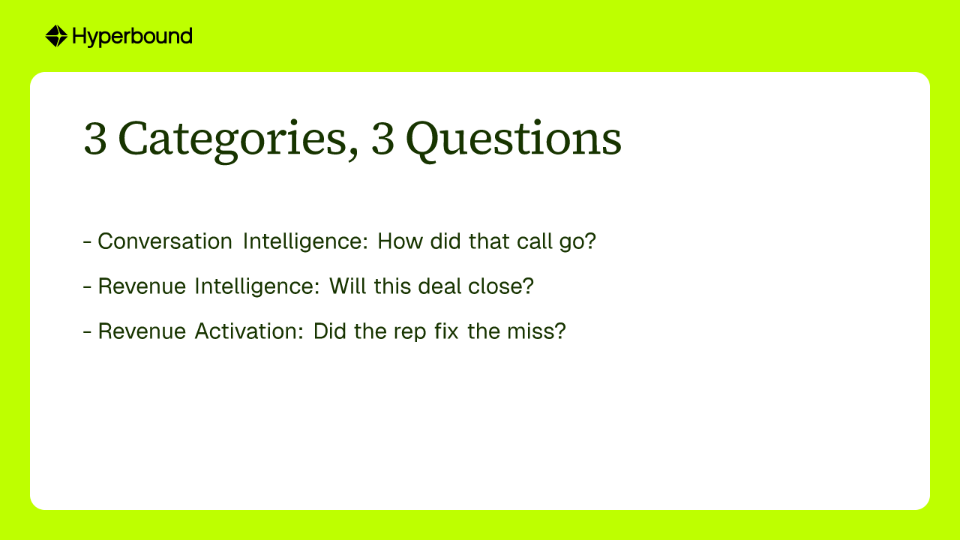
Vendors blur these labels constantly, which makes it difficult to determine whether a new tool duplicates an existing one. The clearest separation is the question each category is built to answer.
Conversation intelligenceRevenue intelligenceRevenue ActivationCore questionHow did that call go?Will this deal close, and is our forecast accurate?Did the rep fix the miss, and does it hold on the next real call?What it capturesCall recordings, transcripts, sentiment, talk ratio, keywordsDeal and pipeline data aggregated across the CRMThe rep's own flagged calls, scorecard criteria, and the next live call against the same criteriaPrimary outputInsight and coaching recommendations delivered inside the workflowForecast accuracy and pipeline risk scoringA practice scenario built from the actual miss, then a re-checkWhen it actsAfter the call, on a delayOngoing, across the pipelineBefore the next call and during the dealCloses the loop back to a behavior changeNoNoYesPricingVariesVariesVaries
Conversation intelligence and revenue intelligence answer diagnostic questions. Revenue Activation answers an execution question and is the only one of the three built to check whether a fix took hold.
Vendors in the conversation intelligence category describe it the same way: as software that automatically captures, transcribes, and analyzes business conversations and turns unstructured calls, meetings, and emails into structured, actionable data. The scope ends at data. That is the category's stated boundary.
Gong lists three reasons enablement and sales leaders use conversation intelligence: to uncover hidden insights, patterns, objections, and buying signals; to drive coaching using real examples pulled from analyzed calls; and to automate manual work such as note-taking, call summaries, and CRM updates. Each of those outcomes ends in insight or automated administrative work. None ends in a rep doing something differently on the next call and a system confirming it.
The category's walkthrough makes the boundary explicit. Step one is recording and transcribing the call. Step two is AI models analyzing that transcript for topics, objections, competitor mentions, and buying signals. Step three is the insight itself, delivered as recommendations and automations inside the rep's daily workflow. There is no fourth step where a flagged miss becomes a practice scenario, and no step where the same criterion is re-checked on the next call. The category was not built to run that fourth step; it was built to surface flags quickly and accurately, at scale, across every call a team runs.
That scale is a core strength. Gong states its platform captures 99% of customer interactions automatically and that its models train on billions of sales interactions, which is a coverage argument no smaller tool can match. A sales manager cannot personally sit on every call a team runs in a week. Conversation intelligence can review all of them. That is why Revenue Activation is built to run alongside it rather than instead of it: the coverage and capture problem is already solved, and duplicating it would be wasted spend.
The clearest distinction in the research comes from Parsley, a vendor selling into the pre-call side of this stack: conversation intelligence asks how the call went, while revenue intelligence asks whether the deal will close and whether the forecast is accurate. Both questions are diagnostic. Neither is an execution question.
Revenue intelligence aggregates deal and pipeline data to forecast outcomes. It pulls from CRM fields, deal stage, engagement signals, and historical win patterns to answer a forecasting and risk-scoring question at the portfolio level. Its capability list overlaps heavily with conversation intelligence, which is the problem: many conversation intelligence vendors have expanded into revenue intelligence, and the two categories now blur into each other in vendor marketing. That blur matters because a buyer cannot rely on a vendor's category label to know what the tool does, and it argues for drawing the line by function rather than by brand name: does the tool diagnose, or does it act.
AI sales coaching sits closer to the diagnostic side in its conventional form. A manager reviewing conversation intelligence flags and delivering feedback in a one-on-one is coaching, but it is coaching gated by manager bandwidth and it occurs after the fact, on a delay measured in days or weeks. None of these three categories, in their conventional form, returns the rep to a rehearsal of the exact situation that went wrong and checks whether the fix generalizes to the next live call. That gap is where Revenue Activation sits.
Parsley's own critique sharpens the point further: neither conversation intelligence nor revenue intelligence captures anything before a call happens. Both categories are reactive by design. They tell a revenue leader what already happened. They do not intervene while the outcome is still changeable, which is before the next call starts and while the deal is still open. Hyperbound's Live Call Coaching is the one piece of the loop that intervenes during the call itself, surfacing the points to hit in real time so the rep does not scramble for the answer mid-conversation.
Conversation intelligence stops at the flag; Revenue Activation starts there. The mechanism is the difference. Conversation intelligence's core value, as Parsley describes it, is pattern recognition at scale, surfacing coaching moments a manager could not catch by listening manually. That is diagnosis. Revenue Activation takes the diagnosis and acts on it: it builds a practice scenario from the rep's actual flagged call, with the actual stakeholder and the actual objection that created the miss, has the rep rehearse it, and then re-checks the same criterion on the rep's next live call. The loop closes only when that third step, the re-check, occurs. Insight without a return check is a more detailed way of watching the same problem repeat. That re-check is the part most teams are missing, and it is the whole point: a roleplay that never gets scored against the next real call proves the rep can do it once in a simulator, not that they do it in the field.
This is the structure of the loop Hyperbound's Practice and Perform products run together, the two halves of the suite that turn call data into rehearsed behavior change. The loop works like this: a rep runs a real call, the call is scored against criteria that enablement set, and if the rep missed a criterion, the system builds a roleplay from that exact call and stakeholder. The rep practices it. The next real call is checked against the same criteria. Enablement sees whether the fix held, not just whether the rep completed a training module.
That final step matters. The only metric most enablement programs can currently report is completion rate: who clicked through the training. Completion rate says nothing about whether the behavior changed on a real call afterward. A rep can complete a certification, perform well in a controlled roleplay, and still make the identical mistake with a live prospect a month later, with no system checking for it. The Practice-and-Perform loop is built to close that gap, connecting a scored real call to a targeted practice session and back to the next scored real call, so the loop reports on behavior change rather than attendance.
The loop runs on real call data. It requires call recording access and works properly when the CRM is connected, because the loop depends on the rep's actual calls and actual deal context, not a simulated account. The organizations that receive the most value are mid-market and upper mid-market revenue organizations that already share call data across their stack. Large enterprises with siloed call recordings cannot run the loop until that data is connected, which for those teams is a reason to revisit how calls flow between conversation intelligence and the rest of the stack.
Hyperbound is building Agentic Enablement, its autonomous behavior change system, to automate this loop end to end, so the practice assignment and the re-check happen without enablement manually routing either one. The system is in development and not yet generally available: it is in private preview, with no published outcome figures. If you're interested in making your behavior change autonomous, talk to our team. The loop it automates, though, is already running today on Practice and Perform for teams that have both connected. For teams that purchased Practice and have not adopted Perform's real-call scoring, that missing scoring is the gap to close: scoring feeds the loop with real flags instead of assumptions. For teams that purchased Perform for scoring alone, the practice layer is what gives that scoring an action layer it did not have before.

None of this argues for removing an existing conversation intelligence subscription. The opposite is true, and the concern matters because the fear of a duplicate purchase is the core objection revenue leaders bring to this comparison.
Conversation intelligence solves a coverage problem no other layer solves as well: capturing and analyzing every call at scale, without requiring a human to review each one. That coverage feeds the loop. Without it, there is no flag to build practice from. The two layers are sequential, not competing: conversation intelligence captures and flags, Revenue Activation practices and re-checks, and the re-check flows back through conversation intelligence's own capture on the next call. Each layer depends on the other to justify the investment.
There is also a budget argument for keeping both, not only a mechanical one. The market data supports the conversation intelligence line item as a sound purchase on its own terms: sellers spend just 17% of the buying journey with suppliers directly, and 70% of B2B buyer research happens anonymously, which means the conversations a team does get are disproportionately valuable and worth capturing well. Revenue intelligence layered on top delivers an average 28% improvement in forecast accuracy, and the broader conversation AI market is projected to reach $8.2 billion by 2030, which tells a RevOps leader this spending category is not going away or being replaced wholesale. Separately, 69% of sellers using AI report shortening their sales cycle by an average of one week, which is the return profile that already justifies the tools within the conversation intelligence category.
None of those statistics describe Revenue Activation. They describe why the stack underneath it is already worth its cost, which is the point: a revenue leader is not choosing between conversation intelligence and Revenue Activation. Revenue leaders are deciding whether the flags that conversation intelligence already produces, at scale, at a material cost, are turned into anything beyond a dashboard.
The category-defining vendors do not answer this, because it sits one step past where the product's stated scope ends.
Under conversation intelligence alone, a flagged miss becomes a note in a dashboard, a highlight clip in a call library, or a bullet in a coaching summary a manager may not reach before the next one-on-one. The rep who missed a qualifying question on Tuesday's call has no structured path back to practicing that exact question before Thursday's call with a similar prospect. The manager, who spends only a small share of their time coaching and cannot listen to more than a fraction of recorded calls personally, is the bottleneck that determines whether the flag ever becomes a coaching conversation.
Under Hyperbound's Practice-and-Perform loop, the same flagged miss becomes a roleplay built from the rep's own call and stakeholder, rather than waiting on a manager's calendar to schedule a review. The rep rehearses the specific situation that caused the miss, not a generic scenario unrelated to their actual pipeline. The next real call against a similar buyer is scored against the same criterion. Enablement can see, criterion by criterion, whether the fix generalized, rather than inferring it from whether the rep showed more confidence in the one-on-one. Hyperbound is building Agentic Enablement to run that assignment and re-check automatically; the underlying loop already works for teams running Practice and Perform together.
This is the difference between visibility and intervention. Watching a rep's calls and reporting on what went wrong is valuable, but it is not the same thing as changing what happens on the next call. A more detailed dashboard is still a dashboard. The loop closes only when a flagged behavior is practiced and then checked again on a live call, which is the mechanism Hyperbound Perform and Practice are built to run together.
The decision differs by role, because each function in a revenue organization owns a different part of the problem.
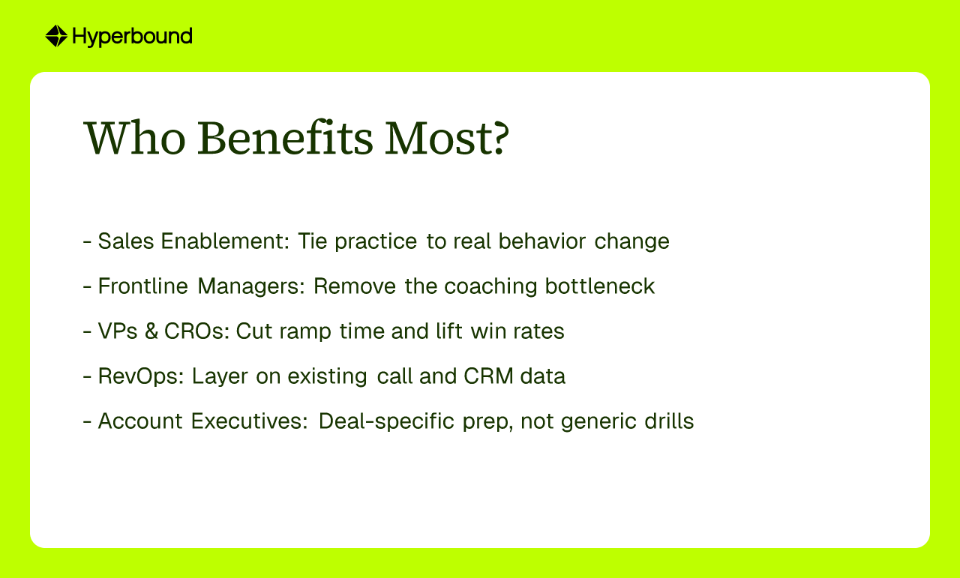
Sales enablement leaders typically own the training program and are significantly outnumbered relative to the managers and reps they support. Most training content is forgotten within a month of delivery, and the only metric available to report on program impact is completion rate, which proves attendance, not behavior change. Enablement leaders considering Revenue Activation are the primary buyer for a system that ties a specific practiced skill back to a specific scored behavior on a real call.
Frontline sales managers spend a small fraction of their week coaching and listen to a small fraction of the calls their team runs. Adding a layer that automatically builds and assigns practice from flagged real calls removes the bottleneck of a manager having to catch every miss personally before it can be addressed.
VPs of sales and CROs focus on ramp time and win rate, and both are difficult to move when the only lever available is manual coaching that does not scale with headcount growth. Vanta's sales organization, for example, cut SDR ramp time from roughly 210 days to 72 days, a 60% reduction, and achieved 30% faster time to first meeting and first opportunity after building a structured practice-and-scoring loop into onboarding. Klaviyo's new-hire productivity per rep rose 42% year over year using the same practice-then-score model, while manager time spent on roleplay creation dropped from weeks to roughly five minutes per scenario. Those results came from the Practice-and-Perform loop built on real call scoring feeding practice. Agentic Enablement is designed to automate that same loop, but it has no published outcome data of its own yet.
RevOps leaders field the tool-sprawl objection and the pressure to consolidate rather than add another line item. The direct answer for RevOps is that Revenue Activation is not a conversation intelligence replacement and does not compete for the same budget line. It sits on top of the call data a conversation intelligence tool is already capturing and connects to the existing CRM and call-recording infrastructure rather than requiring a separate one. The security posture matters here as well: any tool being layered onto call and deal data should carry the certification a RevOps team can reference in a security review, which is the standard revenue leaders should apply to any addition before it reaches procurement.
Account executives are the primary users of the loop. Reps who go through low-volume stretches lose proficiency on skills they do not use daily, and generic full-length training modules rarely reflect the complexity of their actual deals. A senior rep will decline a generic certification roleplay but will complete a short, deal-specific practice session built from their own flagged call, because it is directly relevant to the deal they are working to close this week rather than a hypothetical one.
The organizations that receive the least value from adding this layer are those without call data flowing between systems. Revenue Activation's loop depends on a rep's real calls and connected CRM context. An enterprise account with siloed call recordings will not see the loop work until that data is connected, which is worth raising with the RevOps team before evaluating anything on top of it.
Revenue Activation is the layer that turns call flags from conversation intelligence into targeted practice and then verifies the fix on the next real call. Conversation intelligence captures, transcribes, and analyzes calls to surface insight; Revenue Activation acts on that insight by building a scenario from the rep's actual missed call and re-checking the same criterion later.
No. Revenue Activation runs on top of the call data a conversation intelligence tool is already capturing and scoring. It does not duplicate recording, transcription, or flagging; it closes the loop from diagnosis to behavior change.
Conversation intelligence answers how a specific call went. Revenue intelligence answers whether a deal will close and whether the forecast is accurate. Both are diagnostic categories, while Revenue Activation is an execution category that asks whether a rep fixed the miss and holds the fix on the next live call.
It takes the flagged call, builds a practice scenario from that exact call and stakeholder, has the rep rehearse it, and then re-scores the same criterion on the rep's next real call. That re-check is the step conversation intelligence does not perform.
In a conversation-intelligence-only stack, the flag usually becomes a dashboard note, a call-library clip, or a coaching bullet that depends on manager follow-up. In a Revenue Activation loop, the same flag becomes an assigned practice scenario and a verified re-check on the next similar live call.
Sales enablement leaders, frontline managers, VPs and CROs, RevOps leaders, and account executives all benefit from closing the loop, provided the organization's call and CRM data is connected. The primary first evaluators are enablement and RevOps because they own the program and the data layer.
Revenue Activation needs access to call recordings and works properly with a connected CRM. The loop depends on the rep's actual calls and deal context; siloed call data will prevent the loop from functioning until it is shared.
Manager coaching is gated by bandwidth and often delayed until after the next call has already happened. Revenue Activation automates the step after the flag, building practice from the specific miss and verifying behavior change on the next real call without waiting on a manager's calendar.
Teams can request a demo to see how Revenue Activation would apply to their own call and CRM data rather than a generic walkthrough. The mechanism is best evaluated against real calls and real deal context, not a simulated account.










Use Cases
Legal