
Conversation intelligence (CI) answers one question well: what happened on the call. It captures, transcribes, and scores conversations after they end, and for that job it is genuinely useful. What it does not do, because it was never built to, is act on that data before the next call happens or while a deal is still live. Revenue activation, the category Hyperbound built the Practice → Perform → Activate model around, covers the full loop: practice before the call, coaching during it, and scoring after it, all running against the same scorecards and the same content. This is not a quality argument against CI. It is a scope argument. Sales and revenue leaders evaluating a conversation intelligence tool today are not choosing between two versions of the same thing; they are choosing how much of the "before, during, after" loop they want covered, and by what.
The category comparison below reflects that scope difference at the feature level, not a head-to-head on any single vendor's polish.
DimensionConversation Intelligence (category)Hyperbound (Revenue Activation)Core question answeredWhat happened on the callWhat to do before, during, and after the callCoverage windowAfter the call (capture and analyze)Before (practice), during (live coaching), after (scoring)Practice / roleplay before the call—AI roleplays built from real call and content dataLive in-call guidanceSome full-stack vendors now bundle real-time battle cards and promptsLive Call Coaching: Guided Coaching and Active Listening modesPost-call scoringYes: transcription, keyword tagging, talk-to-listen ratioYes: scored against the same scorecards used in Practice and live coachingCross-call, deal-level analysisRevenue intelligence tools add this as a separate layerNative in Perform: analyzes all calls in a deal, not just oneCRM and recap automationVaries by vendorRecap email and call notes push automatically to CRMScorecard continuity across the loopNot the design point of the categorySame scorecard runs Practice, live coaching, and post-call scoring
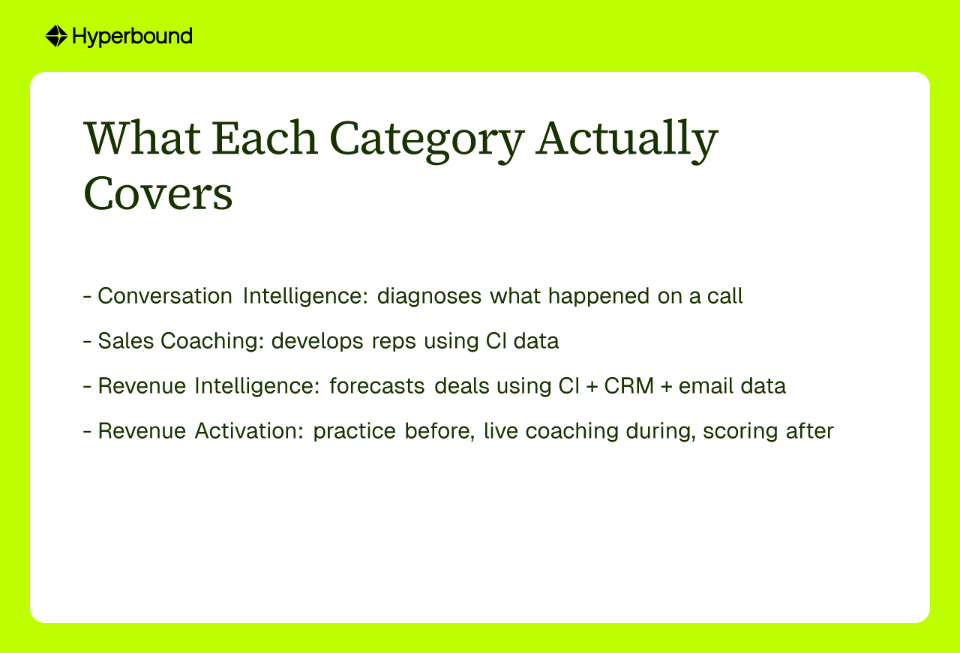
Conversation intelligence platforms record sales calls, transcribe them, and mine the transcript for signal: keyword mentions, talk-to-listen ratio, competitor references, how many questions a rep asked. That is the diagnosis layer of the sales stack. It tells a manager or a rep what happened on a specific call, after it happened. According to Demodesk's breakdown of the space, sitting next to CI in most category maps is sales coaching, described as the development layer that takes CI's raw data and uses it to improve reps, and revenue intelligence, which aggregates conversation data with CRM and email data to answer a different question entirely: what a given deal or pipeline segment is likely to do next. Vendors describe these three as a feedback loop: capture, coach, forecast.
Revenue activation is a different frame on the same underlying problem. Rather than treating capture, coaching, and forecasting as three adjacent categories that hand off to each other, it treats practice, live execution, and post-call review as three stages of a single loop running on one set of scorecards and one body of content. Hyperbound is the platform built around that frame: Practice covers roleplay and onboarding before the call, Perform covers deal-level coaching and cross-call analysis during the deal, and Kota, the orchestration layer sitting above both, recommends and, where instructed, takes the next coaching action. As a frame it is newer than CI or revenue intelligence, both of which are long-established categories with settled definitions; what sets it apart is that it refuses to treat practice, execution, and review as three separate tools handing off to each other.
Notably, practice and roleplay are absent from the standard CI/coaching/revenue-intelligence category map altogether. Demodesk's three-pillar breakdown of the space (CI, AI sales coaching, revenue intelligence) never mentions practice or roleplay as a capability of any of the three. That is a meaningful gap: the before/during/after loop running on one scorecard is not a space any of the three established categories claims for itself.
The two terms get used loosely, but the distinction is scope, not subject matter. CI operates at the meeting level: what was said on this call, by whom, in what proportion. Revenue intelligence operates at the deal or organizational level: what conversation data plus CRM and email data together imply about where a specific deal or a pipeline segment is headed. They do overlap in that RI typically ingests CI's output as raw material, and vendors market both alongside sales coaching as a connected feedback loop rather than as competing purchases.
That loop, though, is described only at category level. Capture feeds coaching, coaching feeds forecasting. It is never described as a single practice-to-live-coaching-to-scorecard loop running on shared content. That gap is exactly where revenue activation sits: it does not compete with CI or revenue intelligence for the "diagnose the past" or "forecast the deal" jobs. It picks up the job neither one does, which is turning the diagnosis into practiced behavior before the next call and into a live intervention during the one happening now.
This is the question every sales leader already running a CI tool is quietly asking, and the honest answer is that CI was not designed to solve it. CI's job is capture and analysis: transcription, keyword tagging, talk-to-listen ratio, question frequency. It does that job well. The problem is what happens after the data exists.
Teams with a full CI deployment (recording, transcription, AI scores, dashboards) still coach the same way they did before: a manager listens to a handful of calls when time allows and delivers generic feedback days after the call that prompted it. The data was never the bottleneck. Operationalizing it is. One vendor in the space puts this plainly: CI alone risks becoming "expensive recording libraries that managers browse occasionally instead of coaching systems that change behavior weekly." That is not a knock on the accuracy of the scoring. It is an acknowledgment that visibility and behavior change are two different problems, and CI solves the first one.
Scale compounds the problem rather than solving it. A 15-rep team making 40 calls a day generates 600 calls a week. More AI scoring does not remove the prioritization problem a manager faces on Monday morning. It just produces more data to prioritize. And even when a manager does sit down with a rep, there is a real difference between coaching and observation. A manager who reviews a call and tells a rep "your discovery needs work" has not coached that rep. They have observed. Coaching requires naming the specific behavior, connecting it to a specific outcome, and giving the rep a specific alternative to execute on the next call. CI surfaces the score. It does not, by itself, produce that specific alternative or put the rep in a position to practice it before the next live call.
The admin drain behind all of this is real and measurable: by one widely cited estimate, sales reps spend nearly two thirds of their time on tasks that do not generate revenue. CI was supposed to help close that gap by making the call itself more visible. It has made the call more visible. It has not, on its own, closed the gap between what the data shows and what the rep does differently next time.

The two are not a replacement fight. CI's output is the input a coaching and practice layer needs to be specific rather than generic. The score trend is the operating unit that carries from the CI data into the coaching conversation. A rep's discovery score dropping from 75 percent to 52 percent over two weeks signals a behavior change that needs attention; a climb from 45 to 68 deserves recognition. That scorecard criterion, sourced from CI, is exactly what an execution layer needs to turn a data point into a practiced skill.
The standard handoff cadence described in the coaching literature runs weekly: a 15-minute Monday scan of aggregate coaching scores to identify the bottom performers and any team-wide skill gap, followed by one 20-minute coaching conversation per priority rep across the rest of the week. That cadence works, but it depends entirely on a manager's calendar and memory to close the loop. There is no mechanism in CI itself that turns Monday's score into Tuesday's practiced behavior automatically.
This is the seam Hyperbound's Practice → Perform loop is built to close, and it runs on the same scorecard the diagnosis came from rather than a separate one. The pattern shows up across customers already live on the platform: at ALKU, the loop runs as score real calls, identify the gap, practice the specific roleplay tied to that gap, then score real calls again. A continuous cycle rather than a one-time intervention. Staff Domain used the same mechanism to identify coaching needs in four weeks instead of the ninety days it previously took them to surface a gap and build a response. Klaviyo's managers pull a coaching report through a Kota prompt in roughly thirty seconds, turning what used to be a manual scan into something closer to instant. None of that replaces the CI data. It operationalizes it. That is the missing half of the loop that CI was never built to run.
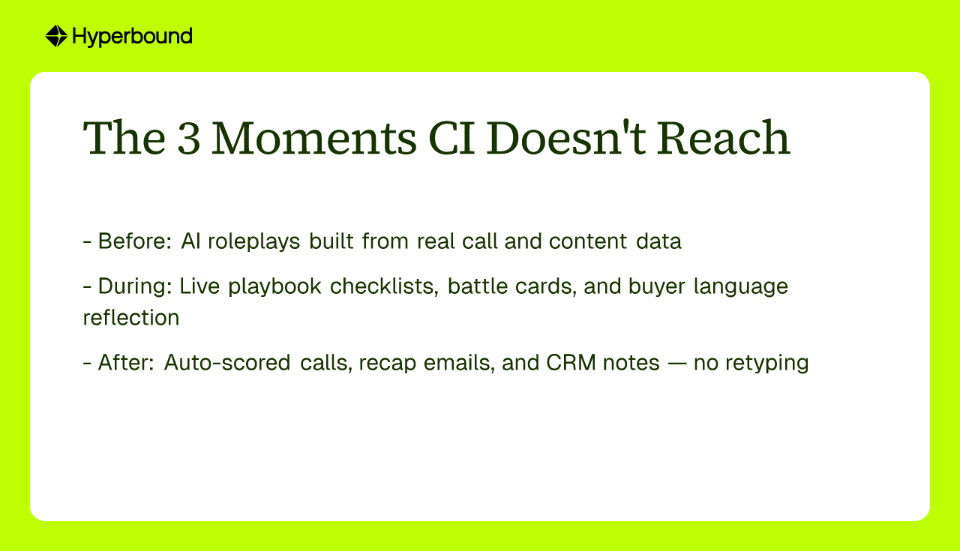
This is where the scope argument becomes concrete rather than conceptual, because Hyperbound's product line maps directly onto the three moments CI does not reach.
Before the call: Hyperbound Practice puts reps into AI roleplays built from real call and content data before they get on a live conversation. The opposite of generic scenario training. finally, for example, requires every SDR to pass a cold-call certification with the VP of Sales and CRO before they are allowed to learn any other tool in the stack, including Salesforce. Nivoda runs the same discipline: reps are certified before they go live on calls at all. CI has no equivalent moment, because by definition it only sees calls that have already happened.
During the call: this is the newest piece of the loop and the one CI's real-time feature bundling comes closest to touching without actually closing. Live Call Coaching, which launched as part of the Perform product line on August 12, 2026, is a desktop side panel that detects when a rep joins a video call or dialer session and activates automatically. It runs in two modes. Guided Coaching shows a playbook checklist that ticks off live as the rep covers each item, and surfaces battle cards the moment a competitor is named, an objection is raised, or a pricing question comes up. Each card cites the content it was pulled from. Active Listening runs quieter: no cards, no prompts, just the specific language the prospect used, highlighted so the rep can reflect it back in real time. Both modes run on content already in Hyperbound, and both are scored against the same scorecards the team already uses for Practice and post-call review. The panel works across Zoom, Teams, Meet, Slack huddles, and dialers through a desktop SDK, and is available on macOS at launch, with Windows to follow on demand. Full-stack CI vendors have begun bundling similar real-time prompts and battlecards as an add-on to the recording-and-scoring core, which is a fair signal the category recognizes the gap. The distinction is that in Hyperbound's case the same call that got live guidance is also the call that was practiced beforehand and the call that gets scored afterward, on one scorecard, not three separate systems handing off data between them.
After the call: when the call ends, the panel scores it, marks what was hit and missed against timestamps, and writes a summary of what the buyer flagged and what to do differently on the next one. It drafts a recap email with the relevant case study attached and the next meeting noted, and call notes push to the CRM automatically. Nothing gets retyped. The scored call lands in the same call record as every other call the team runs, feeding the same scorecards, coaching, and deal view that Practice and Perform already use. That is the structural difference from CI's after-the-call scoring: the score is not the end of the process, it is the input to the next practice session and the next live call.
CI cannot demonstrate a closed loop by design, because closing the loop requires connecting a specific coached behavior to a measurable change in that behavior over time and to deal outcomes. Without an execution layer to run the practice and the live intervention, there is nothing to track between the diagnosis and the next call. The single test that separates a team that has the loop closed from one that does not: can a manager point to a specific coached behavior improving week over week, and to that improvement correlating with better deal outcomes? If the answer is no, the missing piece is not more scoring. It is the execution layer that turns the score into practice and into a live intervention on the next call.
Where Hyperbound customers have run the loop long enough to measure it, the results show up in ramp time and revenue, not just in coaching activity. Vanta cut ramp time from 210 days to 75 while growing its BDR team fourfold and its pipeline fivefold. Nivoda cut ramp time in half and doubled revenue year over year alongside a 150 percent increase in demo conversion. Across the customer base, Hyperbound cites a 50 percent faster ramp, a 150 percent increase in DM-to-demo conversion, and a 2x improvement in time to first won deal as validated proof points. Those figures come from Practice and Perform customers before the Live Call Coaching launch, which has not yet published its own outcome data, and they come from closing the loop CI alone cannot close, not from scoring calls more accurately.
For a team that has just stood up CI and has not yet audited how the data gets used, the right move is not to rip out CI and replace it. It is to run the self-diagnostic the coaching literature itself recommends: can the manager state what to look at first Monday morning without drowning in the week's call volume; can they name the specific behavior a rep needs to change plus the specific alternative to execute next call; and can they measure whether the coaching time they spend is producing a return. A "no" on any of those three is not a CI failure. It is a signal that the stack is missing the execution layer, not that the diagnosis layer needs replacing.
RevOps leaders under pressure to consolidate tooling rather than add another line item face a related but distinct question, and the answer runs through integration rather than replacement. Hyperbound is built to sit alongside an existing CI deployment, including Gong, rather than compete for the same budget line, feeding the same scorecards and the same CRM record the CI tool already populates.
Enablement leaders managing a small team against fifty or a hundred reps face the scale problem most directly: one enablement professional cannot manually build a specific coaching plan for every rep off of raw CI transcripts. That is the exact gap Practice and Perform are built to close. Turning a CI-surfaced score trend into a roleplay and a live-call intervention without requiring a manager to manually author either one.
Frontline managers, who by most accounts spend only five to eight percent of their time coaching and listen to under one percent of recorded calls, are the group with the least bandwidth to close the loop manually regardless of how good the underlying CI data is. For that group, an execution layer that automates the handoff from score to practice to live intervention is not a nice-to-have on top of CI. It is the only way the CI investment turns into a behavior change at the volume a sales floor actually runs.
Revenue activation is the category that closes the loop on conversation intelligence by covering practice before the call, live coaching during it, and scored review after it. All on the same scorecards and content. Hyperbound built the Practice → Perform → Activate model around this frame. Unlike conversation intelligence, which diagnoses what happened on a call, revenue activation operationalizes that diagnosis so reps change behavior before the next call and while a deal is still live.
Conversation intelligence answers “what happened on the call” after it ends; revenue activation answers “what to do before, during, and after the call.” CI captures, transcribes, and scores calls. Revenue activation runs practice before the call, live intervention during it, and post-call scoring after it. All against the same scorecards. The distinction is scope, not quality: CI and revenue activation solve different jobs.
Conversation intelligence records, transcribes, and analyzes sales calls, then mines the transcript for signals like keyword mentions, talk-to-listen ratio, competitor references, and question frequency. It tells managers and reps what happened on a specific call after it happened. That diagnosis is valuable, but CI alone does not turn the data into practiced behavior or in-call intervention.
CI provides the diagnosis; revenue activation provides the operating loop that turns that diagnosis into behavior change. CI alone tends to leave managers with dashboards and recording libraries rather than weekly coaching that changes behavior. Revenue activation uses CI’s output as input for roleplay, live coaching, and scorecard-driven review, closing the gap between what the data shows and what the rep does differently next time.
The right trigger is when a manager cannot answer three questions: what to look at first on Monday morning without drowning in call volume; what specific behavior a rep needs to change and what alternative to execute next call; and whether coaching time is producing a measurable return. A “no” on any of those signals that the diagnosis layer is in place but the execution layer is missing. It is not a reason to rip out CI; it is a reason to add the loop CI was never built to run.
Hyperbound is designed to sit alongside existing CI deployments rather than replace them. It integrates with the CI tool and CRM record, feeding the same scorecards and deal views the CI tool already populates. The CI data remains the diagnosis; Hyperbound’s Practice and Perform layers turn that diagnosis into practice reps, live call coaching, and post-call scoring.
Live Call Coaching is a desktop side panel in Hyperbound Perform that activates when a rep joins a video call or dialer session. It runs in two modes: Guided Coaching shows a playbook checklist that ticks off live and surfaces battle cards when a competitor, objection, or pricing question comes up; Active Listening highlights the prospect’s exact language so the rep can reflect it back in real time. Both modes run on the same scorecards used for Practice and post-call review, and work across Zoom, Teams, Meet, Slack huddles, and dialers.
Where Hyperbound customers have run the loop long enough to measure, the results show up in ramp time and revenue rather than just coaching activity. Vanta cut ramp time from 210 to 75 days while growing its BDR team fourfold and pipeline fivefold; Nivoda cut ramp in half and doubled revenue year over year alongside a 150 percent increase in demo conversion. Hyperbound cites a 50 percent faster ramp, a 150 percent increase in DM-to-demo conversion, and a 2x improvement in time to first won deal as validated proof points.
Ownership depends on the core constraint. Enablement leaders managing a small team against many reps need it to scale coaching without writing manual plans from transcripts; RevOps leaders under pressure to consolidate tooling need it to integrate with existing CI rather than add another silo; frontline managers, who often coach only 5–8 percent of their time and listen to under 1 percent of recorded calls, need it to automate the handoff from score to practice to live intervention. In practice, the loop works best when all three share the same scorecards.
Yes. Tenured reps often get less value from long generic certification programs, but they respond to short, deal-specific practice tied to a live opportunity. Hyperbound’s bite-sized, deal-context roleplays reflect that rather than requiring one long module repeated for every rep regardless of tenure. The same scorecard continuity applies: practice before the call, live guidance during it, and scored review after it help tenured reps sharpen specific deals rather than re-learn basics.










Use Cases
Legal