
Most conversation intelligence software is built to answer one question for managers: What happened on that call?
That's a useful question. But it's the wrong finish line.
Knowing what went wrong and having a scalable way to fix it are fundamentally different problems — and most CI tools are only solving the first one. As one sales rep put it in a Reddit thread on AI coaching tools: "most AI coaching tools just score calls and give automated feedback. That can help a little, but I'm not sure it really teaches someone how to sell."
That gap — between knowing what went wrong and having a structured path to fix it — is the intervention gap. And it's exactly what separates tools built for visibility from tools built for improvement.
This article ranks seven leading conversation intelligence software tools not just on features, but on coaching depth: how far each tool goes from flagging a problem to giving a rep a genuine path to improvement.
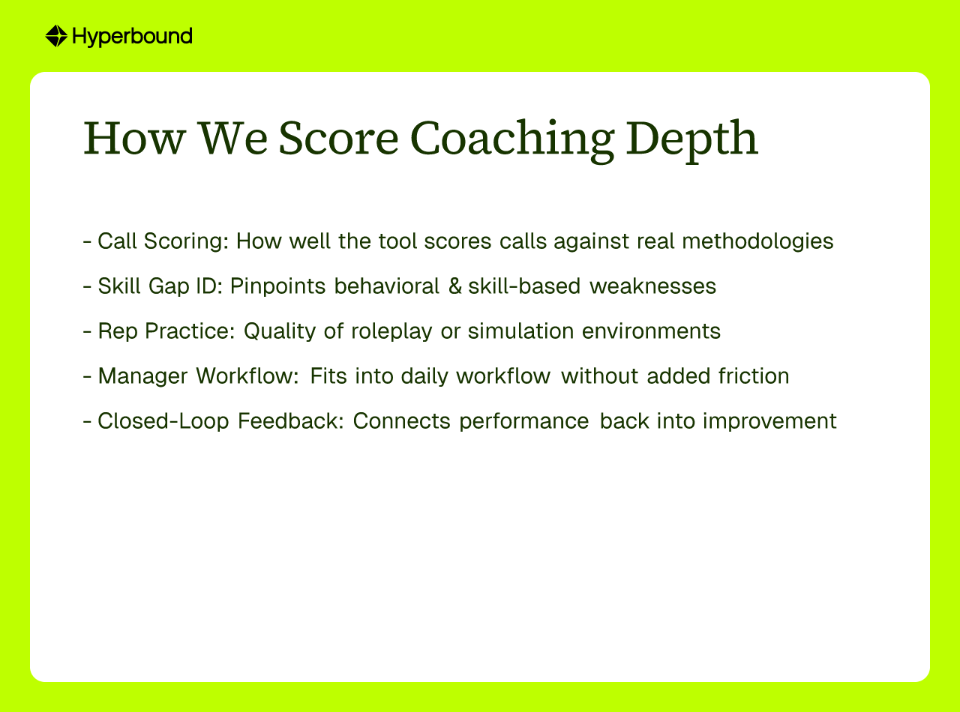
Each tool is scored 1–5 across five categories:
.png)
*spend only 5–8% of their time coaching
.png)
Overall Coaching Depth: 5/5
Hyperbound is the only platform in this list that was purpose-built to close the intervention gap — not just surface it. Where traditional conversation intelligence tools stop at analysis, Hyperbound picks up with action.
The platform operates as a triangle: Hyperbound Practice handles rep preparation and skill-building through AI roleplays; Hyperbound Perform handles real deal coaching across the entire deal lifecycle; and Kota Activate sits above both, orchestrating coaching interventions in Slack or Teams.
Call Scoring: Hyperbound Perform deploys customizable AI Scorecards on real calls ingested from Gong, Chorus, Salesloft, or the native Hyperbound Call Recorder. Auto-routing applies the right scorecard based on meeting type — a discovery call gets scored differently than a pricing conversation.
Skill Gap Identification: Unlike call-by-call analysis, Perform analyzes insights across an entire deal — from first cold call to close. Kota then analyzes all active deals simultaneously, cross-references historical closed-won and closed-lost patterns, and recommends personalized coaching interventions.
Rep Practice Environment: This is where Hyperbound separates itself entirely. Practice gives reps AI buyer personas trained on 2M+ hours of real B2B sales conversations. Reps can build a digital twin of a specific prospect from their LinkedIn profile, run multiparty simulations with multiple buyer personas, and practice demos with Screen Comprehension. Critically, Bitesized Roleplays solve the tenured rep problem — short, targeted sessions tied to specific skill gaps identified in real calls, not generic certifications nobody finishes.
Manager Workflow Integration: Kota lives inside Slack and Microsoft Teams. A manager can ask "which reps are struggling with pricing objections this week?" and get an answer grounded in real call data — then assign a targeted Bitesized Roleplay with a single action, without leaving the tool they're already in.
Closed-Loop Feedback: The operational loop is complete: Score Real Calls → Identify Skill Gaps → Assign Targeted Practice → Measure Improvement on Future Calls. Customers like Vanta saw a 60% ramp reduction (210 days down to 72), and Nivoda achieved a 150% increase in demo conversion rate — outcomes that flow from the full closed loop, not from call summaries alone.
.png)
Overall Coaching Depth: 3.4/5
Gong is the market leader in Revenue Intelligence and the most frequently recommended tool in sales ops communities — "Gong is strong for deal insights, call scoring, and pattern recognition across the team," as one practitioner on Reddit noted. That reputation is earned.
G2 reviewers consistently praise its analytics depth, deal tracking, and the ability to build a library of best-practice calls. Managers can leave timestamped coaching comments, create playlists, and track engagement metrics across the team.
The core gap: when Gong identifies that a rep's discovery calls are weak, it has no mechanism for that rep to practice and fix them before the next live call. Gong gives managers an excellent view into what happened. It doesn't give reps a path to change it. For teams with substantial budgets who want best-in-class analysis, it's hard to beat — though the cost is a recurring pain point, with some users noting that the bill is becoming difficult to justify. The closed loop depends entirely on the manager's time and judgment to bridge analysis to action.
.png)
Overall Coaching Depth: 3.6/5
Mindtickle takes a broader approach than pure conversation intelligence tools by combining call analysis with a built-in LMS and structured coaching programs. Its key strength is connecting call performance to specific sales competencies and learning paths — G2 reviewers consistently highlight its comprehensive platform as a major advantage for structured enablement programs.
Where it loses ground is in conversational AI fidelity. Its practice scenarios exist, but they don't match the dynamic responsiveness of purpose-built roleplay tools — the AI buyer personas don't replicate the unpredictability of real prospects at scale. The feedback loop also tends to be structured around formal program cycles rather than immediately responsive to a specific deal stumble. Strong for teams that want to build a certification-based readiness culture; less suited to teams that need live deal coaching and in-the-moment skill remediation.
.png)
Overall Coaching Depth: 2.8/5
Salesloft's conversation intelligence earns its highest score in Manager Workflow Integration, and intentionally so — it's embedded directly in the tool reps already use for sequencing and outreach, which eliminates the friction of switching contexts. Coaching doesn't require reps to open a separate platform; the feedback lives where the work already happens.
The tradeoff is depth. Salesloft Conversations provides solid transcription and basic call metrics, but its analytics don't compete with dedicated CI tools like Gong or Chorus for identifying nuanced skill gaps or deal patterns. And like most of the tools in this list, there's no practice environment — a rep who repeatedly skips pain quantification will continue doing so between sessions without any mechanism to correct the behavior.
.png)
Overall Coaching Depth: 3/5
Chorus is a powerful call analysis tool that competes directly with Gong on the visibility side of the equation. It scores highly on call analysis, surfacing insights on talk-to-listen ratios, question frequency, objection handling, and competitor mentions. User reviews on G2 point to its depth of conversational analysis as a core strength.
Like Gong, the falloff comes on the action side. Chorus surfaces what needs to improve; it offers no environment where reps can actually improve it before the next call. Its Manager Workflow Integration also trails Gong slightly in terms of native coaching UX. Best suited for teams already embedded in the ZoomInfo ecosystem who want strong CI data without a separate tool.
.png)
Overall Coaching Depth: 2.2/5
Jiminny focuses on automating the administrative side of call intelligence — logging, summarization, CRM sync, and team collaboration around recordings. For smaller teams that need to stop losing insights after calls without a six-figure call recording budget, it's a genuine option.
Its coaching depth is limited by design. Jiminny is primarily a documentation and review tool, and it lacks the deeper coaching infrastructure to drive behavioral change. Managers can comment on calls and create review playlists, but the feedback loop ends at the recording.
Not every team needs the deepest coaching depth on day one. Here's how to match a tool to where your team actually is.
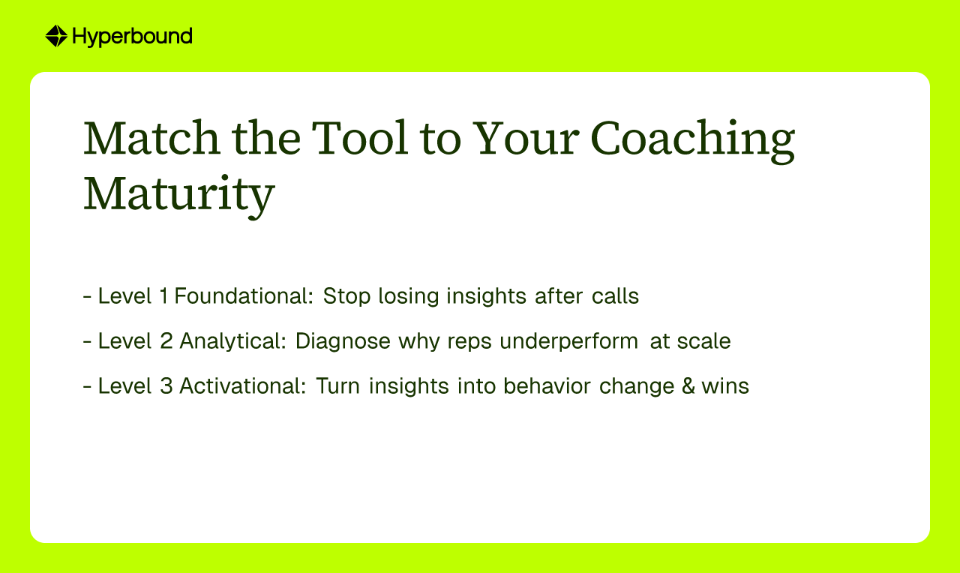
Level 1 — Foundational (Getting Visibility)
You're here if: Valuable information is still getting lost after meetings, your team relies mostly on CRM notes from memory, and coaching is ad-hoc based on occasional ride-alongs.
What you need: Call recording with basic analysis — nothing more.
Recommended tools: Hyperbound Call Recorder, Jiminny, Salesloft Conversations. These tools stop the bleeding and give managers a starting point without overwhelming a team that hasn't built coaching processes yet.
Level 2 — Analytical (Driving Insight)
You're here if: You're already recording calls, but you haven't connected the data to a coaching system. Managers know who's underperforming — they just can't diagnose why or address it at scale. You want to build a library of best-practice calls and surface patterns across your team.
What you need: A full-featured Revenue Intelligence platform.
Recommended tools: Hyperbound Perform, Gong, Chorus, Mindtickle. These platforms are the right investment at this stage — just go in knowing most options help managers see more, not reps win more. The cost can be significant (Gong in particular has become a pressure point for some teams), so evaluate whether you're getting full utilization across your team before committing.
Level 3 — Activational (Driving Action and Outcomes)
You're here if: You have call data. You have insights. And you've realized that insights alone aren't closing the gap. Reps leave debrief sessions, nod, and make the same mistakes on the next call — because knowing what to improve and having a safe, repeatable way to practice it are two completely different things. You want to close the loop.
What you need: A Revenue Activation platform that connects real call analysis to targeted practice and deals-in-flight coaching.
Recommended tool: Hyperbound. The complete loop — Score Real Calls → Identify Skill Gaps → Practice in AI Roleplays → Measure Improvement on Future Calls — is the only architecture that actually changes behavior before it costs you a deal. Teams using Hyperbound have seen 50% faster ramp times and, in Vanta's case, a 60% ramp reduction accompanied by 5x pipeline growth.
Conversation Intelligence made execution visible for the first time. That was real progress. But most salespeople don't practice enough, and visibility alone doesn't solve that problem — a manager can comment on ten call recordings and nothing fundamentally changes if there's no mechanism to turn that feedback into deliberate practice.
Before evaluating any tool on this list, ask one question: Does this help my managers see more, or does this help my reps win more?
If you're at Level 1 or 2, visibility tools are the right answer. If you're at Level 3 — if insights are already sitting in your call library and win rates still aren't moving — it's time to look at whether your stack is built for activation, not just observation.
Conversation intelligence (CI) software is a tool that records, transcribes, and analyzes sales calls to provide data-driven insights into conversations. It uses AI to identify keywords, talk patterns, and other metrics, helping sales teams understand what happens during customer interactions for coaching, deal analysis, and forecasting.
Conversation intelligence software helps sales coaching by giving managers a clear, objective view of what reps are actually saying on calls. Instead of relying on ad-hoc ride-alongs, managers can review full recordings, pinpoint specific moments for feedback (like a missed objection handle), and identify team-wide skill gaps for more targeted and data-backed coaching.
The "intervention gap" is the disconnect between identifying a problem on a sales call and having a structured, scalable way for a rep to practice and fix that problem. Most CI tools show you what's wrong but don't provide a mechanism for the rep to practice handling those issues before their next live call, leaving improvement to chance.
Most conversation intelligence tools fall short in coaching because they are built for visibility and analysis, not active skill development. They excel at answering "what happened on that call?" but offer no integrated way for reps to practice and improve. This leaves the burden on managers to manually translate insights into action, which is often not scalable.
A strong rep practice environment should offer realistic, AI-powered simulations where reps can safely apply coaching feedback before a live call. Key features include customizable AI buyer personas, screen comprehension for practicing demos, and the ability to run short, targeted roleplays ("Bitesized Roleplays") focused on specific skills identified from real calls.
The right conversation intelligence tool depends on your team's coaching maturity. For basic visibility (Level 1), a simple call recorder is enough. For deep analytics (Level 2), a revenue intelligence platform like Gong or Hyperbound Perform works well. For driving behavior change and closing the intervention gap (Level 3), an activational platform like Hyperbound that connects insights to practice is necessary.
Both Gong and Chorus are powerful for call analysis and identifying coaching opportunities, but neither offers an integrated environment for reps to practice and apply that coaching. They are excellent for providing visibility (Level 2 maturity) but cannot close the "intervention gap" on their own. For teams focused on activation and measurable skill development (Level 3), a platform that combines analysis with practice is more effective.
The Revenue Activation era is here. Stop watching. Start winning.







Use Cases
Legal