
Every sales leader knows the feeling. A critical deal is on the ropes, and the reasons why are buried somewhere across a dozen calls. Your reps "rely mostly on notes and CRM updates, which isn't very efficient" — and when insights stay in a rep's head or get lost in sloppy CRM fields, coaching and forecasting both suffer. This is the classic Sales Ops headache.
Conversation intelligence software was supposed to fix this. And it did — partially. The first wave of CI tools gave teams visibility they'd never had before: automatic transcription, keyword tracking, talk-to-listen ratios, deal risk alerts. That was real progress.
But visibility was never the same as improvement. Managers are listening to less than 1% of recorded conversations. Manual call scoring remains, in the words of one sales enablement leader on Reddit, "soul-crushing." And far too many AI outputs feel "very generic and completely random at times." The data piles up. The win rate doesn't move.
So what separates a CI tool that just records from one that actually changes rep behavior and deal outcomes?
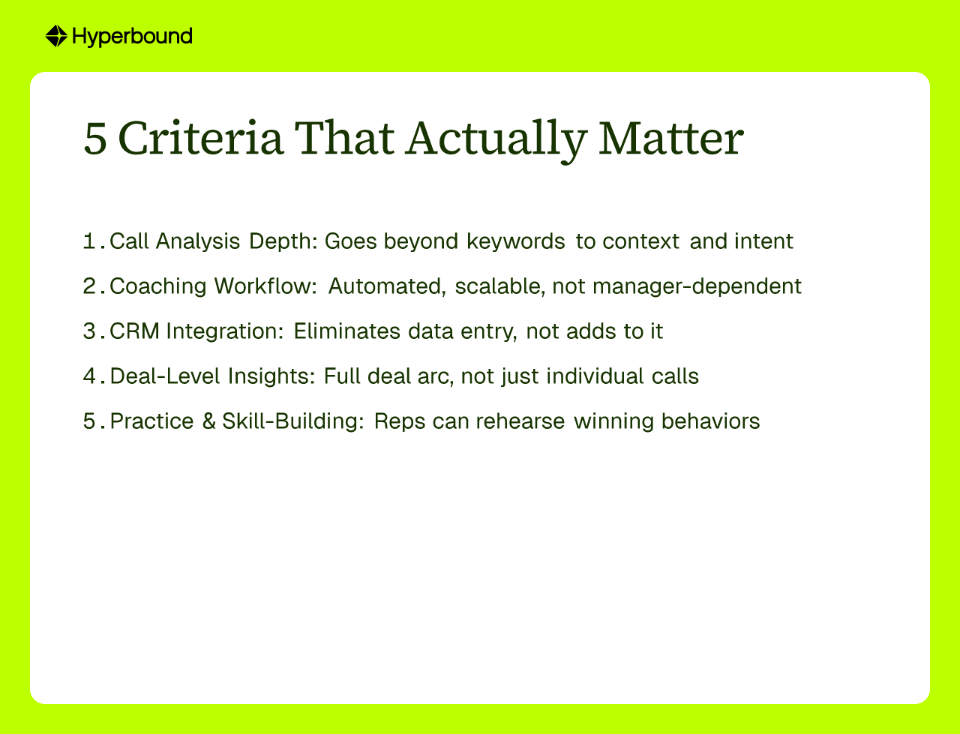
Before diving into the tools, here's the framework you should use to evaluate any conversation intelligence platform:
With that rubric in hand, here are the 7 best conversation intelligence tools for B2B sales teams in 2025.
Best for: B2B sales teams who already have visibility into their calls but can't translate that visibility into higher win rates or faster ramp times.
Hyperbound isn't just a conversation intelligence tool — it's a Revenue Activation Platform built to close the gap between insight and behavior change. Where most CI tools stop at the summary, Hyperbound starts. It coined the "Revenue Activation" category to describe exactly what's missing from the current market: analysis that leads to action.
The platform operates in three interconnected layers:
.png)
Proof points: At Vanta, Hyperbound drove a 60% reduction in BDR ramp time (from 210 to 72 days), 4x team growth, and $125M+ pipeline influenced. At Nivoda, teams saw a 50% ramp reduction and a 150% increase in demo conversion rates.
Limitation: Hyperbound Perform is live as of March 2026 — newer to market than Gong or Chorus on the deal intelligence side.
Best for: Enterprise teams that need a robust system of record for every customer interaction and want deep analytics on conversation patterns at scale.
Gong is the category-defining conversation intelligence platform. If you haven't heard of it, you haven't been in B2B sales long. It captures calls, transcribes them, and surfaces insights on talk-to-listen ratios, competitor mentions, deal risk signals, and more. At scale, it's genuinely powerful.
.png)
The core strength of Gong is its library of call data and its ability to detect patterns across thousands of interactions. Its CRM sync with Salesforce is best-in-class.
The limitation is structural: Gong is a library, not a coach. It tells you what went wrong yesterday. It provides tools for managers to create feedback loops — but the manager still has to find the coachable moments, initiate the coaching, and track whether improvement actually happened. There is no native practice environment. There is nowhere for a rep to take a Gong insight and drill it until it's a reflex.

Pricing: Custom quote required. Known to be at the higher end of the market.
Best for: Teams already embedded in the ZoomInfo ecosystem who want conversation intelligence enriched with contact and firmographic data.
Chorus offers Gong-comparable core CI functionality — call recording, transcription, and conversation analytics — with one significant differentiator: it's embedded in the ZoomInfo data platform. That means your call data can be cross-referenced with buyer intent signals, org charts, and contact intelligence from ZoomInfo's database.
.png)
Chorus offers custom AI scorecards and post-call coaching suggestions. However, like Gong, there is no live coaching support and the workflow is reactive by design. Managers see what happened; they decide what to do about it.
Pricing: Not publicly listed. Estimates place it at $1,200–$1,400 per seat annually.
Best for: Sales teams who want their conversation intelligence tightly woven into their cadencing, dialing, and engagement workflows — one platform instead of many.
Salesloft's "Conversations" module is one piece of a much larger sales engagement suite. The advantage is cohesion: CI data lives in the same platform as outreach sequences, pipeline analytics, and rep activity dashboards. Managers can review a call and tie it to a specific sequence step without toggling between tools.
.png)
The tradeoff is depth. Salesloft's CI features cover core recording and basic analytics, but they're less specialized than Gong or Hyperbound. If conversation intelligence is a primary use case rather than a supplement, you may find the analysis thin.
Pricing: Custom quote required.
Best for: SMB and mid-market teams already running on HubSpot who want to start capturing call data without adding another vendor.
HubSpot's CI is a native feature inside Sales Hub and Service Hub. It records calls, auto-transcribes them, and attaches everything directly to the contact and deal record — no integration required, no data lag.
.png)
The tradeoff is scope. HubSpot CI covers the essentials — keyword tracking, basic transcription, call logging — but as one Sales Ops practitioner put it, "manager coaching layers are pretty thin." It's primarily call-level analysis, not deal-level intelligence.
Pricing: Included in Sales Hub Professional and Enterprise tiers.
Best for: SMBs and mid-market teams looking for affordable, all-in-one meeting productivity and conversation intelligence without enterprise pricing.
Avoma positions itself as a full meeting lifecycle assistant — scheduling, agenda templates, collaborative notes, and AI-powered conversation intelligence in a single, transparent pricing model. For teams that need more than a recorder but don't have the budget for Gong, it punches well above its price point.
.png)
Avoma offers customizable AI scorecards, topic intelligence, and coaching automation. It's notably stronger on coaching workflow than tools at comparable price points. The focus, however, remains on the individual meeting rather than cross-deal pattern analysis.
Pricing: Transparent and affordable, starting around $29/user/month.
Best for: Sales teams that want to emphasize in-the-moment coaching and have a structured, gamified approach to call performance improvement.
Jiminny differentiates itself with a strong focus on real-time support and structured post-call coaching workflows. One Sales Ops practitioner on Reddit recommended it specifically because "you can create prompts to help score the call based on your wants/needs" — meaning the scoring rubric is customizable to your methodology, not generic.
.png)
Jiminny is strong for teams that want call-level coaching rigor with live assistance. It doesn't offer pre-call practice or a deal-level intelligence layer, but for the coaching workflow itself, it's among the best at its price point.
Pricing: Custom quote required.
This is one of the most common scenarios in B2B sales right now. You invested in a top-tier conversation intelligence platform. You have 100% visibility into every rep call. You can see talk-to-listen ratios, competitor mentions, key moments — all of it. The problem is, none of it seems to be moving the number.
Here's why: visibility and improvement are not the same thing. Gong gives you a library of game tape. But your reps still walk into the same discovery call making the same mistakes, because knowing is not the same as practicing. This is what's called the intervention gap — the space between insight and behavior change.
You don't need to replace Gong. You need to activate the data it's already collecting.
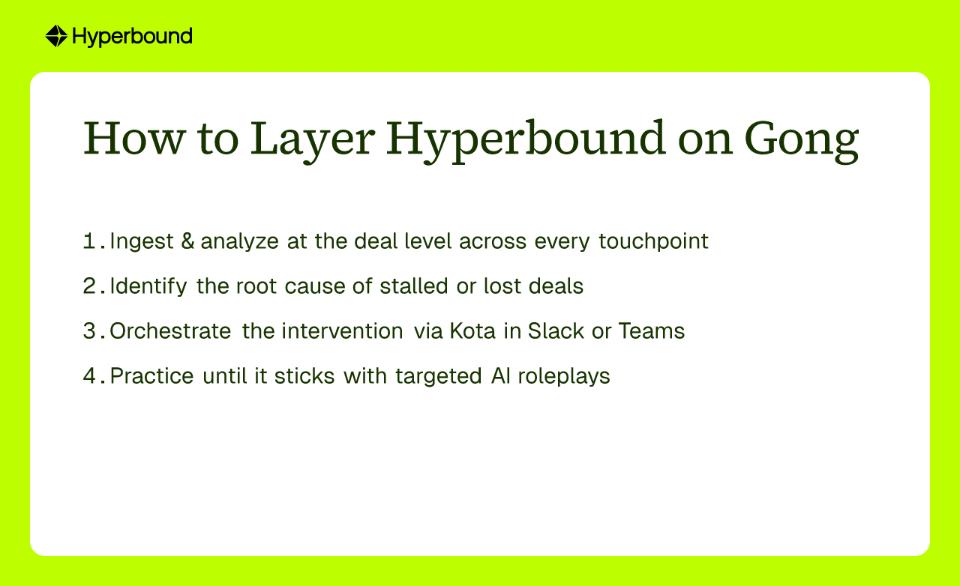
Here's how to layer Hyperbound on top:
This closed loop — Score Real Calls → Identify Skill Gaps → Practice Roleplays → Score Real Calls — is what turns Gong's passive data into measurable behavior change. The team at Hyperbound calls this Revenue Activation, and they've built the entire platform around making it repeatable.
The conversation intelligence market has matured. Recording and transcribing calls is table stakes. The real question in 2026 is: does your CI tool change what reps do in their next conversation?
For teams that need a system of record and deep call analytics, Gong or Chorus remain the standard. For teams on HubSpot looking for simplicity, HubSpot's native CI is an easy starting point. For SMBs who need more coaching rigor without enterprise pricing, Avoma delivers strong value.
But if you're a B2B sales team trying to close the loop — from call analysis to rep behavior to deal outcomes — the only platform doing that end-to-end is Hyperbound. It's the difference between watching the game and changing the score.
Conversation intelligence (CI) software is a tool that automatically records, transcribes, and analyzes sales calls and meetings to uncover data-driven insights. These platforms use AI to analyze what's said in conversations, identifying keywords, topics, talk patterns, and sentiment. This helps sales teams understand what's working in their sales process, improve coaching, forecast more accurately, and ultimately, close more deals by learning from real customer interactions.
Conversation intelligence is important because it provides objective, scalable visibility into the single most critical part of the sales process: the conversations between reps and buyers. Without CI, sales leaders rely on subjective rep notes and CRM entries, leaving valuable insights trapped. CI tools surface key moments, identify deal risks, and highlight winning behaviors, allowing for data-driven coaching and process improvements that are otherwise impossible to scale across an entire sales team.
The main difference is that Gong is a "system of record" focused on call visibility and analysis, while Hyperbound is a "Revenue Activation Platform" focused on changing rep behavior and improving deal outcomes. Gong excels at creating a comprehensive library of your sales calls and analyzing what happened. Hyperbound takes this a step further by identifying skill gaps from those calls and then providing an targeted practice environment for reps to actively rehearse and improve those specific skills. In short, Gong shows you the problem; Hyperbound helps you fix it.
Conversation intelligence tools improve sales coaching by replacing subjective feedback with objective data, allowing managers to pinpoint specific coachable moments from real calls and track improvement over time. Instead of relying on ride-alongs or anecdotal evidence, managers can review call transcripts, see analytics on talk-to-listen ratios, and identify where reps struggle with objections or miss buying signals. Advanced platforms like Hyperbound automate this process, flagging skill gaps and even assigning targeted AI roleplays to help reps practice and master the required behaviors.
Revenue Activation is the process of closing the gap between sales insights and rep behavior change to directly impact revenue outcomes. This concept, pioneered by Hyperbound, addresses the common problem where teams have plenty of data from CI tools but still see stagnant win rates. It involves a closed-loop system: analyzing real deals to identify skill gaps, orchestrating targeted coaching and practice interventions, and then measuring the impact on performance in subsequent calls. It's about turning passive data into active skill development.
Yes, Hyperbound is designed to integrate with and enhance existing conversation intelligence tools like Gong and Chorus. You don't need to replace your current system of record. Hyperbound Perform can ingest call data from other platforms, apply its deal-level analysis to surface deeper insights and skill gaps, and then use Hyperbound Practice to provide the targeted coaching and skill-building that other platforms lack. This allows you to activate the data you're already collecting.
When choosing a CI platform, you should evaluate it based on five key criteria: the depth of its call analysis, the scalability of its coaching workflow, the quality of its CRM integration, its ability to provide deal-level insights (not just call-level), and whether it includes a practice or skill-building component. Simply recording and transcribing calls is now table stakes. A top-tier tool should understand context and intent, automate coaching rather than create more work for managers, eliminate CRM data entry, analyze the entire deal lifecycle, and provide a way for reps to apply insights and improve their skills.
For small to mid-sized businesses (SMBs), tools like Avoma or HubSpot's native Conversation Intelligence offer a great balance of features and affordability. Avoma provides a comprehensive meeting lifecycle assistant with strong coaching features at a very accessible price point. HubSpot's CI is an excellent choice for teams already using HubSpot Sales Hub, as it offers seamless integration and core functionality without requiring an additional vendor. These tools provide the essential benefits of CI without the enterprise-level cost of platforms like Gong.
Ready to stop watching and start winning? See how Hyperbound's Revenue Activation Platform works.







Use Cases
Legal