
You've invested in conversation intelligence software. Your call library is growing. Reps are recorded, transcripts are searchable, and your conversation intelligence dashboard is full of data points. And yet — your win rates haven't moved.
If that hits close to home, you're not alone. Sales leaders across the industry have been voicing a version of this frustration for years. As one RevOps professional put it in a candid Reddit thread: "It required so much TLC that most managers didn't invest the time to get the benefits, and ended up paying $30k/year for a call recorder." (Source)
The irony is striking. Revenue teams today have more call data, transcript analysis, and sentiment scoring than at any point in history. Yet, only 12% of go-to-market leaders report being satisfied with their existing customer engagement technology. The data exists. The outcomes don't follow.
This is what we call the Conversation Intelligence Paradox: more recordings, same win rates.
Conversation intelligence tools are powerful diagnosticians. They tell you what happened — who talked too much, which objections came up, whether your rep mentioned the competitor by name. They are excellent at capturing and cataloguing reality.
What they don't do is change reality.
The gap isn't in the data. The gap is in the behavior. Between "here's what went wrong on this call" and "here's a rep who now does it differently" lies an entire execution layer that most CI tools don't touch. That execution layer requires repetition, feedback loops, and contextual practice — the things that actually produce behavior change.
The revenue teams that are moving the needle aren't just reading their call data. They're using that data to do three very specific things:
Let's walk through each one.
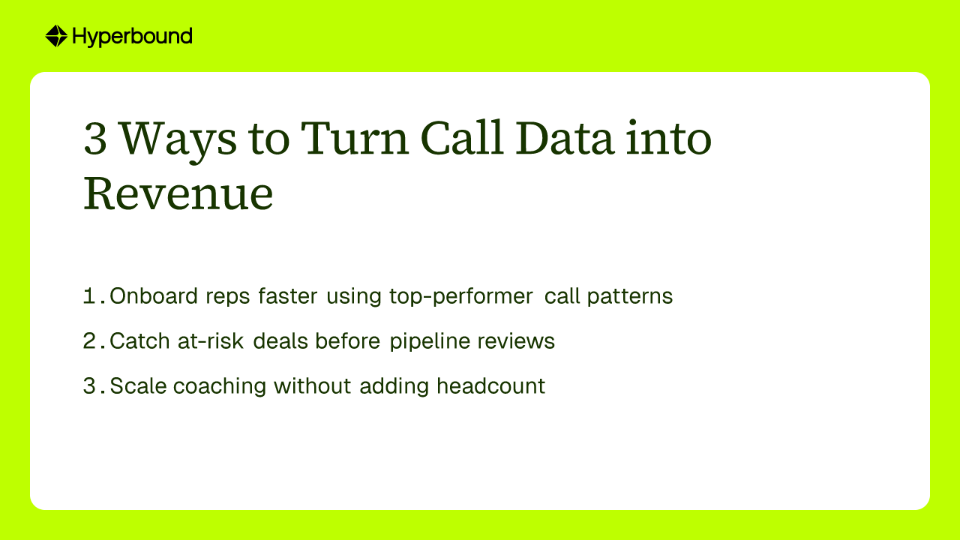
Here's how most onboarding works: a new rep joins, gets handed a 40-page onboarding doc, watches a few recorded calls from top reps, sits through some product training, and is then put in front of real prospects. As one sales manager described it, "new hires usually show up pumped, full of energy… but when you hand them a 40-page onboarding doc or training videos, their enthusiasm is gone." (Source)
This matters because ramp time is a direct cost. Every week a new rep isn't productive is a week of salary, tools, and management overhead with no return. McKinsey research confirms that top performers generate significantly higher gross margins per sales dollar invested — and the gap between top performers and average reps widens precisely because of how onboarding compounds over time.
Here's what changes with a behavior-change layer:
Your conversation intelligence software has already done the hard analytical work. It's identified which discovery questions your top reps ask, which objection responses lead to progression, and what talk patterns correlate with closed-won deals. That's the blueprint. The question is whether your new reps are studying blueprints or practicing the plays.
Hyperbound Practice takes those winning patterns from your real sales conversations and turns them into interactive AI roleplay scenarios. New reps practice cold calls, discovery, objection handling, and multi-stakeholder conversations against AI buyer personas that behave like real prospects — before a single real deal is touched. Every session generates instant AI Scorecard feedback tracking methodology adherence, talk ratios, and missed opportunities. Managers can certify reps on specific conversations before they're allowed into live pipeline.
The result isn't anecdotal. Vanta, the security compliance company, deployed this approach and cut ramp time from 210 days to 72 days — a 60% reduction — while simultaneously growing their BDR team 4x and influencing $125M+ in pipeline. That's what happens when you stop treating onboarding as content delivery and start treating it as deliberate practice.
Sales managers are the highest-leverage variable in revenue performance. And yet, research consistently shows that managers spend only 5–8% of their time on actual coaching. Coaching is always the first thing cut when calendars fill up — and the consequences compound silently across every rep on the team.
The underlying problem isn't that managers don't want to coach. It's that the current workflow doesn't scale. As one sales enablement leader described it: "reviewing call recordings and giving feedback… it's a time sink. You end up listening to the same mistakes over and over — bad discovery, weak objection handling, no clear next steps — and typing out the same feedback in slightly different ways for each rep." (Source)
This is the treadmill. More recordings. More manual review. More typed feedback that gets acknowledged and forgotten within 30 days.
The Revenue Activation answer is to automate the coaching workflow — not replace the manager, but eliminate the manual steps so the manager can focus on the decisions that require human judgment.
Kota Activate, Hyperbound's AI assistant, sits above both Practice (roleplay performance data) and Perform (real call execution data) and acts as an AI Revenue Analyst. A manager can ask Kota directly inside Slack: "Which reps are struggling with the new competitor objection this quarter?" Kota analyzes all deals and all roleplay sessions simultaneously, surfaces the answer, and then takes action — automatically assigning the struggling reps a targeted AI roleplay on that specific objection and notifying the manager when it's completed.
The loop closes without the manager listening to a single recording.
This is what 3.5 workweeks of coaching saved looks like in practice — freeing managers to focus on high-judgment coaching moments rather than administrative review. And when Hyperbound deployed their own Perform product internally before its customer release, the outcome was their "strongest quarter ever" — proof that the methodology works even at the company building it.
Conversation intelligence gave revenue teams a window into what's actually happening in sales conversations. That was the first breakthrough — replacing gut feel and anecdote with recorded, searchable, analyzable reality.
But a window doesn't change anything. What changes outcomes is acting on what you see.
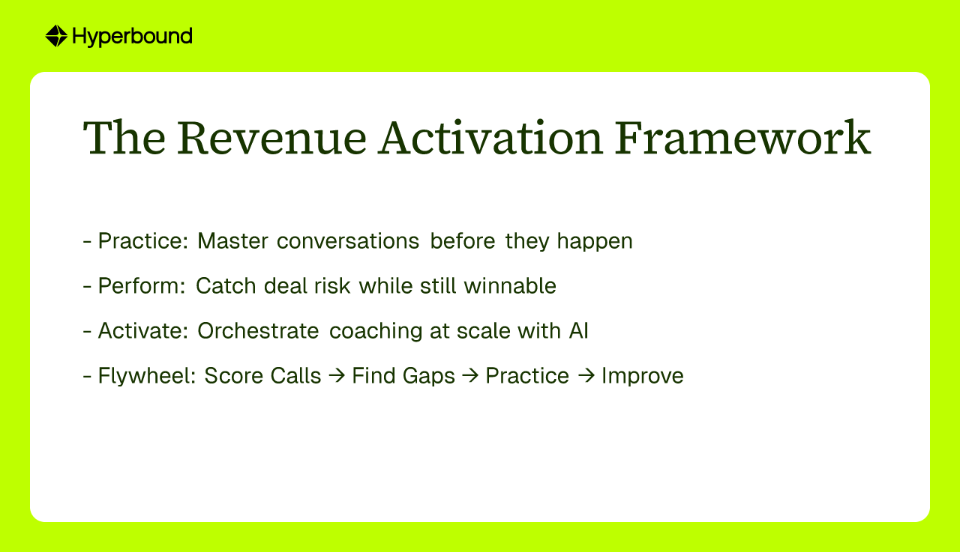
The revenue teams winning right now have moved beyond intelligence into Revenue Activation — the framework of turning conversation data into measurable changes in seller behavior and deal outcomes. The engine for that framework is a three-product loop:
The resulting flywheel: Score Real Calls → Identify Skill Gaps → Practice in Roleplays → Improve on Real Calls. Continuously, automatically, without adding headcount.
If your conversation intelligence software is sitting in a data library while your win rates stay flat, the missing piece isn't more data. It's the layer that turns that data into new rep behaviors — and new behaviors into closed deals.

The Conversation Intelligence Paradox describes the common situation where sales teams have access to more call data, recordings, and analytics than ever before, yet their actual sales outcomes and win rates fail to improve. It highlights that simply possessing data is not enough to drive performance; the gap lies in translating those insights into consistent changes in seller behavior.
Your conversation intelligence tool is likely not improving performance because it excels at diagnosis, not behavior change. It can tell you what happened on a call, but it doesn't provide the execution layer—the practice, feedback loops, and automated coaching—needed to ensure reps apply those learnings and actually improve their skills on future calls.
You can turn call recordings into better outcomes by using them as blueprints for a structured execution plan. This involves three key steps: 1) Analyzing top-performer calls to create realistic AI practice scenarios for onboarding and training, 2) Synthesizing data across all calls in a deal to proactively identify and address risks, and 3) Automating coaching workflows to scale feedback without adding manager headcount.
Revenue Activation is a framework for turning conversation data into measurable improvements in seller behavior and deal outcomes. It moves beyond passive data analysis to create an active loop of skill development and deal execution. This framework is built on a cycle of Practice (AI roleplays), Perform (real-time deal analysis), and Activate (AI-driven coaching) to create a continuous improvement flywheel.
AI scales sales coaching by automating the most time-consuming manual tasks for managers. Instead of listening to hours of calls, an AI assistant can analyze all conversations to pinpoint specific skill gaps across the team (e.g., struggling with a new competitor objection). The AI can then automatically assign targeted practice to the relevant reps, closing the loop and freeing up managers to focus on high-level strategy and human-centric coaching.
The fastest way to onboard new sales reps is by shifting from passive learning (reading docs, watching videos) to deliberate practice. By turning the call patterns of your top reps into interactive AI roleplay scenarios, new hires can practice key conversations, handle objections, and master your sales methodology in a safe environment before they ever speak to a live prospect. This method has been shown to reduce ramp time by over 60%.
No, Revenue Activation platforms like Hyperbound are designed to work with and enhance your existing conversation intelligence software. They act as an execution layer that connects to your call recorder (Gong, Chorus, Salesloft, etc.), pulls in the conversation data, and uses it to power the practice, performance, and coaching engine that drives behavior change.
You can identify at-risk deals by using cross-call analysis to find risk signals across a deal's entire lifecycle, rather than focusing on single conversations. A system that analyzes every touchpoint can automatically flag critical issues like a key stakeholder dropping off calls, an important objection going unresolved, or stalled momentum. This allows you to intervene with specific actions while the deal is still winnable.










Use Cases
Legal