
After a strong discovery call or demo, the insight gap between the conversation and the CRM record is immediate. What the prospect said about their budget constraint, the hesitation before they answered the timeline question, and the moment they leaned in on a specific feature does not survive the trip to the CRM. The information is buried in call notes, paraphrased into something generic, or remains with the rep until displaced by the next call.
Sales operations teams adopt call recording and transcription tools to close that gap. Many of those tools deliver a transcript and an AI summary. Some add a call score. Most of what they produce tells teams what was said. Very little of it tells a rep what they should do differently.
That distinction matters more than most evaluations acknowledge. There is a clear line between a tool that records and summarizes, and a platform that applies conversation intelligence to surface structured, objective data from unstructured conversations. The first gives teams a recap. The second gives them a factual record: what happened, when, and in what pattern across hundreds of calls. Neither one tells the rep what to do next.
Transcription is a meaningful step up from manual notes. It makes calls searchable and faster to review. But transcription is a document, not an analysis. It only makes it easier to skim text. It does not interpret intent, flag sentiment shifts, or measure whether the rep asked three questions or twelve.
The same ceiling applies to AI summaries when they operate at the surface level. Sales teams consistently report that generic AI outputs miss the contextual detail that makes a call insight useful. A summary that reads "prospect expressed interest in the enterprise tier and mentioned a Q3 budget cycle" captures the words. It drops the hesitation before the budget answer, the point at which the prospect's tone shifted, and the objection that came three minutes later and was never fully addressed.
Relying on manual notes means losing the nuanced "why" behind a prospect's objection by the time it reaches the CRM. AI summaries that treat a call as a block of text rather than a structured interaction with measurable signals produce the same loss at greater speed.
Call scores compound the problem when they are not grounded in defined criteria. A score attached to vague or opaque logic gives managers a number without evidence. It produces an impression of analysis without the data that would make coaching possible.
Conversation intelligence uses AI to analyze and extract insights from business conversations, applying Natural Language Processing (NLP) and Machine Learning (ML) across the full structure of a call rather than treating it as a body of text to be condensed.
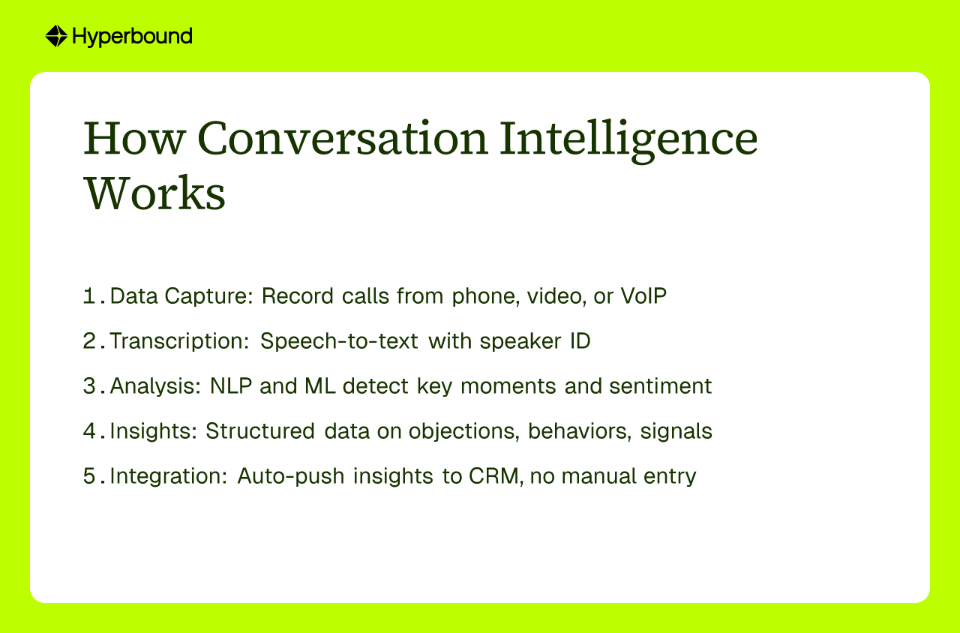
The process follows a defined sequence:
The critical layer is the third step. CI software automatically records, transcribes, and analyzes sales calls, extracting coaching signals and behavioral patterns. It measures talk-to-listen ratios, tracks how questions are distributed across the call, detects sentiment shifts, and flags the moments where customer engagement dropped or increased.
Conversation intelligence provides an objective analysis of calls without offering personalized feedback. It does not tell a rep they were wrong. It shows them that their talk-to-listen ratio on the last four discovery calls was 72:28, and that the three calls that progressed to proposal had a ratio closer to 50:50. The conclusion is the rep's to draw.
The standard coaching model relies on a manager's recall of a call they may not have attended, combined with the rep's CRM entries. Feedback delivered under those conditions is easily contested and difficult to act on. "You need to listen more" is an opinion. A rep can agree with it in the moment and have no mechanism for tracking whether anything changes.
Conversation intelligence shifts coaching from opinion-based feedback to evidence-based training. The same call that produced a vague impression for the manager surfaces a set of measurable facts: the rep spoke for 68 percent of the call, asked two questions in the first twenty minutes, and did not address the pricing objection that emerged at the forty-minute mark. The manager can pull the flagged moment, review it with the rep, and attach next-session criteria to it.
CI software automatically flags key coaching moments, risks, and successful behaviors, so managers do not need to sit on every call to coach effectively. The platform identifies the moments worth reviewing. The manager responds to evidence rather than relying on a sample of calls they attended.
The same mechanism builds peer learning at scale. New reps can study a library of recorded calls from top performers to see how they handle pricing objections, establish next steps, and navigate competitive questions. That library is built from objective data, not curated impressions. The teams that extract the most from conversation intelligence are those that establish a structured review process, with managers reviewing specific flagged moments and attaching concrete criteria to what good looks like on a call.
A single call summary has limited strategic value. The insight that a prospect mentioned a competitor three times on one call is a data point. The insight that the same competitor has appeared in 34 percent of discovery calls this quarter, concentrated in the mid-market segment, is a finding that changes how sales, marketing, and product respond.
Aggregating insights from hundreds of conversations reveals trends that no individual call summary can surface. Conversation intelligence applied at scale answers questions that sales ops teams otherwise cannot: which objections are appearing most frequently this quarter, which call structures correlate with deals that progress, and which topics generate the strongest positive sentiment from prospects.
This data equips marketing, product, and customer success teams to make better decisions. Objection patterns inform battlecard updates. Feature interest data feeds product prioritization. Call structure findings reshape onboarding and enablement.
The business results attached to this kind of systematic analysis are measurable. CallRail's data on conversation intelligence shows a 10 percent increase in leads from improved marketing strategies, a 50 percent reduction in time spent reviewing calls, and a 60 percent decrease in time spent qualifying leads. As Vlad Kandybovich of Qshark Moving Company put it: "Today, I'm spending less time monitoring calls and more time serving our customers, which is the way it should be."
None of that comes from a summary. It comes from structured, consistent data collection across the full call volume, connected to the CRM and surfaced in the systems teams already use.
When evaluating conversation intelligence platforms, the primary distinction is whether the platform produces a record or an opinion, not the feature list.
A record is objective. It captures what happened, measures it against defined criteria, and presents the data without a verdict. A rep who sees their talk-to-listen ratio, their objection-handling frequency, and the sentiment arc of their last five calls has everything they need to identify what to adjust. They are not being told they are wrong. They are being shown what occurred.
That is the line: an ungrounded verdict versus an evidence-backed point of view. Generic call scores built on opaque criteria, AI summaries that flatten nuance into a template, and coaching prompts that appear without attached evidence all push a team toward a conclusion it did not reach on its own. A record, by contrast, gives the team the evidence and leaves the conclusion to the people who own the deal.
But "record versus opinion" is the wrong way to frame the choice, because an opinion can be grounded or it can be hollow. An opinion built on the evidence in the deal, argued and pushed back on, is the most useful thing a rep can get. An opinion pulled from a template is noise. The useful distinction is not whether a tool has a point of view. It is whether the point of view is backed by the actual call and deal data, and whether anything gets done with it afterward.
Platforms that define what "good" looks like using the team's own criteria, track deviations from that standard with precision, and deliver the evidence to the manager rather than the verdict, are the ones that produce durable improvement. The tool's job is to make the call visible, measurable, and searchable. The judgment belongs to the people who understand the customer, the market, and what winning looks like for that team. Then, once the judgment is made, someone still has to act on it.
When sales operations teams assess conversation intelligence platforms, these are the criteria that determine whether a platform delivers a record or only a recap:
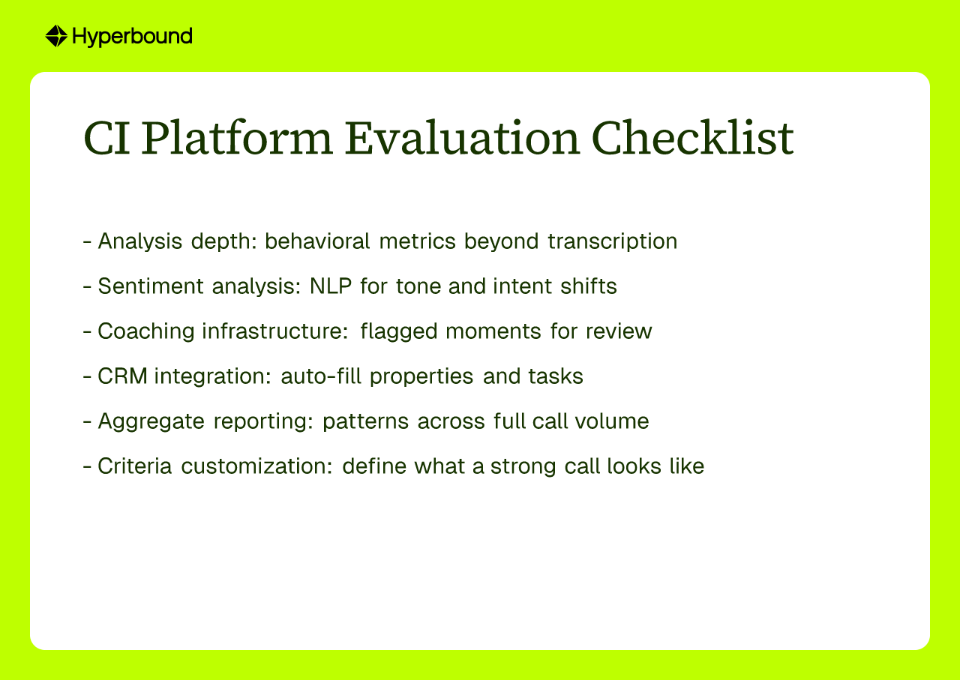
The goal is a platform that makes every call measurable, every pattern visible, and every coaching conversation grounded in evidence rather than impression.
Conversation intelligence does not have an opinion. That is its value, and its limit. It tells you what happened on the call. It does not tell the rep what to do next, and it completes none of the work.
Platforms built for Revenue Activation, such as Hyperbound, take that a step further by adding the two things CI stops short of: an opinion, and the follow-up work. Conversation intelligence tells you what happened. Hyperbound helps the rep figure out what happens next, then drafts the email and updates the CRM instead of leaving a blank page. For the fuller argument on why CI and Revenue Activation are different categories, see conversation intelligence vs revenue activation.
Conversation intelligence is software that uses AI to record, transcribe, and analyze sales and customer calls to surface structured insights such as objections, buying signals, sentiment shifts, and rep behaviors. Unlike a standard call recap, it turns unstructured conversations into measurable, objective data teams can use for coaching and pipeline visibility.
Conversation intelligence follows a defined sequence: it captures audio from phone, video, or VoIP; transcribes it with speaker identification; applies natural language processing (NLP) and machine learning (ML) to detect key moments and sentiment; generates structured insights from the unstructured call; and pushes those insights to the CRM. This creates an objective record of what happened rather than a subjective summary.
Call recording creates a replayable audio file. Conversation intelligence analyzes that recording to identify patterns such as talk-to-listen ratio, objection frequency, sentiment shifts, and risk moments. Call recording documents what was said; conversation intelligence shows what happened across calls and what to coach next.
Generic AI summaries treat calls as blocks of text to condense, so they often omit hesitation, tone shifts, unaddressed objections, and the context around a prospect's answer. Conversation intelligence measures structured signals in the full conversation, preserving the "why" behind key moments.
Call scoring often gives a number based on vague or opaque criteria, which functions as an opinion. Conversation intelligence provides defined, evidence-based metrics and flags the exact moments behind the score, so managers and reps can review the data and form their own judgment.
Conversation intelligence shifts coaching from opinion-based feedback to evidence-based coaching. Managers can review automatically flagged risk moments, compare rep behavior against team-defined criteria, and build peer learning from top-performer calls without sitting on every live call.
Sales teams should look for analysis depth beyond transcription, sentiment and semantic analysis, coaching infrastructure with flagged moments, CRM integration, aggregate reporting across call volume, and the ability to customize what a strong call looks like for their specific sales motion.
Yes. Conversation intelligence uses NLP and ML to detect positive sentiment, feature interest, timeline mentions, and engagement shifts, then surfaces those as structured signals. When aggregated across calls, these signals help teams spot which call behaviors and topics correlate with deals that progress.
Sales operations, sales managers, enablement teams, and revenue leaders benefit most directly. Marketing, product, and customer success teams also gain from the aggregated call patterns, such as recurring objections or feature excitement, that inform messaging, roadmap, and onboarding decisions.










Use Cases
Legal