
You've just met someone new at a networking event. Your mind races to find the perfect question. Should you stick to safe small talk? Ask something deeper to stand out? Your palms get sweaty as the awkward silence stretches on.
We've all been there. That moment when you're desperate to form a connection but terrified of coming across as stilted, intrusive, or turning a casual chat into an impromptu therapy session.
The problem isn't a lack of questions—there are plenty of lists with hundreds of conversation starters online. The real issue is knowing which questions are appropriate when. As one Reddit user aptly noted, "No one actually asks such deep questions" to strangers. Another pointed out that "A 'deep' question asked of a total stranger would probably come off as odd."
This article provides a clear framework for matching the right type of question to the right social context. We'll explore a categorized "toolbox" of questions, map them onto different stages of a relationship, and teach you how to read the social cues that signal whether you have a green light to go deeper or a red light to pull back. The goal is to build meaningful connections, not just follow a script.
Before diving into when to use different questions, let's understand the tools at our disposal. Think of these question types as instruments in an orchestra—each serves a unique purpose in the symphony of conversation.
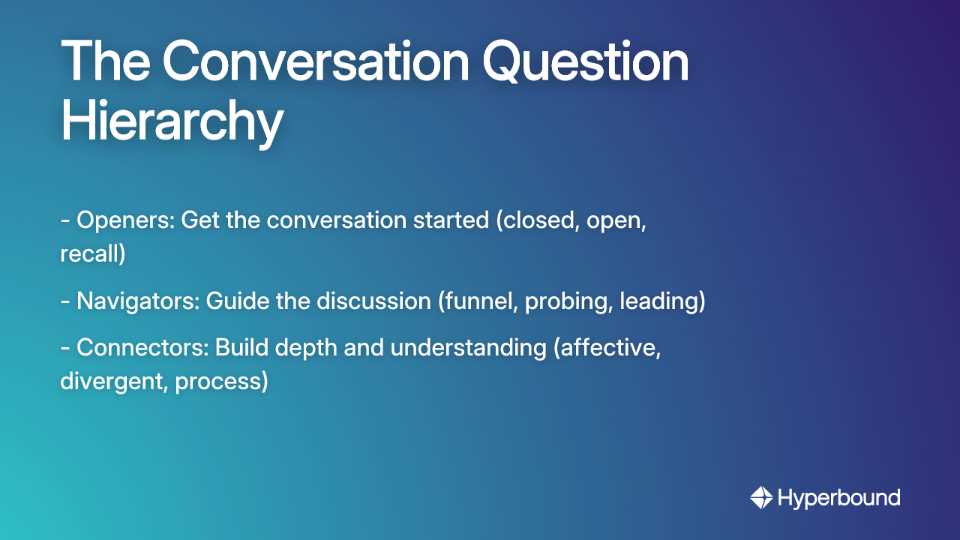
Closed Questions: Require a simple "yes" or "no" answer. Perfect for quick facts or easing into a topic.
Open Questions: Encourage detailed, thoughtful responses. The cornerstone of engaging conversation.
Recall Questions: Ask for specific, factual information from memory.
Affective Questions: Explore feelings, emotions, and opinions. Crucial for building rapport.
Divergent Questions: Encourage creative thinking and exploring possibilities; there's no single right answer.
Process Questions: Require the listener to explain how or why something works, revealing their thought process.
Understanding these question types is just the first step. The real skill lies in knowing which ones to deploy based on your relationship with the other person and the social context.
Now that we have our toolbox, let's create a roadmap for when to use each question type based on relationship stages. This framework will help you avoid the awkwardness of asking a deep, personal question too soon or sticking to superficial topics when there's potential for more meaningful connection.
Goal: Brief, non-threatening interaction. First impressions count.
Appropriate Questions: Stick to closed questions and simple, context-based open questions. This is the realm of "small talk," which serves an important social purpose.
Practical Tip: Use the FORD method (Family, Occupation, Recreation, Dreams) as a guide for safe topics, but at this stage, focus primarily on Recreation and Occupation.
Examples:
What to Avoid: Deep, personal, or affective questions. As one Reddit user warned, "A 'deep' question asked of a total stranger would probably come off as odd."
Even pickup artists, who often get a bad rap, understand this principle—start light and contextual. Effective icebreakers should feel natural to the environment, not forced or scripted.
Goal: Find common ground and shared interests. Learning more about each other.
Appropriate Questions: More open questions, comparison questions, and funnel questions become appropriate.
Practical Tip: This is the perfect time to ask about passions or unique experiences.
Examples:
At this stage, you're moving beyond surface level conversations but still respecting boundaries. The key is to show genuine interest without prying.
Goal: Build trust and intimacy. Vulnerability increases.
Appropriate Questions: Affective, probing, and process questions become appropriate and valued. Language shifts from "I" to "we."
Practical Tip: This is the stage where those "deep questions" lists become useful because a foundation of trust has been built. It no longer feels like a therapy session but rather a natural deepening of understanding.
Examples:
These therapeutic questions can lead to meaningful connections, but only when there's already an established relationship. As one Reddit user noted, "If I've already known someone for a long time our conversations will be organic and won't come across as some kind of therapy session."
Goal: Merge identities and make public commitments.
Appropriate Questions: Problem-solving, structuring, and evaluation questions about shared goals and the future.
Examples:
At this stage, questions often revolve around dreams, shared futures, and deep values—the "D" in the FORD method takes center stage.

Knowing the relationship stages isn't enough; you must be able to read immediate feedback to avoid awkwardness. Self-awareness and social intelligence require recognizing when to advance or retreat in conversation.
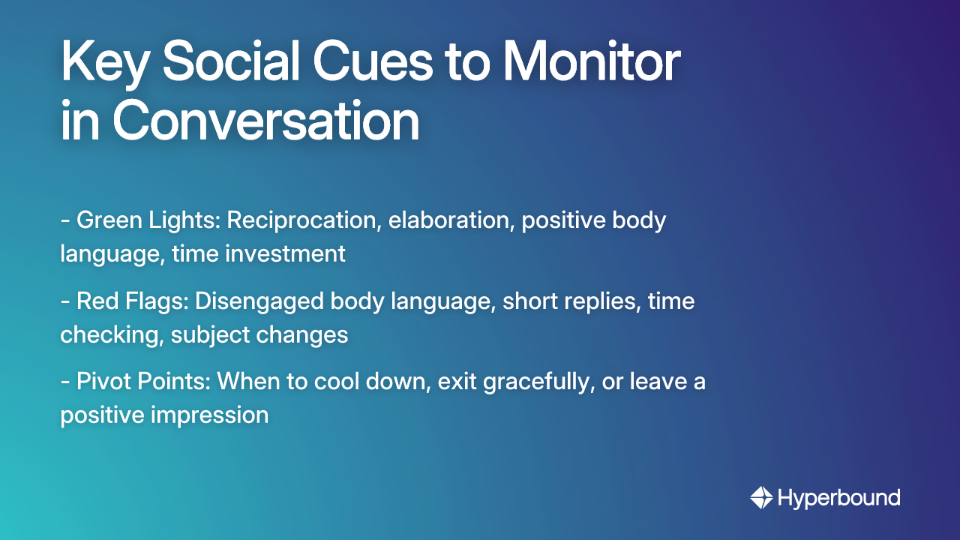
When you see these signals, it's usually safe to deepen the conversation:
According to Science of People, these engagement cues indicate the natural flow of conversation is working.
When you notice these signs, it's time to adjust your approach:
These signs don't necessarily mean the person dislikes you—they might be busy, tired, or simply not in the mood for the type of conversation you're initiating.
When you spot a red flag, don't double down with more intense questions. Instead:
Avoiding awkward silence requires recognizing when a conversation has run its natural course. Social skills include knowing both how to start and how to end interactions positively.
Knowing the right question is one thing; delivering it effectively under pressure is another. For high-stakes conversations, structured frameworks can provide a reliable roadmap. Here are a few popular models:
If you hate job interviews, this framework can help you prepare better answers and ask more insightful questions:
This framework helps you tell compelling stories and evaluate others' experiences in a structured way.
When helping friends work through challenges or receiving advice yourself:
If you need to be persuasive without being pushy:
While knowing these frameworks is useful, true mastery comes from practice. The ability to seamlessly guide a conversation using models like SPIN Selling is what separates top performers from the rest, especially in fields like sales.

The journey from awkward silence to meaningful connections isn't about memorizing perfect questions—it's about developing conversational intelligence. Being a great conversationalist requires being present, curious, and adaptable.
Remember these key principles:
Start small by practicing one new question type in a low-stakes conversation this week. Notice the responses you get and how different questions change the dynamic of the interaction.
As you develop this skill, you'll find yourself naturally selecting the right question for each unique social context—transforming awkward exchanges into opportunities for genuine connection.
After all, the goal isn't to avoid awkward silence at all costs—it's to create the space for meaningful human connection when the context is right.
The best questions to ask someone you just met are simple, context-based open questions. Focus on "small talk" topics related to your shared environment or use the FORD (Family, Occupation, Recreation, Dreams) method, sticking mainly to Occupation and Recreation. For example, "What brings you to this event today?" or "Have you been to this venue before?" These questions are non-threatening and open the door for further conversation without being too personal.
You can tell if someone is open to a deeper conversation by observing their "green light" social cues. Look for signs of engagement like reciprocation (they ask you questions back), elaboration (they give detailed answers, not one-word replies), and positive body language (leaning in, making eye contact). If they are actively contributing to the conversation and seem invested, it's a good sign you can gradually introduce more personal or affective questions.
If you ask an awkward question, the best way to recover is to acknowledge the misstep lightly and quickly pivot the conversation. Don't dwell on it. You can say something like, "Sorry, that was a bit random!" and then immediately steer the conversation back to a safer topic. For example, "Anyway, you were telling me about your project..." The key is to show self-awareness and move on gracefully without making a big deal out of it.
It's crucial to match question types to relationship stages to build trust and comfort gradually. Asking a deep, personal question (a "Connector" question) to a stranger can feel intrusive because there is no foundation of trust. Starting with simple "Opener" questions allows you to establish rapport. As the relationship progresses from stranger to acquaintance to friend, you earn the right to ask more probing and affective questions, leading to more meaningful connections.
Practice asking better questions by focusing on genuine curiosity rather than memorizing a script. Start in low-stakes situations, like with a barista or a colleague. Instead of just memorizing a list, try to be genuinely interested in the other person. Listen actively to their responses and let your follow-up questions stem from what they've just said. This makes the conversation feel organic and authentic, not like an interrogation.
The difference between a probing question and being nosy lies in your intent and the context of the relationship. A probing question is driven by genuine curiosity to better understand something the person has already shared (e.g., "When you said that was challenging, what did you mean?"). It shows you're listening. Being nosy involves prying for information the person hasn't offered, often on sensitive or private topics. Always pay attention to their social cues; if they seem hesitant, it's a sign to back off.










Use Cases
Legal