
When an AI agent's behavior changes and no one on the team can identify who changed it or when, the cause is a missing governance layer that makes the agent's actions traceable from the start.
Microsoft's Cloud Adoption Framework defines AI agents as software systems that access data, make decisions, and take actions across business systems with delegated authority. That delegated authority is the central governance concern. When a shared agent builds shared resources, an undocumented change to its instructions does not affect one user's session; it affects every workflow the agent touches.
For sales teams, that exposure is significant. Qualification frameworks, persona-level objection handling, and scorecard logic all flow from the instructions the agent is given. Governance must be present before the system runs. In any serious agentic content management system, it is the requirement that makes autonomy operational without limiting its utility.
Most revenue teams arrive at AI adoption with their knowledge already fragmented. Methodology documentation lives in Notion. Competitive battlecards sit in Google Drive or SharePoint. Persona briefs are distributed across slide decks and PDFs on individual hard drives.
When a shared agent draws from that fragmented source environment, it produces several interpretations of one methodology with no trail back to the source. Kota CMS identifies this directly: over a quarter, a workspace accumulates conflicting versions of the same content, and no single document is authoritative. Traditional content platforms store files for humans to find. They do not record which document applies to which workflow, which objections map to which persona, or which qualification rules apply to first calls versus renewals.
An agentic system requires those relationships to be explicit and structured. Without them, the agent cannot be consistent, and without governance, no one can tell when it stops being consistent.
Giving a connected agent unrestricted access to a platform creates the risk that MLOps practitioners associate with absent approval gates before an irreversible action fires. When an agent can write to a database or send a file, the question of scope must be resolved before the first action.
Kota CMS exposes tools individually per connector. The operating principle is explicit: teams decide what Kota can do inside each connected app. In practice, this means Kota can be configured to search and read pages in Notion without holding permission to create or edit them. The same granular control applies across the connector library, including Google Drive, SharePoint, Seismic, and Highspot.
This aligns with the access control domain that Microsoft's Cloud Adoption Framework specifies as a core governance requirement for AI agents, including maintaining an agent registry that records the access scope for every agent in the organization. Kota's per-tool configuration makes that scope a deliberate decision at setup rather than a default that someone inherits.
When an agent generates a set of instructions, the output is only as reliable as the inputs that produced it. File provenance answers the question that raw logs rarely can: which specific source documents were used to generate this particular set of agent instructions?
Kota CMS handles this through a structured Guidelines-drafting flow:
The human review step is essential. Source documents are written for internal audiences, not as instructions for an AI system. Kota performs that translation, but the review step ensures a person confirms the output before it governs the agent's behavior. The full walkthrough of what those Guidelines are and how to write them is in How to Give an AI Your Sales Methodology Without Retyping It.
This operational provenance is distinct from cryptographic standards such as C2PA's Content Credentials, which provide a verifiable record of a digital asset's origin and edit history. C2PA addresses media authenticity at scale. Kota's provenance model addresses operational accountability: which files, selected by which team member, produced which set of agent instructions.
Collecting logs is straightforward. The operational requirement is that logs are useful when someone asks why the agent behaved differently on Tuesday than it did on Monday.
Kota CMS provides a before-and-after, side-by-side view for sales content version control. The Knowledge Base surfaces both the source file set and the generated Guideline text as they existed before and after any change. This view makes it immediately visible whether a file was added or removed from the source set, whether the instructional text itself was rewritten, or both.
The practical value is diagnostic speed. If a qualification framework shifts from BANT to MEDDIC, that change appears in the diff as a direct text comparison. The team does not need to reconstruct what happened from separate change records across disconnected systems. The before state and the after state are presented together.
Version history answers what changed. Attributed change logs answer who made the change and when. Without both, accountability is incomplete.
Every meaningful action in Kota CMS is logged and attributed:
Each log entry carries the user's name and a timestamp. The result is an audit trail that teams can present when a compliance question arrives: a single, attributed record of what changed, who changed it, and when the change took effect, rather than raw system events requiring correlation across three separate platforms.
The design principle is direct: every action Kota takes must be visible to the team relying on it.
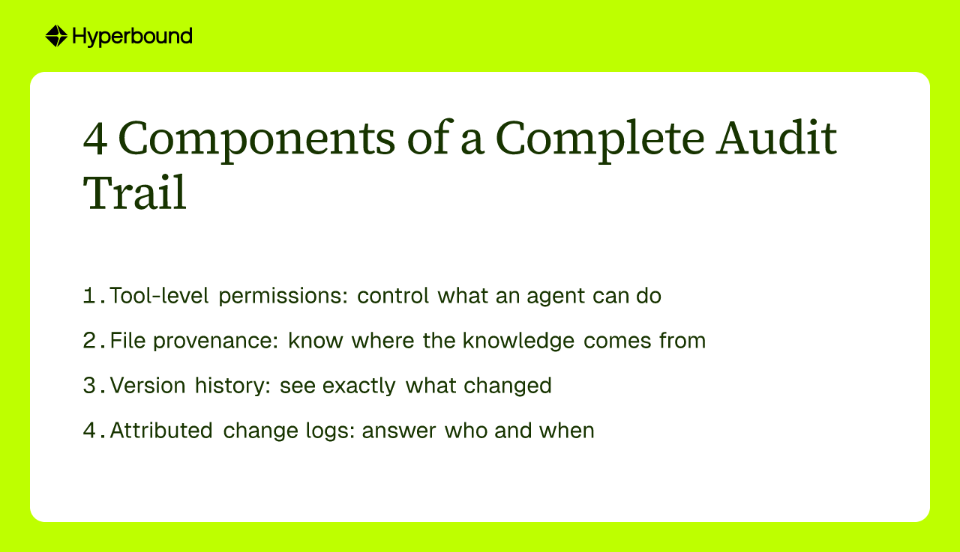
Each of the four components above addresses a specific failure mode: an agent that acts beyond its permitted scope, instructions with no traceable source, a behavior change with no visible diff, an action with no named owner. Taken together, they create the observability required for a team to trust shared AI infrastructure and extend its use with confidence.
The compounding effect is significant for revenue teams. The governed Knowledge Base that Kota CMS maintains for Practice workflows, bot configurations, and scorecard logic is on the roadmap to extend across the Hyperbound platform into Perform and Activate. When that extension ships, the same governed source of truth will power live-call feedback and in-workflow seller recommendations. The investment in governance at the Practice layer does not stay contained there. It propagates consistency and traceability across the full sales cycle.
That is what distinguishes agentic content management from a conventional document library with an AI layer applied on top. A well-governed agentic system carries structured relationships and a clear audit trail through every surface it touches.
When sales teams delegate content work to an AI agent, they are extending that agent a form of authority over shared resources. Scaling that delegation requires a clear answer to a simple question: who changed what?
Kota CMS is Hyperbound's agentic content manager, purpose-built to give revenue teams that answer. Tool-level permissions define what the agent is allowed to do before it acts. File provenance records where every set of Guidelines came from. Before-and-after version history makes every change to those Guidelines visible without reconstruction. Attributed change logs name the person and the timestamp for every consequential action.
Kota CMS is a paid add-on, currently available in private preview. Private preview capabilities, scope, and availability are subject to change as we continue development and incorporate customer feedback.
To see how governed, agentic content management can work for your team, request access through your Hyperbound account manager.

Agentic content management is a system where an AI agent manages, updates, and distributes sales content under governed rules and audit trails. Unlike a traditional document library, it maintains structured relationships between source files, workflows, and permissions, allowing teams to scale AI use without losing traceability.
AI agent governance matters because sales agents are delegated authority to make decisions and modify shared resources, so a single undocumented instruction change can affect every qualification, objection-handling, and scoring workflow. Governance ensures those changes are controlled, visible, and attributable before they impact revenue outcomes.
Sales teams can create an audit trail by implementing four controls: tool-level permissions to restrict what the agent can do, file provenance to track which sources generated agent instructions, version history to compare before-and-after changes, and attributed change logs to record who made each change and when. Together these provide a complete, reviewable record.
Tool-level permissions are granular controls that determine exactly what an AI agent is allowed to do inside each connected application, such as read-only access to Notion or permission to edit Google Drive files. They prevent agents from performing actions beyond their approved scope and are configured before the agent takes any action.
File provenance is the record of which specific source documents were used to generate a particular set of AI agent instructions. In Kota CMS, each set of Guidelines is linked to the files uploaded for it, so teams can verify the origin of every rule the agent follows.
Version history in Kota CMS provides a side-by-side diff of both the source file set and the generated Guidelines before and after any change. This makes it immediately clear whether a file was added or removed, whether the instruction text was rewritten, or both, without reconstructing events from disconnected logs.
In Kota CMS, changes to AI agent instructions are attributed to specific users through change logs that record the person’s name and a timestamp for every action, including app connections, file uploads, and Guidelines edits. While the platform controls what Kota can do, human reviewers approve drafted Guidelines before they take effect, and every change is tied to a named team member.
Revenue teams should implement AI agent governance before deploying shared AI agents into production workflows, not after a compliance incident. Establishing permissions, provenance, version history, and attributed logs early ensures that scaling AI across sales content remains safe and auditable from the first use.
Hyperbound Kota CMS is an agentic content manager purpose-built for revenue teams. It provides governed, traceable management of sales methodology, battlecards, qualification frameworks, and scorecard logic, including tool-level permissions, file provenance, version history, and attributed change logs. Kota CMS is currently available as a paid add-on in private preview.










Use Cases
Legal