You've prepared for hours, researched the prospect, practiced your pitch, and yet when the moment arrives, you hear yourself saying: "I just wanted to check if maybe you might be interested in our solution that kind of addresses your needs..."
Sound familiar? You've just undermined your entire SaaS sales pitch with a string of qualifier words that make you sound uncertain, apologetic, and lacking confidence.
In the competitive world of sales, perception is reality. The words you choose directly impact your credibility and authority. When anxiety creeps in during important calls, many reps default to qualifiers – words that soften statements and unintentionally signal doubt.
As one experienced sales professional noted, "Drop the qualifiers. Words like 'just,' 'kind of,' 'I think,' and 'possibly' are confidence killers." These seemingly harmless words are subtly telling your prospect that you don't fully believe in what you're saying.
Technical people, especially those transitioning to sales roles, often struggle with this the most. There are several reasons we fall into this trap:
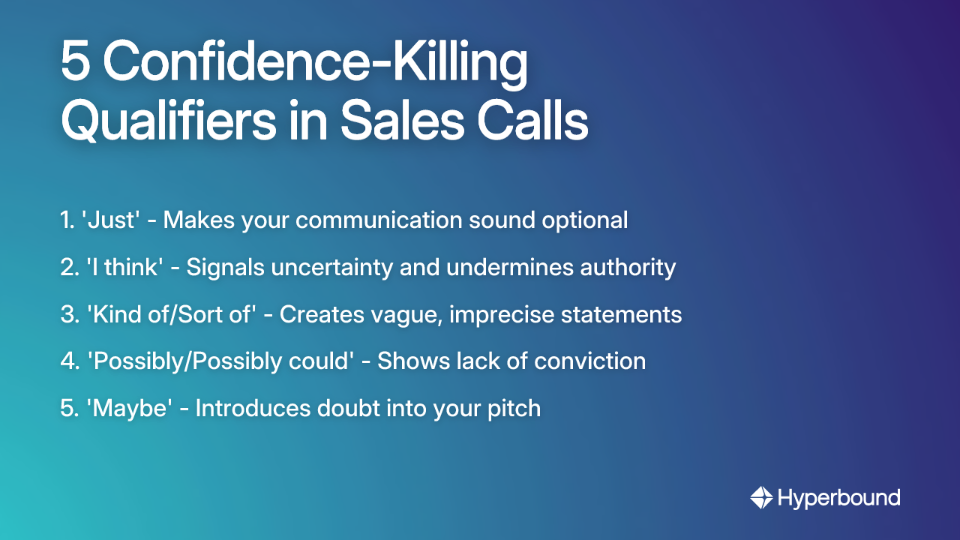
This word instantly diminishes everything that follows it. It's an apologetic qualifier that makes your communication sound optional or unimportant.
How it sounds to prospects: "This person is apologizing for taking up my time before they've even started."
Instead of: "I'm just calling to discuss our solution."Say: "I'm calling to discuss how we can increase your conversion rates by 37%."
This phrase signals uncertainty and hesitation, undermining your authority as an expert in your field.
How it sounds to prospects: "Even this salesperson isn't convinced about what they're telling me."
Instead of: "I think this feature would benefit your team."Say: "Based on what you've shared, this feature will solve your current workflow bottleneck."
These qualifiers create vague, imprecise statements that lack conviction and clarity.
How it sounds to prospects: "This person isn't being straight with me or doesn't fully understand their own product."
Instead of: "Our platform kind of integrates with your existing tools."Say: "Our platform seamlessly integrates with your existing tools, eliminating the need for manual data transfer."
This signals a lack of certainty and conviction about what you're proposing.
How it sounds to prospects: "If they're not sure their solution will work, why should I risk trying it?"
Instead of: "We could possibly improve your customer retention."Say: "We will improve your customer retention through our proven feedback loop system."
Similar to "possibly," this word introduces doubt and hesitation into your pitch.
How it sounds to prospects: "This person isn't confident in what they're telling me."
Instead of: "Maybe we should schedule a demo next week."Say: "Let's schedule a demo next week to show you exactly how this works."
Interestingly, Hyperbound's analysis of thousands of sales calls reveals that traditional filler words like "um," "ah," and "like" don't significantly impact sales outcomes. Our AI has found no meaningful difference in their usage between top performers and average reps.
Yet the five qualifiers we've discussed are different – they don't just fill silence; they actively diminish your authority. The distinction is crucial: a pause signals thoughtfulness, while a qualifier signals doubt.
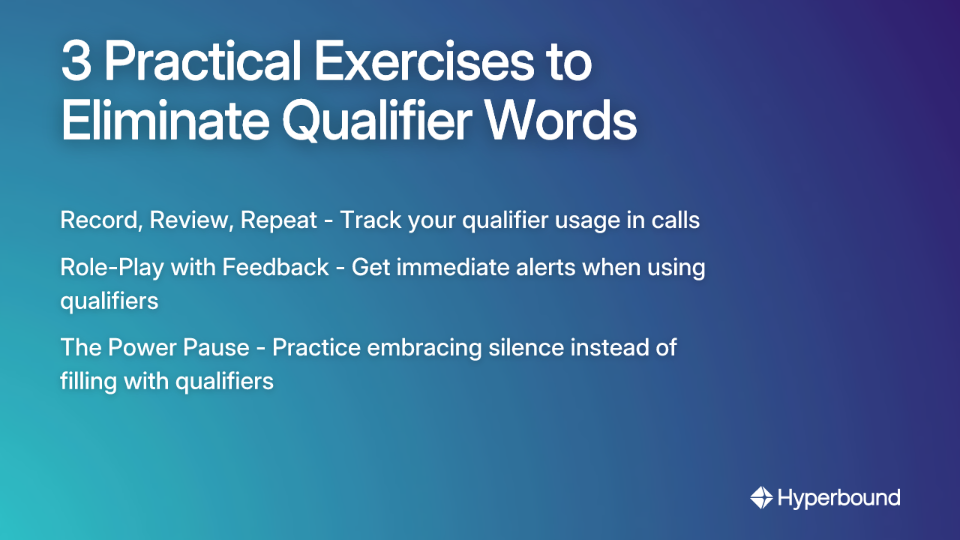
Manually tracking qualifier words is tedious and subjective. Use Hyperbound’s AI Real Call Scoring to do it automatically. It analyzes your real customer conversations, identifies confidence-killing language, and gives you objective data on your speech patterns, helping you track improvement over time without the manual effort.
While practicing with colleagues is helpful, it’s difficult to scale and feedback can be inconsistent. Hyperbound’s AI Sales Roleplays provide a better way to practice. You can role-play any scenario—from cold calls to objection handling—against a realistic AI buyer that responds to your every word. The AI provides instant, objective feedback on your language, allowing you to build confident speech habits much faster.
Often, we use qualifiers to fill uncomfortable silence. Instead, practice embracing the pause. When you feel an "I think" coming on, stop, take a breath, and deliver a clear statement with downward inflection.
A three-second pause feels like an eternity to you but sounds thoughtful and controlled to your prospect. Practice this technique when answering questions during your next team meeting.
Qualifier words are words and phrases that soften a statement, unintentionally signaling doubt, uncertainty, or a lack of confidence to the prospect. They include words like "just," "I think," "kind of," "possibly," and "maybe," which can undermine your credibility and the perceived value of your solution.
It is important to eliminate these words because they act as "confidence killers" that weaken your authority and make you sound apologetic or unsure about your product. When a prospect hears qualifiers, they may question your expertise and the effectiveness of your solution, making them less likely to buy.
You can stop using qualifier words by practicing three key exercises: recording and reviewing your calls to identify your speech patterns, using AI role-play scenarios to build new habits in a safe environment, and practicing the "Power Pause" to replace filler language with thoughtful silence.
No, traditional filler words like 'um' and 'ah' are not as damaging as qualifier words. Analysis of sales calls shows no significant difference in the use of these fillers between top and average performers. Qualifiers actively diminish your message's authority, while fillers like 'um' are often perceived as momentary pauses for thought.
Instead of using weak qualifiers, use direct and confident language. For example, replace "I think this will help" with "This feature will solve your bottleneck." Instead of "Maybe we can schedule a demo," say "Let's schedule a demo to show you how this works." Focus on making definitive statements based on the value you provide.
AI tools can automatically analyze your sales calls to identify and track your use of specific qualifier words, providing objective data on your speech patterns. Furthermore, AI-powered role-play simulations allow you to practice sales scenarios against a realistic AI buyer and receive instant feedback, helping you build confident language habits much faster than traditional methods.









Use Cases
Legal