You've just been told to be "more strategic" in your sales approach. Your manager wants you to stop focusing on tactical, transactional deals and start building deeper relationships with key accounts. But what does that actually mean? How do you transform vague directives like "be strategic" into concrete actions that drive results?
If you're feeling confused, you're not alone. Many sales professionals struggle with this shift, especially when they're given "large quotas + niche targets" without a clear framework to tackle them.
Enter Conceptual Selling – a methodology that provides the roadmap you've been looking for to transform your approach from product-focused to solution-oriented, and from closing deals to building partnerships.
Conceptual Selling, developed by Robert Miller and Stephen Heiman in the 1980s, is built on a simple yet powerful premise: Customers don't buy products; they buy their concept of a solution to their problems.
This is the fundamental shift that separates tactical from strategic selling. Instead of pitching features, specifications, and benefits (the product), you're selling the buyer on their vision of how their problem will be solved (the concept).
Consider a car salesperson. A tactical approach would focus on horsepower, fuel efficiency, and leather seats. A conceptual approach would sell the idea of "family safety and peace of mind on long road trips" or "the prestige and confidence that comes with driving a luxury vehicle." The physical car is the same, but the concept being sold is tailored to what the buyer truly values.
For complex B2B services like cybersecurity, an analogy can make an intangible concept tangible. A cybersecurity service isn't just a package of software and monitoring tools; it's a "digital fortress" that protects a company's most valuable assets from invaders. This concept resonates far more deeply than a feature list.
This methodology is particularly effective for:
In these environments, concept selling shines because it transforms the conversation from "here's what our product does" to "here's how we'll solve your unique business challenge."
To implement concept selling effectively, you need to understand and embrace these five core principles:
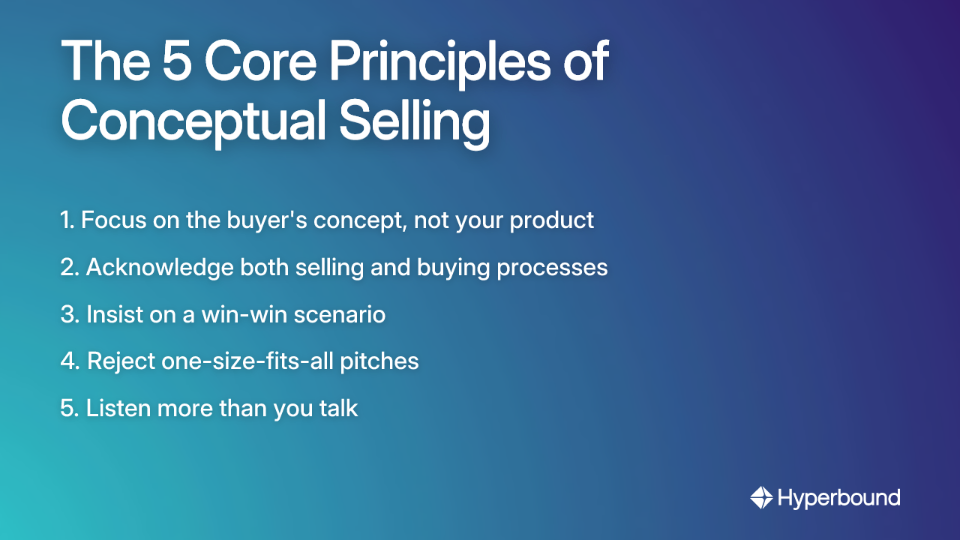
The entire sales process must revolve around discovering and aligning with the prospect's vision of a solution. This requires genuine curiosity about their world and challenges.
Your product's features only matter to the extent that they deliver on the buyer's concept of what success looks like. The most compelling pitch is one that reflects the customer's own vision back to them.
A successful sale recognizes that two processes are happening concurrently:
The key is to guide the buyer through their process, not force them through yours. This means understanding where they are in their journey and meeting them there.
Conceptual Selling rejects manipulative tactics that might win short-term deals but damage long-term relationships. The goal is to find a mutually beneficial solution where both parties gain value.
This approach positions you as a trusted advisor rather than an adversary, which helps eliminate the "desperate for a sale" vibe that prospects can sense and run from.
Every buyer is unique, and a product can mean different things to different people. A generic pitch signals that you haven't done your discovery work.
A CFO may care about ROI and cost reduction, while a CMO might focus on brand impact and market reach. The same solution must be presented differently to each stakeholder based on their concept of value.
This principle is non-negotiable in conceptual selling. Data from Gong shows that the most successful sales reps have a talk-to-listen ratio of 46:54. You simply cannot uncover the buyer's concept if you're the one doing most of the talking.
Active listening – where you truly absorb what the customer is saying rather than just waiting for your turn to speak – is the foundation of this methodology.
Before diving into implementation, it's important to understand both the advantages and potential challenges of this approach.
Better Conversion Rates & Shorter Sales Cycles By customizing the pitch and getting to the core value faster, customers make decisions more efficiently. When they feel deeply understood, there's less hesitation in moving forward.
Higher Average Deal Size When you demonstrate deep, conceptual value that solves a major business problem, you can justify a larger investment. Customers pay premium prices for solutions they believe are tailored specifically to their needs.
Builds Lasting, Trust-Based Relationships This approach transforms the sales rep into a long-term, trustworthy advisor, fostering loyalty and repeat business. The relationship continues beyond the initial sale, leading to renewals, expansions, and referrals.
It's Skill-Intensive Success hinges on the salesperson's listening, questioning, and storytelling abilities. It requires training and practice to master these soft skills, which not all reps may possess naturally. This is where modern tools can accelerate skill development; for instance, platforms like Hyperbound allow reps to practice these nuanced conversations in safe, AI-powered roleplay scenarios, rapidly improving their skills without risking live deals.
It Requires Significant Prep Time Top-performing reps spend an average of six hours per week researching prospects. This is not a "wing it" methodology – it demands thorough preparation before each interaction.
May Frustrate Transactional Buyers Some customers are impatient and just want price and features. This deep, consultative approach may not be suitable for them or for products with very short sales cycles.
Potential for Missed Expectations A highly creative or abstract "concept" can set expectations that the tangible product might not meet if not managed carefully. It's crucial to ensure your solution can deliver on the promised concept.
.png)
Now let's break down the practical implementation of concept selling into eight actionable steps:
.png)
Before any interaction, invest the time to understand:
The goal is to go in armed with hypotheses about what matters to them, which you'll then validate or refine through conversation.
The discovery phase is the heart of Conceptual Selling. The goal is to ask between 11-14 targeted questions to uncover the buyer's true needs and their concept of a solution.
These questions should help you understand:
Remember the 46:54 talk-to-listen ratio. Active listening includes:
Go beyond your product. Offer genuine advice that helps the prospect regardless of whether they buy from you. A powerful trust-building tactic is to preface your recommendation with something you don't recommend for them, showing you prioritize their needs over your sale.
For example: "Based on what you've shared, I actually wouldn't recommend our premium tier for your situation. The standard package would meet all your needs without unnecessary features."
Your presentation should be a direct response to what you learned in discovery. Data shows that keeping sales presentations under 9 minutes maintains higher engagement.
Don't do a feature dump; show them exactly how your product brings their specific concept to life. Focus on the outcomes they care about rather than exhaustive feature lists.
Clearly articulate how your product or service is uniquely positioned to deliver on their concept in a way competitors can't. This isn't about bashing competitors but highlighting your distinct approach to solving their problem.
Explicitly connect your solution to their stated business goals and their internal buying process. Demonstrate how implementing your solution helps them achieve their objectives while also being a good partnership for your company.
Many sales professionals fear "asking for the sale," but in Conceptual Selling, this becomes more natural because it's framed collaboratively. In every meeting, discuss and agree on concrete next steps.
This maintains momentum and clarifies the path to purchase. Examples include scheduling a technical demo, arranging a meeting with decision-makers, or sending over a customized proposal.
To effectively uncover your prospect's concept, you need to deploy different types of questions strategically. Here are the five categories with examples:
Verify information and show you're listening.
Discover their world and motivations.
Gauge their openness to change and their personal stake.
Test their seriousness and readiness to act.
Uncover potential roadblocks and objections.
To illustrate how Conceptual Selling works in practice, here's a sample transcript of a discovery call between Sarah (an Account Executive at "SyncUp," a project management SaaS) and Mark (VP of Operations at "Creative Co," a growing marketing agency).
Sarah: "Hi Mark, thanks for taking the time to chat today. Before we dive in, I noticed Creative Co just won the Industry Innovation Award last month. Congratulations on that achievement!"
Mark: "Thanks for noticing! Yes, it was a big win for our team."
Sarah: "That's impressive. I'd love to understand more about your current project management approach. Could you walk me through how your team handles client projects right now?"
Mark: "Sure. We've grown from 10 to 50 people in the last year, which has been great for business but challenging for our workflow. Currently, each creative director manages their team's projects independently, using a mix of tools – some use Trello, others prefer Asana, and a few are still using spreadsheets. It's becoming a bit chaotic."
Sarah: "That's quite the growth! What's the biggest challenge this mixed approach is causing for you?" (New Information Question)
Mark: "The biggest issue is visibility. I can't easily see the status of all our projects without checking in with each director individually. We've started missing deadlines, and a few deliverables have gone out with inconsistent branding because there's no standardized QA process."
Sarah: "How are these missed deadlines and quality issues affecting your relationships with clients?" (Attitude Question)
Mark: "That's what keeps me up at night. Our reputation was built on creative excellence and reliability. As we scale, I'm worried we'll lose that. We've already had two clients express concern. If this continues, we could damage relationships we've spent years building."
Sarah: "So if I'm hearing you correctly, the real issue isn't just disorganization or missed deadlines – it's the risk that rapid growth could damage the reputation for quality you've worked so hard to build. Is that right?" (Confirmation Question)
Mark: "Exactly. We want to scale without sacrificing what made us successful in the first place."
Sarah: "I completely understand that concern. Have you tried implementing any solutions to address this?" (New Information Question)
Mark: "We've looked at a few options. We tried mandating that everyone use the same tool, but each team has different workflows, so there was a lot of resistance. Our creative people don't want to feel constrained by rigid processes."
Sarah: "That makes sense. Creative teams often value flexibility. How quickly do you need to solve this challenge?" (Commitment Question)
Mark: "We need something in place within the next quarter. We're expecting to add another 15 people, and I honestly don't think our current approach can handle that growth."
Sarah: "Who else would be involved in evaluating and deciding on a new solution?" (Commitment Question)
Mark: "I'd make the final decision, but I'd need buy-in from our creative directors. They're the ones who would use it daily, so if they resist, implementation would be a nightmare."
Sarah: "That's really helpful to understand. What would be the ideal outcome of implementing a new system?" (New Information Question)
Mark: "Ideally, we'd have a flexible system that gives creative teams the freedom they need while providing standardized reporting and visibility for management. We need a single source of truth without stifling creativity."
Sarah: "Got it. Is there anything that would prevent you from moving forward with a solution that meets those requirements?" (Basic Issue Question)
Mark: "Budget is always a consideration, but honestly, if it solves this problem, we can make it work. The bigger concern would be adoption – getting everyone on board and actually using the system consistently."
Sarah: "Thank you for sharing all of that, Mark. Based on what you've described, I think SyncUp could be a great fit for Creative Co. Instead of forcing everyone into the same rigid workflow, SyncUp provides a flexible framework that adapts to each team's preferred approach, while still giving you that 'single source of truth' for oversight.
Creative directors can maintain their autonomy and workflow style, but you get standardized reporting and visibility across all projects. This helps ensure brand standards and deadlines are met on every deliverable, protecting the quality reputation you've built, even as you continue to scale."
Mark: "That sounds promising. How difficult is it to implement?"
Sarah: "That's a great question. One thing I want to be upfront about – I wouldn't recommend our Enterprise package for your situation. The Standard Plus tier would give you all the features you need without unnecessary complexity that could hinder adoption.
Implementation typically takes 2-3 weeks, with dedicated support from our team. We have a specific onboarding program for creative agencies that focuses on balancing structure with creative freedom."
Mark: "I appreciate the honesty about the package recommendation. That all sounds promising."
Sarah: "Based on our conversation, it seems like the next logical step would be a brief, 20-minute personalized demo where I can show you exactly how SyncUp provides that 'single source of truth' we discussed, while still giving creative teams the flexibility they need. I'd also suggest including one of your creative directors in that demo, since their buy-in will be crucial. Would next Tuesday at 2 PM work for that?"
Mark: "Yes, I can make that work. I'll bring Lisa, our senior creative director, as well."
Sarah: "Perfect. I'll send over a calendar invite with the details. Before we wrap up, is there anything else I should know to make the demo as relevant as possible to your specific situation?"
Mark: "I think you've covered the main points. I'm looking forward to seeing how SyncUp might work for us."
Notice how Sarah:
Many sales professionals search for the proprietary tools from the Miller Heiman methodology, like the "Green Sheet" and "Gold Sheet," but struggle to find them without paying for expensive workshops. This is a common frustration, as one sales professional noted: "I was hoping to either find a free download or purchase these online however I can't find them anywhere."
While the official worksheets are proprietary, the principles and question types outlined in this article provide the foundation for any rep to create their own powerful account planning and discovery question templates.
For formal training, you can visit the Miller Heiman Group (now part of Korn Ferry), though be prepared for a significant investment.
For those looking for structured, affordable sales training to "speed up the learning curve," highly-regarded books like Fanatical Prospecting by Jeb Blount provide a strong foundation for building sales skills.
To round out your understanding, consider learning about related methodologies like The Challenger Sales Model and Gap Selling.
Conceptual Selling is more than a tactic; it's a fundamental shift in perspective. It transforms you from a transactional vendor to a strategic partner who co-creates solutions with customers.
The next time your manager asks you to be "more strategic," you'll have a clear framework to put into action: research your buyers, ask probing questions, listen actively, position yourself as a consultant, personalize your pitch, differentiate your solution, align objectives, and move the meeting forward with confidence.
By mastering the art of selling to your customer's concept rather than pushing product features, you'll build deeper relationships, win larger deals, and truly become the strategic seller your organization needs.










Use Cases
Legal