
You've heard cold email is dead. It's not. But the 'spray and pray' version is. The uncomfortable truth? You need to contact thousands of prospects monthly to see meaningful results.
Inboxes are more crowded than ever. As one agency owner put it, "Lately, we've been questioning the effectiveness of cold emails as inboxes get more crowded than ever." Looking at a typical decision-maker's inbox reveals "dozens of templated cold emails stacking up daily, barely getting opened."
This article isn't about finding a magic template or clever subject line. It's about building a mathematical framework for a cold email engine that generates predictable pipeline for your agency.

Let's work backward from your goal. Say your agency wants 5 new clients monthly.
With industry-standard conversion rates:
This isn't hyperbole—it's math. With average reply rates hovering between 3-5%, low-volume efforts simply cannot generate meaningful pipeline.
As one successful agency owner stated bluntly: "Volume is super important. You have to contact thousands of people per month to generate a decent pipeline."
Sending high volumes requires proper infrastructure to maintain deliverability and avoid blacklisting.
Rule #1: Never use your primary domain for cold outreach. This protects your main business asset from potential deliverability issues.
You need multiple sending domains. This reflects real-world practice: "Just bought 30 domains and am warming them up," shared one marketer focusing on high-volume outreach.
Use multiple email accounts across these domains to distribute sending volume—this is the foundation of Inbox Rotation.

These aren't optional—they're essential authentication protocols that prove to inbox providers you are who you claim to be:
Aim for a p=reject DMARC policy with 100% compliance for optimal deliverability. Many agencies struggle because "Deliverability is by far the biggest hurdle" in cold outreach.
New domains must be gradually "warmed up" to build sender reputation:
Tools like Instantly automate this warming process while implementing proper throttling and randomized sending times to simulate human behavior.
Inbox Rotation:
Third-Party SMTP Servers (e.g., SendGrid):

Here's what a robust cold email infrastructure might cost monthly:
Total Monthly Cost: ~$1,200
Simple formula:
ROI = (Revenue from Closed Deals - Total Cost) / Total Cost
Advanced formula:
ROI = (Customer Lifetime Value × New Customers - Total Cost) / Total Cost
According to industry research, email marketing averages $36 for every dollar spent (3600% ROI). If your average client LTV is $10,000 and you close just 2 deals monthly from this system ($20,000 revenue) on a $1,200 investment, your ROI exceeds 1500%.
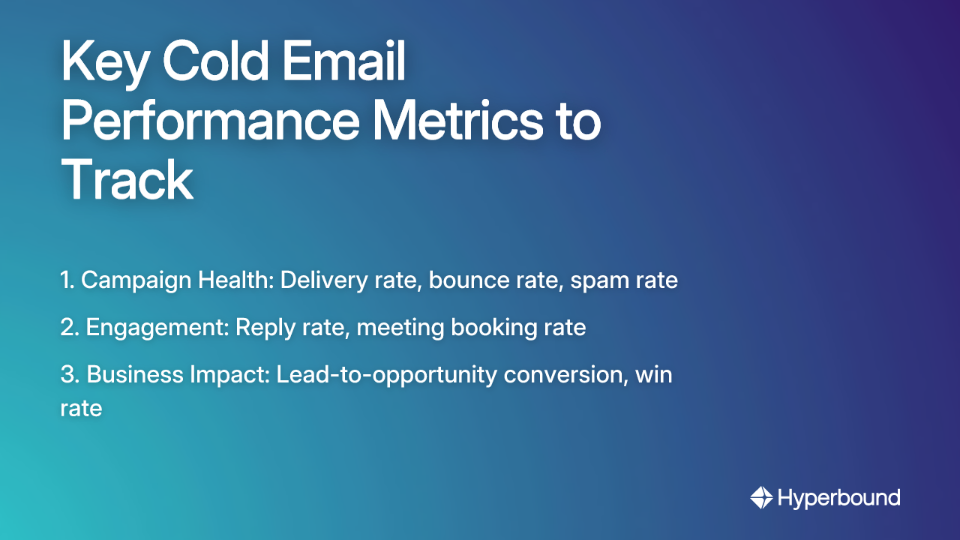
Monitor these key performance indicators to ensure your cold email engine runs effectively:
Focus on tightly defined Ideal Customer Profiles. As one agency owner noted, "personalization is overrated... it all comes down to relevancy." A relevant list is more important than fancy personalization.
Before every campaign, run lists through verification tools like Bouncer or Kickbox. This non-negotiable step protects your sender reputation.
One marketer explained: "People cold email prospects with something to the effect of 'we can help you with X, are you interested?' This doesn't align with how prospects think."
Create a system to categorize replies: Positive (lead), Objection (needs nurture), Not Interested, Out of Office. Move all positive replies immediately to a human sales rep for follow-up. Ensuring your reps are prepared for these critical follow-up conversations is paramount. This is where AI-powered practice can make a significant difference. Platforms like Hyperbound allow reps to practice handling objections, articulating value, and securing the meeting through realistic AI Sales Roleplays, turning a positive email reply into a qualified opportunity.
Success in cold email isn't about luck—it's about math, infrastructure, and disciplined execution. While generic outreach fails, a high-volume, data-driven system remains one of the most scalable ways to build predictable pipeline for your agency.
The math doesn't lie: to generate meaningful results, you need volume. But that volume must be supported by proper infrastructure and relationship-building strategies that emphasize relevancy over generic templates.
Do the math for your agency. How many emails do you really need to send to hit your revenue goals? Use that number as the foundation for building your cold email machine.
Cold email isn't dead—but the agencies treating it as a casual tactic rather than a mathematical system certainly are.
A high-volume cold email strategy is a systematic approach that involves sending thousands of targeted emails monthly, built on a robust technical infrastructure, to generate a predictable sales pipeline. It treats outreach as a mathematical equation rather than a guessing game. The core principle is that to achieve a significant number of client wins, you must work backward through conversion rates, which necessitates a large initial volume of emails to generate enough replies and meetings.
You need multiple domains primarily to protect your main business domain's reputation and to distribute your sending volume, which is crucial for maintaining high deliverability. Using a single domain for high-volume outreach risks it being blacklisted, which can disrupt all company communications. By spreading emails across various domains and inboxes (a technique called inbox rotation), you minimize the risk associated with any single domain and ensure your messages consistently reach the inbox.
For a properly warmed-up email account (typically 6+ months old), it is generally safe to send between 30 to 50 cold emails per day. New inboxes should start much lower, around 2-5 emails per day, and gradually increase each week. Exceeding these limits significantly increases the risk of your emails being flagged as spam, which can damage your sender reputation and deliverability across all your domains.
To prevent emails from landing in spam, you must establish a strong sender reputation through proper technical setup and best practices. This includes authenticating your domains with SPF, DKIM, and DMARC; gradually warming up new domains and inboxes; verifying your email list to remove invalid addresses and reduce bounce rates; and ensuring your email content is relevant and avoids spam-trigger words.
In high-volume outreach, relevancy is more critical than deep, manual personalization. While custom-tailoring every single email is not scalable, your message must be highly relevant to a well-defined Ideal Customer Profile (ICP). This means your offer, language, and value proposition should directly address the specific pain points of the segment you are targeting. The goal is "segment-level personalization" rather than individual personalization.
The most important KPIs for a cold email campaign are Reply Rate, Meeting Booking Rate, and Deliverability metrics (Delivery Rate, Bounce Rate, Spam Rate). While open rates can be misleading due to privacy changes, the Reply Rate is the true indicator of whether your message is resonating with your audience. Ultimately, the goal is to book meetings, making that a critical business-impact metric to track.











Use Cases
Legal