
You've spent hours crafting what you believe is the perfect cold email. You've included their first name, company name, and even mentioned a recent company announcement. Yet instead of the enthusiastic response you expected, you're met with radio silence—or worse, a creeped-out reply asking how you found their information.
Welcome to the personalization paradox of cold outreach.
"I used to think adding {{FirstName}} to a cold email was 'personalization.' Turns out, it's just screams 'automated.'" shared one Reddit user.
In today's hyper-connected world, the line between being relevantly personalized and uncomfortably intrusive has never been thinner. With data enrichment tools and LinkedIn Sales Navigator making prospect information readily available, salespeople face a critical question: How much personalization is too much?
This article will guide you through the nuanced art of cold email personalization, helping you build genuine rapport and boost conversion rates without setting off your prospect's creep alarm.
Meaningful personalization goes far beyond mail merge fields. It's about crafting emails that feel unique and tailored to the recipient's specific context, needs, and professional world.
As one sales professional noted, "Personalization isn't really first name, company name etc. that's the bare minimum IMO!" on Reddit.
Today's savvy prospects have dual expectations:

This creates what I call the "Personalization Paradox." Prospects want you to know enough about them to be valuable, but not so much that it feels invasive.
The "Creepiness Line" is the threshold where your personalization stops being helpful and starts feeling intrusive. When you cross this line, you don't just lose a potential lead—you risk damaging your personal and brand reputation.
The core mistake happens when senders "forget that they're just simply sending mail to another human person," as one sales professional aptly observed.
Crossing the creepiness line typically results in:
Let's examine what constitutes appropriate versus inappropriate personalization to help you stay on the right side of this line.
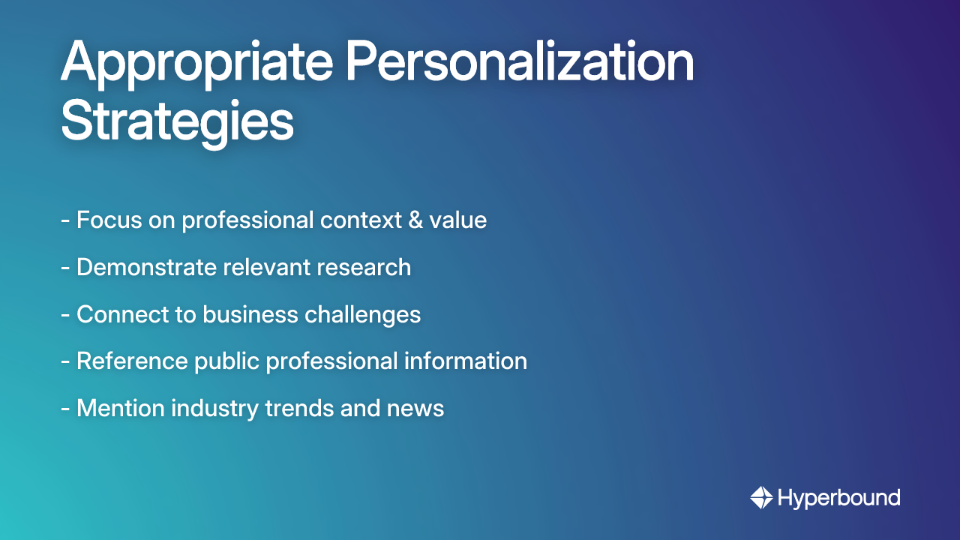
Effective personalization demonstrates that you've done relevant research without invading privacy. Here's what belongs in the Green Zone:
Focus on Professional Context & Value:
Demonstrate Relevant Research:
Example of Green Zone Personalization:
"I noticed your recent presentation at the MarTech Summit about scaling your demand generation efforts. Your point about struggling to maintain personalization while scaling resonated with many of our clients who faced similar challenges before implementing our semi-automated framework."
This approach shows you've done your homework while staying firmly in professional territory.
.png)
When personalization becomes creepy, it typically falls into these categories:
Overstepping Personal Boundaries:
Making Unfounded Assumptions:
Overly Familiar Tone:
Example of Red Zone Personalization:
"I saw from your Facebook that your daughter just started college (congrats!), which must be expensive. Our solution helps companies like yours reduce costs by 30%—perfect timing for those upcoming tuition bills!"
This crosses several boundaries by referencing personal information and making assumptions about financial needs based on family circumstances.
To truly understand the creepiness line, let's examine some real-world personalization failures and why they miss the mark.
The Mistake: An incorrect personalization tag results in embarrassing greetings like "Hey !" or "Hello FName," immediately revealing the automated nature of the message.
Why It's Bad: It shows a lack of quality control and instantly breaks any illusion of a personal message. This simple error can destroy credibility in seconds.
The Fix: Always test your emails before sending, use fallback values for missing data, and have a human review automated messages.
The Mistake: "Hi Sarah! Just checking in again as I haven't heard back from you. I thought we really connected in our last email exchange and I was surprised not to hear from you."
Why It's Bad: This creates a false sense of relationship and guilt where none exists. It misrepresents a standard cold outreach as an established connection, which feels manipulative.
The Fix: Be honest about where you stand in the relationship. A better follow-up would acknowledge the cold nature: "I reached out last week about X. I understand you're busy, but wanted to share a quick resource that addresses the industry challenge we discussed."
The Mistake: Using AI to generate "magic content" that sounds generic or makes incorrect assumptions: "As the Director of Marketing at TechCorp, you must be struggling with generating qualified leads through your content strategy."
Why It's Bad: AI-generated emails often make broad assumptions about pain points without specific evidence. They frequently sound artificial and can be spotted a mile away by savvy professionals.
The Fix: Use AI as a starting point, but customize messages with genuine insights about their specific situation. Focus on enriched data points that are actually relevant to your value proposition.
Now that we know what not to do, let's build a framework for personalization that respects boundaries while driving results:
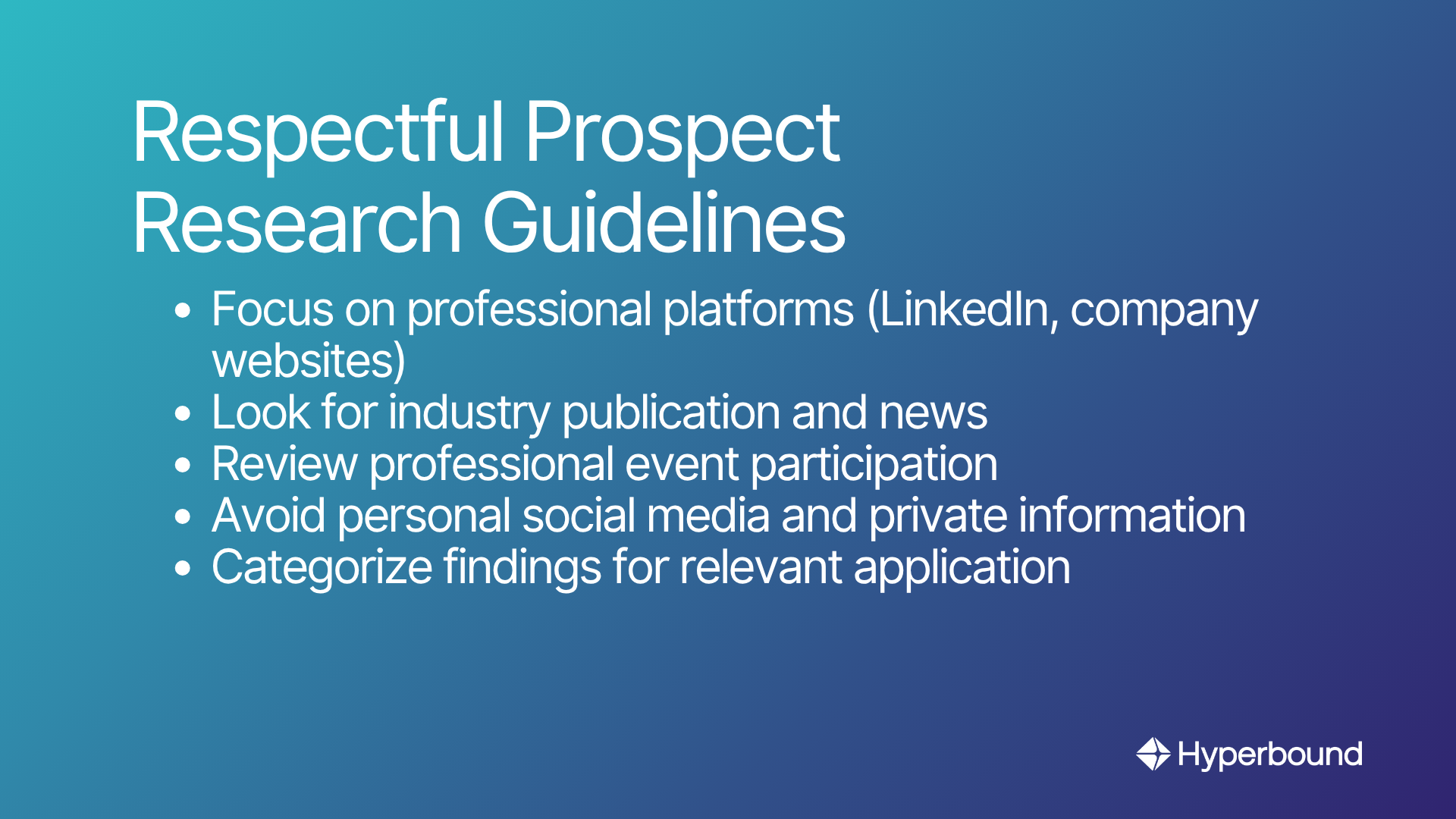
Where to Look:
What to Avoid:
Pro Tip: Segregate your research into categories - professional achievements, company news, industry challenges, and mutual connections. This helps you quickly identify relevant talking points while avoiding personal territory.
Rather than trying to hyper-personalize every single message (which can become creepy when forced), develop a strategic approach:
Segmentation Strategy:
When you properly segregate your prospects, you can develop semi-automated frameworks that feel personal without requiring you to write each email from scratch.
Focus on the Prospect's Pain Point:
Maintain a Professional Tone:
Provide a Single, Clear Call to Action:
Personalization must be balanced with legal compliance and transparency:
Know the Rules: Familiarize yourself with key email privacy laws like CAN-SPAM (USA), CASL (Canada), and GDPR (EU). These aren't just suggestions; they're legal requirements with significant penalties for violations.
Key Compliance Actions:
Remember, permission isn't just a legal requirement—it's the foundation of effective email marketing.
The ultimate goal is to create a scalable outreach process that feels authentic. Here's how to achieve that balance:
Follow-ups are where many salespeople cross the line into creepy territory. Here's a more balanced approach:
First Follow-Up: Add new, relevant value rather than just checking in:
"Since my last message, I came across this industry report that addresses the challenge we discussed. Thought you might find page 7 particularly relevant to your current initiative."
Second Follow-Up: Reference timing without guilt-tripping:
"I understand priorities shift constantly. If improving your conversion rates becomes a focus in the coming quarter, I'd be happy to share how we've helped similar companies achieve a 23% increase."
Final Follow-Up: Give an easy out that maintains dignity:
"I'll assume your priorities lie elsewhere right now. If that changes, here's my direct line. In the meantime, I'll keep sharing relevant insights via our newsletter if you're interested."
The most effective personalization isn't about demonstrating how much you know about a prospect—it's about showing how well you understand their professional challenges and how genuinely you can help solve them.
As one Reddit user aptly put it, cold emailers often "forget that they're just simply sending mail to another human person." The key to staying on the right side of the creepiness line is precisely this—remembering the human on the receiving end.
When your goal shifts from "maximizing open rates" to "starting meaningful conversations with people who could genuinely benefit from your solution," your approach to personalization naturally becomes more respectful and effective.
Action Step: Take 10 minutes today to review your last cold email campaign with fresh eyes. Ask yourself:
By focusing on relevancy, respecting boundaries, and maintaining a professional tone, you'll develop cold outreach that connects rather than creeps—and ultimately drives higher conversion rates from prospects who actually want to hear from you.
Remember: The best personalization doesn't feel like personalization at all—it simply feels like one professional reaching out to another with relevant, timely, and valuable insights.
The personalization paradox is the challenge of meeting a prospect's dual expectations. Prospects want relevant, personalized outreach that shows you've done your research, but they are also highly sensitive to data privacy and can be put off if the personalization feels too invasive or "creepy." The key is to provide value based on their professional context without crossing personal boundaries.
Personalization becomes too much when it crosses the "creepiness line" from professional relevance to personal intrusion. Referencing information from personal social media profiles, making assumptions about their private life, or using an overly familiar tone are clear signs you've gone too far. Stick to publicly available professional information from sources like LinkedIn or their company's website.
The best places to find information are professional platforms and public business sources. Focus your research on a prospect's LinkedIn profile (especially their posts and articles), their company's website (news, press releases, and executive bios), industry publications, and their participation in professional events or webinars. Avoid personal social media accounts like Facebook and Instagram.
Good personalization focuses on professional context and demonstrates genuine interest in the prospect's work. Examples include referencing a recent LinkedIn article they wrote, mentioning their company's new product launch, or connecting your solution to a specific business challenge they discussed in a podcast or at an industry event. The goal is to show you understand their professional world and can offer relevant value.
You can personalize at scale by using a tiered, semi-automated framework. Start by segmenting your prospects by industry, role, or known challenges. Then, create templates with specific, customizable sections for each segment. For high-value prospects, you can write a fully custom message, while for others, you can personalize 2-3 key elements within a proven template. This balances efficiency with authenticity.
To follow up without being annoying, always aim to provide new value with each message. Instead of simply "checking in," share a relevant industry report, a helpful article, or a case study that relates to your initial message. Acknowledge that their priorities may have shifted and give them an easy, respectful way to opt-out, which helps maintain a positive brand reputation.









Use Cases
Legal