
You've spent hours crafting the perfect cold call script. Your product knowledge is solid. But when you dial that prospect's number, your heart still races. What if you fumble? What if they throw a curveball question? What if this potentially valuable lead slips through your fingers because you're still learning?
"Real calls offer invaluable experience. However, with the stakes so high, I'm cautious about using real prospects for practice," confesses one sales professional on Reddit. It's the classic catch-22 of sales training: you need practice to get better, but practicing on real leads risks losing valuable opportunities.
Traditional solutions like peer role-plays come with their own problems—scheduling headaches, inconsistent feedback, and a distinct lack of realism that makes many sales reps roll their eyes. As another salesperson bluntly puts it, "If it doesn't feel real, it defeats the whole purpose."
Enter the game-changer: AI-powered roleplay for cold call training. This revolutionary approach provides a safe, scalable, and surprisingly realistic environment to master your pitch, handle objections, and build the confidence that converts prospects into meetings—all without risking a single valuable lead.
.png)
Despite the rise of digital channels, cold calling remains a cornerstone of B2B sales. When executed skillfully, it's still one of the most direct ways to reach decision-makers and start meaningful conversations.
But let's face the cold, hard facts:
Traditional training methods like shadowing experienced reps, script memorization, and internal role-plays have their place. But they're often time-consuming, inconsistent, and worst of all—they don't scale across today's distributed sales teams.
Effective training typically involves a three-step process: understanding the why, absorbing the script, and reviewing performance. But how can you review performance effectively when feedback is subjective and sporadic?
AI-powered sales training platforms have emerged as a practical solution to this training dilemma. These innovative tools create realistic simulations where sales reps can practice cold calls with AI "buyers" that respond naturally, challenge appropriately, and provide objective feedback.
Here's how it works:
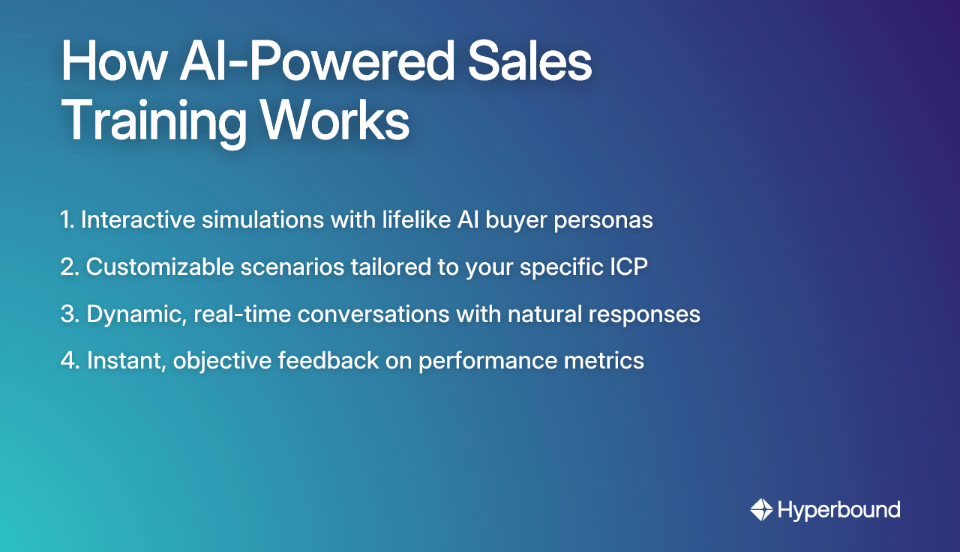
Platforms like Hyperbound, Second Nature, and ColdCALR (now Simmie) have pioneered this space, with a keen focus on realism and low latency—ensuring conversations feel natural rather than robotic. As one Reddit user emphasized, latency is "something to watch out for," but these platforms have made real-time interaction a key focus.
The most obvious benefit is the ability to practice without consequences. Make a mistake? Simply reset and try again. This freedom eliminates the fear of "burning" valuable leads that could have become customers with a more polished approach.
You can:
"Practicing sales pitches with a realistic AI buyer could be a good card to have up your sleeve," notes one sales professional, highlighting the value of having this option available whenever needed.
Management teams consistently cite feedback as "the most important element" of any training tool. AI roleplay platforms deliver this in spades.
Unlike peer feedback, which can be subjective or sugar-coated, AI provides objective insights based on concrete metrics:
Hyperbound's AI Real Call Scoring offers personalized, objective feedback to identify skill gaps and track improvement over time. The platform automatically scores calls against your custom methodology, providing the data managers need to justify investment and guide coaching.
"The key is to fit the context of my business and ensure the interactions are lifelike," emphasizes one potential user. Today's AI platforms understand this need for customization.
You can create scenarios tailored to your:
This level of customization ensures training is directly applicable to your day-to-day selling environment rather than generic role-plays that miss the mark.
One of the biggest barriers to cold calling success is simply psychological—the anxiety that comes with picking up the phone. AI training directly addresses this by creating psychological safety through repeated success experiences.
By practicing difficult scenarios in a safe environment, sales reps develop:
This confidence boost translates directly into more calls made and better performance on those calls—a virtuous cycle that drives pipeline growth.
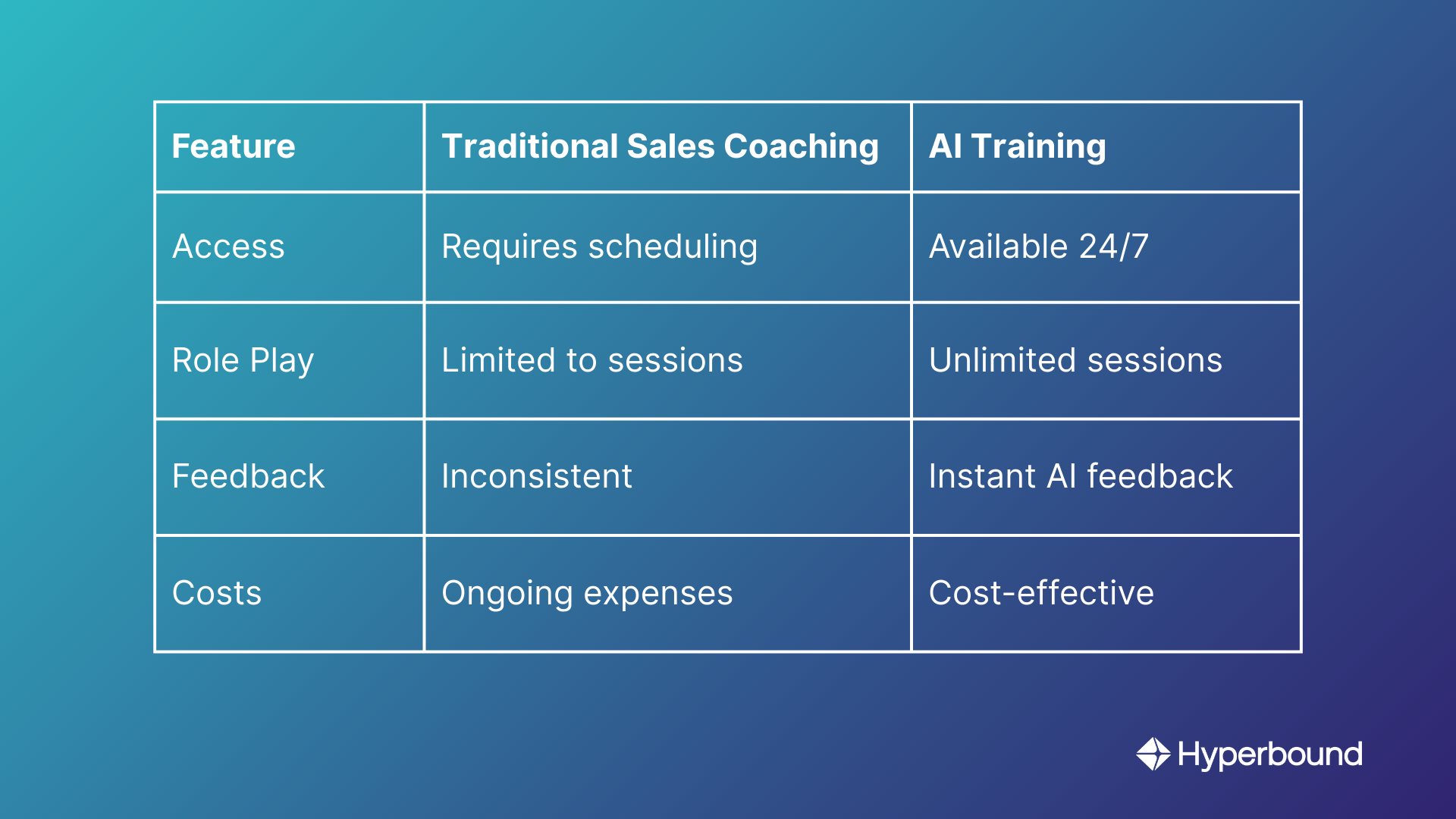
The traditional role-play model breaks down completely for remote or distributed teams. Scheduling becomes a nightmare, consistency is impossible to maintain, and the quality of practice varies wildly.
AI training eliminates these issues by providing:
As ColdCALR points out, the contrast with traditional coaching is stark:
Ready to implement AI roleplay in your sales training? Here's a step-by-step approach to get started:
Begin by identifying the most challenging aspects of your cold calls:
Use a "5-minute research technique" to gather insights about common prospect situations. Research recent trigger events (e.g., funding rounds, new hires) that might come up in conversation to make scenarios more realistic.
When evaluating AI roleplay platforms, look for these key features:
Consider requesting a demo from a leading platform like Hyperbound to experience the technology firsthand.
Begin training with the basics:
These fundamentals build the foundation for more advanced skills and ensure reps aren't overwhelmed when starting out.
Once the basics are solid, move on to more complex scenarios:
As one Reddit user emphasized, "One of the harder parts of cold calling is reacting to something completely out of left field in real time." Modern AI platforms can be fine-tuned to introduce this element of unpredictability in training scenarios.
The true power of AI training emerges in the feedback loop:
This data-driven approach to improvement ensures that training efforts are focused where they'll have the greatest impact.
Despite its benefits, some sales professionals remain skeptical about AI training. Let's address these concerns head-on:
"I don't want to talk to a robot."
This sentiment is understandable. However, modern AI isn't about replacing human interaction—it's about preparing for it. Think of it as a flight simulator for sales: pilots don't learn to fly solely in real planes, they use simulators to build muscle memory for critical situations. The same principle applies here.
"It can't replicate real-world unpredictability."
While no simulation is perfect, today's AI platforms can be programmed with "curveball" scenarios that introduce unexpected elements. As one developer explained, "It's quite feasible to fine-tune the AI to introduce that element of unpredictability."
"The best roleplay is a real call."
There's truth here—nothing fully replaces real-world experience. But that's not the point of AI training. It's about ensuring those real calls are more likely to succeed because you've built the fundamental skills in a safe environment first. It's the practice green before the championship golf course.

AI roleplay isn't a futuristic concept anymore—it's a practical, powerful tool that complements traditional coaching methods while addressing their limitations. By providing unlimited practice, instant feedback, customizable scenarios, confidence building, and on-demand availability, these platforms are transforming how sales teams approach cold call training.
The result? More confident reps, more effective calls, and ultimately, more meetings and deals in your pipeline.
As one enthusiastic sales professional put it: "I love the idea and I would pay for it!" With platforms like Hyperbound, Second Nature, and ColdCALR (now Simmie) now widely available, there's never been a better time to explore how AI roleplay can elevate your sales team's cold calling performance—without risking a single valuable lead.
AI roleplay for cold call training is a technology that uses artificial intelligence to create realistic, interactive simulations where sales representatives can practice their cold calling skills. In these simulations, reps engage in conversations with an AI "buyer" that responds dynamically, presents objections, and mimics the behavior of a real prospect, providing a safe environment to practice without risking actual leads.
AI roleplay offers significant advantages over traditional peer-to-peer role-playing by providing unlimited, on-demand practice, objective data-driven feedback, and consistent scenarios. Unlike practicing with colleagues, which is often subject to scheduling conflicts, subjective feedback, and a lack of realism, AI platforms are available 24/7 and deliver impartial analysis on metrics like talk-listen ratio, filler words, and adherence to sales methodology.
AI sales training improves cold calling skills by providing a risk-free environment for repeated practice, which builds muscle memory and confidence. The instant, objective feedback helps reps identify specific weaknesses, such as overusing filler words or failing to handle objections effectively. By practicing in customizable, hyper-realistic scenarios, reps can master their pitch, conquer call anxiety, and learn to handle unexpected questions before they ever speak to a real prospect.
Yes, modern AI platforms can simulate highly realistic and unpredictable sales calls. These systems are built on advanced natural language processing models that allow for dynamic, low-latency conversations that feel natural, not scripted. Furthermore, scenarios can be customized to include specific industry jargon, common objections, and even "curveball" questions to train reps on how to think on their feet and react to unexpected situations in real-time.
The key benefits of using AI for sales training include:
To get started with AI roleplay, begin by identifying the most common scenarios and objections your team faces. Then, evaluate leading AI training platforms like Hyperbound to find one that offers the necessary customization, analytics, and realism for your needs. Once a platform is chosen, start by having your team master the fundamentals—like the opening pitch and value proposition—before moving on to more advanced objection handling and rapport-building exercises.










Use Cases
Legal