
You've just finished your third hour of cold calling. Zero meetings booked. Twenty-seven rejections. Four people hung up mid-sentence. Your manager wants to know why your numbers are down this quarter, but all you can think about is how much you're dreading tomorrow's call block.
Sound familiar?
Cold calling remains one of the most anxiety-inducing tasks in sales. The constant rejection, the struggle to sound confident when you're anything but, and the pressure to hit your numbers can make even experienced reps feel like they're drowning. As one sales rep confessed on Reddit, "The unpleasant nature of cold calling persists regardless of experience" - a sentiment echoed by countless others facing the daily grind of outbound prospecting.
But here's what might surprise you: 82% of buyers have accepted meetings with salespeople who reached out through cold calls, and 57% of C-level executives actually prefer to be contacted by phone. The problem isn't that cold calling doesn't work - it's that most teams lack a structured training framework to transform their reps from anxious dialers into confident conversation-starters.
In this article, we'll unveil the three-phase training blueprint that top-performing sales teams use to build cold calling machines. This isn't about "natural talent" or "gift of gab" - it's about implementing a process-driven approach that develops skill, resilience, and ultimately, results.
Before diving into the framework, let's establish a fundamental truth: Cold calling experts are made, not born.
The best sales organizations understand that cold calling is a skill that requires deliberate development. According to sales training expert Jeb Blount in his book Fanatical Prospecting, which many sales professionals on Reddit consider "the best prospecting book ever," success in cold calling comes down to process and consistency.
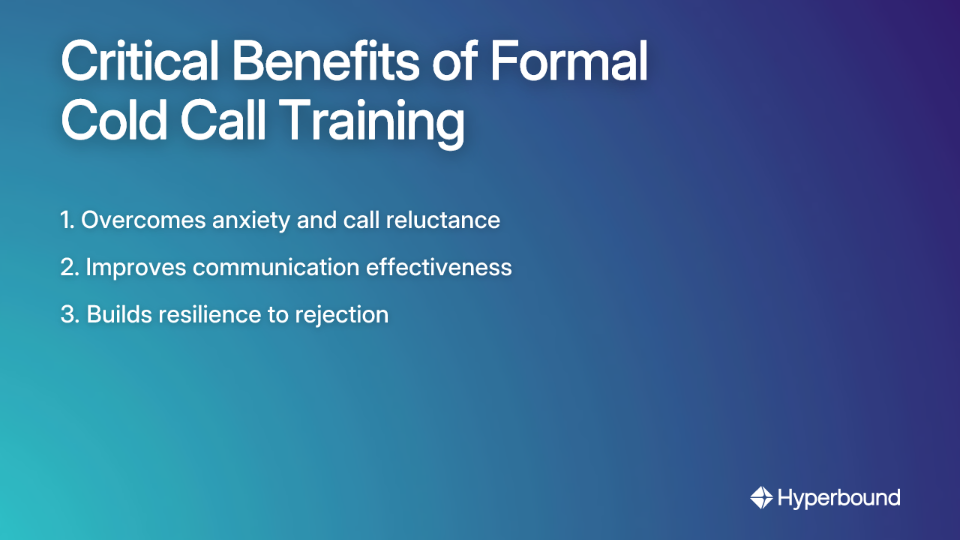
A formal training program delivers three critical benefits:
Now, let's explore the three-phase framework used by elite sales teams to transform their cold calling results.
The most successful cold callers don't just pick up the phone and wing it. They invest time in preparation that dramatically increases their chances of success.
Kyle Coleman, VP of Revenue Growth at Clari, recommends a "5-minute research technique" that top teams train their reps to use: Find five key insights about a prospect or their company in just five minutes.
"The research doesn't need to be extensive," Coleman explains in a Klenty blog post, "but it needs to be relevant and demonstrate that you've done your homework."
This research should focus on:
This targeted approach ensures your lead list consists of qualified prospects who align with your Ideal Customer Profile (ICP), dramatically improving conversion rates.
Top-performing teams understand that scripts serve as guardrails, not handcuffs. They create comprehensive cold calling playbooks that:
As one Reddit sales professional advises: "Write down the top five brush-offs and objections you get, plan out how you'd like to respond going forward, and practice it over and over again until you have it memorized."
Scripts are particularly valuable for managing fear and uncertainty. According to Klenty, "Scripts provide structure to help new reps navigate conversations confidently, while giving them the flexibility to adapt based on the prospect's responses."
Elite teams don't just make more calls—they make smarter calls:

With preparation complete, the next phase focuses on building confidence and mastering the conversation through deliberate practice.
The call reluctance phenomenon is real. As one rep admitted on Reddit: "The fear of rejection negatively impacts cold calling performance." Elite teams combat this through:
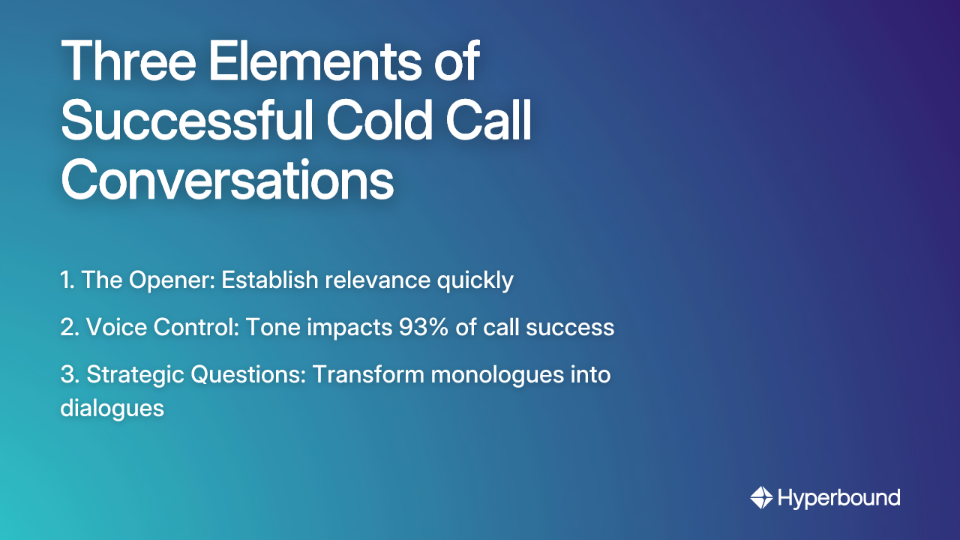
Once on the call, elite performers focus on three key elements:
Top teams don't avoid objections—they embrace them as opportunities. They train reps to:
As one sales leader puts it, "The goal isn't to close every call. It's to move qualified prospects to the next stage of the sales funnel."
What happens after the call often determines whether all that preparation and execution pays off.
Elite teams use AI Sales Coaching platforms like Hyperbound to automate call analysis and scale coaching. This technology allows them to:
This approach empowers reps to review their own calls with actionable insights, fostering self-awareness and accelerating improvement.
According to the National Sales Executive Association, 80% of sales are made after the fifth contact. Yet many reps give up after just one or two attempts. Top teams train reps to:
You can't improve what you don't measure. Elite teams track both qualitative metrics (like script adherence and tone) and quantitative KPIs (like dials, conversations, and meetings booked) to continuously refine their approach.
They also create collaborative environments where reps share insights from successful and unsuccessful calls, turning individual learning into team knowledge.

Effective cold calling isn't about luck or a magical pitch. It's the result of a structured training framework that builds skill, resilience, and confidence through deliberate practice and continuous improvement.
By implementing this three-phase approach—diligent preparation, confident execution, and relentless follow-up—sales leaders can transform one of the most challenging sales tasks into a consistent and powerful pipeline generator.
Remember: The difference between dreading your call block and dominating it comes down to process, not personality. With the right training framework in place, any team can develop cold calling champions who turn the "necessary evil" of outbound prospecting into their secret weapon for sales success.
Cold call training is important because it transforms an anxiety-inducing task into a structured, effective skill. It equips reps with proven techniques to overcome call reluctance, handle objections, and articulate value, which directly leads to more booked meetings and higher conversion rates. Without a formal training framework, teams often struggle with inconsistency, low morale, and poor results.
The most crucial phase is the pre-call preparation. While execution is important, success is overwhelmingly determined before you even pick up the phone. Thorough research, well-developed talk tracks, and strategic call planning ensure you're contacting the right people with a relevant message, which dramatically increases your chances of starting a meaningful conversation.
You can overcome the fear of cold calling through structured practice in a safe environment. Call reluctance stems from the fear of rejection and uncertainty. By using tools like AI sales role-playing platforms and practicing with peers, you can rehearse scripts and handle objections, building confidence without the pressure of a live call. This preparation makes you feel more in control and less anxious when you start dialing.
Yes, sales reps should use a script or a flexible talk track. A script should not be a rigid, robotic monologue but rather a guide to keep the conversation on track. It provides structure, ensures key value points are mentioned, and offers proven responses to common objections, which is especially helpful for building confidence and consistency.
The best times to make cold calls are typically mid-morning and late afternoon on Wednesdays and Thursdays. Data suggests that prospects are most receptive between 10 am-11 am and 4 pm-5 pm. However, the optimal time can vary by industry, so it is crucial to test different time blocks and track your own data to see when you have the highest connection rates.
You should handle objections by reframing them as requests for more information rather than as outright rejections. Instead of getting defensive, listen to the objection, acknowledge it, and use it as an opportunity to clarify your value proposition. Top-performing teams create an "objection matrix" with proven responses to common brush-offs, allowing reps to respond calmly and effectively.
Most sales are made after the fifth contact, so a persistent, multi-touch follow-up strategy is essential. A single call is rarely enough. Top teams train their reps to use an omnichannel approach, integrating calls with personalized emails and LinkedIn messages. The key is to add value with each touchpoint and maintain persistence without being annoying.








Use Cases
Legal