You've rehearsed your pitch a dozen times. Your finger hovers over the dial button. You take a deep breath, knowing the tech executive on the other end is probably swamped with meetings and likely annoyed by interruptions. You press dial, and your heart rate spikes as the phone rings.
Sound familiar?
For Business Development Representatives (BDRs) in tech, cold calling high-level executives feels like walking through a minefield. One wrong phrase and the conversation explodes or, worse, fizzles into awkward silence.
"I just want to sound like a real person, not some robot reading from a script," laments one BDR on Reddit. "Most cold call scripts feel so forced and inauthentic."
This guide moves beyond generic templates. We'll provide a playbook of tailored scripts for engaging C-level executives, VPs, and Directors in tech, diving deep into the unique psychology, motivations, and pain points of each persona. We'll share concrete examples that "the best of the best use."
And despite what you may have heard, cold calling still works. Research shows 57% of C-level executives prefer to be contacted via phone. When done correctly, cold calling remains one of the most effective ways to start meaningful conversations with decision-makers.
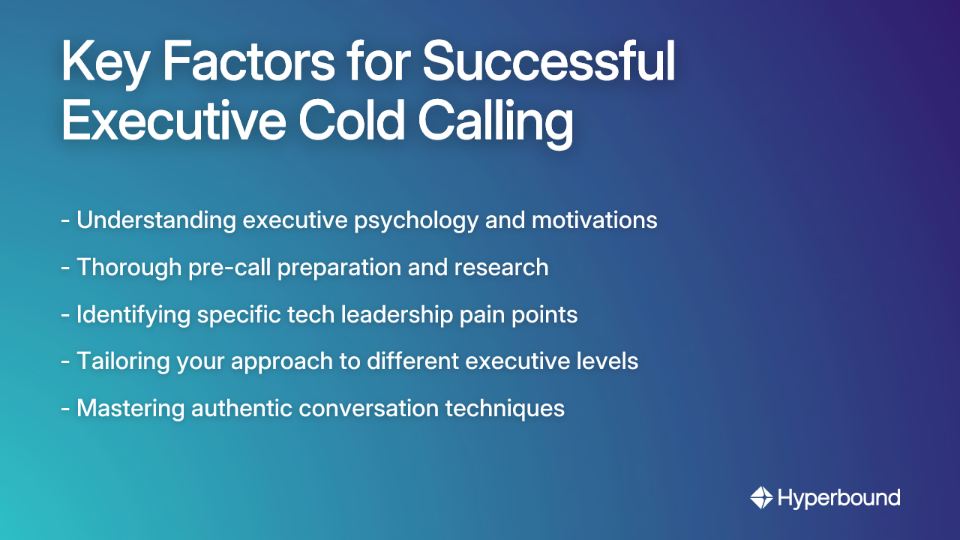
To sell to a CXO, you must understand their core psychological drivers. According to behavioral economists, around 70% of economic decision-making is emotional, not rational.
Based on the work of psychoanalysts like Manfred F. R. Kets de Vries, executives are driven by three key motivations:
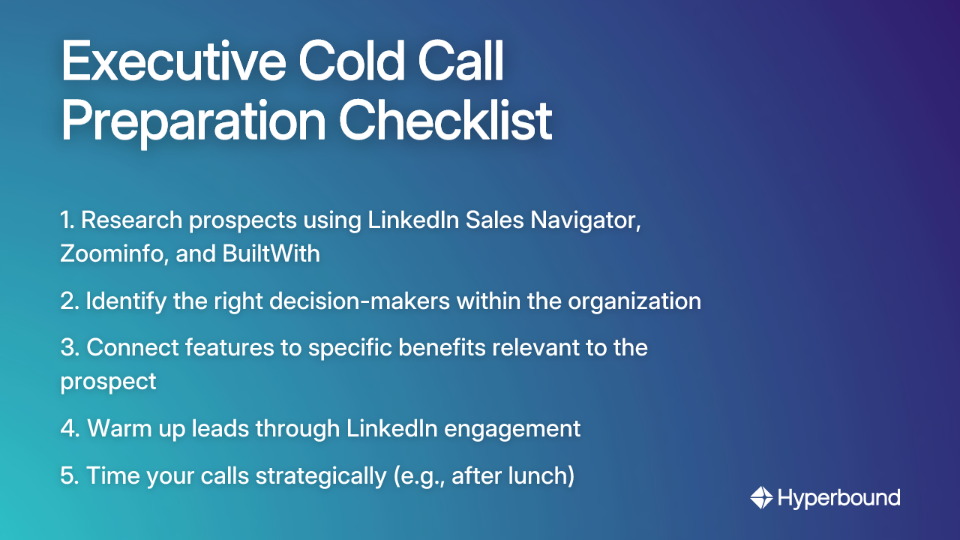
Before dialing, your preparation can make or break the call:
Research Your Prospects: Use tools like LinkedIn Sales Navigator, Zoominfo, and BuiltWith to understand their background, company structure, and current tech stack. Record this information in your CRM for future reference.
Identify Decision-Makers: For larger organizations, find the right person in annual reports or on LinkedIn. For SMEs, it might be the CEO directly. Learn how to get to the decision maker to avoid gatekeepers.
Match Features to Benefits: Don't say, "Our product automates tasks." Instead, say, "We've helped companies like [Competitor/Similar Company] increase productivity by 70% by automating their X, Y, and Z processes."
Warm-Up the Lead: Connect on LinkedIn or engage with their content before calling. This creates familiarity and opens the rapport window.
Optimal Timing: A key tip from sales pros is to call mid-afternoon. One successful BDR found that calling "exactly after 1:00 PM, they just finished lunch and they are super relaxed."
When crafting your value prop, focus on these major challenges tech leaders currently face:
1. Digital Maturity: Leaders are under pressure to guide their organizations through digital transformation, harness data for better customer journey mapping, and find new business models.
2. Growing Security Threats: Hackers are using AI, IoT adoption creates new vulnerabilities, and regulations like GDPR add compliance pressure.
3. The IT Skills Shortage: Gartner reports that 63% of organizations see talent shortages as a major concern. This impacts their ability to execute on other priorities.

The CXO Persona:
Opener & Core Script Framework for CXOs:
Permission Opener (Direct & Respectful):
"Hi [CXO Name], this is [Your Name] from [Your Company]. I know I'm calling you out of the blue, so I'll be brief. My reason for calling is that I saw your company is focused on [Strategic Initiative, e.g., 'expanding into the EMEA market']. We work with other leaders in [Their Industry] to specifically address the challenges around [Pain Point]. I have an idea that could be relevant. Do you have 30 seconds for me to explain?"
Value Prop (High-Level Benefit):
"Leaders at companies like [Similar Company 1] and [Similar Company 2] use our platform to [Achieve High-Level Outcome, e.g., 'reduce their risk of a data breach by 40% while accelerating time-to-market by 6 months']. This is about ensuring your strategic goals aren't derailed by unforeseen operational hurdles."
The Ask:
"This might not be the right time to dive deep, but would you be open to a 15-minute call next week with my specialist to explore if this is a priority for you in Q3?"
The VP Persona:
Opener & Core Script Framework for VPs:
Permission Opener (Reference a Team/Function):
Value Prop (Departmental Impact):
"Right now, you might be using [Tool A] and [Tool B], which can lead to [Common Problem]. We've helped the team at [Similar Company] integrate these processes, which resulted in a [Specific Metric, e.g., '25% faster project completion rate']."
The Ask (Connect to a Direct Report):
"Based on this, who on your team is most responsible for [Relevant Function, e.g., 'managing the project management tools']? Would it make sense for me to connect with them, or are you the right person to explore this further?"
The Director Persona:
Opener & Core Script Framework for Directors:
Permission Opener (Specific and Tactical):
"Hi [Director Name], my name is [Your Name] with [Your Company]. I'm calling because I work with other Directors of [Their Title] who use [Competitor Tool/Current Process] and often run into issues with [Specific Problem, e.g., 'integrating it with their data visualization software']. Is that something your team has ever encountered?"
Value Prop (Hands-On Benefit):
"We have a solution that directly plugs that gap. For example, we helped [Similar Company]'s team cut down the time they spend on [Tedious Task] by 10 hours per week, per employee. This freed them up to focus on [More Important Task]."
The Ask (Product Demo):
"I could explain it all day, but it's much easier to show. Would you have 15 minutes next Tuesday for a quick screen-share where I can walk you through the exact feature that solves this? No long presentation, I promise."
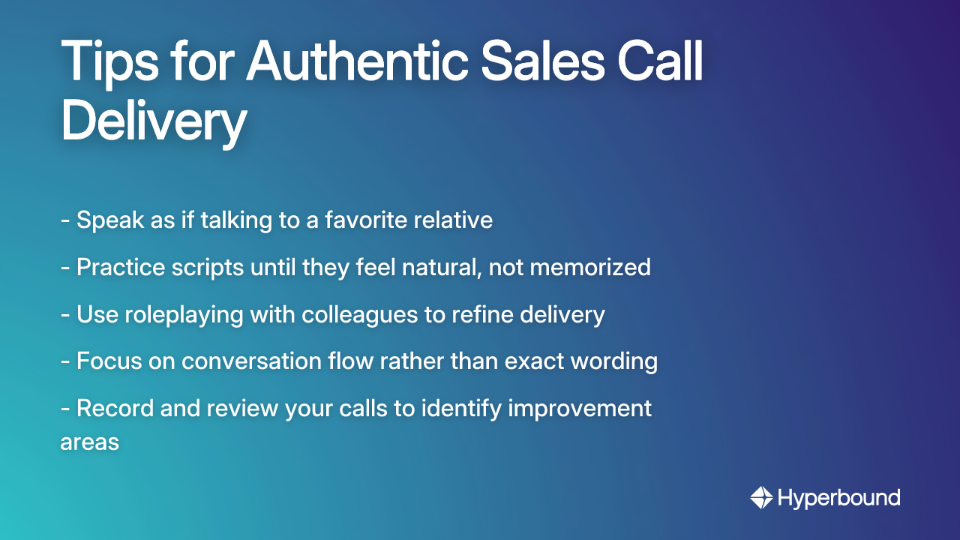
The best advice from experienced sales pros: "As soon as they pick up, talk to them like they're your favorite cousin that just showed up on Thanksgiving." This creates a friendly, disarming, and engaging tone. It's about being human and straightforward.
Practice your scripts until they don't sound like scripts. While roleplaying with colleagues is helpful, AI-powered tools like Hyperbound's AI Sales Roleplays provide a safe, repeatable environment to refine your delivery against realistic AI buyers. The goal is to internalize the flow, not memorize the words. This addresses the common pain of struggling with rigid adherence to scripts.
Acknowledge and Validate: Always start by showing you heard them. "I understand," or "That makes sense."
Prepare Responses: As recommended by sales veterans, "Write down the top five brush offs and objections you get, plan out how you'd like to respond going forward, and practice it over and over again."
This is where practicing with AI can be a game-changer. Tools like Hyperbound's AI Sales Roleplays let you build out these specific objection-handling scenarios and practice them until your responses are confident and automatic.
Example Objection Handling Scenarios:
Objection: "I'm not interested."
Response: "I understand. Many people I speak with say the same thing at first. Could I ask just one quick question to make sure I'm not wasting your time in the future? What is your biggest priority right now when it comes to [Their Area of Responsibility]?"
Objection: "Just send me an email."
Response: "I'd be happy to. To make sure I send something relevant and not just generic marketing fluff, could you tell me what aspect of [Topic, e.g., improving developer productivity] is most important to you right now?"
Objection: "This isn't a priority right now."
Response: "I understand this might not be a priority now. Can we have a brief discussion to see how we can assist you when the time is right?"
For more strategies, refer to resources on handling sales objections.
Always Define Next Steps: End every call with a clear action item, whether it's a scheduled demo, an email with specific information, or a follow-up call.
Voicemail Strategy: If you get voicemail, leave a concise and compelling message:
"Hi [Prospect's name], this is [your name] from [Your Company]. I'm calling to briefly discuss how we're helping other [Their Title] with [challenge they're facing]. You can reach me back at [contact number]. Again, that's [Your Name] at [Phone Number]."
Use your CRM: Log every call and insight. This is crucial for tracking progress and personalizing future interactions. A detailed CRM record helps you pick up exactly where you left off in your next conversation.
Success in cold calling tech executives isn't about having the perfect script. It's about a combination of:
Remember that every call is a learning opportunity. Embrace the failures and collaborate with your team to share what works. The goal isn't a "one call close" but to start meaningful conversations that build relationships.
By being authentic, transparent, and genuinely helpful, you transform a dreaded cold call into the start of a valuable business relationship. Your pitch becomes not an interruption but a timely solution to a pressing problem.
As one sales veteran put it, "Just be upfront, nobody likes when you beat around the bush or try to wiggle your pitch in elsewhere." This straightforward approach builds trust and shows respect for the executive's time and intelligence.
The most successful BDRs don't "race to the yes." They focus on creating value in every interaction, knowing that the relationship—not the transaction—is what matters most in the tech industry.
So take a deep breath, pick up the phone, and remember: on the other end is just another human being with problems to solve. And you might just have the solution they've been looking for.










Use Cases
Legal