You've dialed the number. Your heart races slightly as it rings. The prospect picks up, and you have exactly 60 seconds to make an impression before they mentally check out—or worse, hang up.
For Business Development Representatives (BDRs), this scenario plays out dozens of times daily. The cold call remains a critical tool in your arsenal, but the hard truth? Only 2% of cold calls result in a meeting, and it typically takes eight attempts just to reach a prospect. With only 28% of cold calls even being answered, every second of that connection is precious.
When a prospect answers an unsolicited call, their defenses immediately rise. As one experienced sales professional put it: "Immediately, people raise their defenses when they receive an unsolicited call, so we need to disarm them and instill trust."
Those initial 60 seconds aren't just important—they're everything. In this guide, we'll break down a proven framework for structuring your opening minute to disarm objections, establish value, and secure the next step.
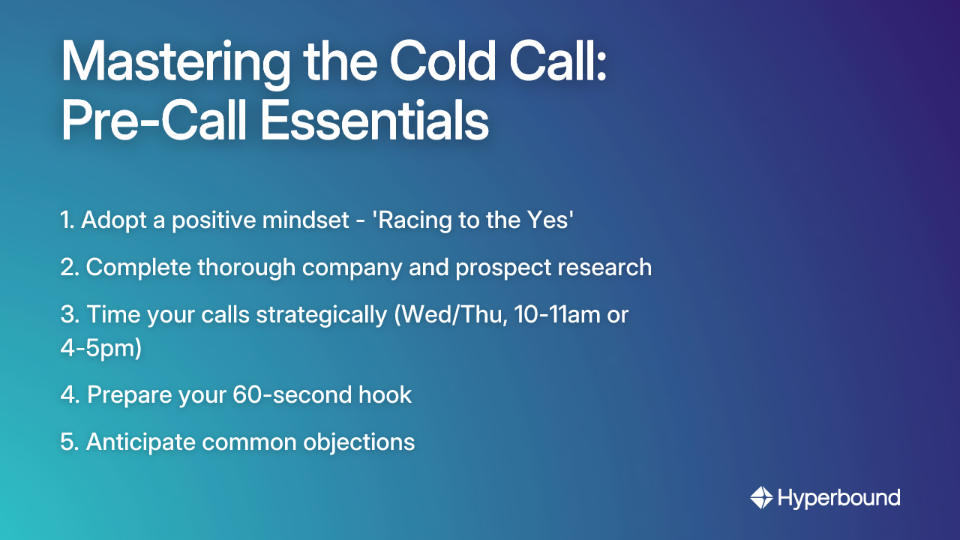
Before picking up the phone, adopt the right mindset. Don't let rejection rattle you. Every "no" is one step closer to a "yes." Seasoned BDRs call this "racing to the yes"—getting through the no's quickly so you can find qualified prospects who will engage.
Remember: A cold call is like a first date, not a marriage proposal. Your goal isn't to close a deal but to advance the prospect in your pipeline.
Did you know 82% of B2B decision-makers expect sales reps to be prepared before calling? Research isn't optional—it's essential for a successful cold call. Before dialing:
A well-researched call transforms a cold interaction into a warm conversation.
Your timing can dramatically impact your connection rates:
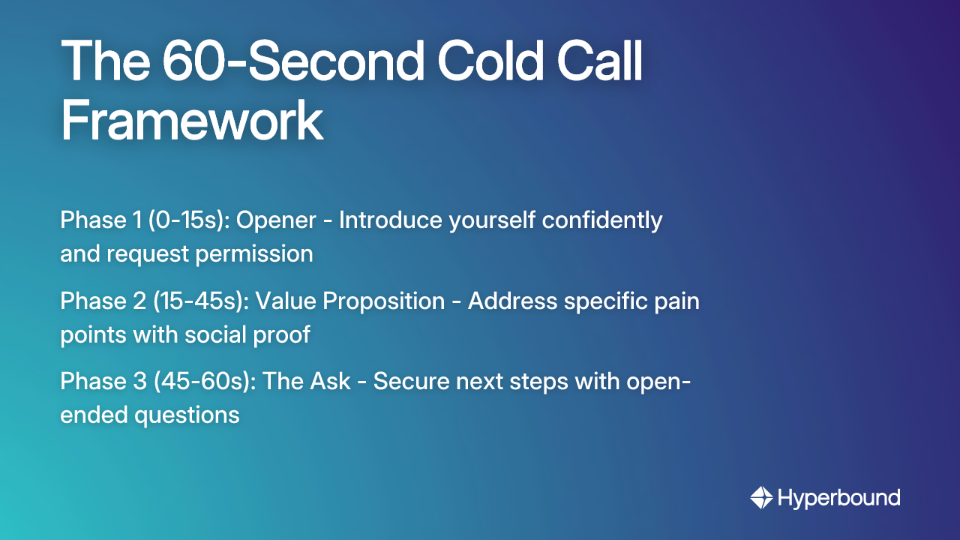
Now for the main event: structuring your critical first minute. Let's break it down into three strategic phases:
Your goal in the first 15 seconds is to quickly establish who you are and why the prospect should continue listening. This is where most cold calls succeed or fail.
The Introduction: Instead of the tentative "My name is...", use the power phrase: "This is [Your Name] from [Company Name]." This subtle shift projects confidence and commands attention.
The Permission Opener: Follow with a respectful acknowledgment that you're interrupting their day:
"Hi [Name], thanks for taking my call. I know I'm calling out of the blue; do you have a minute to chat?"
This permission-based approach shows respect for their time and disarms their initial defenses.
What to Avoid: The disingenuous "How are you?" As one sales professional candidly shared: "I hate it when sales people ask me: 'How are you?' I know they don't care, and it's honestly a waste of time asking." Unless you have a genuine reason to ask, skip the small talk.
Alternative Openers:
With the prospect's attention secured, you now have 30 seconds to deliver a compelling value proposition that addresses a specific pain point. This is where your pre-call research pays off.
How to Craft Your On-the-Fly Value Prop (3-step process):
Your value prop should clearly articulate how you can help solve a problem they actually have. The most effective value propositions identify a customer's main pain point, differentiate your offering, and avoid industry jargon.
Remember: As one BDR put it, "If you make it your goal to care about THEIR business more than they do, it makes selling 10x easier." This level of genuine interest comes through in how you position your value proposition.

The final 15 seconds is where you make your ask. Remember, your goal isn't to pitch your entire product lineup—it's to secure the next conversation.
Frame the Ask with Open-Ended Questions:
When dealing with a gatekeeper (GK), focus on getting to the decision-maker (DM) rather than pitching prematurely. Your CRM notes should reflect this progression for effective follow-up.
Did you know 80% of sales require five follow-ups after the initial contact? Persistence pays off, but it must be strategic.
Voicemail Strategy: There's debate about voicemail effectiveness, but when you do leave one, keep it brief (30 seconds or less) and use a proven script:
"Hey! This is [Your Name] from [Company Name]. I see your organization values [relevant value]. Companies like [Customer 1] and [Customer 2] have seen [Results] after working with us. I'd love to discuss how we can help you too. Call me back at [Number]."
This mini-version of your value proposition can pique interest even when you don't make a direct connection.
The 60-Second Hook framework transforms traditional cold calling into a strategic, research-backed approach. By structuring your calls with a disarming opener, a problem-focused value proposition, and a low-friction ask, you dramatically increase your chances of success.
Remember: "Sales is one of the only jobs where how much money you make is directly tied to how much you care and how skilled you are." The 60-Second Hook is a master skill that every BDR should perfect.
With practice, you'll find yourself moving from dreading objection handling to confidently navigating each call, racing to the yes, and filling your pipeline with qualified opportunities.
The cold call isn't dead—it's simply evolved into a warm, value-driven conversation that starts with the perfect 60-second hook.
The most important part of a cold call is the first 60 seconds. This brief window is critical for making a positive impression, disarming the prospect's natural defenses to an unsolicited call, and establishing enough value to earn the right to continue the conversation.
Research is crucial because it allows you to personalize your approach and demonstrate genuine interest. A well-researched call, where you understand the prospect's role, company initiatives, and potential pain points, transforms a "cold" call into a relevant, warm conversation and helps you craft a compelling value proposition.
To avoid an immediate hang-up, start with a confident introduction like, "This is [Your Name] from [Company Name]," followed by a permission-based opener such as, "I know I'm calling out of the blue; do you have a minute?" This approach respects the prospect's time, builds initial trust, and is far more effective than disingenuous questions like "How are you?"
A compelling value proposition directly addresses a specific, researched pain point the prospect likely has. Instead of listing features, it should connect a problem to a solution using social proof. A great structure is to state an observation about their company, mention how similar companies solved a related problem using your service, and connect it back to their potential goals.
Use a structured model like LAER: Listen to their full objection without interrupting, Acknowledge its validity ("That's a fair point"), Explore the reason behind it with a gentle question ("May I ask what specifically isn't a priority right now?"), and then Respond with a tailored answer that addresses their concern.
The best days to make cold calls are typically Wednesdays and Thursdays. The golden hours are between 10-11 am, after the morning rush, and 4-5 pm, before people completely sign off for the day. Calling during these windows can significantly increase your connection rates.
Data shows that 80% of sales require at least five follow-ups. Persistence is key, but it must be strategic. Each follow-up, whether by call or email, should provide additional value or a new insight rather than simply "checking in."
Yes, cold calling is still highly effective, but it has evolved. Success is no longer about high volume alone; it requires a strategic, research-backed approach focused on providing immediate value. By mastering the 60-second hook, you can turn cold calls into qualified pipeline opportunities.









Use Cases
Legal