The moment they pick up, an invisible timer starts. You have 30 seconds, maybe less, before their finger hovers over the "end call" button. As one sales professional on Reddit put it, "You're immediately on the defensive - you need to disarm the prospect as quickly as possible." You've interrupted their day, and their guard is up.
But what if you could transform that defensive posture into genuine curiosity? What if you could make those critical first 30 seconds work in your favor?
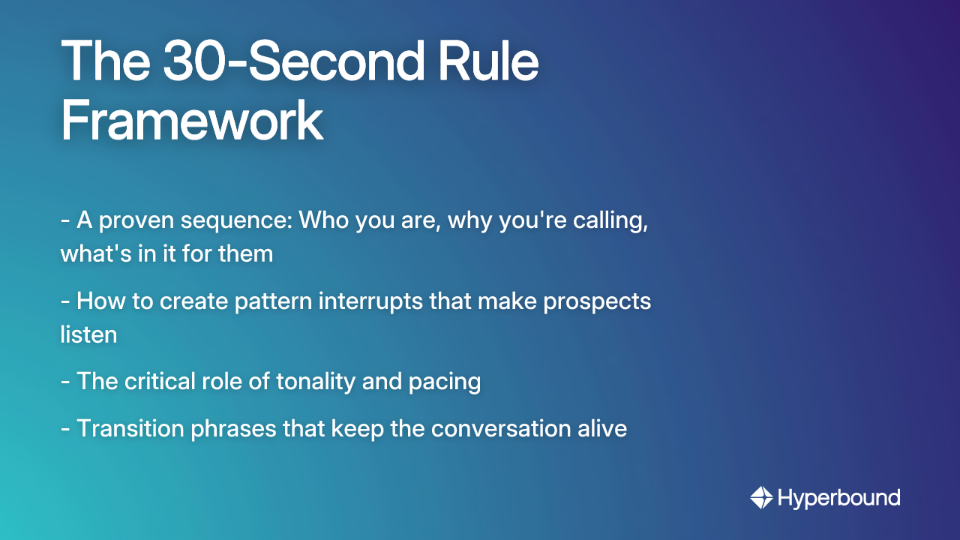
This article introduces the "30-Second Rule" framework - not a rigid script, but a proven approach to turning cold calls into productive conversations. You'll discover:
Research on attention spans shows that people make incredibly fast judgments about value and interest. According to HubSpot research, prospects typically decide whether to continue a call within the first 8-14 seconds. This makes the first 30 seconds the most critical part of your conversation.
Most salespeople fail by immediately talking about themselves. Instead, the goal is to make a positive connection. As noted by Sitkins, "A brilliant conversationalist is one who talks to you about yourself." In the first 30 seconds, say something encouraging or relevant to them. This builds rapport and energizes the conversation.
The prospect's default state is resistance. They expect a pitch and are ready to say no. As one prospect mentioned in a sales forum, "I never want to know why you know who I am. I am just going to reply telling you I don't want to be sold to." The techniques in this article are designed to overcome this exact feeling.
Your cold call opener should follow a three-part structure that can be delivered in the first 10-15 seconds:
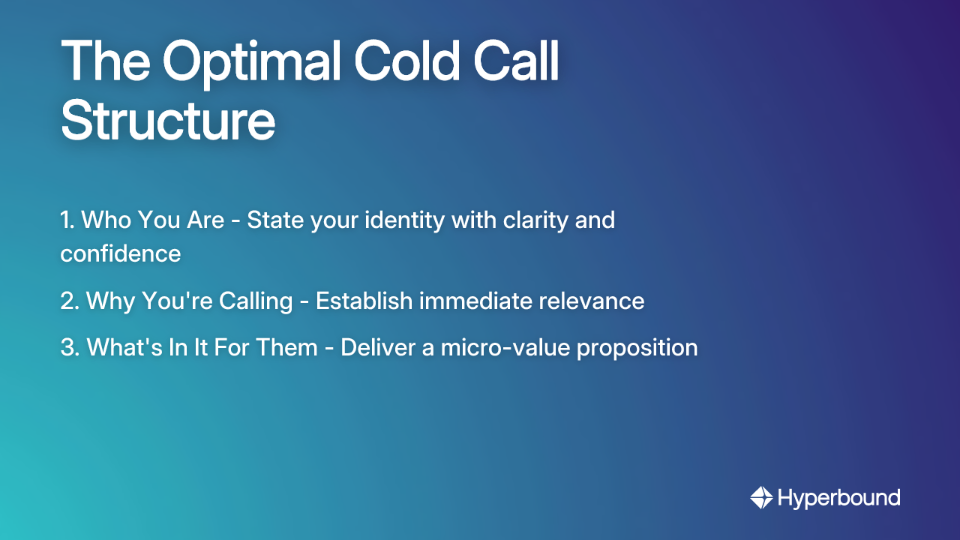
State your name and company clearly and confidently. This is not a question.
Example: "Hi [Name], this is [Your Name] from [Company]."
Why it works: It establishes a professional tone and removes ambiguity from the start. As noted in user research, you have to "say who you are and why you're calling."
This is the most critical part. You must immediately establish relevance and show you've done your homework. This directly tackles the pain point of needing to "establish common ground quickly."
Techniques for Establishing Relevance:
Your goal is not to sell the product, but to sell the next 30 seconds of conversation. Connect your reason for calling to a potential benefit or Customer Pain Point your solution addresses.
Transition to a Permission-Based Opener (PBO): This technique shows respect for their time and gives them control.
Example: "Do you have 30 seconds for me to share why I'm calling, and then you can tell me if it makes sense to continue?"
Example: "I noticed your organization recently [specific observation], and I wanted to share how we've helped similar companies with [specific challenge]. Do you have a moment to discuss this?"
A pattern interrupt is a technique used to break a person's typical mental pattern or state. In sales, it disrupts the habitual "not interested" response and makes the prospect genuinely listen.

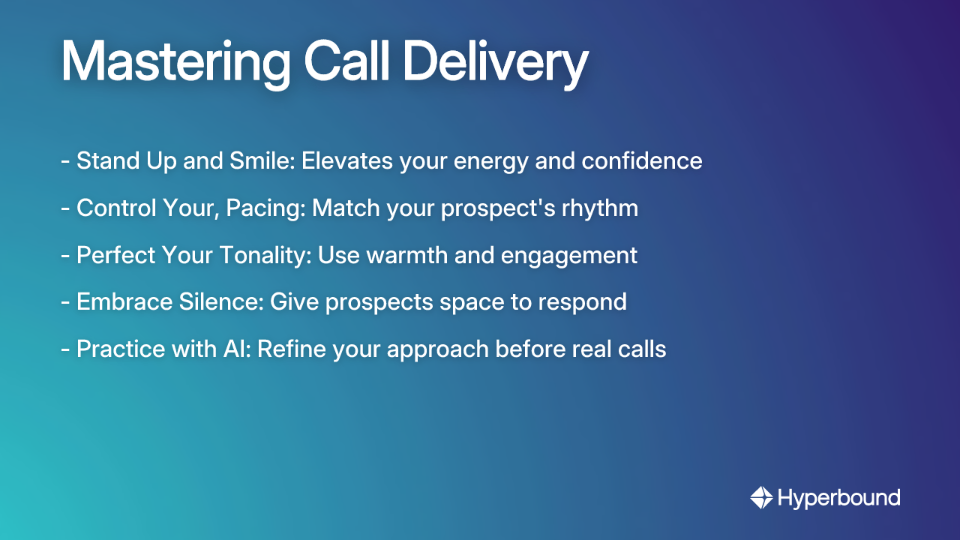
Research from Berkeley shows that confident communication boosts perceived competence. Your delivery often matters more than your exact words.
The goal is not a one-call close but setting a Qualified Meeting. Address the user research insight: "You interrupted their day. Don't try to sell them anything but the appointment on the cold call."
Use these to pivot from your opener to a Discovery & Qualification conversation.
Be direct and clear.
Address the common concern: "But what if they no-show?"
The Confirmation Cadence: Once a meeting is booked, send a calendar invite immediately. Then, follow the recommended practice: "You send an invite then day before you see if they accept it," or send a confirmation email/call the day before to reinforce the commitment.
The first 30 seconds are about disarming the prospect and building a connection, not pitching. Follow the Who > Why > What's In It For Them sequence. Use Pattern Interrupts to break through the noise and make them listen. Your tonality and confidence are your most powerful tools.
Remember that the goal is always the next conversation (Qualified Meeting or Soft Appointment), not the one-call close. Many sales professionals wish we'd "get rid of the idea of a one-call close" because it creates unrealistic expectations.
By mastering this "30-Second Rule," you transform the cold call from a source of anxiety into a predictable, effective tool for building your pipeline. By focusing on genuine connection and respect for their time, you become a welcome interruption rather than just another salesperson.
When you craft your opener with the prospect's needs in mind, tailoring your Value Proposition to address specific Customer Pain Points, you'll find that those first 30 seconds become the gateway to productive sales conversations rather than the cliff they hang up from.

The 30-Second Rule is a framework for structuring the first half-minute of a cold call to disarm the prospect, establish relevance, and earn permission to continue the conversation. It's not a rigid script but a three-part sequence: state who you are, explain why you're calling with a personalized hook, and present a micro-value proposition that makes them curious to hear more. The goal is to turn a defensive prospect into an engaged one within this critical window.
The first 30 seconds are critical because prospects make snap judgments about whether to continue the conversation, often deciding within the first 8-14 seconds. During this time, the prospect's guard is up, and they are looking for a reason to end the call. A strong opening builds rapport and signals that the call is relevant and valuable to them, overcoming their initial resistance and preventing an immediate hang-up.
To make a prospect listen, use a "pattern interrupt" to break their expectation of a typical sales pitch. Techniques like the "brutally honest opener" (e.g., "This is a cold call, you probably want to hang up...") or using humor can disarm them. The key is to disrupt their automatic "not interested" response, which creates a moment of curiosity and makes them pay attention to what you say next.
The best structure for a cold call opening follows a three-part sequence: 1) Who You Are, 2) Why You're Calling, and 3) What's In It For Them. First, state your name and company clearly. Second, establish immediate relevance by referencing something specific about them or their company. Third, offer a micro-value proposition and ask for permission to continue, such as, "Do you have 30 seconds for me to explain why I called?"
Handle gatekeepers by using a confident, friendly, and familiar tone, as if you're expected. Avoid sounding like a typical salesperson. If asked for the reason for your call, tie it to the decision-maker's job function (e.g., "I'm calling about their team's sales training process") rather than your product. This provides a legitimate business reason for the call. Pre-call research using tools like LinkedIn Sales Navigator helps ensure you're asking for the right person.
The main goal of a cold call is not to make a sale, but to secure the next step, which is typically a qualified meeting or appointment. Trying to close a deal on the initial call is unrealistic and puts too much pressure on the conversation. By focusing on earning just the next 15 or 30 minutes of their time in a future meeting, you can have a more relaxed and effective discovery conversation, increasing your chances of success.
To improve your tone and confidence, focus on your physical state and practice consistently. Standing up while you call, smiling, and speaking at a measured pace can significantly boost your energy and authority. Your delivery is often more persuasive than your words. Match the prospect's pacing and use a warm, engaging tonality. Practice is key; using AI roleplay tools allows you to refine your delivery and get objective feedback in a risk-free environment before making live calls.
Source: Sitkins - The Most Important 30 Seconds in Every Conversation










Use Cases
Legal