You've spent hours perfecting your cold call script, meticulously analyzing every word choice and refining each transition. Yet when you finally dial that number, something feels off. Your carefully crafted masterpiece sounds stiff and robotic coming out of your mouth. The prospect seems disengaged, and you can practically hear them mentally checking out as you speak.
Sound familiar? You're not alone.
Many sales professionals fall into the trap of believing that the perfect script will magically transform their cold calling results. They obsess over word choices and syntax, thinking that if they just find the right combination of phrases, prospects will suddenly start saying yes.
But here's the uncomfortable truth: you're wasting precious time.
As one experienced sales rep confessed, "I wasted a lot of time tweaking one word in my talk track or A/B testing emails... Making 20 extra dials is more effective than agonizing over syntax." The real game-changer isn't finding the perfect words—it's how you deliver them.
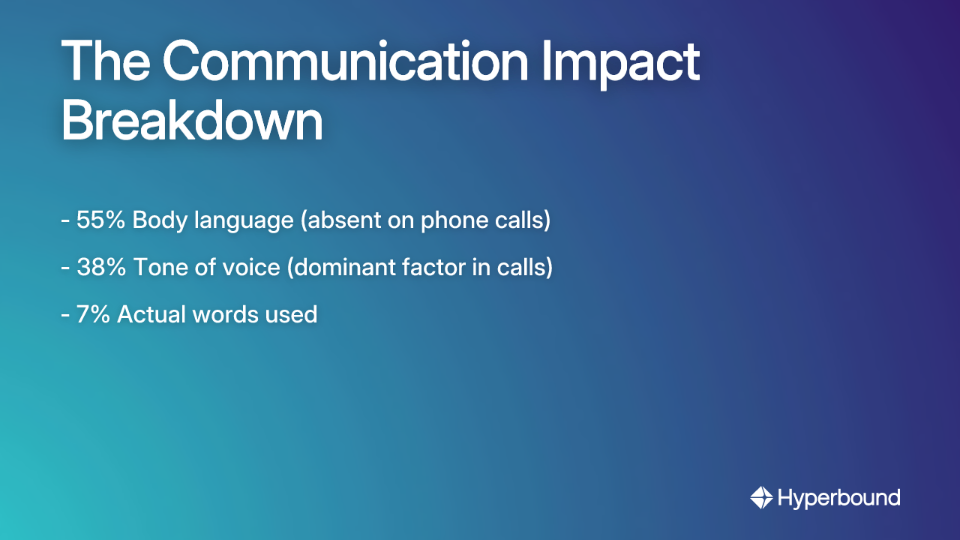
When you make a cold call, the words you say account for only a tiny fraction of your message's impact. According to the widely cited Mehrabian model of communication:
On a phone call where body language is completely removed from the equation, your tonality becomes the dominant factor in how your message is received. This means that even the most brilliantly written cold call script will fall flat if delivered poorly.
Think about it: When a prospect picks up the phone, they're immediately on the defensive. As one sales professional put it, "You're immediately on the defensive - you need to disarm the prospect as quickly as possible." Your delivery is what determines whether you sound like yet another pushy salesperson or a helpful resource worth engaging with.
The most successful cold outreach doesn't sound like cold outreach at all—it sounds like a normal, confident conversation between two professionals. And that comes down to delivery, not script perfection.
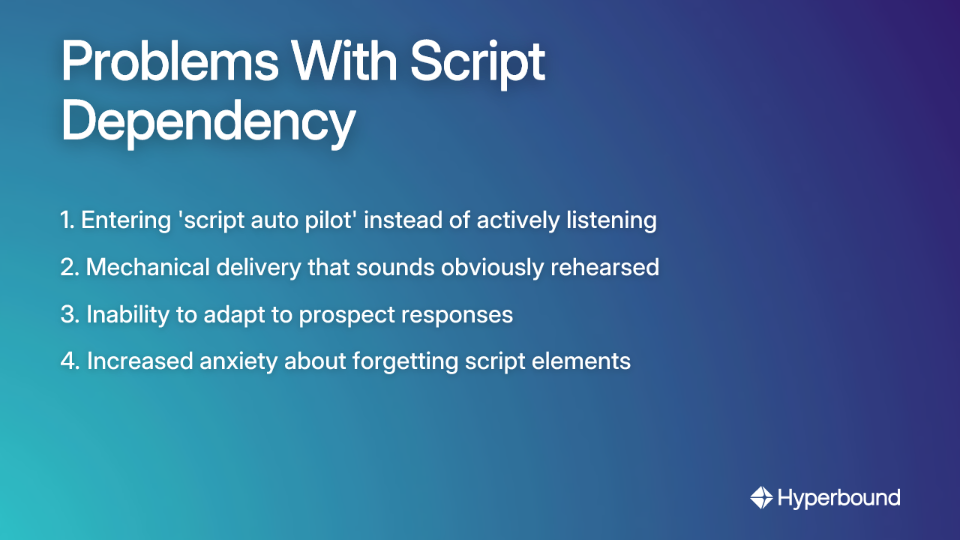
When you rely too heavily on a script, several problems emerge that damage your ability to connect with prospects:
The solution isn't abandoning scripts entirely—they provide valuable structure and ensure you cover key points. Instead, transform how you use them.
One powerful technique recommended by seasoned sales professionals is converting full-sentence scripts into simple dot points. Instead of memorizing paragraph-long openers and transitions, distill your script into key talking points.
For example, rather than: "Hello, this is Jane from XYZ Company. We're a leading provider of logistics solutions that help manufacturing companies like yours reduce shipping costs by up to 30%. I'm calling because I noticed your company recently expanded into new markets, and I thought you might be interested in learning how our platform could help streamline your distribution network."
Create dot points:
This approach gives you the freedom to sound natural while ensuring you hit all your key points. You'll maintain the structure needed for an effective sales funnel without sounding like you're reading a script.
As one sales veteran puts it, "Just do it. Be human." Your goal isn't a one-call close—it's starting a genuine conversation that moves qualified leads through your sales process.
Your tonality—the way your voice sounds when you speak—is your most powerful tool for building rapport and keeping prospects engaged during cold calls. It communicates confidence, credibility, and trustworthiness far more effectively than your choice of words.
The PAVP framework provides a structured way to think about and improve your vocal delivery:
The highness or lowness of your voice. A monotone delivery puts prospects to sleep, while strategic variation in pitch keeps them engaged. Lowering your pitch slightly at key moments (like when stating your value proposition) projects authority and confidence.
Speaking clearly signals professionalism and makes you easier to understand. Mumbling or slurring words undermines your credibility and forces prospects to work harder to follow what you're saying.
Speaking slightly louder than your normal conversational volume projects confidence and energy. However, varying your volume creates contrast that helps emphasize key points and maintain interest.
Perhaps the most critical element of effective delivery, which we'll explore in depth in the next section.
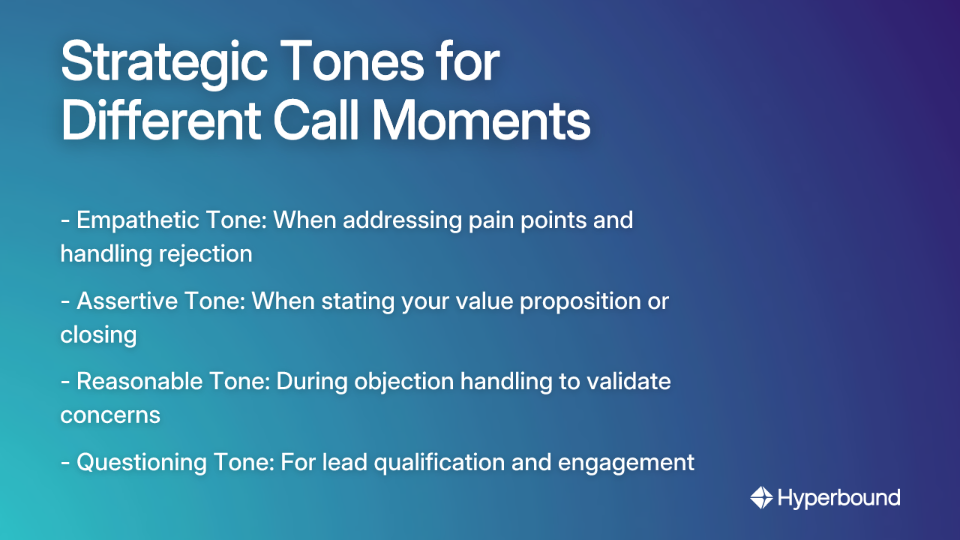
Different vocal tones serve different strategic purposes during your sales calls:
The key is matching your tone to the moment, rather than maintaining the same tone throughout the call.
One of the most common delivery problems in cold calling is speaking too quickly. As one sales rep admitted, "I have a habit of talking way too fast and getting overly excited to the point it can sound like gibberish." This rapid-fire delivery signals nervousness, makes you harder to understand, and gives the impression you're trying to rush through a script before the prospect can object.
When a prospect feels rushed or pressured, they're more likely to end the call. The solution? Do the opposite of what feels natural: slow down.
Top crisis negotiators intentionally slow their speech to de-escalate tense situations and maintain control of the conversation. This same technique works remarkably well in sales calls. When you speak slowly and deliberately:
Strategic pauses are equally powerful. After making an important point or asking a question, resist the urge to fill the silence. A comfortable pause gives the prospect space to think and respond, while demonstrating your confidence.
Before making your calls, practice this simple breathing technique used by Navy SEALs to control anxiety and improve focus:
Repeat four times before dialing. This exercise calms your nervous system and naturally slows your speaking pace, setting you up for more controlled, confident delivery.

Confidence is contagious. When you genuinely believe in your solution, that conviction transmits through your voice and influences how prospects perceive your offer. During outbound sales calls and especially during objection handling, you're not just answering questions—you're transferring your belief to the prospect.
As one sales leader put it, "If you aren't confident, fake it." Your delivery is precisely how you "fake it until you make it." Even when you're nervous, a measured pace and strong tonality can project the confidence needed to build trust with warm leads.
Before important calls, try this powerful mental reframe: switch from a "be perfect" mindset to an "it doesn't matter if this call goes well" mindset. This psychological detachment reduces performance anxiety and, paradoxically, often leads to a more natural, confident delivery.
Remember that your physical posture affects your vocal delivery. Even though your prospect can't see you, standing up, maintaining good posture, and even smiling while you speak will naturally improve your vocal energy and confidence.
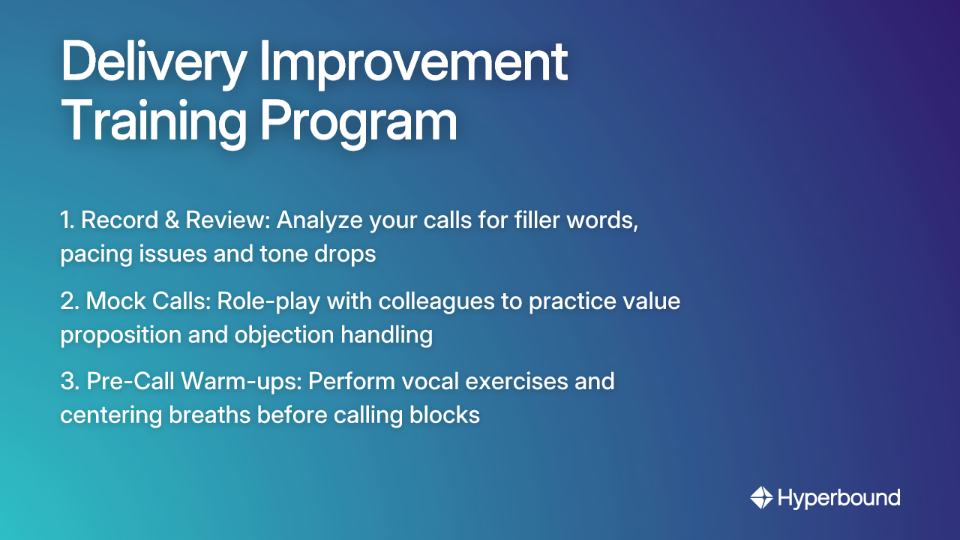
Like any skill, masterful delivery requires consistent practice. Here's your training program to move from robotic script-reading to authentic, confident conversations:
This is non-negotiable for improvement. Manually reviewing calls is a start, but it can be time-consuming and subjective. Record both your practice sessions and actual calls, then listen for:
To accelerate this process, AI-powered tools like Hyperbound's AI Real Call Scoring can automatically analyze your calls against your playbook, providing objective, data-driven feedback on your performance.
While role-playing with colleagues can be helpful, it's often difficult to scale and dependent on busy managers' schedules. To get unlimited, on-demand practice, leverage AI.
Platforms like Hyperbound's AI Sales Roleplays allow you to practice against hyper-realistic AI buyers in a safe environment. This allows you to:
Before your calling blocks:
Your success in cold calling isn't determined by having the perfect script, but by your ability to deliver your message in a way that sounds natural, confident, and conversational. When you master tonality, pacing, and confident delivery, you transform from an interruption into a valuable resource worth engaging with.
Stop wasting time on endless A/B testing and minor word tweaks. Instead, invest that time in practicing your delivery until it becomes second nature. Record your calls, role-play with your team, and focus on sounding like a trusted advisor rather than someone mechanically working through a sales cadence.
Remember: The most successful salespeople aren't just reciting lines—they're transferring belief. Your voice is your most powerful instrument for connecting with prospects, addressing their pain points, and closing the deal. It's time to learn how to play it masterfully.
By shifting your focus from perfecting scripts to perfecting delivery, you'll not only improve your cold outreach results—you'll also enjoy the process more. Because ultimately, sales isn't about reading scripts; it's about having meaningful conversations that solve real problems.

Your delivery is significantly more important than your script. On a phone call where body language is absent, your tone of voice accounts for the vast majority of your message's impact—far more than the specific words you use. A perfect script delivered robotically will fail, while a simple message delivered with confidence and natural pacing can successfully open a conversation.
Sounding robotic is a common side effect of relying too heavily on a full script, which can put you on "script auto pilot." When you focus on reciting lines perfectly, you stop actively listening to the prospect. This makes your delivery mechanical, prevents you from adapting to their responses, and creates an unnatural, one-sided monologue instead of a genuine conversation.
No, you should not abandon your script entirely, but rather change how you use it. A script provides valuable structure and ensures you cover key talking points. The solution is to transform your word-for-word script into a flexible set of dot points. This gives you the structure you need with the freedom to have a natural, conversational interaction.
You can slow down your speaking pace by consciously using the "Hostage Negotiator Technique"—speaking slowly and deliberately to project confidence and control. Additionally, practicing pre-call breathing exercises like Box Breathing (inhale for 4s, hold for 4s, exhale for 4s, hold for 4s) can calm your nervous system and naturally slow your speech.
Tonality refers to the way your voice sounds—its pitch, pace, volume, and articulation. It is crucial in sales because it conveys confidence, credibility, and trustworthiness when the prospect cannot see your body language. Using strategic tones, such as an assertive tone for your value proposition or an empathetic tone for handling objections, can dramatically improve prospect engagement.
To improve your vocal delivery, focus on the PAVP framework: Pitch, Articulation, Volume, and Pace. Vary your pitch to keep listeners engaged. Speak with clear articulation to sound professional. Use appropriate volume to project energy and confidence. Most importantly, control your pace by speaking slowly and using strategic pauses to sound authoritative.
The most effective practice involves recording and reviewing your calls, and using AI-powered roleplays. Recording your calls helps you identify specific issues like filler words, pacing problems, and poor tonality. AI roleplay platforms like Hyperbound provide a safe, scalable environment to practice handling objections and mastering your delivery with instant feedback, building the muscle memory needed for live calls.










Use Cases
Legal