
Most sales organizations run three disconnected systems. Reps practice in one tool, calls are scored in a second, and coaching occurs in a third, usually a spreadsheet or a manager's memory. The only connection between them is the rep, who is expected to remember a scorecard note from Tuesday and apply it correctly by Thursday. Closed-loop enablement is the model that replaces the rep as the integration layer: it links what a rep practices, what happens on the real call, and what a manager coaches into a single cycle that keeps running until a behavior changes in the field, not just on a training log.
This piece defines that loop, identifies where it breaks in a typical enablement stack, and lays out a framework that sales enablement and revenue operations leaders can apply with the tools they already own. It closes with what a closed-loop system should score for and what it should look like operationally.
Closed-loop enablement connects performance assessment, learning, and outcome tracking into a cycle, so that an insight from a real call becomes sustained behavior change rather than ending at a score or a completion log. The problem it solves is architectural: "the tools that assess performance do not talk to the tools that deliver learning, and neither of them talk to the tools that track deals," and the gap between insight and behavior change is where organizations lose value, according to a 2026 Learning Technologies session dedicated to the concept.
That framing matters because it names the failure mode precisely. A conversation-intelligence platform captures the call. A learning management system delivers the course and logs the completion. A CRM records whether the deal closed. Each system does its job well in isolation. None of them tells an enablement leader whether the specific behavior a rep was coached on last week showed up on the call this week, or whether it moved a deal forward. That connective layer is what "closed loop" describes, and it is the layer most sales organizations do not have.
The term is still forming as a category. It appears in vendor blogs and conference sessions, but no canonical definition page exists yet, and the incumbents describe the cycle differently enough that a reader evaluating vendors needs to know the variants exist before comparing anything.
The clearest sign that this is an emerging, unowned category is that the two vendors already using the phrase describe different loops. Imparta, an established sales-training vendor, brands a five-stage cycle: "Prepare -> Do -> Assess -> Improve -> Follow-through," sold as a closed-loop methodology inside a single subscription. Syrenn, a smaller vendor, defines the loop with three stages instead: live call analysis, individualized skill diagnosis, and targeted practice scenarios, where the diagnosis auto-generates practice and the improvement feeds back into the system.
Both are legitimate models. Imparta's five stages describe a training lifecycle around a methodology. Syrenn's three stages describe something narrower and more operational: the direct line from a scored call to a practiced fix to the next scored call. This article uses the second frame, expanded to three handoffs rather than three stages, because it maps onto how enablement leaders and revenue operations teams experience the breakdown: practice, real calls, and coaching, with a rep positioned between each pair as the only carrier of information.
That framing has a second advantage. It is deliberately tool-agnostic. Sales enablement leaders evaluating vendors, or trying to fix a stack they already own, can apply the three-handoff model to whatever practice tool, call-scoring tool, and coaching process they currently run, before they decide whether any of it needs to change.
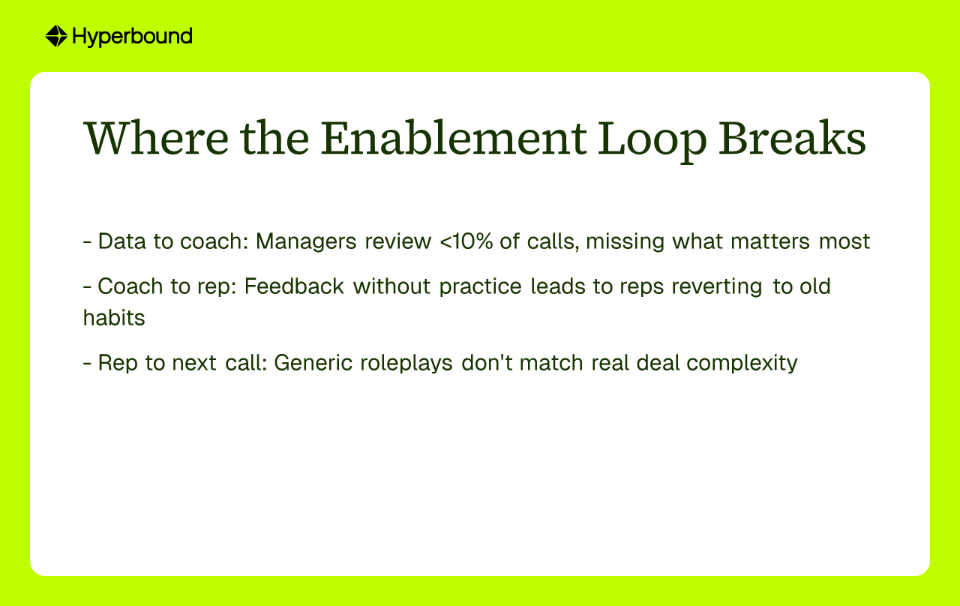
The root architectural failure is siloed systems. Conversation intelligence holds the call data, the LMS holds content and completion records, and the CRM holds outcomes, and because they do not interconnect, nothing in the chain improves. Each of the three handoffs in the loop breaks for a distinct, identifiable reason.
Data to coach. A team of fifteen reps making forty calls a day generates six hundred calls a week. No manager reviews that volume, so managers only ever see a fraction of it, and the fraction they see is rarely the calls that matter most. Even when a manager does listen, the resulting feedback is frequently an observation rather than coaching: "your discovery needs work" describes a problem without prescribing a practiced fix, and there is typically no mechanism to measure whether the coaching had any impact at all.
Coach to rep. Feedback delivered once, in a debrief or a 1:1, is not the same as a rep having practiced the replacement behavior before the next live call. This is the same distinction that separates deal-level coaching from deal inspection: a manager who reviews a call and leaves a note has inspected it; a manager who routes that note into a practiced next move is coaching it. Reps who receive a note without a rehearsal opportunity revert to old habits or apply new guidance inconsistently, especially without ample practice. The handoff fails because feedback and practice are treated as the same event when they are distinct.
Rep to next call. Even where practice happens, it is frequently disconnected from what the real call required. Generic roleplay content does not mirror the deal complexity a rep is entering, so the practice rep completed on Monday has no relationship to the objection a prospect raises on Thursday. Buyers evaluating practice tools already treat this as a purchase criterion: a Head of Growth cited turning real call recordings into role-plays as the feature that made a practice tool usable at all, and the category's own shorthand for the intended cycle is score call, identify gaps, practice scenarios, score next call, measure improvement.
Conversation intelligence solved visibility. Before it, organizations could not see what happened on a call. Visibility answers what happened on a call; it does not answer what the rep should do differently before the next call. A closed loop is built to answer that second question.
The cost of an open loop is not abstract. Coaching is already the scarcest resource in most sales organizations: most managers spend under 8% of their time coaching, even though top-performing teams are 51% more likely to maintain a regular coaching cadence than the rest of the field, according to research Syrenn cites. A parallel figure from a separate vendor reports a similar gap: reps who receive regular quality coaching outperform peers by as much as 19%, yet managers review only 5 to 10% of calls, and 73% of reps say they need more of it than they get.
The scarcity compounds because conversation-intelligence platforms are typically sold on what they capture, not on what a manager should do with the recording. The result is an expensive library that gets browsed occasionally rather than a coaching system that changes behavior weekly. An enablement team paying for call intelligence and getting a searchable archive back has bought visibility, not a loop.
Real call data, treated correctly, is also a leading indicator of deal risk, not just a coaching input after the fact. A coaching score that drops 15 points or more between Stage 2 and Stage 3 of a deal predicts a stall two to three weeks before it shows up anywhere in the pipeline report, according to analysis of coaching and call score trends. That single fact is the strongest argument for treating the loop as an operating system rather than a training add-on: the same data that diagnoses a rep's skill gap is the data that flags a deal about to slip, weeks before a forecast call catches it.
There is also a budget argument worth naming directly. Imparta sells its own loop with the line "one subscription, every seller, the whole system," treating the connected cycle as a single system purchase rather than a training course. That reframing matters for an enablement leader building an internal business case. The ask to a CRO is no longer "approve a training budget." It is "approve a performance system," which is a different conversation with a different owner and a different bar for return.
A closed loop is event-driven. Enablement leaders who wait for a quarterly review to decide what needs coaching miss the two or three weeks in which correction is least expensive. A vendor-neutral trigger framework already exists and translates cleanly to any call-scoring tool:
These three triggers, drawn from conversation-intelligence coaching practice, work regardless of which scoring tool produces the underlying number. The discipline they impose is what makes a loop closed rather than open: a trigger fires, an action follows, and the action is measured back against the next real call, rather than filed as a note in a coaching document nobody revisits.
A closed-loop program built around these triggers can run on a weekly cadence without requiring a new headcount. A useful shape: a fifteen-minute Monday scan across the team's bottom performers, team-wide gaps, and trend changes, followed by three twenty-minute one-on-ones that each use one criterion, one near-miss call, and a sixty-second clip, with the rep self-diagnosing before being handed a specific action for the next call. That structure, documented as an operating cadence for coaching off conversation-intelligence data, is the practical answer to "how does an enablement team run this," independent of tooling.
The Kirkpatrick Model gives the loop its most durable vocabulary, because it was built for exactly this problem: training programs that stop at a completion log instead of measuring whether behavior changed. The model runs four levels: Reaction, Learning, Behavior, and Results. It is explicitly cyclical rather than linear, with each level feeding back into the design of the next cycle, which is the same structure a closed-loop enablement program needs.
Level 3, Behavior, is the level most enablement stacks skip, and it is the one that matters most. It requires measuring whether a rep applies a coached skill back in their real environment, on a real call, not in a survey or a certification exercise. The Kirkpatrick framework is explicit that this cannot wait ninety days: waiting that long to measure application means losing the window to correct course, which is precisely why a closed loop needs to run continuously on real calls rather than on a quarterly review calendar.
Level 2 adds a useful early signal: a rep's confidence and commitment after training predicts, ahead of the next real call, whether the new behavior will show up at all. Level 4 recommends tracking both leading and lagging indicators of results, rather than waiting for a lagging revenue number to validate a training investment months later. Applied to the practice-to-call handoff, that means a program should track a leading signal, such as roleplay completion and score, alongside the lagging signal of whether the behavior appeared in the next real call and whether the deal moved.
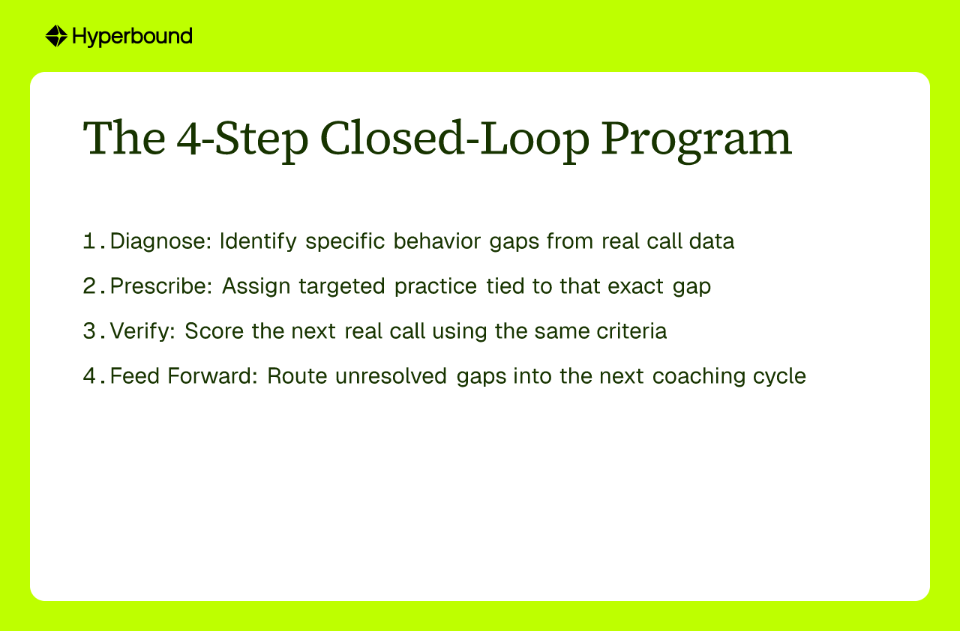
Put together, a closed-loop program built on this model runs four connected steps, and the broader program that houses it — scope, scorecards, practice, and measurement — is covered step by step in our guide to building a revenue enablement program that changes behavior:
This is the loop a reader can run manually, with a call-scoring tool, a shared practice library, and a coaching calendar, before ever evaluating a platform that automates it.
Every closed loop depends on scorecards that record when a behavior was possible to observe. This is the part enablement leaders most often get wrong when building their own scoring criteria, and it is worth stating as a rule: a criterion only scores when its trigger fires on the call. A call where pricing never comes up should return not-applicable on a pricing criterion, not a fail. Scoring it as a fail penalizes a rep for a conversation that never required the behavior, and it corrupts every trend line built on top of that scorecard.
A discount-discipline initiative is built for a team where margin is eroding because reps open with a discount before value is established. The eligibility rule is any call where pricing, budget, or discount comes up, and a workable scorecard runs three to five criteria: whether the rep asked what the prospect is comparing the price against before responding to an objection, whether the rep restated the value already established on the call before naming a number, whether any concession was traded against a term rather than simply given away, and whether list price held through the first objection. On a discovery call where the prospect never mentions budget, none of those four criteria fire, and the call correctly returns not-applicable across the board rather than a set of failing marks that drag down the rep's average for a conversation that was never eligible to be scored on pricing in the first place.
That same discipline applies to every other trigger-based initiative an enablement team might run: a competitive messaging rollout that only scores when a competitor is named, a multi-threading push that only scores on calls past the first meeting, a security-objection initiative that only scores when compliance or procurement comes up. Enablement leaders who build a full cluster of these initiatives, one per rollout, find that three to five criteria per initiative is the workable range. Two criteria is too thin to say anything about a behavior. Eight starts to look like a general call scorecard rather than a specific behavior change program, and it becomes harder for a rep to act on because the signal gets diluted across too many things to fix at once.
Any system built to close this loop is, by definition, ingesting real call recordings, which means the security and pricing bar has to be treated as a first-order evaluation criterion, not an afterthought handled during procurement. Enablement and revenue operations leaders evaluating a platform should expect a baseline that includes ISO 27001 certification, SAML-based single sign-on, AES-256 encryption, CSA Cloud Security alignment, and a published trust center, the compliance profile buyers should demand of any vendor handling call recordings at scale.
The commercial model also warrants early review. The category's incumbent pricing pattern combines a per-seat subscription that covers the platform, a methodology or skill library, and integrations, with AI compute metered separately, either as pay-as-you-go usage or a flat per-user allotment with a cap, plus professional services layered on top for implementation, a seat-plus-usage-plus-services structure that enablement leaders should expect to negotiate across, rather than assume a single flat number covers everything.
The checklist that matters most, though, is not on any vendor's compliance page. It is whether the criteria a system scores are built the way the discount and security examples above are built: trigger and action pairs, three to five per initiative, that return not-applicable rather than a fail when the behavior was never eligible to be observed. A tool that scores everything on every call, regardless of whether the moment ever arose, produces a scorecard, not a closed loop.
Everything above can be run manually, with a spreadsheet, a call-scoring tool, and a coaching calendar disciplined enough to follow the trigger framework. The reason enablement organizations increasingly buy a platform for it is the volume problem: a fifteen-rep team already produces six hundred calls a week, and doing the diagnose-prescribe-verify-feed-forward cycle by hand does not scale past a handful of reps before the loop reopens.
Hyperbound builds toward this loop across three connected products. Practice is where reps rehearse a behavior with AI roleplays before it ever reaches a real prospect. Perform scores real calls and surfaces deal-level coaching across the full lifecycle of a deal, not just a single call in isolation. Kota, sitting above both, orchestrates the handoff between them, recommending which reps need which practice based on what occurred on their real calls. The operational cycle across all three follows the same shape described in this article: score real calls, identify skill gaps, assign practice, and score the next real call to confirm the gap closed.
The manager-bandwidth problem described earlier in this piece, where a handful of enablement leaders and managers are trying to cover a stack of calls no human review process can keep up with, is the starting point for most of the closed-loop deployments Hyperbound has run. At Staff Domain, coaching needs that used to take ninety days to surface were identified in four weeks after implementing Hyperbound, closing the data-to-coach handoff described earlier in this piece. At Vanta, ramp time dropped from roughly 210 days to 75, a 60% reduction, while the SDR team scaled more than four times over, a result attributed to closing the loop between practice and live pipeline performance. The daily-practice discipline behind results like these matters as much as the tooling. Staff Domain runs a non-negotiable morning warm-up for every rep. Finally takes a similar line and requires every SDR to run sixty practice reps a day, split between morning and afternoon, before touching a live call, treating practice as a daily ritual embedded in the workday rather than an occasional training exercise.
Hyperbound is currently building Agentic Enablement, its autonomous behavior change system, a mechanism for running these trigger-and-action programs directly against real call data, so that a rollout ends with proof a behavior changed in the field rather than a completion report showing who attended a training session. It is described here as how it is designed to behave, not as something live today. If you're interested in making your behavior change autonomous, talk to our team.
No, closed-loop enablement is not the same as closed-loop marketing. Closed-loop marketing connects marketing activity to sales outcomes, typically campaign source to closed-won revenue in a CRM. Closed-loop enablement connects a rep's practiced behavior to what happens on a real call and back to coaching. Both are "closed loops" in the sense that they route an outcome back to the activity that produced it, but they close different gaps. A revenue operations leader evaluating tools for one should not expect it to solve the other.
Traditional sales training stops at delivery and completion, while closed-loop enablement verifies behavior change on real calls. In a traditional model, a rep completes a course or workshop, and the enablement team reports attendance or a completion rate. In a closed-loop model, the rep's next real call is scored against the same criteria that identified the skill gap, and the result feeds back into coaching. The difference is whether the system can prove the rep applied the new behavior in the field, not just that the rep learned the concept.
Not necessarily. Closed-loop enablement is a model for how data should move between systems, not a mandate to rip out an existing conversation-intelligence platform or learning system. An enablement team can apply the trigger framework and the not-applicable scoring discipline to tools it already owns. The gap most teams have is process and connective tooling between systems, not a missing point solution.
Course completion tracking answers whether a rep attended training or finished a module. Closing the loop answers whether the specific behavior that training targeted shows up in the rep's next real call, and whether that shift correlates with a better deal outcome. Completion is a leading indicator at best; closing the loop requires measuring behavior in the field, which is the distinction Kirkpatrick's model draws between its Learning and Behavior levels.
A closed-loop response should start when real call data signals a specific, measurable gap. The three core triggers are bottom performers flagged across multiple scoring periods, team-wide skill gaps where a meaningful share of reps scores below threshold on one criterion, and sharp score trend changes such as a team average dropping from 75% to 52%. These triggers work regardless of which call-scoring tool produces the number, and they force the loop to run on evidence rather than on a quarterly calendar.
A closed-loop program should score only behaviors that were eligible to be observed on a given call. A criterion scores when its trigger fires, such as pricing or discount language appearing on the call. If the trigger never fires, the criterion returns not-applicable, not a fail. Scoring a non-observed behavior as a fail corrupts trend lines and penalizes reps unfairly. Each initiative should run three to five trigger-and-action criteria, which keeps the scorecard focused on the behavior the program is meant to change.
A closed-loop program should track leading indicators and lagging outcomes together: roleplay completion and score before a call, scorecard change on the next real call, coaching frequency, and changes in deal progression or win rates. Leading indicators like practice completion and confidence predict whether the behavior will appear. Lagging indicators like the next call score and deal movement confirm whether the behavior changed. This aligns with Kirkpatrick Level 4's recommendation to track leading and lagging indicators rather than waiting for a revenue number months later.
Buyers should look for three things: baseline security and compliance for call recordings, a transparent commercial model that separates seat, usage, and services, and scorecards built on trigger-and-action pairs that return not-applicable when a behavior was not eligible to be observed. Security expectations should include ISO 27001 certification, SAML SSO, AES-256 encryption, CSA Cloud Security alignment, and a published trust center. The scoring design matters most: a tool that scores everything on every call produces a scorecard, not a closed loop.
Ownership is shared between enablement and sales or revenue operations. Enablement typically owns the practice and coaching design, since it already owns training content and rep development. Sales or revenue operations typically owns the call-scoring infrastructure and the trigger logic tied to pipeline data. A program that works has both functions agreeing on the same trigger definitions and the same scorecards, rather than running two separate versions of what counts as a skill gap.
Results appear in weeks when the program runs on a weekly trigger-and-action cadence. A coaching score that drops 15 points or more between stages predicts a deal stall two to three weeks before it appears in a pipeline report, which means the same data surfaces issues early. In deployed examples, what used to take ninety days to surface was identified in four weeks after implementing closed-loop practice and scoring, and ramp-time improvements have shown up in a single ramp cycle. The key is that the loop runs continuously on real calls, not on a quarterly review calendar.










Use Cases
Legal