
You've invested in a conversation intelligence platform. Your dashboards are full. Call transcripts are piling up. Your managers have more data than they know what to do with — and yet, win rates are still flat, new reps are still ramping at the same slow pace, and you're still hearing the same objection-handling mistakes on every other call.
Sound familiar? This is the coaching gap — and it's the silent killer of sales intelligence ROI.
Conversation intelligence tools like Gong and Chorus are powerful. They lead the market for a reason. But as more and more sales teams are discovering, knowing what your reps need to fix and actually fixing it are two very different things. That's the problem this guide is built around.
In this guide, we'll break down Gong vs. Chorus on the features that matter most, show you exactly where both platforms leave you hanging, and introduce Hyperbound — not as a head-to-head replacement, but as the activation layer that makes your existing investment (or your new one) actually move the needle.
Before we get to the gap, it's important to understand the landscape. Gong positions itself as a Revenue Intelligence platform, focused on broader sales data and pipeline analytics. Chorus, now part of ZoomInfo, emphasizes deep Conversation Intelligence — analyzing what's being said to improve performance.
Here's how they stack up on key features:
.png)
The verdict: Both platforms excel at telling you what happened on calls. But as research consistently shows, neither Gong nor Chorus offers a dedicated practice solution — a way for reps to actually rehearse the behaviors they've been coached to fix.
That's not a minor gap. That's the whole game.
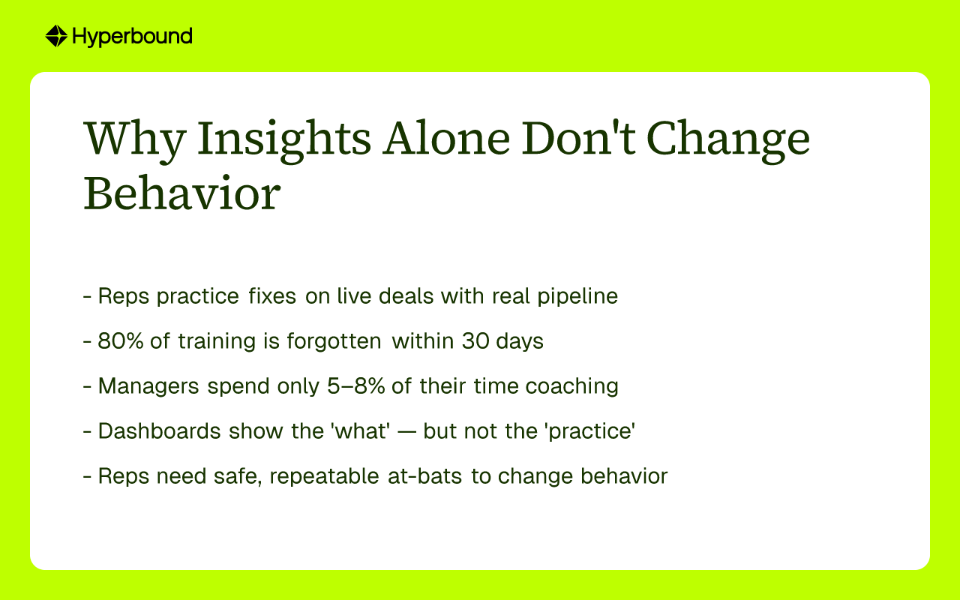
Here's the scenario that plays out in sales teams every week: A manager reviews a call recording. They see exactly where a rep fumbled a budget discovery question. They send a comment in the platform. Maybe they schedule a 15-minute debrief. The rep nods, takes notes — and then the next chance they have to try the new approach is on a live deal with real pipeline on the line.
That's not a coaching system. That's a feedback loop with no activation mechanism.
The problem is compounded by a well-documented reality: 80% of training is forgotten within 30 days. Passive observation and note-taking simply don't create behavior change at the rep level. Frontline managers — who already spend only 5–8% of their time actually coaching — can't bridge this gap through manual effort alone.
This is what sales teams mean when they say they're struggling to translate analytical insights into actionable coaching. The tools provide the "what." They don't provide the "practice."
To drive real improvement, reps need safe, repeatable, realistic at-bats — not just a dashboard showing where they fell short.
Hyperbound pioneered the Revenue Activation category to describe exactly this problem: teams have more call data, deal data, and pipeline analytics than they know what to do with — but data alone doesn't change outcomes.
Hyperbound closes the coaching gap with a continuous loop:
What makes Hyperbound's AI roleplays different from generic simulations is that they're built from 2M+ hours of real B2B sales conversations — not scripted scenarios. Reps aren't gaming a bot. They're practicing against AI buyer personas that push back the way real prospects do.
The results speak for themselves:
.png)
.png)
Hyperbound Perform | Hyperbound Practice
While platforms like Gong and Chorus offer broad call intelligence and analytics, neither gives reps a way to practice the behaviors they need to fix. That's the gap Hyperbound was built to fill.
If you're already using Gong or Chorus, you don't have to replace anything. Hyperbound is designed to plug in as the activation layer on top of your existing call intelligence investment. Think of it this way: Gong is the diagnostic tool that tells you what's broken. Hyperbound is the rehabilitation program that actually fixes it.
Here's what that workflow looks like in practice:
Step 1 — Diagnose with Your Call Intelligence Platform Use your call intelligence platform to identify a team-wide pattern. For example: reps are consistently failing to uncover budget during discovery calls, or they're struggling with a specific competitor objection after a product update.
Step 2 — Build the Practice Scenario in Hyperbound Create a custom AI roleplay in Hyperbound Practice targeting that exact gap — a "Budget Discovery" scenario or a "Competitor Objection" simulation. Hyperbound's AI buyer personas can be customized to mirror the objections and behaviors your reps encounter in real deals.
Step 3 — Practice at Scale Assign the roleplay to the team. Reps complete targeted sessions — even Bitesized Roleplays for tenured reps who won't sit through a 30-minute module — and get instant, objective AI scorecard feedback on talk ratios, question quality, methodology adherence, and more.
Step 4 — Close the Loop Use Hyperbound Perform (or Gong's trackers) to verify whether the behavior actually changed on real calls in the following weeks. This is how you generate measurable ROI on both platforms simultaneously.
Hyperbound has named integrations with Gong, Aircall, and Outreach, as well as Salesforce, HubSpot, Pipedrive, and LMS platforms like Seismic, Highspot, and Showpad — so the integration story is clean.
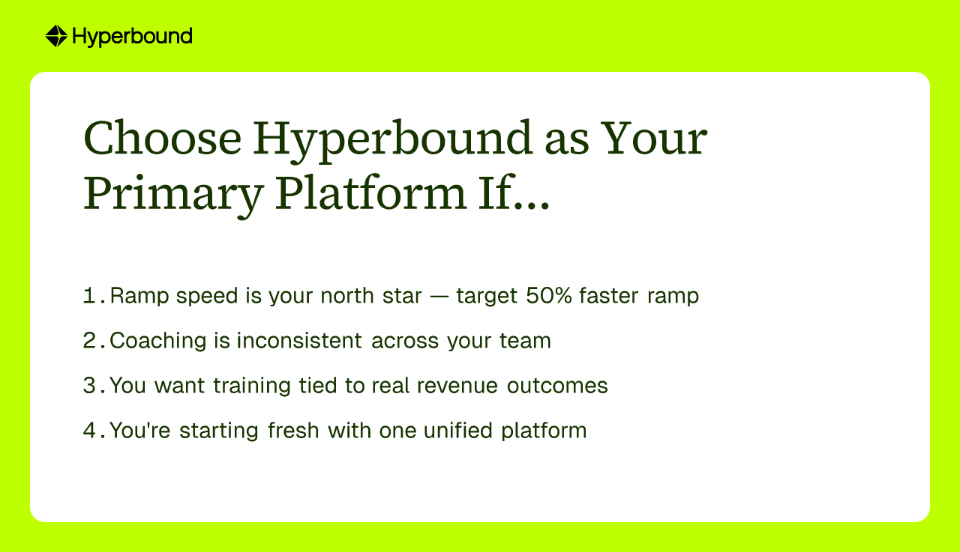
Not every team needs a full conversation intelligence suite on day one. If ramp speed and coaching consistency are your biggest bottlenecks — not analytics breadth — Hyperbound standalone is a compelling option, especially for teams where the cost of enterprise call intelligence is genuinely prohibitive.
Conversation intelligence platforms are powerful systems of record. They tell you what's happening in your sales conversations with impressive precision, and for teams that need that level of deal analytics and pipeline visibility, they can be effective. If you're evaluating alternatives specifically because you want something more coaching-forward, this distinction matters.
But insight without action is just expensive documentation.
Hyperbound is the system of action. It takes what your call intelligence platform surfaces — the missed questions, the fumbled objections, the deal-killing habits — and turns them into targeted practice that actually sticks. The result isn't just better-informed reps. It's reps whose behavior changes, deals that close at higher rates, and a team that ramps in weeks instead of quarters.
The right answer for most mature revenue teams: Use your conversation intelligence platform for insights. Add Hyperbound to activate them.
The right answer for fast-growing teams prioritizing performance over analytics: Start with Hyperbound and build from there.
The primary difference is that Gong and Chorus are platforms for analysis (revenue intelligence), telling you what happened on past calls. Hyperbound is a platform for action (revenue activation), providing AI-powered practice to improve future conversations. While Gong finds the problem, Hyperbound provides the reps to fix it.
Conversation intelligence platforms are not enough on their own because they identify problems without offering a scalable way for reps to practice and implement feedback. This creates a "coaching gap." Insights alone don't change behavior; reps need safe, repeatable practice to build new skills, which is exactly what Hyperbound provides.
Hyperbound's AI roleplays use advanced AI buyer personas trained on over 2 million hours of real B2B sales conversations. This allows reps to practice against realistic scenarios and objections. After each session, the AI provides instant, objective feedback on their performance, helping them improve key skills without waiting for a manager.
Yes, absolutely. Hyperbound is designed to be the activation layer on top of your existing call intelligence platform. You can use Gong or Chorus to identify team-wide skill gaps and then build targeted AI practice scenarios in Hyperbound to fix them. Hyperbound has direct integrations to make this workflow seamless.
A team should choose Hyperbound as a standalone platform when their most critical challenge is accelerating new hire ramp time, ensuring consistent coaching, and directly linking training to revenue. If your primary bottleneck is performance and practice rather than analytics, Hyperbound offers a powerful, focused solution.
Teams using Hyperbound typically achieve a 50% faster ramp time, a 150% increase in decision-maker to demo conversion rates, and a 2x faster time to a new rep's first won deal. The platform is built to drive measurable improvements in core sales metrics by turning insights into action.










Use Cases
Legal