
You know the laugh. The one that comes out when someone asks if you have a dedicated person for Sales Ops, another for Marketing Ops, and a third for CS Ops. As one RevOps professional put it on Reddit: "Hahahahaha (laughs because otherwise...). I see you; our CFO jokes (but it's also true) that I'm worth at least $1M off OpEx every year because of how much I've had to automate out of pure necessity." (Source)
That's the lived reality of mid-market RevOps. You're one person — maybe two — running the entire GTM motion while leadership simultaneously asks you to cut vendor spend, consolidate the tech stack, and somehow drive more pipeline. Then ZoomInfo's renewal comes around, and suddenly Chorus is "included" in the bundle, and you've added another tool to the pile without a clear plan for what to do with it.
That's the real problem. Not Chorus specifically — but the pattern it represents: buying call intelligence without a coaching loop.
Conversation intelligence tools are excellent diagnostics. They'll tell you that a rep's talk-to-listen ratio is off, that a competitor got mentioned three times in the last month, or that a specific deal hasn't had a meaningful touchpoint in two weeks.
But dashboards don't fix dashboards. A transcript showing a rep stumbling through an objection doesn't automatically make them better at handling it next time. And with frontline managers spending only 5–8% of their time coaching — and coaching being the first thing cut when the quarter gets tight — the insight just sits there. Unused. Shelf-ware with a nice UI.
The "so what?" gap is where most call intelligence tools fail RevOps. You paid for the analysis. You got the insight. What actually changed?
That gap is exactly what the best Chorus alternatives are designed to close — and the reason this list is segmented by what actually matters: what the tool does after it records the call.
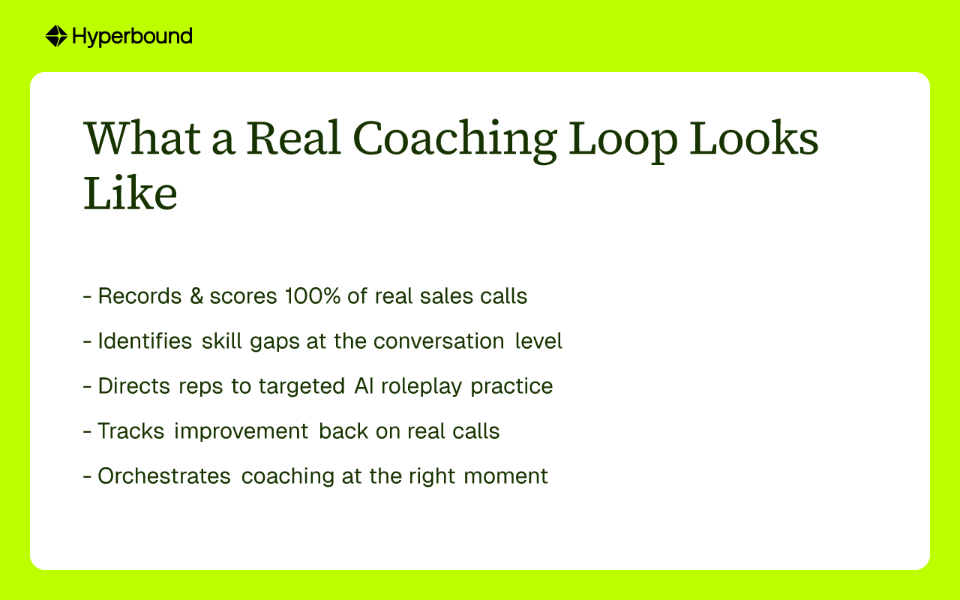
These tools go beyond recording and reporting. They use call data to change rep behavior — connecting what happened on a call to what a rep practices next and how deals move forward.
Best for: RevOps teams that want to connect call scoring to rep practice to deal outcomes — in one integrated loop.
Hyperbound is the platform that coined the Revenue Activation category — and for good reason. While most Chorus alternatives stop at analysis, Hyperbound starts after the analysis ends.
Here's how the loop works:
The result is a continuous improvement cycle: Score Real Calls → Identify Skill Gaps → Practice Roleplays → Score Real Calls again. It's the operational loop that replaces the "so what?" with a clear next action.
For RevOps teams worried about stack fit: Hyperbound is built as an integration layer, not a replacement. It connects with the tools you already have:
Proof it works:
G2 Rating: 4.9/5 | SOC 2 Type II, GDPR, ISO 27001, HIPAA compliant
Best for: Teams that need structured enablement with call coaching as one component of a broader readiness program.
Mindtickle is a comprehensive sales readiness platform that combines AI role-plays, skills-based coaching, and structured learning paths. It's a strong choice for organizations that want to build a full onboarding and enablement infrastructure — not just analyze calls.
Where it differs from Hyperbound: Mindtickle is primarily an enablement platform that has added conversation intelligence features, while Hyperbound is built around the closed loop between real call analysis and targeted practice.
G2 Rating: 4.7/5
Best for: Mid-market teams that want to standardize their coaching process with structured scorecards and call libraries.
Jiminny focuses on call analytics and manager-driven coaching scorecards. Managers can evaluate reps against consistent criteria, curate best-practice playlists, and run structured coaching sessions based on recorded calls.
It's a good fit for teams where the bottleneck is inconsistent coaching standards — every manager doing it differently — rather than a lack of practice opportunities for reps.
G2 Rating: 4.6/5
These tools are built to give you the deepest possible understanding of what's actually happening in your sales conversations — deal risks, competitor mentions, engagement patterns, and winning behaviors.
Best for: Organizations that want the most robust conversation intelligence layer as their system of record.
Gong is the market leader in conversation intelligence, and for good reason. It records and transcribes every customer interaction, then uses AI to surface deal risks, identify winning patterns, and flag engagement signals across the pipeline. If you want the deepest analytical layer for understanding what's happening in your GTM motion, Gong is the benchmark.
One important framing for RevOps: Gong is excellent at telling you what happened. Hyperbound slots in as the activation layer that tells you what to do about it — and the two are designed to work together via direct integration.
G2 Rating: 4.8/5
Best for: Teams already in the Outreach ecosystem that want to add conversation intelligence without switching platforms.
Outreach has expanded well beyond its sequencing roots into a broader sales execution platform, now including AI-driven conversation analytics, deal management, and forecasting. If your team is already using Outreach for cadences and engagement, it's a natural place to consolidate your call intelligence as well — reducing vendor sprawl without a rip-and-replace.
The trade-off: Outreach's conversation intelligence is solid, but it's most powerful when your team is fully committed to its ecosystem. As a standalone call analytics play, it doesn't go as deep as Gong.
Best for: Regulated industries where compliance monitoring is as important as sales effectiveness.
CallMiner takes an enterprise-grade, compliance-first approach to speech and text analytics. It goes beyond sales calls to analyze every customer interaction across voice and text channels — making it a strong fit for industries like financial services, insurance, or healthcare where conversations carry regulatory risk as well as commercial opportunity.
For a typical mid-market SaaS RevOps team, CallMiner may be more infrastructure than required. But if your industry is regulated, it deserves a serious look.
These tools solve a more fundamental problem: ensuring calls are captured, notes are accurate, and CRM data is clean without burning your reps' time on manual entry.
Best for: High-volume prospecting teams that need a single platform for outreach, calling, and activity logging.
Salesloft combines cadence management, a built-in dialer, call recording, and automated CRM logging in one platform. For SDR and BDR teams running high-volume outbound, it dramatically reduces the gap between "call happened" and "CRM reflects it." Its conversation intelligence features are solid at a basic level — good enough for teams whose primary need is activity capture, not deep coaching analytics.
Best for: SMB to mid-market teams looking for an affordable, easy-to-deploy meeting intelligence solution.
Avoma is an AI meeting assistant that records, transcribes, and summarizes sales conversations — and syncs key details to your CRM automatically. It's a strong value-for-money option for teams that want to eliminate manual note-taking and ensure nothing falls through the cracks after a discovery call or demo.
It won't replace a full conversation intelligence platform, but as a CRM hygiene and note-taking solution, it punches above its price point.
Best for: Teams or individual reps that want the simplest possible path to automated meeting summaries and CRM sync.
Fathom is the easiest tool on this list to deploy. It captures, transcribes, and summarizes meetings with minimal setup — and it has a free tier. For teams where the primary pain is "reps aren't filling in the CRM after calls," Fathom is an extremely low-friction starting point. It highlights key moments in calls and lets reps sync summaries to Salesforce or HubSpot with one click.
The trade-off for RevOps: Fathom is deliberately simple. You won't get deal-level analytics, coaching scorecards, or rep performance trend lines. But if basic call documentation is the gap you're solving, it's hard to beat.
G2 Rating: 4.9/5
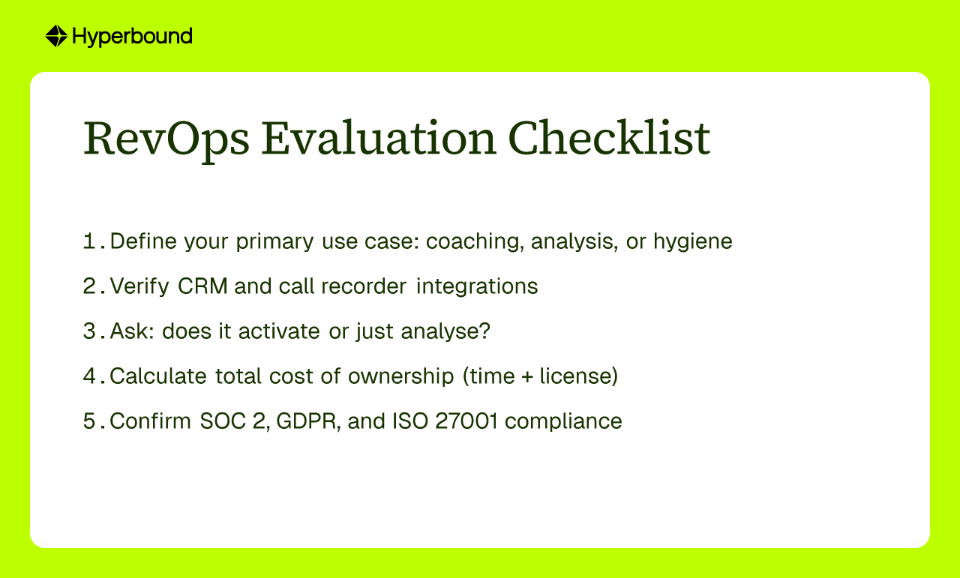
Before you evaluate any vendor, get alignment internally on which of these three questions is your primary driver. Every tool on this list solves one of them better than the others.
.png)
A quick way to shortcut the evaluation: if your team already has Gong and the issue isn't data, it's activation — you don't need another analytics tool. You need the layer that turns Gong's insights into rep practice and deal momentum. That's a fundamentally different purchase than replacing Chorus.
The "do more with less" mandate isn't going away. Neither is the pressure to cut vendors, justify every line item, and somehow show that the tools you're buying are actually moving ARR.
The teams winning this game aren't the ones with the most sophisticated call analytics. They're the ones who've built a closed loop between what happens on a call, what a rep practices next, and what happens to the deal. Analyze Real Calls → Identify Skill Gaps → Practice Scenarios → Improve on Real Calls.
Whether you're consolidating away from Chorus, renegotiating your ZoomInfo bundle, or just trying to reduce functional silos in your GTM stack — use this list as a starting point. Map each tool to a specific outcome you're accountable for. And before you buy another platform that generates beautiful dashboards, ask the one question that matters most: what does this tool actually do after it records the call?
That's the question the best Chorus alternatives are built to answer.
The biggest problem is that they provide analysis without a clear path to action, creating a "so what?" gap. They are excellent at diagnosing issues—like a poor talk-to-listen ratio or missed competitor mentions—but they don't provide the tools to fix the underlying rep behaviors. This often turns expensive software into "shelf-ware" that generates dashboards but doesn't drive tangible improvement.
A sales coaching loop is a continuous, closed-feedback system designed to connect call analysis with rep improvement. It involves four key steps:
To choose the right Chorus alternative, first define your primary goal. Are you trying to:
Once you identify your main use case, you can evaluate vendors based on their core strengths, stack compatibility, and ability to activate insights rather than just report on them.
Yes, absolutely. Tools like Hyperbound are designed to act as an activation layer on top of powerful analytics platforms like Gong. While Gong is best-in-class at telling you what happened on a call, Hyperbound focuses on what to do about it. It ingests Gong's insights and uses them to direct reps to the specific AI-powered practice they need to improve, effectively turning Gong's data into measurable skill development.
Conversation Intelligence (CI) focuses on recording, transcribing, and analyzing sales calls to generate insights and surface data. Revenue Activation is the next step; it takes those insights and uses them to drive specific actions—like personalized AI coaching, targeted practice, and just-in-time manager interventions—that directly change rep behavior and improve deal outcomes. CI provides the diagnosis; Revenue Activation provides the cure.
AI improves sales coaching by making it personalized, consistent, and available 24/7. AI scorecards can analyze 100% of sales calls to identify nuanced skill gaps for each rep—a task impossible for a manager to do manually. Based on that data, AI-powered roleplay simulators can provide reps with unlimited, on-demand practice on their specific weaknesses, allowing them to improve their skills without consuming valuable manager time.
For teams whose primary goal is automating call recording and improving CRM hygiene, tools like Fathom and Avoma are excellent, cost-effective choices. They are built to be simple solutions that automatically capture, transcribe, and summarize meetings. They then sync key notes, action items, and call details to your CRM, which saves reps significant time on manual data entry and ensures your records are always clean.








Use Cases
Legal