
Most Challenger training programs fail. Not because the methodology is flawed — but because the delivery mechanism is broken.
You send your team to a two-day workshop. They come back energized, armed with frameworks, and ready to "teach, tailor, and take control." Then week two hits. The pipeline pulls them back in. The coaching cadence slips. The methodology fades. And 80% of what they learned is forgotten within 30 days.
This isn't a Challenger problem. It's a reinforcement problem.
Reps on Reddit have noted the frustration firsthand: rollouts that are "woefully inadequate" with no customization and no follow-through. Others have shared that when they try to apply the methodology, "customers see the approach as aggressive and arrogant" — not because the framework itself is wrong, but because the training didn't equip them to execute it with nuance.
The problem isn't the Challenger Sale. The problem is how it gets trained.
Most reviews of Challenger sale training platforms evaluate surface-level features: curriculum quality, video production value, and course completion rates. None of that tells you whether your team is actually closing more deals. This article evaluates platforms across three dimensions that actually matter:
Let's start with what Challenger actually is — and why it still matters in 2025.
Introduced in the book The Challenger Sale, the methodology emerged from a study of over 6,000 sales reps that categorized sellers into five profiles:
Challengers account for 27% of high performers in complex sales environments. What makes them different? Three core behaviors:
Yes, some have criticized the methodology as "outdated" or overly aggressive when misapplied. But the core skills — reframing buyer thinking, building consensus, navigating complex multi-stakeholder deals — are more relevant than ever in B2B. The issue isn't the framework. It's that most training programs fail to translate it into consistent, coachable behavior.
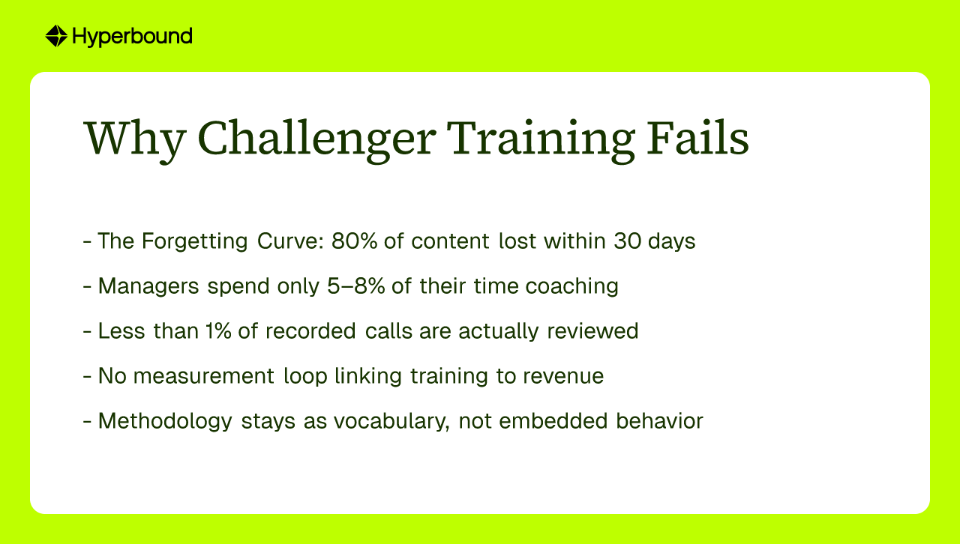
Here's the structural problem with how most organizations deploy Challenger:
The Forgetting Curve kills the investment. Studies consistently show 80% of training content is forgotten within 30 days. A two-day workshop is not a behavior change program — it's a temporary enthusiasm spike.
Managers aren't plugging the gap. Frontline sales managers spend only 5–8% of their time coaching, and coaching is the first thing cut when pipeline pressure mounts. They're also listening to less than 1% of recorded calls — meaning their coaching is based on guesswork, not the actual behaviors happening in the field.
There's no measurement loop. VPs and CROs have no reliable way to connect training investment to revenue performance. Win rates stagnate. Ramp time drags. But nobody can point to which skills are breaking down and where in the deal cycle.
The result? Challenger becomes a language your team speaks during QBR reviews — not a behavior embedded in how they actually sell.
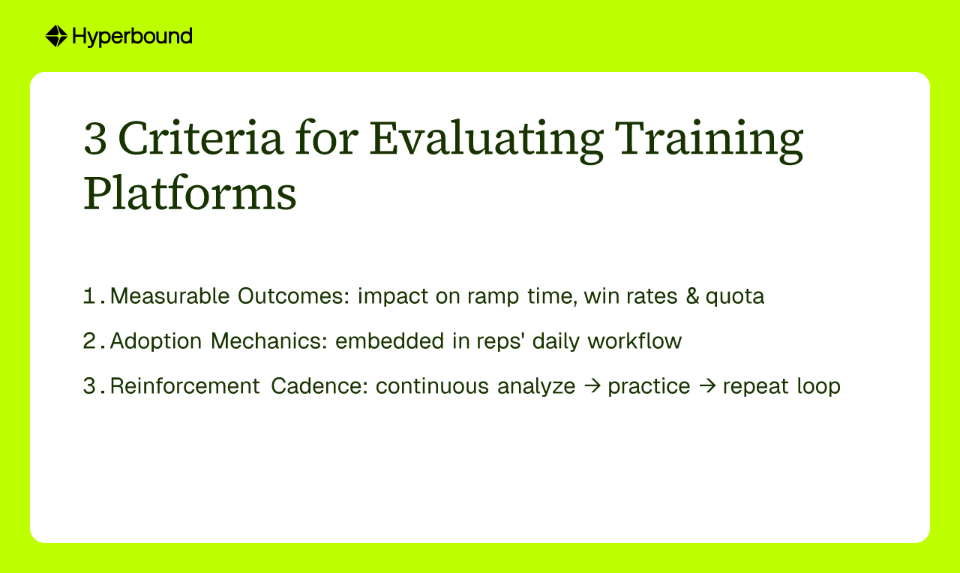
Before ranking platforms, here's the lens you should apply to any Challenger sale training platform you evaluate:
Criterion 1: Measurable Outcomes. Forget completion rates. Demand impact on ramp time, win rates, quota attainment, and deal cycle length. If a platform can't show you a before-and-after on those metrics, it's training theater.
Criterion 2: Adoption Mechanics. Training that lives in a separate portal — divorced from the rep's daily tools — is a context switch. And context switches kill adoption. Look for platforms like Hyperbound that embed into a rep's daily tools: CRM (Salesforce, HubSpot), communication tools (Slack, Teams), call intelligence layers, and LMS systems. As practitioners have noted: "making enablement show up in the workflow, not next to it" is what drives rep engagement.
Criterion 3: Reinforcement Cadence. Look for a closed-loop system:
One-time training has no cadence. A platform does.
Hyperbound is the Revenue Activation Platform purpose-built to turn real conversation data into closed-won deals. It operationalizes methodologies like Challenger by creating a continuous improvement loop between practice and live deal performance — not a one-time training module.
Measurable Outcomes:
Hyperbound's results are validated and specific:
These aren't survey-based satisfaction scores. They're operational metrics tied directly to the sales pipeline.
Adoption Mechanics:
Hyperbound lives where reps already work. Native integrations with Gong, Chorus, Salesloft, Salesforce, HubSpot, Slack, Teams, Seismic, and Highspot mean there is no portal to log into, no context switch to make. The LinkedIn Chrome Extension allows reps to trigger a practice roleplay directly before a live call — in seconds, without leaving their browser.
Reps engage because they see value. When captured call data comes back to them as specific, actionable coaching tied to a real deal they're working, it's not training. It's help.
Reinforcement Cadence:
This is where Hyperbound separates itself entirely. The entire platform is built around a continuous improvement loop:
Score Real Calls (Hyperbound Perform) → Identify Skill Gaps (Kota Activate) → Practice Roleplays (Hyperbound Practice) → Repeat.
Hyperbound Perform doesn't just score individual calls in isolation — it rolls up insights across every touchpoint in a deal to surface what's helping or hurting an opportunity and what behavior to work on next. Hyperbound Practice delivers AI roleplays built from 2M+ hours of real B2B sales conversations — not generic scripts — so practice mirrors actual buyer behavior. Bite-Sized Roleplays let tenured reps target specific in-deal scenarios without sitting through a full certification module. And Kota Activate, Hyperbound's AI orchestration layer, analyzes performance data and automatically recommends personalized coaching interventions directly in Slack or Teams — closing the loop between insight and action.
Challenger Inc. is the originator of the methodology and offers expert-led training programs, workshops, and structured coaching programs focused on organizational-level behavior change.
Measurable Outcomes: Results are typically documented through case studies and qualitative reporting. There's no automated, real-time metric tracking tied to deal performance.
Adoption Mechanics: Challenger Inc. recommends embedding the methodology into CRM workflows as part of their consulting engagement — but this is a manual, project-based process, not a native product integration.
Reinforcement Cadence: Their coaching programs equip managers with frameworks for consistent coaching. However, execution depends heavily on manager discipline and bandwidth — the same constraint that causes coaching to be the first thing cut under pressure.
Bottom line: The strongest option for teams that want deep methodology expertise and organizational change management. Less suited for teams that need a technology layer to enforce adoption and measure impact continuously.
Sales enablement platforms offer unified sales enablement: content management, adaptive learning paths, and AI coaching — all within a CRM-connected interface.
Measurable Outcomes: These platforms can correlate training completion to CRM data, but struggle to prove direct causation between a specific skill practice and a deal outcome. The measurement story is plausible, not precise.
Adoption Mechanics: Strong. These platforms excel at surfacing relevant content and training at the moment of need inside CRM and communication workflows. Adoption tends to be better than standalone LMS tools because the integration is deliberate.
Reinforcement Cadence: AI-powered roleplays and personalized learning paths exist on these platforms. However, they are primarily content delivery systems — the closed loop between real call performance and targeted practice is not as tightly integrated or purpose-built as a dedicated Challenger sale training platform. It's training adjacent to the workflow, not training driven by live deal data.
Bottom line: A strong choice for organizations that want to consolidate content management and training in one place. If your primary goal is Challenger skill reinforcement tied to live deal performance, you'll hit a ceiling.
The one-time, instructor-led workshop is where most Challenger training still begins and ends. A keynote, breakout sessions, a workbook — and then everyone flies home.
Measurable Outcomes: Post-session satisfaction surveys. Nearly impossible to tie to ramp time, win rate, or any downstream revenue metric.
Adoption Mechanics: None. The workshop is the context switch. It pulls reps out of their workflow entirely for one to two days — and sends them back with notes they'll never reopen.
Reinforcement Cadence: Non-existent. This is the model that produces the 80% knowledge decay stat. Without a structured feedback loop, a reinforcement schedule, or a practice mechanism built into daily work, the methodology doesn't stick past the first pipeline review.
Bottom line: Useful as a launch event to align a team on vocabulary and vision. Catastrophically insufficient as a standalone training strategy.
The Challenger Sale works. The research behind it is solid, and the behaviors it develops — reframing buyer thinking, managing multi-stakeholder deals, holding commercial tension — are genuinely predictive of win rates in complex B2B sales.
But the methodology only delivers when reps can actually execute it, deal after deal, call after call. That requires a system: one that scores real conversations, identifies where Challenger behaviors break down, assigns targeted practice to close those gaps, and repeats that cycle continuously.
Platforms that treat training as an event will produce event-sized results. Platforms that treat training as an ongoing operational loop — embedded in the tools reps use every day, driven by live deal data, and measured against real pipeline outcomes — are what actually move the number.
Hyperbound was built to be that system. With validated proof points like 50% faster ramp, 2x faster time to first won deal, and 3.5 workweeks of coaching saved per manager, it's the only Challenger sale training platform where the loop between practice and performance closes automatically.
Ready to see how Hyperbound measures training impact on live deals — and builds a continuous improvement loop for your team? Get started with Hyperbound →
The Challenger Sales Methodology is a B2B sales approach where sellers "challenge" the customer's thinking. It's based on a study that identified five seller profiles, with the "Challenger" being the most successful in complex sales. Instead of just building relationships, Challengers use their deep understanding of a customer's business to teach them something new, tailor their message to different stakeholders, and take control of the conversation to guide the deal forward.
Most Challenger training fails due to a lack of reinforcement, not a flaw in the methodology itself. Training is often delivered in a one-time workshop, but studies show reps forget up to 80% of what they learn within 30 days. Without a system to continuously practice, get feedback, and apply the skills in their daily workflow, the initial enthusiasm fades and reps revert to old habits.
Yes, the core principles of the Challenger Sale are more relevant than ever. In today's complex B2B buying environment, customers are overwhelmed with information. The Challenger skills—teaching with unique insights, tailoring messages to build consensus across a buying committee, and confidently taking control of the sales process—are crucial for cutting through the noise and guiding customers to a decision.
A sales team sounds aggressive when they mistake "taking control" for being pushy, which is a sign of poor training. Effective Challenger execution requires nuance. It's about confidently guiding the conversation with commercial insights, not arrogance. Proper training with reinforcement, practice roleplays, and coaching on real calls helps reps learn to reframe a customer's thinking constructively and lead the conversation without alienating the buyer.
Challenger sellers exhibit three core behaviors:
The effectiveness of a Challenger training program should be measured by business outcomes, not course completion rates. Look for direct impacts on key sales metrics like shorter ramp times for new hires, increased win rates, higher quota attainment, and shorter deal cycles. Platforms like Hyperbound connect training activities directly to CRM data and call performance, allowing you to see a clear before-and-after on the metrics that matter to revenue.
A one-time workshop is an event; training reinforcement is an ongoing process. A workshop delivers a large amount of information at once, most of which is quickly forgotten. Reinforcement uses a continuous loop of analyzing real-world performance (like sales calls), identifying skill gaps, and assigning targeted practice (like AI roleplays) to close those gaps. This embeds the methodology into a rep's daily habits for lasting behavior change.










Use Cases
Legal