
Here's an uncomfortable truth most sales enablement leaders already know but rarely say out loud: attendance is not readiness.
Your reps watched the launch kickoff recording. They sat through the product demo. They nodded along during the positioning session. And now, according to your LMS, training is "complete." But when they get on that first live call with a real prospect and get asked, "How is this different from what [Competitor] offers?" — what happens?
If you've run a product launch before, you already know the answer. Silence. A fumbled answer. A vague callback to a talking point they half-remember from a slide deck they skimmed at 1.5x speed.
This is the core problem with how most teams approach new product launch sales readiness: they confuse exposure with capability. They measure completion, not competence. And reps pick up on this, too. The sales community is loud about the fact that "experience always trumps certs" — and they're right, in the traditional sense. A passive certification that tests memory doesn't build real-world skill. But that's not an argument against certification. It's an argument for doing it differently.
A modern sales certification program built around a new product launch isn't about awarding a badge. It's about manufacturing the experience reps need before they're live with customers — compressing the learning curve, eliminating the "burn pipeline while learning" phase, and guaranteeing that every rep can execute with confidence from day one.
Here's the four-stage framework to make that happen.
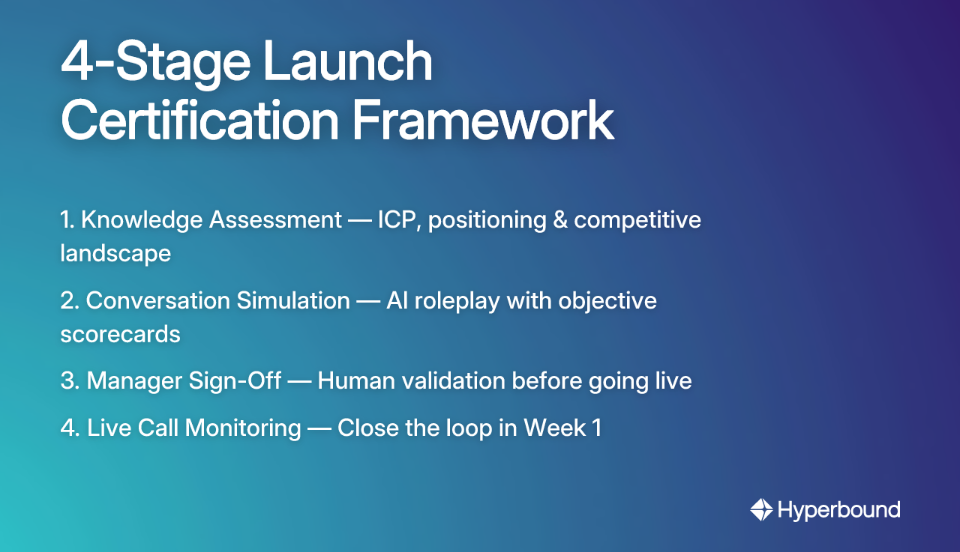
Before a rep can have a great conversation, they need to have the right information. Stage 1 is about verifying that the foundational knowledge has actually been internalized — not just that it was sent in a Slack message or buried in slide 47 of the kickoff deck.
What to cover:
How to implement it:
Go beyond a multiple-choice quiz. True comprehension testing requires a variety of formats. Best practices for effective certification programs recommend moving beyond simple recall toward assessments that test application — scenario-based questions, written value prop summaries, and open-ended responses that reveal whether a rep can explain something, not just recognize it.
Build a self-study package that includes battle cards, updated competitive one-pagers, and a concise product brief. Keep it tight — reps will engage with a focused, relevant package far more than a 60-slide deck. Then run a short live group session to discuss the competitive landscape and surface any questions as a team. This surfaces confusion early, before it shows up in a live call with a prospect.
Set a minimum passing score. If a rep scores below the threshold, they return to the materials and retake the assessment. No exceptions.
This is the most critical stage in the entire framework — and the one most teams skip entirely.
Knowing the ICP and competitive positioning doesn't mean a rep can use that information under pressure. The gap between knowing something and being able to articulate it smoothly on a live call is enormous. The only way to close that gap is through deliberate practice, and the only way to scale deliberate practice across a team of 20, 50, or 100+ reps without burning out your managers is with AI-powered conversation simulation.
How to implement it:
Step 1: Identify the top 5 launch scenarios. Don't try to simulate every possible conversation. Focus on the highest-frequency, highest-stakes situations your reps will face in the first 30 days:
Step 2: Build realistic AI roleplays for each scenario. This is where Hyperbound Practice becomes the engine of your certification program.
Hyperbound's AI buyer personas are built from analysis of 2M+ hours of real B2B sales conversations — not generic, stilted scripts. That means when your rep is practicing the competitive objection handling scenario, they're up against a buyer who responds the way a real prospect would: with follow-up questions, skepticism, and the kind of natural pushback that breaks a rehearsed answer. It sounds like the real thing because it's trained on the real thing.
For complex enterprise scenarios, you can run Multiparty Roleplays — putting reps in a simulated room with both a champion and an economic buyer simultaneously. For product-heavy conversations, Demo Call Screen Sharing lets reps practice the actual presentation flow inside the roleplay environment.
Step 3: Define objective pass/fail scorecards. This is what separates a real certification gate from a checkbox exercise. Before launch, define the specific criteria that constitute a "passed" simulation:
Hyperbound's AI Scorecards track all of this automatically after every simulation, delivering instant, specific coaching feedback so reps can identify exactly where they went wrong and practice again before any manager's time is involved. The feedback is objective, repeatable, and consistent across your entire team — no more variation based on who a rep happens to shadow or which manager reviewed their call.
Step 4: Let reps practice asynchronously — at volume. As a sales enablement leader, you're likely supporting 50–100+ reps while being outnumbered by managers who themselves only have about 5–8% of their time available for coaching. You cannot personally roleplay the competitive objection scenario with every rep. AI roleplays eliminate that bottleneck. Reps can complete their required simulations on their own schedule, run them as many times as needed, and only advance to Stage 3 once they've hit the passing threshold on the scorecard. Every single rep gets the at-bats they need. No rep gets skipped. No rep gets a favorable grade because their manager was in a good mood that day.
Stages 1 and 2 handle scale. Stage 3 restores the human judgment that a fully automated process can't replicate.
The manager sign-off is the official certification gate. A rep doesn't go live on this product until their manager confirms they're ready. But the key to making this stage efficient — and not a burden that managers skip because they're overwhelmed — is to make it fast and focused.
How to implement it:
Have the manager review the rep's best-performing AI roleplay from Stage 2. Hyperbound's analytics surface each rep's highest-scoring simulation, so a manager can watch a real practice session in a few minutes rather than scheduling a live roleplay from scratch. This is especially valuable for distributed or remote teams where live observation is logistically difficult.
Alternatively, the manager conducts one final observed roleplay or call review. The critical rule: use the same scorecard from Stage 2. This ensures evaluation is consistent across the team. A rep doesn't pass because their manager is more lenient, and a rep doesn't fail because their manager applies a different standard. The criteria are set in advance, shared with reps, and applied uniformly.
When the manager signs off, that's the certification. That's the gate. No sign-off, no live calls on the new product. This accountability structure also gives managers real visibility into which reps are ready and which need more reps before they're in front of a prospect.
Certification earns the right to go live. Live call monitoring is how you protect the launch pipeline and build on what the certification process started.
The first week of live calls is the highest-leverage coaching window you have. This is where reps discover what the simulations didn't fully prepare them for — the real buyer's tone, the unexpected direction a discovery call goes, the competitive claim they haven't heard before. Capturing and acting on this data is what turns a certification program from a one-time event into a continuous improvement engine.
How to implement it:
Use your call intelligence platform — whether that's Hyperbound Perform, Gong, Outreach, Aircall, or another tool you already have in your stack — to monitor the first live calls on the new product. You don't need to listen to every call in real-time; use AI scoring to flag calls that scored below a threshold for immediate coaching attention.
In your Week 1 debrief (which should already be on the calendar before launch day), bring the data. Which messaging is landing? Which objections are tripping people up? Where is the ICP off from what reps expected? Feed that intelligence back into your practice scenarios. If a new objection is emerging consistently across the team, build a targeted Bitesized Roleplay in Hyperbound and distribute it immediately. Live call data becomes your coaching curriculum for Week 2 and beyond.
This is the continuous improvement loop in action: Score Real Calls → Identify Skill Gaps → Practice Roleplays → Score Real Calls. The launch certification program doesn't end at launch; it evolves based on what the market is actually telling you.
.png)
If you've ever pitched a certification program to leadership and been met with "we don't have time for that before the launch," you need to reframe the conversation. The question isn't whether you can afford to build a certification gate. The question is whether you can afford to skip it.
Every rep who goes live without passing a certification standard is a liability. They're burning real pipeline on calls they're not ready for. They're setting first impressions with prospects that shape whether those deals ever close. They're generating objection-handling patterns that are wrong from day one and difficult to unlearn under performance pressure.
The data on what happens when teams get this right is compelling:
These aren't hypothetical projections. They're outcomes from teams that replaced attendance-based training with structured certification — using AI roleplay to build competency at scale before any live call happens.
Beyond the revenue math, there's a qualitative case that's equally important: rep confidence. Sales reps know when they're underprepared. The "burn pipeline while learning" experience is demoralizing. Reps who go into a launch feeling genuinely ready — who've practiced the hard conversations, gotten feedback, and earned their certification — show up differently on calls. That confidence is contagious, and it's something that no amount of motivational messaging in a kickoff deck can manufacture.
The sales community isn't wrong when they say experience trumps certifications. Generic certs that test memory don't build real capability. But a four-stage certification framework built around your new product launch — with real knowledge assessments, AI-powered conversation simulations with objective scoring, manager validation, and live call monitoring — doesn't test memory. It builds and verifies the experience reps need before they ever face a live prospect.
The framework is straightforward:
This is how you de-risk a product launch. This is how you give leadership the confidence that the sales team is ready — not just that they attended the training. And this is how you connect your enablement investment directly to the revenue outcomes that actually matter.
A sales certification program for a product launch is a structured process designed to verify that every sales representative has the necessary knowledge and skills to effectively sell a new product before they interact with customers. Unlike traditional training that only tracks attendance, this framework uses a four-stage process—Knowledge Assessment, Conversation Simulation, Manager Sign-Off, and Live Call Monitoring—to ensure reps are competent and ready from day one.
AI-powered roleplay is essential because it provides the only scalable way for sales reps to get consistent, objective practice on key conversations, like handling competitive objections, without burning out managers. It allows reps to practice asynchronously at high volume, receive instant, data-driven feedback via AI scorecards, and master messaging in a safe environment before facing real prospects.
This certification framework improves ramp time, often by as much as 50%, by compressing the learning curve and manufacturing experience before reps engage with live prospects. Instead of reps "learning on the job" and burning valuable pipeline, they enter the market having already practiced the most critical scenarios. This builds confidence and competence, leading directly to faster time-to-first-deal and quicker quota attainment.
The sales manager's role is to act as the final human checkpoint and certification gate, ensuring that reps meet a consistent, predefined standard of readiness before they go live with a new product. Rather than leading every roleplay, managers efficiently review a rep's best AI simulation or conduct one final observed session using the same objective scorecard. This makes their coaching targeted and ensures uniform evaluation across the team.
To ensure a certification is effective, it must be built on objective, performance-based criteria rather than simple completion. This is achieved through AI-powered conversation simulations with automated scorecards that measure specific skills, such as using correct positioning language or handling objections. The mandatory manager sign-off based on these objective criteria serves as a final quality gate, tying certification directly to demonstrated capability.
The first steps to building a product launch certification program are to define the foundational knowledge reps need (Stage 1) and identify the top 3-5 highest-stakes conversation scenarios they will face (Stage 2). Start by creating a concise self-study package and knowledge assessment. Simultaneously, map out the most common objections and questions reps will encounter to build realistic AI roleplay simulations for practice.
Ready to build a certification program that drives real new product launch sales readiness? See how Hyperbound Practice can help you create realistic AI roleplay scenarios for your next launch, score reps objectively before they ever speak with a prospect, and give your team the at-bats they need to show up prepared.








Use Cases
Legal